
Voice Over Internet Protocol (VOIP) Market Outlook: Size, Share, Trends, Growth Analysis, Competitive Landscape & Forecast, 2026-2033

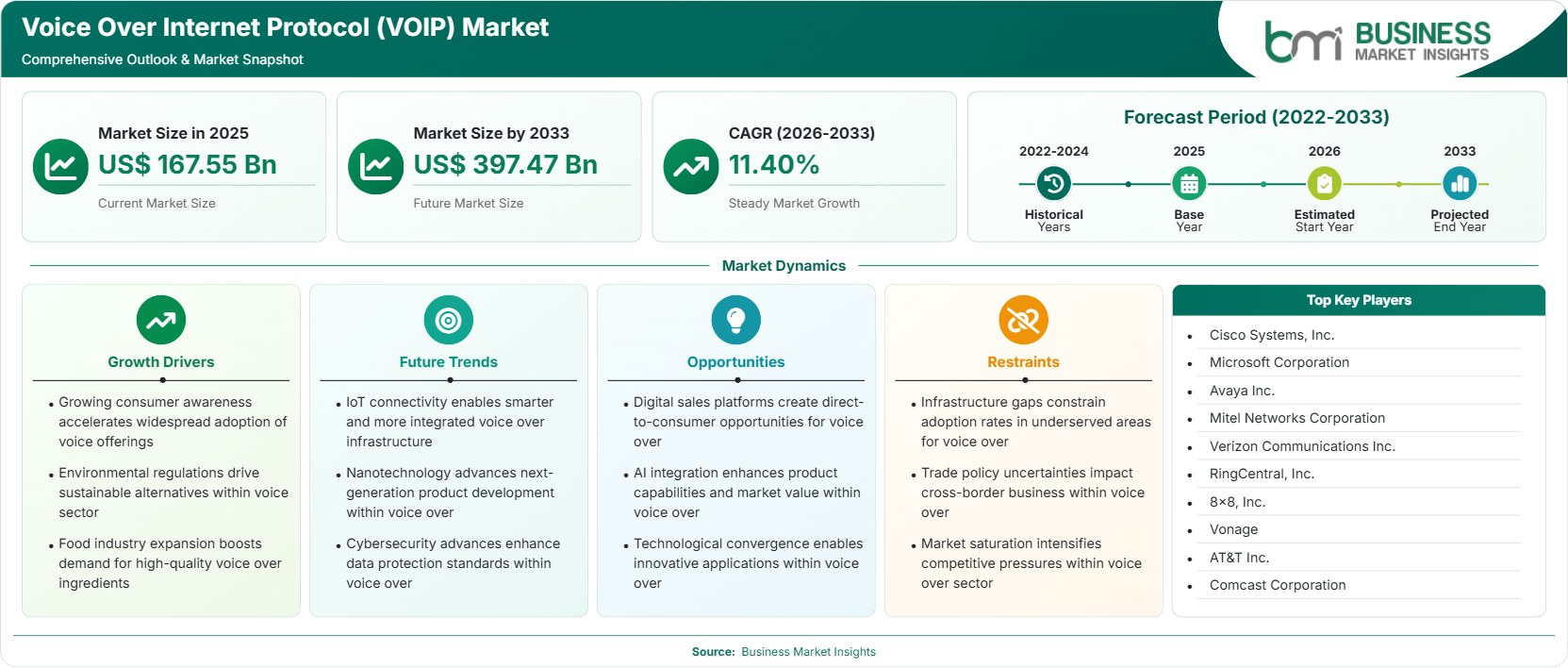
The Voice Over Internet Protocol (VOIP) Market size was valued at US$ 167.55 Billion in 2025 and is projected to reach US$ 397.47 Billion by 2033, growing at a CAGR of 11.40% during 2026–2033, driven by cloud communication adoption, hybrid workplace expansion, unified communications demand, AI-enabled calling platforms, enterprise digital transformation, and growing broadband infrastructure investments worldwide.

Report Coverage
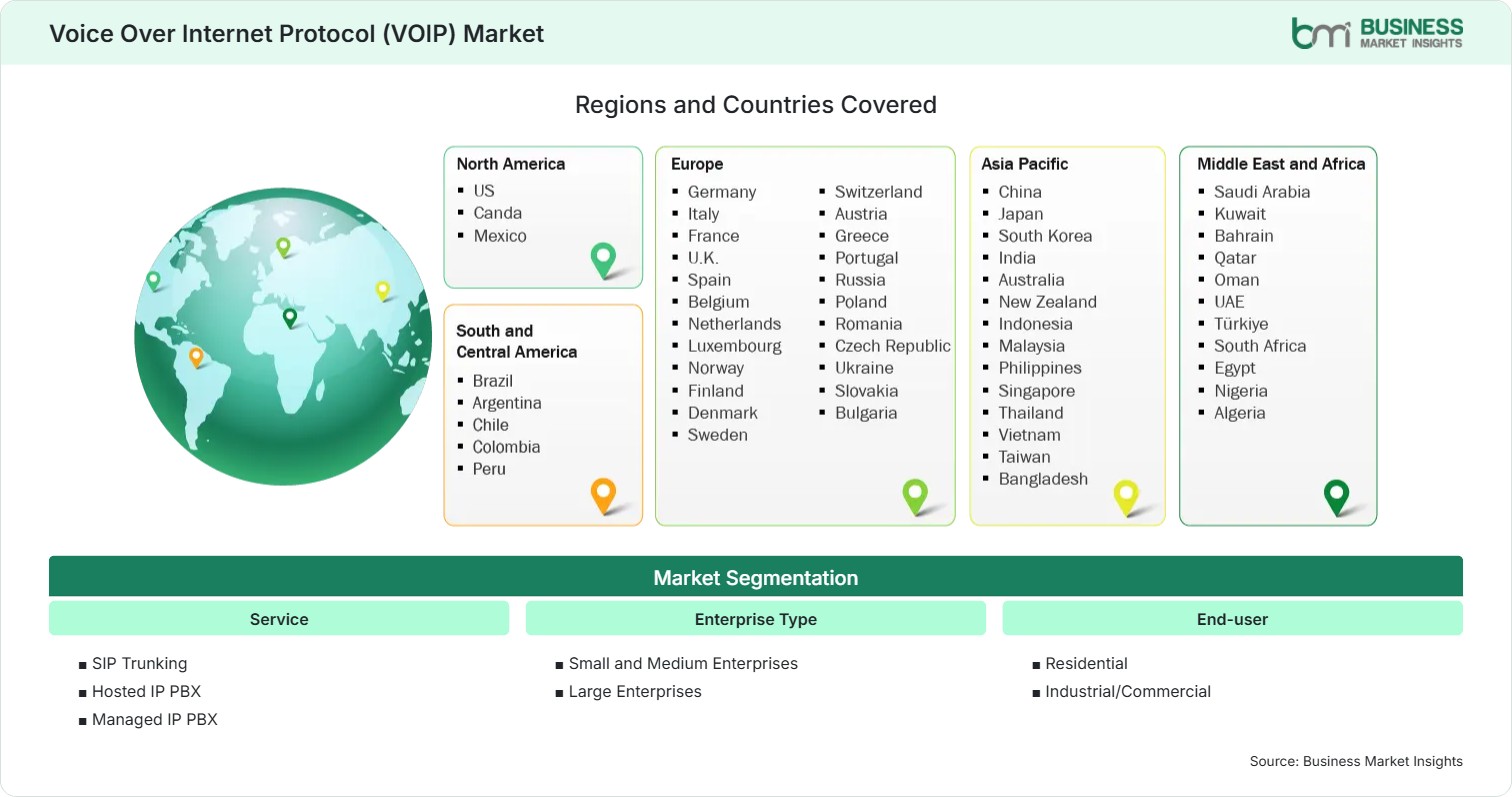
  • Service: SIP Trunking, Hosted IP PBX, Managed IP PBX
  • Enterprise Type: Small and Medium Enterprises (SMEs), Large Enterprises
  • End-user: Residential, Industrial/Commercial
US$ 167.55 Bn Market size in 2025
US$ 397.47 Bn Market Size by 2033
11.40% CAGR, 2026 - 2033
2026-2033 Forecast Period

01 AI Overview

Voice Over Internet Protocol (VOIP) Market Summary

  • North America Region: North America holds 35%–38% market share in 2025 and is projected to grow at a 10.5%–11.2% CAGR during 2026–2033, supported by widespread cloud migration, unified communications investments, AI-enabled business telephony adoption, enterprise modernization, strong broadband infrastructure, and increasing remote workforce collaboration requirements across industries. The United States remains the regional growth engine through rapid enterprise cloud communication investments, AI integration, and digital workplace transformation, expanding at approximately 10.8%–11.3% CAGR.
  • Fastest Growing Region: Asia Pacific accounts for 25%–28% market share in 2025 and is forecast to register a 13.2%–14.1% CAGR during 2026–2033, fueled by SME digitization, affordable broadband expansion, government digital economy initiatives, cloud communications adoption, mobile-first enterprises, and accelerating investments in modern business communication infrastructure.
  • Leading Segment: Hosted IP PBX holds 43%–46% market share in 2025 and is expected to expand at a 12.0%–12.8% CAGR during 2026–2033, driven by scalable deployment models, subscription pricing, simplified management, AI-powered communication features, stronger cybersecurity capabilities, and enterprise migration from legacy telephony systems.
  • High Growth Segment: Small and Medium Enterprises (SMEs) account for 40%–43% market share in 2025 while growing at a 12.8%–13.6% CAGR during 2026–2033 due to increasing cloud adoption, affordable communication platforms, operational flexibility, remote workforce expansion, and growing investments in digital collaboration technologies.
  • Key Market Opportunity: AI-powered unified communications, multilingual virtual assistants, intelligent call routing, conversational analytics, and integration with CRM and collaboration software create substantial long-term opportunities across enterprises seeking productivity improvements, customer engagement, and communication automation.
  • Major Market Players: Microsoft Corporation, Cisco Systems, Inc., RingCentral, Inc., Vonage Holdings Corp., Nextiva, Dialpad, Inc., Mitel Networks Corporation, Zoom Communications, Inc., 8x8, Inc., AT&T Inc., Grasshopper Group LLC, Ooma, Inc., GoTo Technologies USA, Inc., Verizon Communications Inc., InPhonex LLC, 3CX Ltd., Xorcom Ltd., astTECS Communications Pvt. Ltd., HoduSoft Pvt. Ltd., and IQ Infotech.
02 Strategic Insights

Voice Over Internet Protocol (VOIP) Market: Strategic Insights

Voice Over Internet Protocol (VOIP) Market Strategic Framework
FREE PDF
Request your free sample
Request free sample
03 Stakeholder View

Key Takeaways

  • The industry value chain continues shifting toward software-driven communication ecosystems where cloud providers, network operators, cybersecurity vendors, AI developers, and unified communication platform providers increasingly collaborate to deliver integrated enterprise communication solutions instead of standalone voice services.
  • The strongest commercial opportunity exists among small and medium enterprises transitioning from conventional PBX systems to subscription-based hosted communication platforms, supported by lower upfront investment requirements, simplified deployment, and scalable collaboration capabilities across distributed workforces.
  • Artificial intelligence is becoming a primary differentiator as vendors introduce intelligent call routing, speech analytics, automated meeting summaries, voice biometrics, multilingual virtual assistants, predictive customer engagement, and conversational analytics to enhance productivity and customer satisfaction simultaneously.
  • Asia Pacific offers one of the most attractive long-term investment destinations due to expanding digital economies, increasing fiber broadband penetration, government-backed cloud adoption initiatives, growing startup ecosystems, and rapid enterprise modernization across India, China, Southeast Asia, Japan, and Australia.
  • Strategic partnerships, acquisitions, and platform integration agreements increasingly shape competitive positioning as communication vendors strengthen portfolios through AI capabilities, cybersecurity enhancements, contact center solutions, CRM integration, and unified collaboration platforms that support enterprise digital transformation initiatives.
  • Future competitive advantage will increasingly depend on delivering secure, AI-enabled, interoperable communication platforms capable of integrating seamlessly with enterprise applications while complying with evolving global privacy, cybersecurity, and data sovereignty regulations, ensuring sustainable long-term customer retention and recurring subscription revenues.
04 Geographic Outlook

Voice Over Internet Protocol (VOIP) Market Regional Highlights

North America Voice Over Internet Protocol (VOIP) Market

North America accounted for 35%–38% of the Voice Over Internet Protocol (VOIP) Market share in 2025 and is anticipated to register a 10.5%–11.2% CAGR during 2026–2033. Enterprise cloud migration, mature broadband infrastructure, increasing unified communications deployment, and AI-enabled business collaboration continue strengthening regional demand. Organizations across banking, healthcare, retail, government, and manufacturing increasingly replace legacy PBX systems with cloud-based communication platforms offering scalability, advanced analytics, and improved cybersecurity while supporting distributed and hybrid workforces.

  • Large enterprises increasingly consolidate voice, messaging, video conferencing, and contact center functions into unified cloud platforms, reducing infrastructure complexity while improving workforce collaboration, operational agility, and customer engagement across multiple business locations.
  • Continuous investments by hyperscale cloud providers and telecom operators strengthen data center capacity, enabling lower communication latency, higher service reliability, and secure deployment of enterprise-grade VoIP services across industries.
  • AI-powered speech recognition, automated call summarization, intelligent routing, and conversational analytics are becoming standard enterprise capabilities, improving customer experience while reducing operational costs across service-oriented organizations.
  • Regulatory emphasis on emergency communication compliance, cybersecurity, and digital infrastructure modernization encourages enterprises to replace aging telephony networks with secure IP-based communication platforms supporting future digital transformation initiatives.

US Voice Over Internet Protocol (VOIP) Market

The United States represented 79%–82% of the North American market in 2025 while expanding at a 10.8%–11.3% CAGR through 2033. Strong enterprise software spending, widespread cloud adoption, advanced fiber connectivity, and continuous investments from leading communication technology providers position the country as the largest innovation hub for AI-powered unified communications and cloud collaboration platforms serving organizations of every size.

  • Fortune 500 enterprises increasingly deploy cloud-native communication ecosystems integrated with CRM, ERP, and customer support software, improving employee productivity while delivering personalized customer engagement experiences.
  • Healthcare providers accelerate secure voice communication adoption to support telemedicine, patient coordination, regulatory compliance, and encrypted communication across distributed healthcare networks.
  • Financial institutions prioritize encrypted cloud communications, identity verification, and AI-assisted customer service platforms to strengthen operational resilience while meeting stringent security and compliance requirements.
  • Continuous investments in 5G infrastructure and edge computing improve communication quality, enabling low-latency enterprise voice services supporting modern hybrid workplaces.

Europe Voice Over Internet Protocol (VOIP) Market

Europe held 26%–29% market share during 2025 and is forecast to grow at a 10.9%–11.7% CAGR between 2026 and 2033. Enterprise digitalization, GDPR-compliant cloud communication deployments, and growing investments in secure collaboration platforms continue supporting regional expansion. Germany remains the largest national market, while Poland records one of the fastest growth rates with an estimated 12.5%–13.2% CAGR, supported by expanding IT investments and cloud adoption.

  • Enterprises prioritize GDPR-compliant communication platforms featuring end-to-end encryption, secure cloud storage, and advanced identity management for regulated industries including finance, healthcare, and government.
  • Manufacturing companies increasingly integrate cloud voice solutions with industrial digitalization initiatives, improving communication efficiency across geographically distributed production facilities.
  • Rising hybrid working models across the United Kingdom, Germany, France, and the Nordic countries accelerate demand for scalable unified communications and collaboration platforms.
  • Telecom operators continue modernizing network infrastructure while retiring legacy PSTN systems, encouraging businesses to migrate toward fully IP-based enterprise communication environments.
  • Growing adoption among educational institutions and public sector organizations supports stable long-term subscription revenue for cloud communication vendors.

Asia Pacific Voice Over Internet Protocol (VOIP) Market

Asia Pacific represented 25%–28% market share in 2025 and is projected to record the fastest regional expansion at 13.2%–14.1% CAGR through 2033. Rapid enterprise digitalization, increasing broadband accessibility, expanding SME ecosystems, and supportive government digital economy initiatives continue strengthening demand. China leads regional revenue generation, whereas India demonstrates the strongest growth trajectory with an estimated 14.5%–15.3% CAGR.

  • Rapid startup formation and SME digital transformation increase adoption of affordable hosted communication platforms offering subscription-based pricing, remote collaboration, and integrated business applications.
  • Governments across India, Singapore, Australia, Japan, and South Korea continue investing in broadband expansion, digital public infrastructure, and cloud-first policies supporting enterprise modernization.
  • Rising smartphone penetration and improved fiber connectivity enable businesses to deploy mobile-first communication strategies without extensive legacy infrastructure investments.
  • International outsourcing, IT services expansion, and growing contact center operations strengthen demand for scalable AI-enabled business communication solutions.
  • Increasing adoption of multilingual AI voice assistants improves customer engagement across linguistically diverse markets while supporting regional business expansion.

Rest of World Voice Over Internet Protocol (VOIP) Market

The Rest of World region accounted for 10%–12% Voice Over Internet Protocol (VOIP) Market share during 2025 and is expected to expand at 11.5%–12.3% CAGR through 2033. South and Central America continue benefiting from enterprise cloud adoption and expanding broadband infrastructure, while Middle East and African countries accelerate digital transformation through smart city investments, telecom modernization, and business communication upgrades supporting public and private sector organizations.

  • Brazil remains the leading South and Central American market, while Mexico demonstrates one of the strongest regional growth profiles due to increasing cloud adoption and enterprise digitalization initiatives.
  • Saudi Arabia and the United Arab Emirates continue investing in digital economy strategies, smart government programs, and next-generation communication infrastructure supporting enterprise cloud services.
  • African telecom providers increasingly expand broadband coverage and fiber deployments, creating favorable conditions for enterprise cloud communication adoption among SMEs and multinational organizations.
  • Growing foreign direct investment across commercial sectors encourages deployment of scalable communication platforms supporting multilingual operations, cross-border collaboration, and remote workforce management.
  • Expanding managed service provider ecosystems improve technology accessibility for businesses seeking affordable cloud communication solutions without significant capital expenditure.
Global Market Geography
FREE PDF
Request your free sample
Request free sample
05 Segment Analysis

Voice Over Internet Protocol (VOIP) Market Segmentation

Service

The Service segment accounted for approximately 48%–51% market share in 2025 and is projected to register a 11.8%–12.5% CAGR through 2033. The Voice Over Internet Protocol (VOIP) Market scope continues expanding as enterprises prioritize cloud-based communication services over hardware-intensive systems. Growing demand for scalable deployment, subscription pricing, AI-enabled communication capabilities, and simplified infrastructure management supports sustained adoption across organizations of varying operational sizes.

  • SIP Trunking: Enables organizations to replace conventional telephone lines with internet-based connectivity, improving scalability, lowering communication costs, supporting disaster recovery capabilities, and simplifying integration with modern enterprise communication platforms.
  • Hosted IP PBX: Provides fully managed cloud communication infrastructure supporting remote workforces, unified messaging, advanced analytics, AI-powered call management, and simplified administration without requiring extensive on-premises hardware investments.
  • Managed IP PBX: Appeals to enterprises requiring outsourced communication management, proactive maintenance, enhanced cybersecurity, regulatory compliance support, and predictable operational expenses while maintaining high service reliability.

Enterprise Type

Enterprise Type represented nearly 31%–34% of total Voice Over Internet Protocol (VOIP) Market value in 2025 while recording an estimated 12.0%–12.8% CAGR through 2033. Organizations increasingly prioritize flexible subscription models, cloud-native communication platforms, AI-driven collaboration, and integrated business applications to improve workforce productivity and customer engagement while reducing infrastructure complexity across geographically distributed business operations.

  • Small and Medium Enterprises (SMEs): Increasingly adopt subscription-based communication platforms because of lower deployment costs, flexible scalability, integrated collaboration tools, and simplified IT management supporting sustainable digital transformation initiatives.
  • Large Enterprises: Continue investing in AI-powered unified communications integrating contact centers, collaboration software, cybersecurity solutions, workflow automation, and enterprise business applications across global operations.

End-user

The End-user segment contributed approximately 19%–22% market share during 2025 and is forecast to grow at 11.3%–12.1% CAGR through 2033. The Voice Over Internet Protocol (VOIP) Market trends indicate increasing adoption across commercial organizations seeking secure cloud communications, while residential users continue embracing internet-based voice services for affordability, flexibility, and seamless integration with digital communication ecosystems.

  • Residential: Consumers increasingly utilize internet-based voice services because of affordable international calling, bundled broadband offerings, mobile application compatibility, and improved voice quality supported by expanding high-speed internet infrastructure.
  • Industrial/Commercial: Businesses deploy advanced cloud communication platforms supporting omnichannel customer engagement, AI-enabled call analytics, secure collaboration, remote workforce management, and enterprise-wide operational efficiency improvements.
06 Market Forces

Voice Over Internet Protocol (VOIP) Market Dynamics

Key Market Drivers

Expansion of Cloud-Based Unified Communications Platforms

The move is increasingly fast among enterprises around the world towards migrating from traditional telephony systems to a cloud-native UC system which encompasses voice, messaging, video conferencing, collaboration, and contact centers in one solution. The Voice Over Internet Protocol (VOIP) Market growth is supported by organizations seeking lower infrastructure costs, faster deployment, and greater operational flexibility. Cloud workloads are continuously growing worldwide based on trends in the adoption of the cloud by enterprises in accordance with international technology organizations. Service providers are strengthening platform interoperability with productivity software, CRM applications, and enterprise resource planning systems, enabling seamless collaboration. This driver continues to promote subscription-based deployment models that enhance scalability, reduce maintenance needs, build up disaster recovery, and enhance communication reliability for organizations having a dispersed and hybrid workforce.

Artificial Intelligence Enhancing Enterprise Communication

AI technology is emerging as a key differentiator in the corporate communications arena through the enhancement of calls, workflow automation, and provision of business intelligence. Speech recognition, multilingual translations, intelligent call routing, automation of meeting minutes, sentiment analysis, and conversational analytics have all been incorporated into communication systems. The Voice Over Internet Protocol (VOIP) Market trends demonstrate growing enterprise demand for AI-enabled productivity solutions capable of reducing response times while improving customer engagement. Organizations have also resorted to using AI-driven virtual assistants that handle routine customer interactions and assist employees by offering suggestions instantly. Further advancements in areas such as generative AI, natural language processing, and machine learning will ensure increased automation opportunities alongside improved communications within various sectors including customer services, healthcare, finance, education, and governments.

Hybrid Work and Enterprise Digital Transformation

The expansion of hybrid and remote working models continues reshaping enterprise communication strategies worldwide. Organizations increasingly require secure, scalable, and device-independent communication platforms capable of connecting geographically distributed employees without compromising productivity. Investments in broadband infrastructure, 5G deployment, cloud computing, and cybersecurity strengthen adoption of internet-based voice solutions across both developed and emerging economies. Organizations around the world, including the OECD, are consistently emphasizing the need for continued investments in digital transformation that would enable enterprises to become modernized. The integration of communication systems with collaboration tools, workflow automation, identity management, and cloud storage enables enterprises to create digital workplaces. Such efforts of digital transformation are key to modernizing enterprise communication.

Key Market Opportunities

Growing Adoption Among Small and Medium Enterprises

Small and medium enterprises represent one of the strongest long-term investment opportunities as digital transformation initiatives become increasingly affordable through subscription-based cloud communication services. The Voice Over Internet Protocol (VOIP) Market Forecasts indicate expanding demand from SMEs seeking enterprise-grade communication capabilities without significant capital expenditure. Cloud-hosted deployment models eliminate complex infrastructure requirements while enabling businesses to scale communication resources according to operational needs. Integration with accounting software, CRM platforms, e-commerce applications, and customer engagement tools further increases commercial value. Vendors offering localized language support, simplified onboarding, managed security, and flexible pricing models are expected to strengthen market penetration across rapidly digitizing economies in Asia Pacific, Latin America, and the Middle East.

Expansion of Industry-Specific Communication Solutions

Vertical-specific communication platforms present significant growth opportunities as enterprises increasingly demand customized solutions supporting unique regulatory and operational requirements. Healthcare organizations require secure patient communication and telemedicine integration, financial institutions prioritize encrypted communications and compliance management, while manufacturing companies seek seamless integration with industrial automation platforms. Education providers continue adopting cloud communications supporting hybrid learning and campus-wide collaboration. Vendors capable of delivering tailored industry functionality, compliance frameworks, workflow automation, and secure application integration can establish stronger competitive positioning while generating higher customer retention through specialized enterprise solutions that address industry-specific operational challenges rather than generic communication requirements.

Emerging Digital Economies and Telecom Modernization

Rapid broadband expansion, national digital economy programs, and telecom infrastructure modernization create attractive long-term opportunities across developing economies. Governments continue investing in fiber connectivity, 5G deployment, cloud infrastructure, and digital public services that strengthen enterprise communication ecosystems. Rising startup formation, increasing foreign direct investment, and expanding outsourcing industries further support demand for scalable communication platforms. Telecom operators retiring traditional public switched telephone networks encourage businesses to migrate toward internet-based communication services offering improved flexibility and lower operational costs. Vendors establishing regional partnerships, localized service delivery, and cloud infrastructure investments are well positioned to capture sustained demand from emerging enterprise markets.

Market Restraints and Challenges

Cybersecurity Risks and Data Privacy Compliance

Factor: Increasing dependence on cloud-based communication platforms exposes organizations to cybersecurity threats including phishing attacks, identity theft, unauthorized access, ransomware, and voice fraud. Global privacy regulations require providers to maintain strict compliance with evolving security standards while protecting sensitive enterprise communication data.

Impact: Organizations operating within regulated industries often require additional investments in encryption, identity management, compliance monitoring, and secure cloud infrastructure before migrating communication workloads. These additional implementation requirements can extend deployment timelines, increase operational expenditure, and slow adoption among businesses maintaining highly sensitive customer information or operating under stringent regulatory frameworks.

Network Quality Dependence and Legacy Infrastructure Integration

Factor: Internet-based voice communication performance depends heavily on reliable broadband connectivity, low network latency, adequate bandwidth, and effective quality-of-service management. Many enterprises continue operating legacy PBX systems that require complex migration strategies and interoperability with modern cloud communication environments.

Impact: Organizations located in regions with inconsistent broadband infrastructure may experience service disruptions affecting call quality, operational continuity, and customer satisfaction. Integration complexity also increases implementation costs, requiring professional services, network optimization, employee training, and phased migration programs before enterprises fully realize the operational and financial benefits of modern cloud-based communication platforms.

07 Company Analysis

Competitive Landscape

The competitive environment remains highly dynamic as vendors expand cloud-native communication portfolios through artificial intelligence, unified communications, contact center solutions, and cybersecurity capabilities. The Voice Over Internet Protocol (VOIP) Market analysis indicates that strategic partnerships, platform integrations, product innovation, and subscription-based service models continue differentiating leading participants while increasing recurring revenue opportunities.

Company Name

Overview

Products and Services Relevant to this Market

Microsoft Corporation

Global technology leader offering cloud communications integrated with productivity software and enterprise collaboration ecosystems for organizations of all sizes.

Microsoft Teams Phone, Azure communication services, unified communications, enterprise collaboration, cloud telephony, AI-powered productivity solutions.

Cisco Systems, Inc.

Leading networking and enterprise communication provider delivering secure cloud collaboration platforms with global enterprise deployment capabilities.

Webex Calling, Unified Communications Manager, collaboration software, contact center, networking infrastructure, cloud communication services.

RingCentral, Inc.

Cloud communications specialist providing unified communications and contact center solutions through subscription-based delivery models for businesses worldwide.

RingCentral MVP, cloud PBX, video meetings, messaging, contact center, AI-enabled business communication solutions.

Vonage Holdings Corp.

Provides cloud communication platforms and programmable communication APIs supporting enterprise digital transformation and customer engagement strategies.

Unified communications, CPaaS solutions, voice APIs, messaging APIs, contact center platforms, cloud telephony services.

Nextiva

Business communications provider focused on cloud-based unified communication platforms for SMEs and enterprise customers globally.

Cloud PBX, VoIP calling, customer experience software, business messaging, video conferencing, workflow collaboration tools.

Dialpad, Inc.

AI-driven communications company integrating voice intelligence with enterprise communication and customer engagement platforms.

AI-powered VoIP, cloud calling, meetings, contact center, speech analytics, unified communications software.

Mitel Networks Corporation

Enterprise communications company delivering hybrid and cloud communication solutions across global commercial markets.

Business phone systems, unified communications, cloud PBX, contact center solutions, collaboration software.

Zoom Communications, Inc.

Leading collaboration platform expanding beyond video conferencing into enterprise cloud telephony and communications services.

Zoom Phone, Zoom Meetings, contact center, collaboration platform, AI Companion, unified communication services.

8x8, Inc.

Cloud communications vendor offering integrated communication and customer engagement platforms for global enterprises.

Unified communications, contact center, cloud PBX, business voice services, analytics, conversational intelligence.

AT&T Inc.

Global telecommunications company delivering managed enterprise communication and cloud connectivity services.

Business VoIP, SIP trunking, managed communication services, network connectivity, enterprise mobility solutions.

Grasshopper Group LLC

Business communication provider serving entrepreneurs and small businesses through virtual phone solutions.

Virtual business phone systems, cloud calling, voicemail, business messaging, mobile communication applications.

Ooma, Inc.

Cloud communications company providing residential and business voice services through internet-based communication technologies.

Business VoIP, residential VoIP, cloud phone systems, virtual receptionist, SIP communication solutions.

GoTo Technologies USA, Inc.

Provider of cloud collaboration and communication platforms supporting enterprise productivity and customer connectivity.

GoTo Connect, cloud PBX, meetings, messaging, remote support, business communication software.

Verizon Communications Inc.

Telecommunications provider offering enterprise networking, cloud communication, and managed business collaboration solutions.

VoIP services, SIP trunking, unified communications, managed networking, cloud voice solutions.

InPhonex LLC

International cloud telephony provider serving enterprises, service providers, and wholesale communication markets.

SIP trunking, hosted PBX, DID services, cloud voice, business communication infrastructure.

3CX Ltd.

Developer of software-based business phone systems supporting cloud, hybrid, and on-premises deployment environments.

IP PBX software, video conferencing, live chat, business messaging, SIP communication platforms.

Xorcom Ltd.

Enterprise communication solutions provider delivering IP PBX systems and unified communication technologies.

IP PBX appliances, cloud telephony, business communication servers, unified communications software.

astTECS Communications Pvt. Ltd.

Indian communication technology company specializing in enterprise IP telephony and contact center solutions.

IP PBX, VoIP gateways, call center software, SIP communication, unified communications platforms.

HoduSoft Pvt. Ltd.

Communication software developer offering cloud telephony, contact center, and unified communication platforms globally.

Hosted PBX, call center software, SIP solutions, business communication platforms, omnichannel communication.

IQ Infotech

Technology solutions provider delivering enterprise communication and VoIP implementation services across commercial sectors.

VoIP deployment, IP telephony, unified communications, networking integration, managed communication solutions.

10 Trust & Transparency

Research Methodology

The market analysis combines proprietary research with secondary data from government agencies, company disclosures, regulatory filings, industry databases and expert interviews. Market estimates are validated through data triangulation, cross-market benchmarking and analyst review.

View Full Research Methodology

11 Questions Answered

Frequently Asked Questions

What does a Voice Over Internet Protocol (VOIP) Market Report typically include?

A comprehensive Voice Over Internet Protocol (VOIP) Market Report generally covers market sizing, forecasts, regional analysis, segmentation, competitive benchmarking, technology trends, regulatory developments, investment opportunities, company profiles, and strategic recommendations for stakeholders.

Which industries represent the largest commercial opportunities?

Healthcare, banking, manufacturing, retail, education, government, information technology, telecommunications, and professional services are among the strongest adopters due to increasing demand for secure, scalable, and integrated communication ecosystems.

How is artificial intelligence influencing enterprise communication platforms?

Artificial intelligence improves communication through intelligent call routing, speech analytics, automated transcription, multilingual assistance, meeting summarization, predictive customer engagement, and workflow automation that enhance employee productivity and customer experience.

Which enterprise category is expected to create the strongest future demand?

Small and medium enterprises are projected to generate substantial demand as affordable hosted communication platforms enable digital transformation without significant upfront investment while supporting flexible workforce expansion and business collaboration.

What factors are driving adoption of cloud-based VoIP platforms?

Organizations increasingly adopt cloud-based VoIP platforms because they reduce infrastructure costs, improve scalability, support hybrid workforces, enable AI-powered collaboration, and simplify communication management through subscription-based deployment models.

Access the Full Voice Over Internet Protocol (VOIP) Market Report

Get segment-level forecasts, regional estimates, competitive benchmarking, company profiles and downloadable Excel datasets.

Access the full Voice Over Internet Protocol (VOIP) Market Report
350 pages PDF & Excel | 2026-08-17