
Satellite Attitude and Orbit Control System Market Outlook: Size, Share, Trends, Growth Analysis, Competitive Landscape & Forecast, 2026-2033

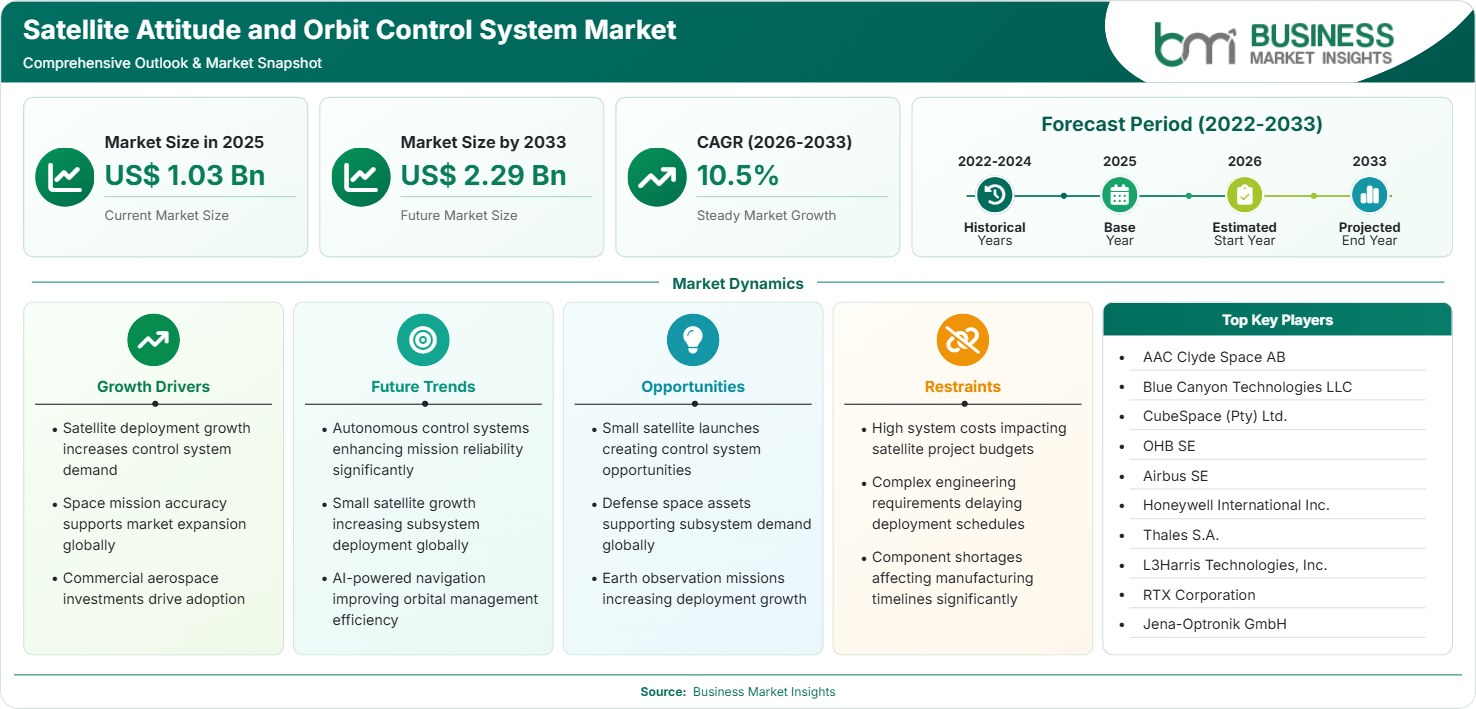
The Satellite Attitude and Orbit Control System Market size was valued at US$ 1.03 Billion in 2025 and is projected to reach US$ 2.29 Billion by 2033, growing at a CAGR of 10.5% during 2026–2033. Rising small satellite deployments, expanding defense space programs, advancing autonomous navigation technologies, and growing demand for precise positioning capabilities are creating substantial commercial opportunities across global satellite ecosystems.

Report Coverage
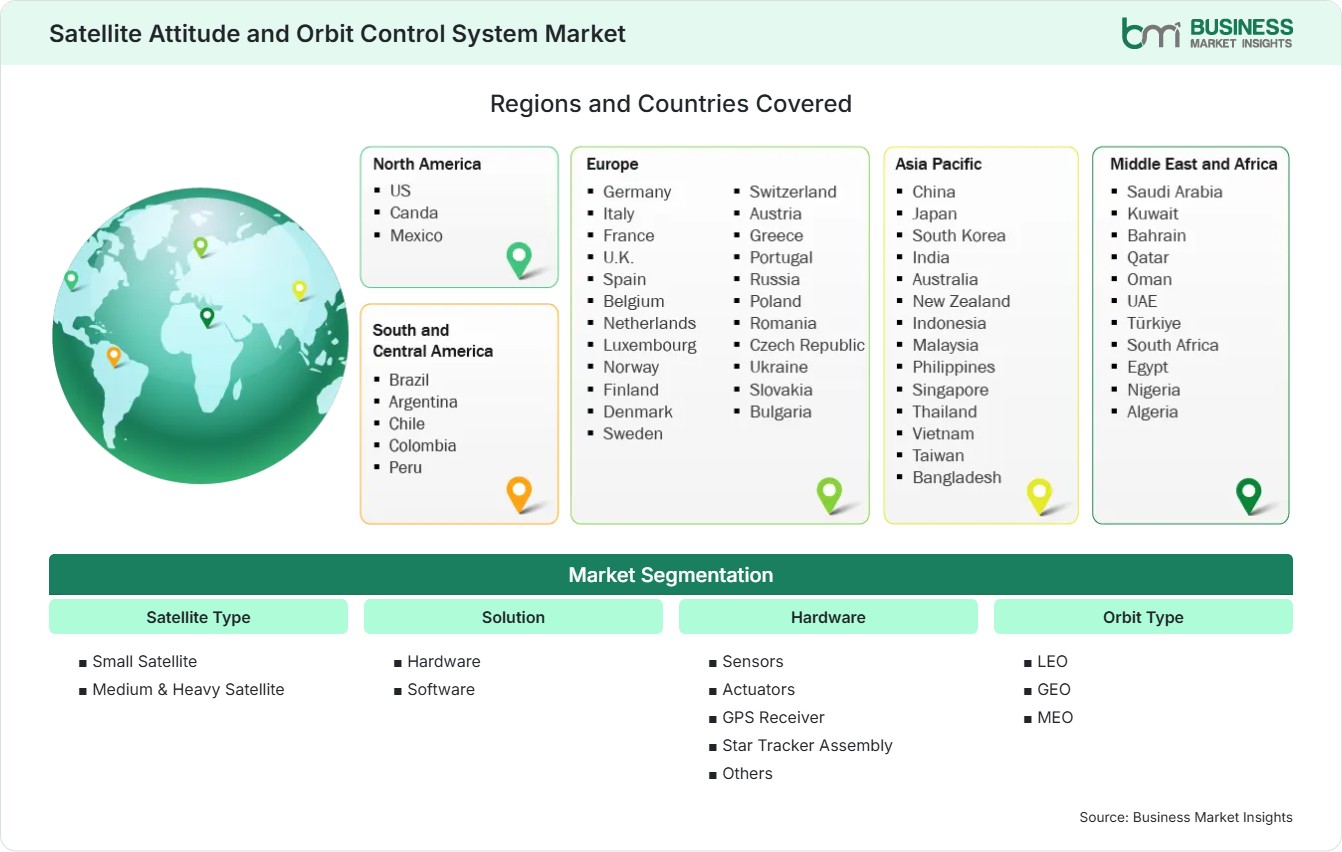
  • Satellite Type: Small Satellite, Medium & Heavy Satellite
  • Solution: Hardware, Software
  • Hardware: Sensors, Actuators, GPS Receiver, Star Tracker Assembly, Others
  • Orbit Type: LEO, GEO, MEO
  • Application: Commercial, Government & Civil, Defense
US$ 1.03 Bn Market size in 2025
US$ 2.29 Bn Market Size by 2033
10.5% CAGR, 2026 - 2033
2026-2033 Forecast Period

AI Overview

Satellite Attitude and Orbit Control System Market Summary

  • North America Region: North America holds a market share of 37%–40% in 2025, growing with a CAGR of 9.5%–10.0% during 2026–2033. Growth is supported by military satellite modernization, commercial constellation deployments, increased private investment, autonomous spacecraft development, deep-space exploration programs, onboard navigation innovation, advanced component manufacturing, and strategic government procurement initiatives worldwide.
  • Fastest Growing Region: Asia Pacific holds a market share of 25%–28% in 2025, growing with a CAGR of 11.8%–12.5% during 2026–2033. Expansion stems from national space programs, increasing indigenous satellite manufacturing, rising launch frequency, commercial space startups, defense modernization spending, technology transfer initiatives, and expanding regional demand for satellite-based connectivity services.
  • Leading Segment: Hardware accounts for 62%–66% market share in 2025 and is projected to grow at a 9.8%–10.4% CAGR. Demand is driven by increasing deployment of sensors, reaction wheels, propulsion units, star trackers, miniaturized electronics, mission-critical reliability requirements, satellite constellation growth, and longer operational lifespan expectations.
  • High Growth Segment: Small Satellite represents 46%–50% of the Satellite Attitude and Orbit Control System Market share in 2025 and is expected to expand at a 12.0%–12.8% CAGR. Accelerated adoption results from lower launch costs, Earth observation missions, broadband constellations, defense intelligence applications, technology demonstration projects, academic programs, and commercial demand for real-time space-based data services.
  • Key Market Opportunity: Emerging autonomous satellite operations enable reduced ground intervention, improved orbit maintenance, enhanced collision avoidance, optimized fuel utilization, scalable constellation management, and stronger mission economics across commercial and government space programs globally.
  • Major Market Players: AAC Clyde Space AB, Blue Canyon Technologies LLC, CubeSpace (Pty) Ltd., OHB SE, Airbus SE, Honeywell International Inc., Thales S.A., L3Harris Technologies, Inc., RTX Corporation, and Jena-Optronik GmbH.
Strategic Insights

Satellite Attitude and Orbit Control System Market: Strategic Insights

Satellite Attitude and Orbit Control System Market Strategic Framework
FREE PDF
Request your free sample
Request free sample
Stakeholder View

Key Takeaways

  • The value chain in the industry is becoming more integrated since satellite manufacturers are looking for closer cooperation with propulsion suppliers, sensor suppliers, software developers, and launch service companies to reduce the complexity of the mission and the operational risks.
  • The potential for revenue from the use of small satellites for Earth observation, for communications, for weather monitoring, and for defense intelligence is the greatest because of the continued launch activity and the strategies involving expansion of satellite constellations.
  • Innovation is now being directed towards autonomous navigation systems, AI-assisted adjustments to orbital position, smaller reaction control systems, more advanced star trackers, and software-defined architectures for spacecraft operation.
  • The Asia Pacific region has one of the most appealing investment environments because of its growing number of domestic launch programs, the increasing amount of government funding, the rise in commercial startup activities, and its developing satellite manufacturing capabilities.
  • Companies are still making strategic acquisitions, carrying out venture capital investments, and forming public-private partnerships to gain access to advanced technologies, manufacturing expertise, and international customer networks.
  • There is an ever-greater focus on space situational awareness and orbital sustainability, and this is leading to increased demand for systems that are capable of performing precise maneuvers, avoiding collisions, and optimizing missions over the long term.
Geographic Outlook

Satellite Attitude and Orbit Control System Market Regional Highlights

North America Satellite Attitude and Orbit Control System Market

North America represented approximately 37%–40% of the Satellite Attitude and Orbit Control System Market share in 2025 and is expected to expand at a 9.5%–10.0% CAGR through 2033. The region benefits from an advanced aerospace supply chain, substantial defense budgets, commercial satellite constellation deployments, and continuous investment by national space agencies.

  • The defense modernization programs are still providing for advanced capabilities in spacecraft navigation, maneuverability, and tracking. Increasing investments in robust space assets are generating long-term procurement opportunities in both the government and commercial sectors.
  • Increasingly, operators of commercial satellites are putting in place broadband and Earth observation constellations which require advanced onboard control technologies to maintain their orbits with precision and ensure mission efficiency.
  • The area has access to a great deal of manufacturing expertise, has well-developed testing facilities, and is able to draw on a highly specialized aerospace engineering workforce, all of which support innovation across the entire ecosystem.
  • As more initiatives aimed at promoting space sustainability are introduced, there is a greater uptake of advanced orbital management technologies which are designed to enhance performance in avoiding collisions and to ensure responsible operations at the end of a satellite's life.
  • The share remains highest in the region due to strong institutional demand, technological leadership, and continuous spacecraft production activities.

US Satellite Attitude and Orbit Control System Market

The United States accounts for approximately 72%–76% of North American Satellite Attitude and Orbit Control System Market revenue in 2025 and is projected to grow at a 9.7%–10.2% CAGR. Demand is supported by extensive defense space programs, commercial communications networks, scientific missions, and large-scale constellation deployments.

  • The frequency with which commercial launches take place meets the ongoing demand for next-generation control technologies on communications, Earth observation, and scientific research missions.
  • Investment in resilient satellite systems capable of ensuring the continuity of operations under complicated operational conditions is still being guided by national security priorities.
  • Interest in autonomous spacecraft technology is growing as operators look to reduce the need for intervention and to improve operational efficiency with respect to large fleets of satellites.
  • The development of in-space servicing activities leads to a need for accurate capabilities when it comes to docking, maneuvering, and navigation in future types of missions.

Europe Satellite Attitude and Orbit Control System Market

Europe accounted for approximately 24%–27% of the Satellite Attitude and Orbit Control System Market share in 2025 and is anticipated to register a 9.8%–10.6% CAGR through 2033. Strong support from regional space agencies, sovereign satellite initiatives, and growing defense investments continues to drive procurement of advanced attitude determination and control technologies.

  • Germany continues to be the top national market, due to its robust ecosystem for manufacturing satellites, its substantial investments in research, and its commercial space activities which support the development of advanced spacecraft subsystems.
  • France has continued space programs that are supported by the government and has among its ranks major aerospace contractors taking part in communications, Earth observation, and defense missions.
  • The United Kingdom has one of the highest growth rates as a result of the expansion of satellite startups, the injection of private capital, and the nation's space sector development programs.
  • Ongoing investments in secure communication programs and those concerned with Earth observation are still providing opportunities for high-performance navigation and orbital control technologies.
  • Regulations aimed at promoting sustainability are helping to drive the development of improved maneuvering capabilities to support responsible orbital operations and meet debris mitigation objectives.

Asia Pacific Satellite Attitude and Orbit Control System Market

Asia Pacific captured approximately 25%–28% Satellite Attitude and Orbit Control System Market share in 2025 and is projected to achieve the fastest expansion with a 11.8%–12.5% CAGR through 2033. National space programs, increasing satellite launches, domestic manufacturing initiatives, and growing demand for communication infrastructure support market expansion.

  • China is leading demand in the region by means of large-scale satellite deployment programs, its launch capabilities, investments in navigation infrastructure, and the ongoing expansion of its domestic aerospace manufacturing capacity.
  • India is the fastest-growing of the major markets as a result of the growing number of commercial launch services, increased startup activity, and government initiatives aimed at promoting the development of indigenous space technology.
  • Japan has a strong demand for spacecraft components of high reliability, which are used in scientific, commercial, and defense-oriented satellite missions.
  • The increasing demand for broadband connectivity is leading to the establishment of large constellations, which in turn call for advanced technologies relating to orientation and orbit correction.
  • Funding from regional venture capital and from the government is speeding up the process of putting innovative spacecraft subsystem technologies and autonomous mission architectures into commercial use.

Rest of World Satellite Attitude and Orbit Control System Market

The Rest of World region, encompassing South & Central America and the Middle East & Africa, held approximately 8%–11% Satellite Attitude and Orbit Control System Market share in 2025 and is forecast to expand at a 10.5%–11.3% CAGR through 2033. Governments increasingly recognize satellite capabilities as strategic infrastructure supporting connectivity, environmental monitoring, and security objectives.

  • The United Arab Emirates is still making investments in advanced space programs and scientific missions that require reliable navigation and orbital management technologies.
  • Saudi Arabia is expanding its investments in the space sector as part of its national diversification programs, which focus on communications, Earth observation, and emerging satellite services.
  • Brazil is ahead of the other South American countries in terms of activity, due to its governmental programs, research initiatives, and its involvement in international collaborations for the development of satellites.
  • The increasing need for disaster monitoring and environmental observation is leading to greater demand in developing economies for accurate spacecraft orientation systems.
  • International partnerships are still important for achieving technology transfer, engaging in manufacturing cooperation, and speeding up the development of regional satellite capabilities.
Global Market Geography
FREE PDF
Request your free sample
Request free sample
Segment Analysis

Satellite Attitude and Orbit Control System Market Segmentation

Satellite Type

Satellite Type accounted for a critical share of industry demand in 2025, with Small Satellite platforms gaining momentum due to increasing constellation deployments. The Satellite Attitude and Orbit Control System Market scope continues to expand as operators seek greater mission flexibility and lower deployment costs. Segment CAGR ranges from 10.2%–12.8%.

  • Small Satellite: Strong adoption stems from constellation deployments, lower manufacturing costs, shorter development cycles, and increasing utilization across commercial communications, Earth observation, research, and national defense applications.
  • Medium & Heavy Satellite: Demand remains driven by high-capacity communications, meteorology, navigation infrastructure, and strategic government missions requiring advanced control capabilities, longer operational lifespans, and superior reliability performance.

Solution

The solution segment is divided between integrated hardware and software offerings. Hardware remains dominant with approximately 62%–66% Satellite Attitude and Orbit Control System Market share in 2025, supported by recurring demand for sensors, actuators, and navigation subsystems.

  • Hardware: Physical spacecraft control components remain essential for mission execution, supporting orientation control, stabilization, maneuvering, navigation accuracy, and operational dependability throughout spacecraft lifecycles.
  • Software: Advanced algorithms improve autonomous navigation, collision avoidance, mission planning, fault detection, and constellation management while reducing operational complexity and intervention requirements.

Hardware

Hardware remains the leading category, representing approximately 62%–66% of the Satellite Attitude and Orbit Control System Market share in 2025 and expanding at a CAGR of 9.8%–10.4%. Continued innovation in miniaturization, power efficiency, reliability, and precision performance supports sustained adoption.

  • Sensors: Enable attitude determination through measurement of spacecraft position, motion, environmental conditions, and orientation parameters essential for accurate mission execution.
  • Actuators: Provide physical corrections and stabilization capabilities by translating control commands into precise spacecraft movements and orbital adjustments.
  • GPS Receiver: Supports navigation accuracy, position tracking, timing synchronization, and operational efficiency across Earth observation and communication satellite missions.
  • Star Tracker Assembly: Delivers highly accurate attitude determination by referencing stellar patterns, improving pointing precision and mission reliability in demanding environments.

Orbit Type

Orbit Type segmentation reflects varied mission requirements across commercial and institutional applications. LEO remains the dominant category with approximately 55%–59% share in 2025 and a CAGR of 11.5%–12.2%, driven by communications constellations and imaging missions. The segment highlights evolving Satellite Attitude and Orbit Control System Market trends associated with multi-orbit architectures.

  • LEO: Extensive deployment of broadband and imaging constellations drives significant demand for precision attitude control and frequent orbital maneuvering capabilities.
  • GEO: Stable positioning requirements for communications broadcasting and weather monitoring sustain long-term demand for highly reliable spacecraft control systems.
  • MEO: Navigation and specialized communications missions support adoption of advanced orientation technologies, ensuring operational precision and extended mission performance.

Application

Application demand remains diversified across commercial, government & civil, and defense markets. Commercial applications account for approximately 44%–48% of the Satellite Attitude and Orbit Control System Market share in 2025 and record steady expansion through increasing satellite service monetization.

  • Commercial: Expanding broadband networks, Earth observation services, maritime monitoring, and data analytics applications support sustained procurement of sophisticated spacecraft control technologies.
  • Government & Civil: Scientific research, weather forecasting, environmental monitoring, and public infrastructure initiatives strengthen long-term demand for advanced satellite solutions.
  • Defense: Security requirements, intelligence gathering, surveillance missions, and secure communications programs drive investments in highly dependable orbital control systems.
Market Forces

Satellite Attitude and Orbit Control System Market Dynamics

Key Market Drivers

Expansion of Commercial Satellite Constellations

Commercial constellation deployment is increasing demand for repeatable, compact, and dependable attitude control equipment. The International Space Station and individual scientific missions are important parts of the broader space ecosystem, but large commercial fleets create a different purchasing pattern: operators need consistent subsystem specifications across successive spacecraft. Standardized reaction wheels, star trackers, sensors, and integrated control modules can reduce engineering effort and simplify spacecraft production. These conditions support Satellite Attitude and Orbit Control System Market growth, especially for suppliers that combine flight heritage with competitive unit economics.

Increasing Demand for Precision Pointing and Imaging

Because of the need for accurate control of the orientation of spacecraft, high-resolution Earth observation, optical communications, scientific instruments, and surveillance equipment have been developed. Even small angular errors can degrade image quality, reduce observation efficiency, or disrupt communication links. With the growing capabilities of payloads, spacecraft integrators are increasingly likely to assess the overall performance of optical sensors, inertial measurement devices, reaction wheels, and control algorithms. The NASA Small Spacecraft Systems Virtual Institute records the variety of guidance, navigation, and control technologies employed in today's small spacecraft, such as star trackers, reaction wheels, GPS receivers, and magnetic torquers.

Development of Integrated and Autonomous Control Architectures

Spacecraft manufacturers are integrating sensing, processing, and control functions to reduce interface complexity and support more autonomous operations. Integrated architectures can coordinate attitude estimation, maneuver execution, momentum management, and fault detection within a common control framework. This approach is particularly relevant to small satellites, where mass, power, and onboard computing capacity are constrained. The Satellite Attitude and Orbit Control System Market trends increasingly favor modular products that offer straightforward integration without sacrificing performance, reliability, or mission-specific adaptability.

Key Market Opportunities

Modular Control Systems for Small-Satellite Fleets

The production of small satellites presents a favorable opportunity for suppliers who can standardize subsystem designs while meeting the requirements of different missions. A modular range of products can integrate selectable sensors, different actuator arrangements, and various software options within a common interface structure. This method decreases the need for redesign and enables customers to set up the products in accordance with pointing accuracy, the amount of power available, the mass of the payload, and the orbit. Investors and manufacturers should focus on component businesses that have a proven record of having flown, scalable methods of production, and flexible integration support.

Software-Defined Control and Onboard Autonomy

The higher level of autonomy on board offers chances for software companies and hardware makers to develop control platforms that are compatible with one another. By using advanced estimation algorithms, carrying out autonomous fault recovery, and planning adaptive maneuvers, the need for frequent ground interventions can be reduced and the operational flexibility improved. Furthermore, software upgrades might enable spacecraft operators to adjust the control behavior after launch, provided that the mission architecture and the qualification procedure allow it. Potential areas for investment are simulation environments, verification tools, hardware-in-the-loop testing, and software libraries that are compatible with existing flight computers.

Demand for National and Regional Space Capabilities

National space programs create opportunities for suppliers that can support domestic spacecraft manufacturing, technology transfer where permitted, and local subsystem integration. Countries developing Earth observation, navigation, communications, and scientific missions may seek qualified components alongside engineering support and testing capabilities. The Satellite Attitude and Orbit Control System Market Forecasts are influenced by the conversion of announced space strategies into funded missions, procurement contracts, and production schedules. Suppliers should evaluate customer funding, local sourcing rules, export controls, and technical readiness before committing to new manufacturing capacity.

Market Restraints and Challenges

Long Qualification Cycles and Mission Assurance Requirements

The satellite control components must withstand launch vibrations, repeated thermal cycling, radiation exposure, vacuum conditions, and prolonged operation without physical maintenance. Carryout and acceptance testing may necessitate the use of special facilities, involve thorough documentation, call for repeated verification, and demand a great deal of engineering work. As a result, the development times are extended, non-recurring costs rise, and it becomes difficult for new suppliers to compete right away with existing manufacturers. Even if a product is technically capable, delays can occur if it does not have enough flight experience or sufficient evidence of compatibility.

Supply Constraints and Cost Pressure

The fact is that high-reliability electronics, optical assemblies, precision bearings, special semiconductors, and space-qualified materials may have to rely on a small number of suppliers or may involve long procurement lead times. As a result, delays or unexpected rises in cost can interfere with the spacecraft integration schedule and damage the economic viability of high-volume constellation programs. Manufacturers that are smaller in scale may be especially vulnerable since they have less purchasing power and fewer chances to keep strategic stocks.

Company Analysis

Competitive Landscape

The competitive environment remains characterized by innovation, subsystem specialization, and growing integration capabilities. Current Satellite Attitude and Orbit Control System Market analysis indicates strong competition among aerospace primes, subsystem manufacturers, and emerging specialized technology providers.

Company Name

Overview

Products and Services relevant to this market

AAC Clyde Space AB

Space technology company focused on small satellite missions, subsystem engineering, and integrated spacecraft solutions serving commercial and government customers.

Satellite platforms, power systems, navigation solutions, spacecraft control technologies, mission integration services, and related engineering support.

Blue Canyon Technologies LLC

Specialized spacecraft manufacturer known for compact satellite systems and advanced guidance, navigation, and control capabilities.

Reaction wheels, star trackers, spacecraft buses, navigation systems, flight software, and attitude control solutions.

CubeSpace (Pty) Ltd.

Developer of compact attitude determination and control technologies supporting global small satellite programs.

Reaction wheels, control electronics, actuators, navigation subsystems, and integrated attitude control platforms.

OHB SE

European aerospace company engaged in satellite development, space transportation, and exploration activities.

Satellite manufacturing, onboard navigation systems, control technologies, integration services, and mission engineering.

Airbus SE

Global aerospace leader providing advanced spacecraft technologies across commercial and institutional programs.

Satellite platforms, star trackers, guidance systems, navigation technologies, and mission support solutions.

Honeywell International Inc.

Diversified technology company supplying aerospace systems and navigation technologies for space applications.

Inertial measurement systems, sensors, navigation electronics, spacecraft control components, and aerospace engineering services.

Thales S.A.

Aerospace and defense company supporting communications, navigation, and secure space infrastructure programs.

Satellite subsystems, control electronics, navigation solutions, space communications, and mission management technologies.

L3Harris Technologies, Inc.

Defense and aerospace technology provider with strong participation in national security space programs.

Space sensors, mission systems, navigation technologies, tracking capabilities, and satellite control solutions.

RTX Corporation

Aerospace and defense manufacturer supporting advanced spacecraft, sensing, and mission assurance requirements.

Guidance technologies, control electronics, aerospace components, and secure mission support systems.

Jena-Optronik GmbH

Specialist provider of optical navigation and attitude determination technologies for spacecraft applications.

Star trackers, navigation sensors, guidance systems, precision positioning technologies, and engineering support services.

Trust & Transparency

Research Methodology

The market analysis combines proprietary research with secondary data from government agencies, company disclosures, regulatory filings, industry databases and expert interviews. Market estimates are validated through data triangulation, cross-market benchmarking and analyst review.

View Full Research Methodology

Questions Answered

Frequently Asked Questions

What insights does a Satellite Attitude and Orbit Control System Market Report provide?

A comprehensive report evaluates market size, demand drivers, competitive positioning, technology developments, segmentation trends, regional opportunities, investment patterns, and future growth prospects supporting strategic business decisions.

How does software contribute to attitude and orbit control performance?

Software enhances mission efficiency through autonomous navigation, fault management, collision avoidance, orbit optimization, and predictive analytics, helping operators reduce intervention requirements and improve spacecraft performance.

Which region offers the highest growth potential through 2033?

Asia Pacific is expected to record the strongest growth due to increasing satellite launches, indigenous manufacturing initiatives, expanding space budgets, commercial startup activity, and supportive government programs.

Why are small satellites becoming increasingly important in the industry?

Small satellites offer reduced manufacturing costs, shorter deployment cycles, and greater mission flexibility. They enable operators to build scalable constellations supporting communications, imaging, scientific research, and defense applications.

What is the primary application driving demand for satellite attitude and orbit control systems?

Commercial satellite deployments, particularly broadband communications and Earth observation constellations, represent the largest source of new demand. These missions require precise navigation, pointing accuracy, and orbit-maintenance capabilities throughout operational lifecycles.

Access the Full Satellite Attitude and Orbit Control System Market Report

Get segment-level forecasts, regional estimates, competitive benchmarking, company profiles and downloadable Excel datasets.

Access the full Satellite Attitude and Orbit Control System Market Report
350 pages PDF & Excel | 2026-11-03
Similar Research

Related Market Reports