Market Summary
Executive Summary and Global Market Analysis
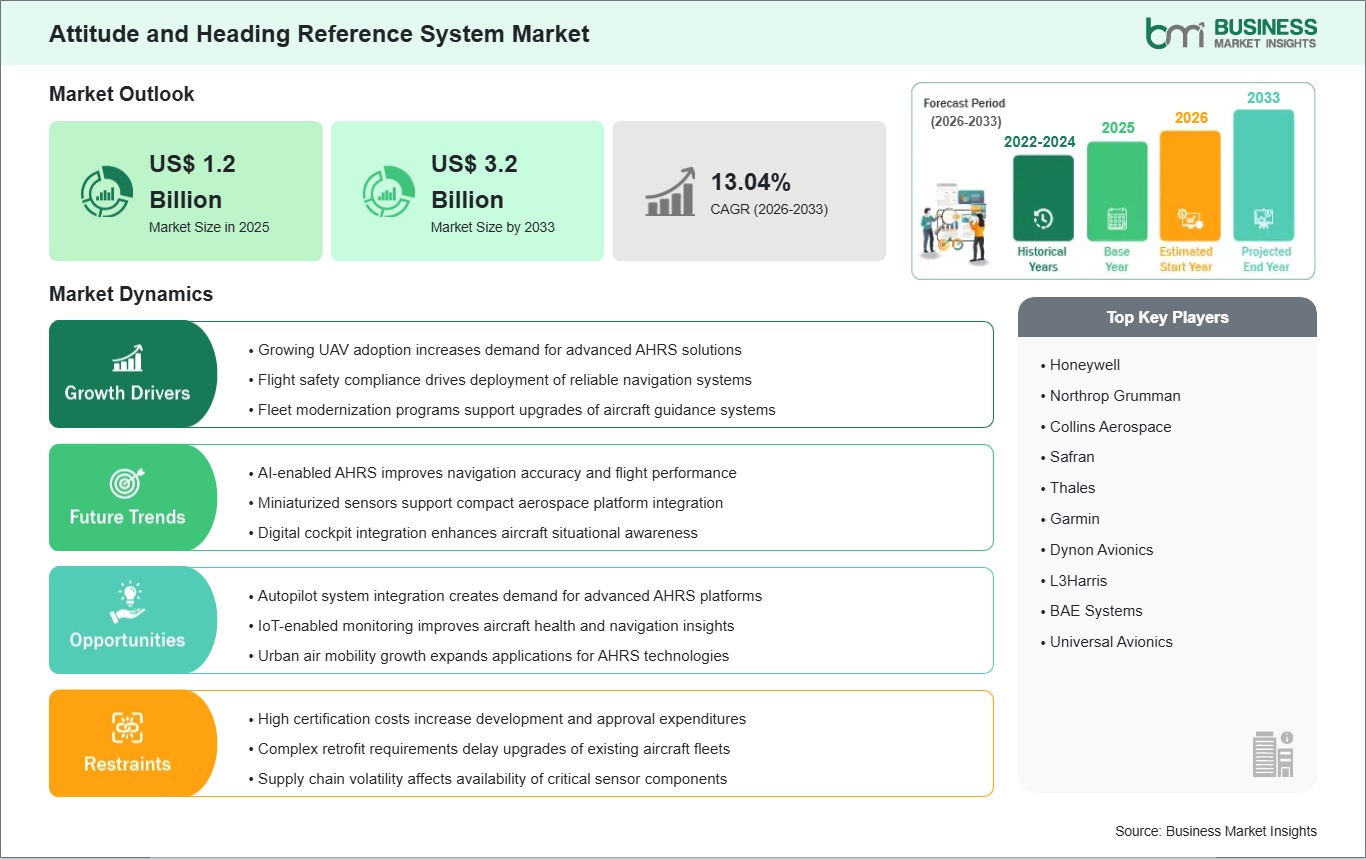
Attitude and Heading Reference Systems (AHRS) are navigation systems used to provide critical flight information such as aircraft orientation, heading, pitch, roll, and yaw. These systems combine data from sensors, gyroscopes, and accelerometers to deliver accurate attitude and directional information for pilots and onboard navigation systems. AHRS technology is widely used across commercial aviation, military aviation, and unmanned aerial vehicles (UAVs), where precise navigation and flight stability are essential. The Attitude and Heading Reference System market is growing as aircraft operators seek advanced avionics solutions that improve flight safety, operational efficiency, and navigation accuracy. Increasing adoption of digital cockpit technologies, modernization of aviation fleets, and the expanding use of UAVs for commercial and defense applications are supporting market growth.
There are several challenges that may affect market expansion. The development and certification of aviation-grade navigation systems require significant investment and compliance with strict regulatory standards. Integration of AHRS equipment into existing aircraft platforms can be complex and costly, particularly for older fleets. The industry also faces challenges related to cybersecurity, system reliability, and the need for continuous performance validation. Supply chain constraints for advanced electronic components and specialized sensors can impact production timelines and equipment availability. In addition, maintenance and calibration requirements may increase operational costs for aircraft operators.
Despite these challenges, the market presents considerable opportunities through technological innovation and growing aviation activity. Advances in microelectromechanical systems (MEMS), sensor fusion technologies, and digital avionics are improving the accuracy, reliability, and efficiency of AHRS solutions. The increasing deployment of UAVs in surveillance, logistics, agriculture, and defense operations is creating new demand for compact and lightweight navigation systems. Growing investments in next-generation aircraft, urban air mobility concepts, and autonomous flight technologies are expected to further support market growth. As aviation systems become increasingly connected and intelligent, the role of AHRS in ensuring safe and efficient navigation is expected to expand significantly.
Segment Analysis
Attitude and Heading Reference System Market Segmentation
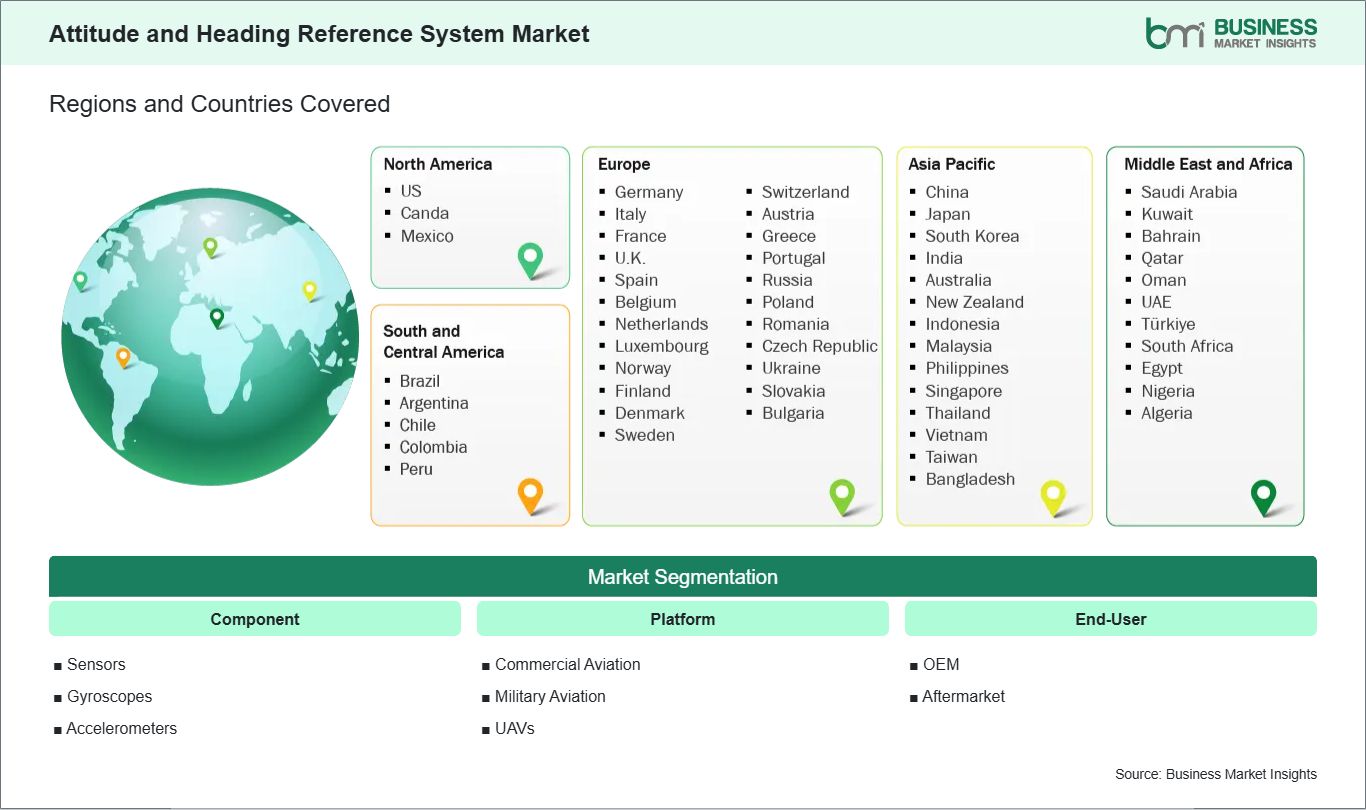
The Attitude and Heading Reference System market is segmented based on component, platform, and end-user. These segments address the varying operational requirements of aviation and aerospace applications.
By Component
- Sensors: Provide critical motion and orientation data required for navigation accuracy.
- Gyroscopes: Measure rotational movement and support aircraft attitude determination.
- Accelerometers: Detect acceleration forces and assist in flight stability calculations.
By Platform
- Commercial Aviation: Utilized in passenger and cargo aircraft for navigation and flight management.
- Military Aviation: Supports mission-critical navigation and situational awareness applications.
- UAVs: Enables stable autonomous operation and precise flight control for unmanned systems.
By End-User
- OEM: Integrates AHRS technology into newly manufactured aircraft and UAV platforms.
- Aftermarket: Focuses on upgrades, replacements, maintenance, and retrofit activities.
Market Forces
Attitude and Heading Reference System Market Drivers and Opportunities
Rising Demand for Advanced Aircraft Navigation Systems
The growing emphasis on flight safety, operational efficiency, and navigation accuracy is driving demand for advanced Attitude and Heading Reference Systems. Modern aircraft increasingly rely on digital avionics and integrated flight management systems that require precise attitude and heading information. AHRS solutions provide reliable data that supports navigation, autopilot functions, and situational awareness, making them essential components in both commercial and military aviation.
The aviation industry continues to modernize existing fleets while investing in next-generation aircraft equipped with advanced electronic systems. Regulatory requirements related to flight safety and navigation performance are encouraging the adoption of highly accurate and dependable navigation technologies. In military aviation, the need for enhanced mission effectiveness and real-time operational awareness is further increasing demand for sophisticated AHRS solutions. Technological advancements in sensor technology and data processing capabilities are improving system performance while reducing equipment size and weight. As aviation operators prioritize safety, efficiency, and digital transformation, demand for AHRS solutions is expected to remain strong across multiple aircraft categories.
Expansion of UAV and Autonomous Aviation Applications
The increasing adoption of UAVs and emerging autonomous aviation technologies is creating significant opportunities for the Attitude and Heading Reference System market. UAVs are being deployed across a wide range of applications, including surveillance, infrastructure inspection, agriculture, logistics, and defense operations. These platforms require compact, lightweight, and highly accurate navigation systems to ensure stable and reliable flight performance.
Recent improvements in MEMS technology will help develop AHRS solutions that are much smaller and affordable, which will suit UAVs. The recent introduction of urban air mobility solutions and autonomous planes will further increase the need for such solutions that ensure proper navigation and orientation of the plane. Increased investment into autonomous flight systems, smart aviation infrastructure, and navigation solutions will contribute to the appearance of new growth prospects in the area. As the industry adopts automation and connectivity technologies, AHRS solutions are likely to gain traction and become integral components of any modern aircraft.
Size and Share Analysis
Attitude and Heading Reference System Market Size and Share Analysis
The Attitude and Heading Reference System Market size is expected to reach US$ 3.2 billion by 2033 from US$ 1.2 billion in 2025. The market is estimated to record a CAGR of 13.04% from 2026 to 2033.
By component, sensors account for a significant share due to their critical role in collecting motion, orientation, and positional data required for accurate navigation. Gyroscopes remain essential for measuring rotational movement and maintaining flight stability, while accelerometers continue to gain importance as aircraft systems increasingly rely on precise motion sensing and sensor fusion technologies.
By platform, commercial aviation dominates the market owing to the widespread adoption of advanced avionics and navigation systems in passenger and cargo aircraft. Military aviation continues to generate strong demand due to the need for mission-critical navigation capabilities, while UAVs are witnessing rapid adoption as autonomous and remotely operated aircraft become increasingly important across commercial and defense applications.
Report Coverage
Attitude and Heading Reference System Market Report Coverage and Deliverables
The "Attitude and Heading Reference System Market Size and Forecast (2022-2033)" report provides a detailed analysis of the market covering below areas:
- Market size and forecast at global, regional, and country levels for all the key market segments covered under the scope
- Market trends, as well as market dynamics such as drivers, restraints, and key opportunities
- Market analysis covering key market trends, global and regional framework, major players, regulations, and recent market developments
- Industry landscape and competition analysis covering market concentration, heat map analysis, prominent players, and recent developments for the market
- Detailed company profiles, including SWOT analysis
Geographic Insights
Attitude and Heading Reference System Market Geographic Insights
The Attitude and Heading Reference System Market shows diverse regional adoption patterns influenced by aviation modernization programs, defense investments, technological advancements, and increasing demand for advanced navigation systems.
North America, being a developed region, has a well-established aerospace and defense industry and a high adoption rate of advanced avionics technologies. The region consists of the United States and Canada, where substantial investments are currently being made to upgrade commercial air fleets, military aircraft, and unmanned aerial vehicles. Safety, efficiency, and accuracy in flights are the main concerns in this region; thus, there is an emphasis on improving these aspects through the use of advanced AHRS technologies.
Asia Pacific is growing significantly, driven by expanding aviation infrastructure, increasing defense expenditures, and rising aircraft procurement activities. The region comprises countries such as China, India, and Japan, where growing commercial air travel demand and military modernization programs are creating substantial opportunities for navigation system providers. The region focuses on strengthening aerospace capabilities, improving air traffic management systems, and supporting domestic aircraft manufacturing initiatives. Increasing deployment of UAVs across commercial and defense applications is also contributing to market expansion.
Both regions are contributing significantly to the growth of the Attitude and Heading Reference System Market, focusing on aviation modernization, technological innovation, and increasing demand for reliable navigation solutions across commercial, military, and unmanned aviation sectors.
Industry Activity
Recent Developments
The Attitude and Heading Reference System Market is analyzed using a mix of primary and secondary research sources, including corporate publications, industry associations, and verified databases. This approach ensures accurate tracking of innovation trends and strategic developments influencing the market.
- In January 2026, Safran Electronics & Defense secured a high-profile contract with the Danish Defense Acquisition and Logistics Organization (DALO) to supply its next-generation Argonyx inertial navigation system to the Royal Danish Navy. The safety-critical maritime initiative introduces solid-state Hemispherical Resonator Gyroscope (HRG) platforms engineered to deliver highly stable, autonomous positioning without relying on satellite signals. The development significantly strengthens localized fleet resilience in contested or GNSS-denied environments and highlights ongoing global investments in high-precision, solid-state sensing architectures across modern defense sectors.
- In September 2025, Honeywell Aerospace launched its groundbreaking Multi-System Alternative Navigation Architecture to address widespread global positioning system (GPS) vulnerabilities. The multi-layered framework introduces vision-based tracking, magnetic anomaly-aided positioning, and low-Earth orbit (LEO) satellite navigation algorithms to maintain aircraft orientation without relying on traditional GNSS networks. The development significantly strengthens flight path resilience across congested warzones and civil corridors while highlighting ongoing industrial investments in sensor-fused software safety nets.
Trust & Transparency
Research Methodology
The market analysis combines proprietary research with secondary data from government agencies, company disclosures, regulatory filings, industry databases and expert interviews. Market estimates are validated through data triangulation, cross-market benchmarking and analyst
review.
View Full Research Methodology
Key Sources Referred:
World Bank - Global Trade IndicatorsWorld Trade Organization (WTO)International Monetary Fund (IMF)International Trade Administration (ITA)Company WebsitesCompany Annual ReportsCompany Investor Presentations