
Sandwich Panel Market Outlook: Size, Share, Trends, Growth Analysis, Competitive Landscape & Forecast, 2026-2033

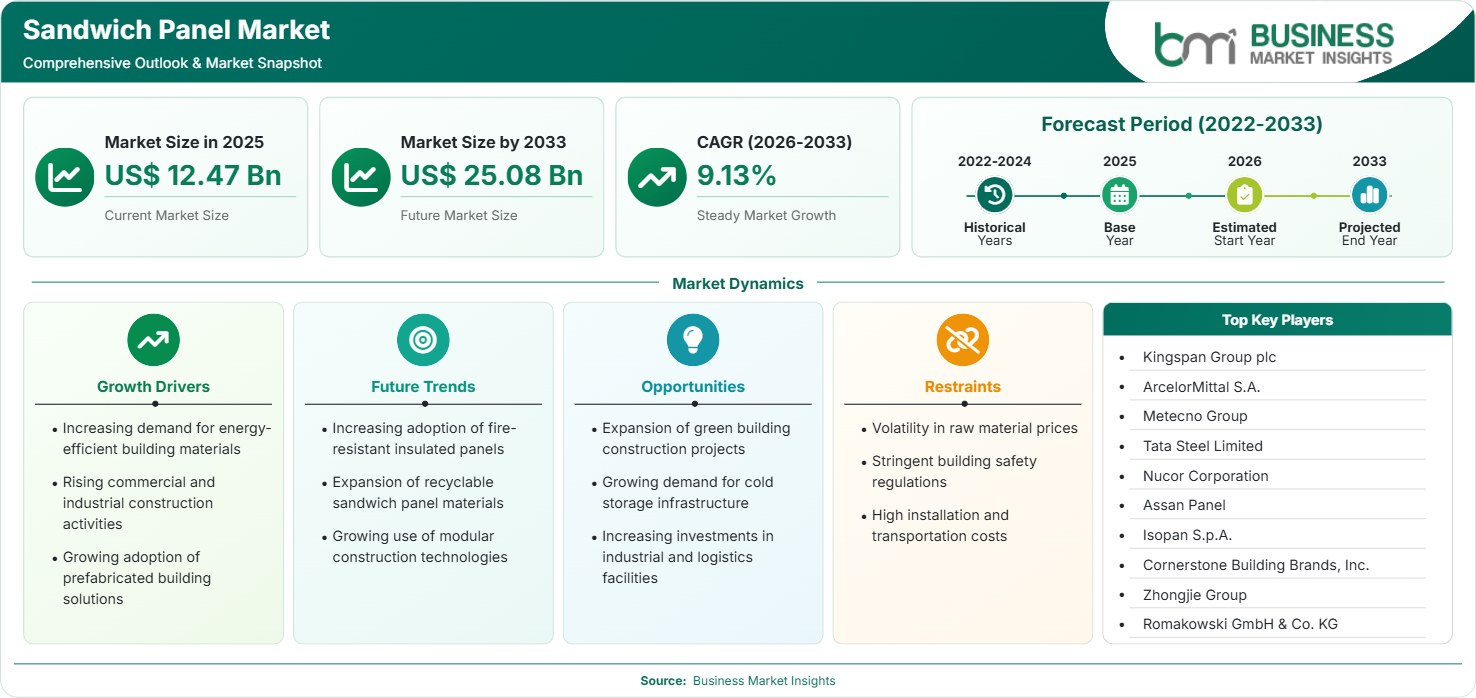
The Sandwich Panel Market size was valued at US$ 12.47 Billion in 2025 and is projected to reach US$ 25.08 Billion by 2033, growing at a CAGR of 9.13% from 2026 to 2033. Rising demand for energy-efficient construction materials, industrial expansion, prefabricated structures, green buildings, and cold storage infrastructure are accelerating market adoption.

Report Coverage
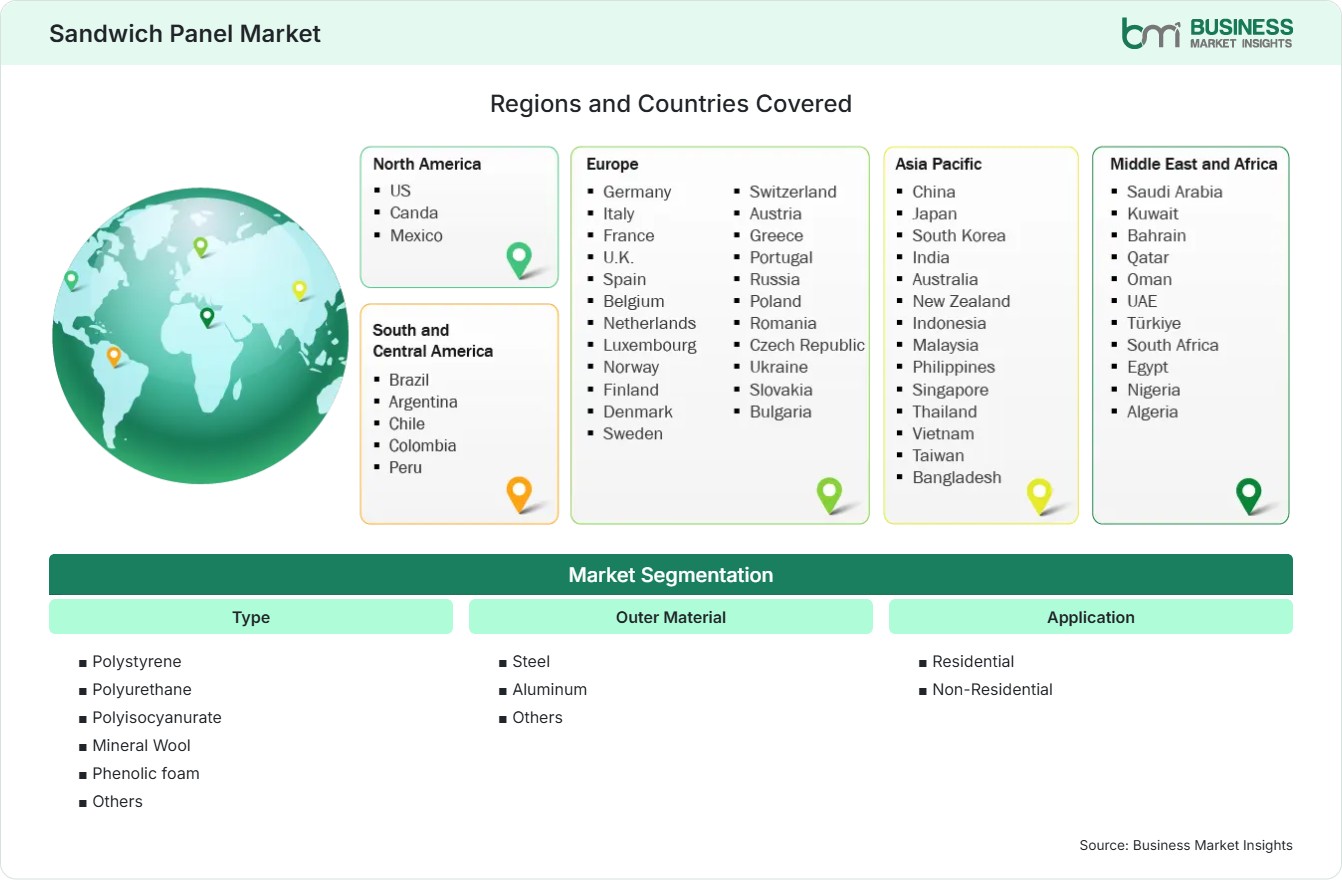
  • Type: Polystyrene, Polyurethane , Polyisocyanurate , Mineral Wool, Phenolic foam, Others
  • Outer Material: Steel, Aluminum, Others
  • Application: Residential, Non-Residential
US$ 12.47 Bn Market size in 2025
US$ 25.08 Bn Market Size by 2033
9.13% CAGR, 2026 - 2033
2026-2033 Forecast Period

AI Overview

Sandwich Panel Market Summary

  • North America Region: North America holds a 28%–31% market share in 2025, expanding at a 8.0%–8.5% CAGR during 2026–2033. The region benefits from energy-efficient construction regulations, warehouse development, industrial modernization, and demand for insulated building solutions. The U.S. market analysis indicates growth at a 8.2%–8.7% CAGR driven by logistics facilities, commercial construction, and sustainable building initiatives.
  • Fastest Growing Region: Asia Pacific represents a 34%–37% market share in 2025 and grows at a 10.0%–10.6% CAGR during 2026–2033. Rapid industrialization, infrastructure investment, urban development, cold chain expansion, and increasing adoption of prefabricated construction systems are supporting regional growth.
  • Leading Segment: Polyurethane (PUR) sandwich panels account for a 30%–33% market share in 2025 with a 9.0%–9.5% CAGR during 2026–2033. Strong thermal insulation performance, lightweight properties, and extensive use in commercial and industrial structures support segment leadership.
  • High Growth Segment: Polyisocyanurate (PIR) sandwich panels represent a 15%–18% market share in 2025 and expand at a 10.0%–10.5% CAGR during 2026–2033 due to superior fire resistance, energy efficiency, and increasing demand from regulated construction environments.
  • Key Market Opportunity: Expansion of green buildings, cold storage facilities, industrial warehouses, and logistics infrastructure is creating opportunities for manufacturers offering high-performance insulated panel solutions.
  • Major Market Players: Kingspan Group plc, ArcelorMittal S.A., Metecno Group, Tata Steel Limited, Nucor Corporation, Assan Panel, Isopan S.p.A., Cornerstone Building Brands, Inc., Zhongjie Group, and Romakowski GmbH & Co. KG.
Strategic Insights

Sandwich Panel Market: Strategic Insights

Sandwich Panel Market Strategic Framework
FREE PDF
Request your free sample
Request free sample
Stakeholder View

Key Takeaways

  • The sandwich panel ecosystem includes raw material suppliers, insulation core manufacturers, metal sheet producers, panel fabricators, distributors, contractors, and end users. Integration across this value chain influences pricing, quality control, and delivery efficiency.
  • Polyurethane and polyisocyanurate panels offer strong growth potential due to their thermal insulation performance, energy-saving benefits, and increasing usage in industrial, commercial, and cold storage applications.
  • Product innovation is shifting toward panels with improved fire resistance, recyclable materials, enhanced durability, and better insulation efficiency to meet evolving building standards.
  • Asia Pacific provides strong investment opportunities due to industrial expansion, logistics infrastructure development, urbanization, and increasing adoption of prefabricated construction methods.
  • Companies are strengthening market positions through capacity expansion, strategic partnerships, regional manufacturing facilities, and development of customized panel solutions.
  • Sustainability requirements are influencing product strategies as builders increasingly seek materials that reduce operational energy consumption and support green building certifications.
Geographic Outlook

Sandwich Panel Market Regional Highlights

North America Sandwich Panel Market

North America accounts for 28%–31% of the global market in 2025 and is projected to grow at a 8.0%–8.5% CAGR during 2026–2033. The region benefits from increasing demand for energy-efficient construction materials, expansion of industrial and logistics facilities, and strict building performance standards. Rising adoption of insulated panels in warehouses, commercial structures, and cold storage facilities is supporting market development. Advanced construction practices, renovation activities, and sustainability-focused projects are further encouraging the use of sandwich panel solutions across residential and non-residential applications.

  • Increasing adoption of insulated panels in commercial buildings is driven by energy conservation requirements, improved thermal performance expectations, and growing preference for construction materials that reduce long-term operational costs.
  • The United States remains the largest contributor due to logistics infrastructure expansion, industrial redevelopment projects, and rising investments in temperature-controlled storage facilities supporting food, pharmaceutical, and manufacturing supply chains.
  • Renovation of aging commercial infrastructure is encouraging replacement of conventional building materials with lightweight sandwich panels that offer faster installation, improved insulation, and enhanced structural performance.
  • Manufacturers are strengthening regional production networks to reduce transportation costs, improve supply reliability, and meet growing demand from commercial, industrial, and institutional construction projects.

US Sandwich Panel Market

The U.S. market represents 85%–88% of North America's market share in 2025 and is expected to grow at a 8.2%–8.7% CAGR during 2026–2033. Growth is supported by expanding warehouse infrastructure, industrial construction, cold chain development, and sustainability-focused building initiatives. Increasing demand for prefabricated construction solutions is improving adoption among contractors and developers. The country’s focus on energy-efficient buildings and faster project completion is encouraging wider usage of insulated sandwich panel systems across commercial and industrial applications in Sandwich Panel Market.

  • Expansion of distribution centers and logistics facilities is increasing demand for insulated panels that provide thermal efficiency, reduced installation time, and improved building performance.
  • Growth in food processing and pharmaceutical storage infrastructure is supporting adoption of high-performance panels designed for controlled temperature environments.
  • Green building initiatives are encouraging developers to select construction materials that improve energy efficiency and support lower operational emissions.
  • Commercial construction projects are increasingly adopting prefabricated solutions to reduce labour requirements and improve construction speed.

Europe Sandwich Panel Market

Europe holds 24%–27% market share in 2025 and expands at a 7.5%–8.0% CAGR during 2026–2033. The market is supported by stringent energy efficiency standards, sustainable construction policies, and modernization of industrial infrastructure. Germany, France, and the United Kingdom represent important markets due to strong construction activity and demand for advanced insulation solutions in Sandwich Panel Market. Increasing focus on reducing building energy consumption is encouraging adoption of sandwich panels across commercial, industrial, and refrigerated facility applications.

  • Germany leads regional demand due to advanced manufacturing infrastructure, strong industrial construction activity, and regulations promoting energy-efficient building solutions.
  • France and the United Kingdom are witnessing increased adoption through commercial renovation projects, sustainable building developments, and modernization of industrial facilities.
  • European environmental regulations are encouraging replacement of traditional construction materials with insulated panels offering improved thermal performance and energy savings.
  • Growing cold storage infrastructure demand is supporting adoption across food processing, pharmaceutical, and logistics sectors.

Asia Pacific Sandwich Panel Market

Asia Pacific represents 34%–37% market share in 2025 and is projected to grow at a 10.0%–10.6% CAGR during 2026–2033. The region is the fastest-growing market due to rapid industrialization, urban development, manufacturing expansion, and increasing infrastructure investments. China, India, and Southeast Asian economies are driving demand through factory construction, logistics development, and cold chain expansion. Rising adoption of prefabricated construction methods is further supporting Sandwich Panel market penetration across residential and non-residential applications.

  • China contributes significantly through large-scale industrial projects, manufacturing expansion, infrastructure development, and increasing use of insulated construction materials.
  • India is experiencing higher adoption due to warehouse development, cold storage investments, urban housing demand, and government-supported infrastructure programs.
  • Southeast Asian countries are benefiting from manufacturing investments, industrial relocation trends, and growing demand for efficient construction systems.
  • Increasing urbanization is encouraging faster construction approaches, supporting adoption of prefabricated sandwich panel solutions.
  • Regional manufacturers are expanding production capacities to serve domestic demand and strengthen export opportunities.

Rest of World Sandwich Panel Market

The Rest of World region accounts for 8%–10% Sandwich Panel market share in 2025 and grows at a 8.5%–9.0% CAGR during 2026–2033. South America, the Middle East, and Africa are gradually adopting sandwich panels due to industrial development, infrastructure expansion, and increasing demand for energy-efficient buildings. Brazil, Gulf countries, and selected African economies are supporting growth through logistics investments, commercial construction, and cold storage development. Rising awareness of lightweight construction solutions is improving adoption across emerging markets.

  • Brazil is supporting regional growth through industrial construction, agricultural storage requirements, and increasing demand for efficient warehouse infrastructure.
  • Middle Eastern countries are increasing adoption through logistics hubs, commercial developments, and large-scale infrastructure projects requiring insulated construction materials.
  • African markets are gradually expanding due to urbanization, industrial development, and improving construction infrastructure.
  • Increasing cold storage investments are creating opportunities for sandwich panel manufacturers serving food and pharmaceutical supply chains.
  • Infrastructure modernization initiatives are encouraging adoption of durable, lightweight, and energy-efficient building materials.
Global Market Geography
FREE PDF
Request your free sample
Request free sample
Segment Analysis

Sandwich Panel Market Segmentation

Type

The type segment includes Polystyrene, Polyurethane (PUR), Polyisocyanurate (PIR), Mineral Wool, Phenolic Foam, and Others. Polyurethane (PUR) panels maintain a leading position due to strong insulation properties, lightweight structure, and broad industrial adoption. The segment is projected to grow at a 9.13%–9.6% CAGR during 2026–2033, supported by increasing demand for energy-efficient buildings, cold storage facilities, and prefabricated construction systems in Sandwich Panel Market.

  • Polystyrene: Adoption is supported by affordability, lightweight characteristics, moisture resistance, and usage in residential and commercial insulation applications.
  • Polyurethane (PUR): Leads demand due to superior thermal insulation, durability, lightweight construction, and extensive application across industrial and commercial buildings.
  • Polyisocyanurate (PIR): Gains traction through enhanced fire resistance, energy efficiency, and increasing adoption in projects requiring advanced building safety performance.
  • Mineral Wool: Demand is supported by fire-resistant properties, acoustic insulation benefits, and usage in industrial facilities with strict safety requirements.
  • Phenolic Foam: Expands through excellent thermal performance, low smoke generation, and increasing application in specialized construction environments.

Outer Material

The outer material segment includes Steel, Aluminium, and Others, with steel representing the dominant material due to strength, durability, cost efficiency, and wide industrial usage. The segment is expected to grow at a 8.8%–9.3% CAGR during 2026–2033. Increasing construction activities and demand for long-lasting building systems are supporting adoption of advanced outer materials in Sandwich Panel Market.

  • Steel: Dominates adoption due to high structural strength, durability, corrosion resistance treatments, and extensive usage in industrial and commercial buildings.
  • Aluminum: Gains preference in selected applications due to lightweight properties, corrosion resistance, aesthetic appeal, and suitability for modern architectural designs.

Application

The application segment consists of Residential and Non-Residential categories. Non-residential applications account for the leading share due to extensive usage in warehouses, manufacturing facilities, cold storage units, and commercial buildings. The segment is projected to grow at a 9.2%–9.7% CAGR during 2026–2033. Increasing infrastructure investments, industrial expansion, and demand for efficient construction methods are strengthening Sandwich Panel Market forecasts.

  • Residential: Growth is supported by increasing demand for energy-efficient housing, faster construction methods, and improved thermal insulation solutions.
  • Non-Residential: Maintains dominance due to widespread usage in industrial facilities, logistics centers, commercial buildings, and temperature-controlled infrastructure projects.
Market Forces

Sandwich Panel Market Dynamics

Key Market Drivers

Increasing demand for energy-efficient building materials

Growing emphasis on reducing building energy consumption is increasing demand for sandwich panels with advanced insulation capabilities. Governments, developers, and construction companies are prioritizing materials that improve thermal efficiency and reduce long-term operating costs. Sandwich panels provide benefits such as faster installation, improved insulation performance, and reduced energy requirements for heating and cooling systems. Increasing adoption of green building standards is further supporting demand across commercial, industrial, and institutional projects. Manufacturers are developing improved insulation cores and sustainable panel solutions to meet evolving construction requirements. These factors are strengthening the Sandwich Panel Market trends as energy-efficient construction becomes a priority across global markets.

Rising commercial and industrial construction activities

Expansion of commercial facilities, manufacturing units, warehouses, and logistics centers is driving demand for sandwich panels due to their lightweight structure and faster installation advantages. Industrial developers are increasingly adopting prefabricated insulated panels to reduce project timelines and improve construction efficiency. Growth in e-commerce, supply chain infrastructure, and manufacturing investments is increasing demand for modern warehouse facilities requiring durable and thermally efficient building systems. Emerging economies are witnessing higher construction activity due to urbanization and industrial development. These Sandwich Panel Market growth are contributing to wider adoption of sandwich panels across industrial applications, strengthening their role as a preferred construction material.

Growing adoption of prefabricated building solutions

Increasing adoption of prefabricated construction methods is supporting sandwich panel demand as builders seek faster, cost-effective, and reliable building solutions.

The increasing adoption of prefabricated construction methods is driving demand for sandwich panels as builders seek faster, more cost-effective, and more reliable building solutions. Prefabricated panels enable reduced labour requirements, improved quality control, and shorter construction schedules compared with conventional building methods. Labor shortages and increased project complexities within the construction industry have made the manufacturers resort to factory-made building products. In commercial, industrial and modular construction projects, sandwich panels are increasingly being used for better performance and efficiency. The manufacturers are employing modern manufacturing methods for delivering customized sandwich panel solutions for various applications.

Key Market Opportunities

Expansion of green building construction projects

The increasing investment in sustainable construction projects is creating opportunities for manufacturers of sandwich panels that produce energy-efficient, eco-friendly products. The green building programs are contributing to increased use of materials that enhance insulation effectiveness, minimize energy consumption by the structure, and support its sustainability. The developers are choosing high-end panels to fulfill regulatory standards and environmental considerations. Those who are keen to offer products that are recyclable, provide better insulation, and use low-impact production techniques will gain a market edge. The construction of sustainable infrastructure in the commercial, industrial, and residential sectors will create opportunities for high-quality sandwich panel producers.

Growing demand for cold storage infrastructure

The development of cold storage structures will provide many business opportunities owing to the rising demand for temperature control in food, pharmaceuticals, and agricultural supply chains. The use of sandwich panels in the construction of cold storage structures is common because they are durable, insulating, and capable of regulating temperature. The development of food, pharmaceutical, and global logistics is leading to more refrigerated warehouses being built. Cold chain infrastructure is also being developed in new markets to reduce losses and improve logistics efficiency. Companies that produce insulated panels for temperature-sensitive materials will benefit from the growing infrastructure investments.

Increasing investments in industrial and logistics facilities

Growing investment in industrial parks, manufacturing facilities, and logistics centers is supporting demand for sandwich panel systems. Expansion of e-commerce, global trade, and regional manufacturing hubs is increasing the need for efficient warehouse and production infrastructure. Sandwich panels provide advantages including quick installation, reduced maintenance requirements, and improved energy performance, making them suitable for large-scale facilities. The government and private organizations are investing in logistics networks to enhance their supply chain capability and create more demand for insulation products. Manufacturers diversifying their portfolio and production capabilities within the region may benefit from industrial infrastructure development.

Market Restraints and Challenges

Volatility in raw material prices

Factor: Sandwich panel production depends on materials including steel, aluminum, insulation chemicals, and polymers, whose prices fluctuate due to supply chain disruptions, energy costs, and market conditions. Impact: Raw material price volatility increases manufacturing costs, affects profit margins, and creates challenges in maintaining competitive pricing. Manufacturers must manage procurement strategies, optimize production processes, and diversify suppliers to reduce cost pressure. Changes in metal prices can directly influence panel pricing, especially in large construction projects. Although demand remains strong, cost instability continues to affect planning, budgeting, and profitability across the sandwich panel manufacturing industry.

Stringent building safety regulations

Factor: Increasing regulatory requirements related to fire safety, structural performance, and building standards require manufacturers to meet strict certification and testing procedures. Impact: Compliance requirements can increase production costs, extend product approval timelines, and create barriers for smaller manufacturers. Companies must invest in research, testing facilities, and quality control systems to ensure compliance with evolving standards. Fire-resistant insulation materials and certified panel designs are gaining importance as regulators focus on building safety. While these regulations improve construction reliability, they may increase operational complexity for manufacturers seeking expansion across different regional markets.

Company Analysis

Competitive Landscape

The Sandwich Panel Market analysis indicates a competitive environment influenced by insulation technology development, manufacturing capacity expansion, sustainable construction requirements, and increasing demand from industrial infrastructure projects. Major companies are focusing on improving panel performance, expanding regional production facilities, developing fire-resistant solutions, and strengthening distribution networks. Competitive positioning depends on material innovation, product quality, compliance with building standards, customization capabilities, and the ability to serve diverse applications including industrial, commercial, residential, and cold storage construction.

Company Name

Overview

Products and Services relevant to this market

Kingspan Group plc

Global building materials company specializing in insulation, energy-efficient solutions, and advanced construction systems.

Provides insulated sandwich panels, architectural panels, and high-performance building envelope solutions for commercial and industrial applications.

ArcelorMittal S.A.

Global steel producer offering advanced steel products and construction solutions across multiple industries.

Supplies steel-based sandwich panels, coated steel materials, and building systems for industrial and commercial structures.

Metecno Group

International manufacturer focused on insulated panels and construction solutions for various building applications.

Offers polyurethane, mineral wool, and insulated sandwich panels for industrial, commercial, and cold storage facilities.

Tata Steel Limited

Global steel manufacturer providing construction materials and engineered building solutions.

Produces steel panels, insulated building systems, and construction products supporting energy-efficient infrastructure development.

Nucor Corporation

North American steel company producing steel products and construction-related solutions.

Provides steel materials and building systems used in insulated panel manufacturing and commercial construction projects.

Assan Panel

Turkish manufacturer specializing in sandwich panels and insulated construction systems.

Offers polyurethane, mineral wool, and roof and wall sandwich panels for industrial applications.

Isopan S.p.A.

European manufacturer focused on insulated metal panels and sustainable building envelope solutions.

Provides insulated panels for industrial buildings, logistics facilities, and energy-efficient construction projects.

Cornerstone Building Brands, Inc.

Building products company delivering exterior and construction solutions across residential and commercial markets.

Offers insulated building products and construction systems supporting efficient building development.

Zhongjie Group

Chinese construction materials company specializing in insulated panels and building solutions.

Manufactures sandwich panels for industrial facilities, warehouses, and commercial construction applications.

Romakowski GmbH & Co. KG

German manufacturer producing high-quality insulated panel systems for specialized construction needs.

Provides sandwich panels for industrial buildings, cold storage facilities, and temperature-controlled environments.

Trust & Transparency

Research Methodology

The market analysis combines proprietary research with secondary data from government agencies, company disclosures, regulatory filings, industry databases and expert interviews. Market estimates are validated through data triangulation, cross-market benchmarking and analyst review.

View Full Research Methodology

Questions Answered

Frequently Asked Questions

Which industries use sandwich panel solutions?

Industrial facilities, logistics centers, manufacturing plants, commercial buildings, cold storage units, and residential projects use sandwich panels for construction efficiency and insulation benefits.

How are green buildings influencing sandwich panel market demand?

Green construction projects are increasing adoption of insulated panels that improve energy efficiency, reduce operational costs, and support sustainability objectives.

Why are sandwich panels used in cold storage facilities?

Sandwich panels provide effective insulation, temperature control, durability, and energy efficiency, making them suitable for refrigerated warehouses and food storage infrastructure.

Which sandwich panel type has strong market demand?

Polyurethane panels maintain strong demand due to thermal insulation performance, lightweight properties, and widespread use in commercial and industrial structures.

What factors are increasing sandwich panel market report adoption?

Demand is increasing due to energy-efficient construction requirements, industrial expansion, prefabricated building adoption, and growing need for faster installation methods.

Access the Full Sandwich Panel Market Report

Get segment-level forecasts, regional estimates, competitive benchmarking, company profiles and downloadable Excel datasets.

Access the full Sandwich Panel Market Report
350 pages PDF & Excel | 2026-08-31
Similar Research

Related Market Reports