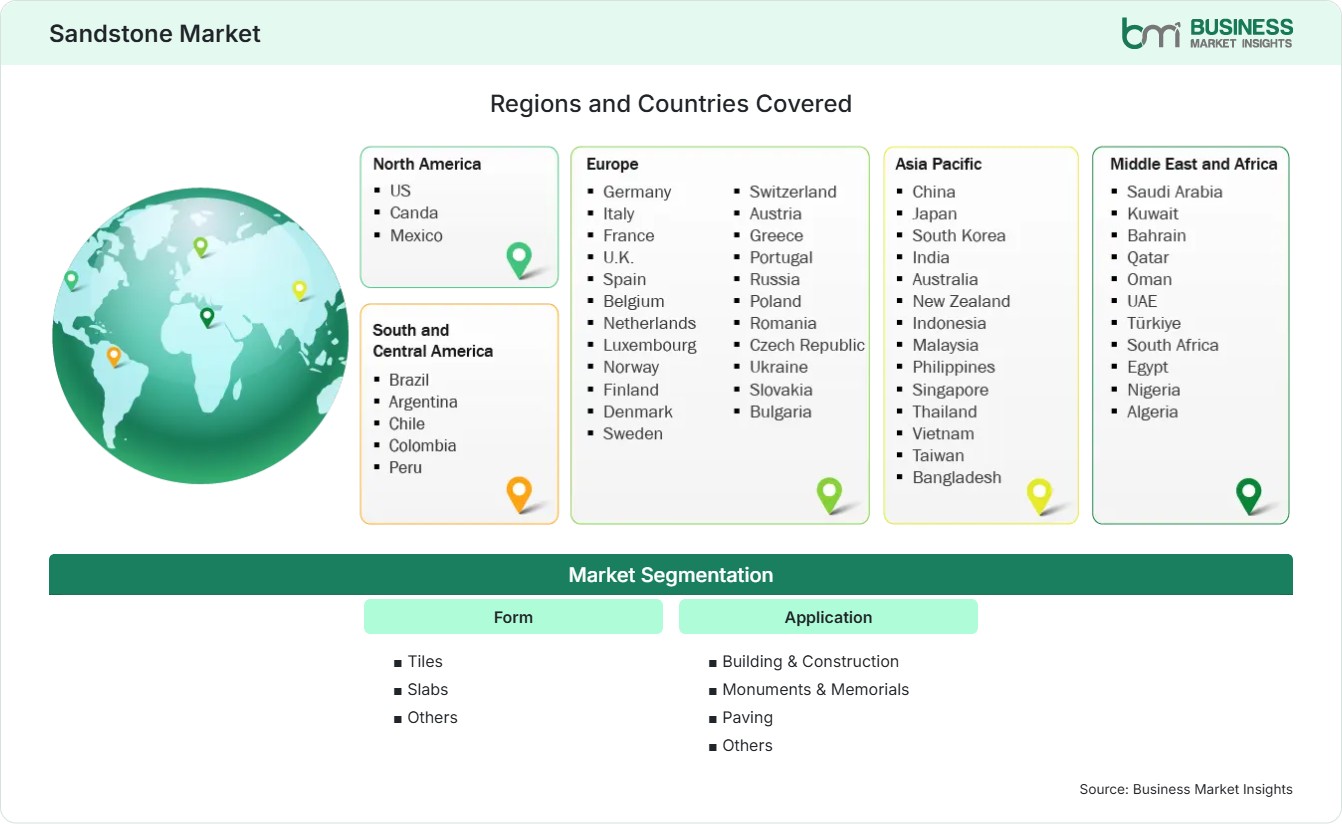
Sandstone Market Regional Highlights
North America Sandstone Market
North America holds a modeled 25%–28% share in 2025 and should expand at 4.0%–4.5% CAGR through 2033. Sandstone Market share is underpinned by renovation, building of institutions, landscape improvement, and local building materials. Specification, fabrication, and delivery are becoming significant factors in determining purchases.
- Commercial renovation favors durable exterior materials where replacement cycles and appearance retention justify premium natural-stone procurement.
- Landscape projects benefit from sandstone’s textured appearance and compatibility with steps, patios, walls, garden features, and pedestrian areas.
- Sustainability documentation strengthens local stone positioning as architects compare material provenance, transportation requirements, and lifecycle considerations.
- Digital specification libraries and samples are reducing uncertainty around color, texture, dimensions, finishes, and project suitability.
- Suppliers with quarry ownership or secure regional inventory can reduce logistics exposure and improve schedule reliability.
US Sandstone Market
The US represents a modeled 21%–24% share of global demand in 2025 and is projected to grow at 3.8%–4.3% CAGR. Sandstone Market growth can be made possible through renovation, institutional building, landscape creation, and hardscape investments, even though higher costs of financing limit some housing projects.
- Institutional projects create recurring opportunities because universities, civic buildings, cultural facilities, and memorial sites prioritize long service life and architectural continuity.
- Outdoor-living investment supports demand for pavers, steps, wall systems, pool surrounds, and landscape elements where natural texture differentiates projects.
- Domestic quarrying can shorten lead times and provide provenance advantages when imported materials face freight volatility or specification uncertainty.
- Restoration work supports specialized stone matching, especially where replacement materials must closely reproduce existing colors, grain structures, dimensions, and finishes.
Europe Sandstone Market
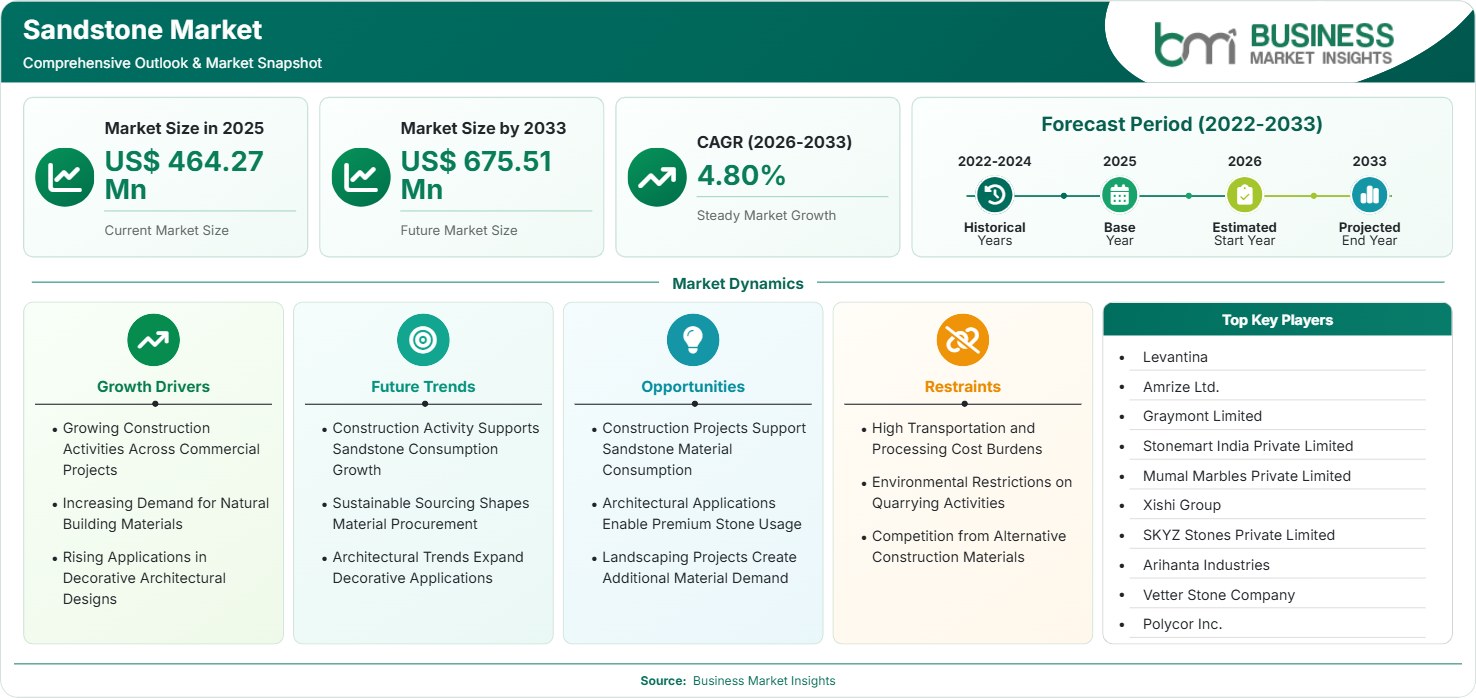
Europe accounts for a modeled 27%–30% Sandstone Market share in 2025, with a 4.3%–4.8% CAGR. Germany and Italy still represent key markets for architecture and construction, whereas Spain and Poland offer good prospects for processing and specifications. Spain is sized to grow at a 4.6%-5.0% CAGR based on the proven natural stone collection of Levantina.
- Renovation and heritage preservation favor materials capable of integrating with established architectural styles while maintaining weathering performance.
- Spain benefits from natural-stone expertise, processing infrastructure, architectural design integration, and established international distribution networks.
- Germany’s emphasis on durable construction and documented material performance supports suppliers capable of providing consistent technical specifications.
- Italy’s architectural sector favors premium surfaces where stone selection is driven by visual differentiation, finishing quality, and designer recommendations.
- Poland and Central Europe provide growth opportunities through urban redevelopment, landscaping, and expanding commercial construction activity.
Asia Pacific Sandstone Market
Asia Pacific commands a modeled 34%–37% Sandstone Market share in 2025 and is the fastest-growing region at 5.5%–6.0% CAGR. India and China lead regional demand and processing, while India is modeled at 5.8%–6.2% CAGR as quarry modernization and export capabilities expand. SKYZ Stones illustrates the region’s established export infrastructure.
- India combines extensive sandstone resources with established cutting, finishing, fabrication, domestic distribution, and export capabilities.
- China provides scale in stone processing and construction supply chains, supporting architectural, landscaping, paving, and monument applications.
- Southeast Asian hospitality projects create opportunities for premium exterior finishes, pool landscapes, courtyards, walkways, and resort architecture.
- Rising urban infrastructure spending increases demand for durable pedestrian surfaces, landscape elements, and visually differentiated public spaces.
- Export suppliers increasingly compete through calibrated products, custom finishing, packaging quality, documentation, and project-specific logistics rather than quarry access alone.
Rest of World Sandstone Market
Rest of World represents a modeled 9%–12% share in 2025 and should grow at 4.8%–5.3% CAGR. South and Central America benefit from urban development and hospitality projects, while Middle Eastern and African markets emphasize landscaping, luxury construction, and public-realm upgrades.
Brazil is modeled at 4.9%–5.3% CAGR, while the United Arab Emirates is modeled at 5.2%–5.7%, reflecting premium architectural and landscape applications.
- Latin American developers increasingly use natural stone to differentiate residential, hospitality, civic, and mixed-use developments.
- Gulf projects favor high-quality exterior stone for plazas, resorts, pathways, courtyards, and landscape environments exposed to intensive outdoor use.
- South African projects provide opportunities in commercial landscaping, institutional construction, residential architecture, and restoration-oriented applications.
- Exporters serving distant markets require stronger packaging, container planning, quality documentation, and inventory coordination to protect finished products during transit.
- Regional distributors can create value by holding multiple formats and finishes, reducing project delays caused by international lead times.