
Retro Reflective Materials Market Outlook: Size, Share, Trends, Growth Analysis, Competitive Landscape & Forecast, 2026–2033

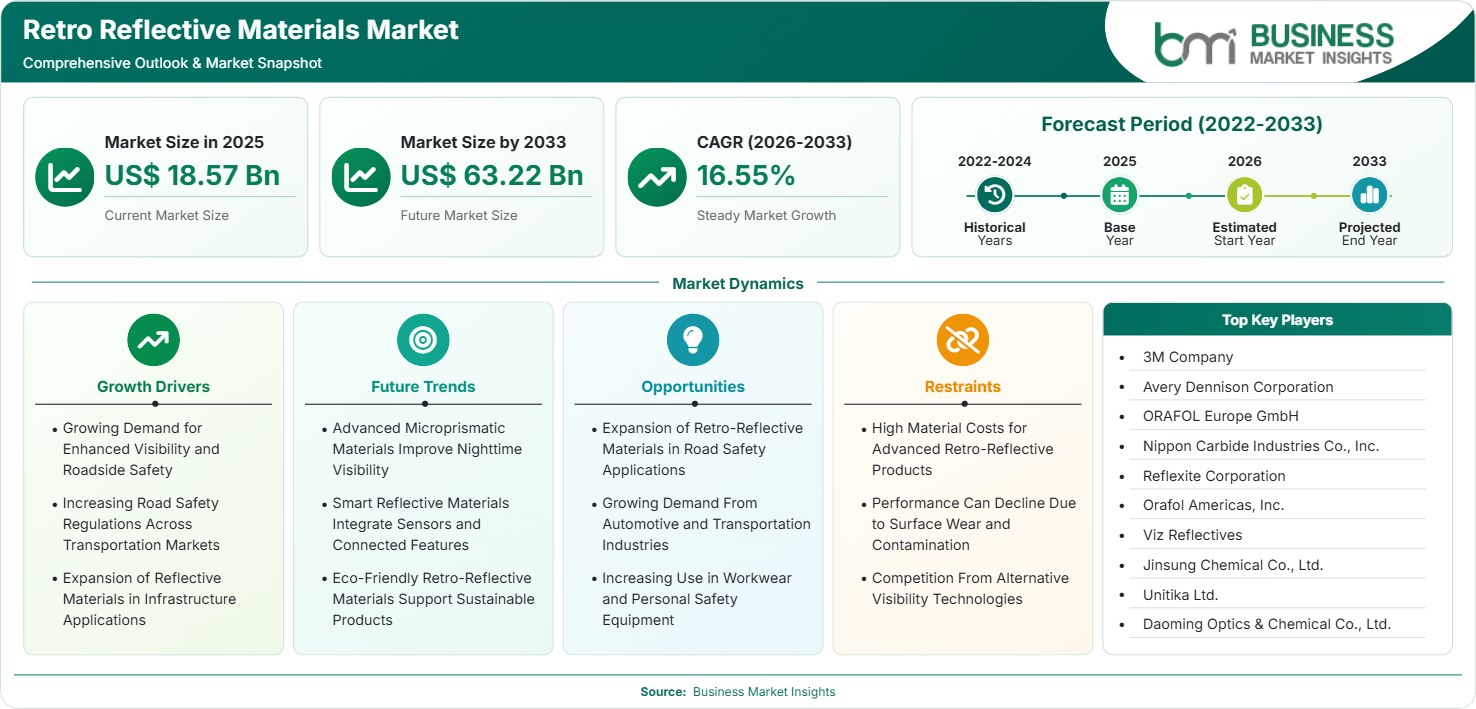
The Retro Reflective Materials Market size was valued at US$ 18.57 Billion in 2025 and is projected to reach US$ 63.22 Billion by 2033, growing at a CAGR of 16.55% during 2026–2033, driven by road safety requirements, reflective workwear demand, infrastructure upgrades, automotive visibility, and advanced material development.

Report Coverage
  • Type: Paints, Inks & Coatings, Films & Tapes, Others
  • Application: Traffic Control & Work Zone, Safety Apparel, Automotive, Industrial, Others
US$ 18.57 Bn Market size in 2025
US$ 63.22 Bn Market Size by 2033
16.55% CAGR, 2026 - 2033
2026-2033 Forecast Period

AI Overview

Retro Reflective Materials Market Summary

  • North America Region: holds Retro Reflective Materials Market share of 31%–34% in 2025, growing with a CAGR of 15.20%–16.00%, influenced by road safety standards, infrastructure maintenance, reflective workwear, and replacement demand across transportation applications. The US accounts for most regional demand, with a 15.40%–16.20% CAGR supported by highway safety programs and commercial vehicle visibility requirements.
  • Fastest Growing Region: Asia Pacific holds market share of 25%–28% in 2025, expanding at a CAGR of 18.20%–19.10%, supported by road infrastructure expansion, vehicle production, construction activity, worker safety requirements, and increasing adoption of reflective materials across transportation and industrial applications.
  • Leading Segment: Films & Tapes holds market share of 48%–52% in 2025, advancing at a CAGR of 16.80%–17.60%, supported by broad use in traffic signs, vehicle markings, infrastructure assets, work zones, and durable visibility applications requiring consistent reflective performance.
  • High Growth Segment: Automotive holds market share of 18%–21% in 2025, advancing at a CAGR of 18.00%–19.00%, supported by vehicle visibility requirements, commercial fleet safety, regulatory compliance, reflective markings, and wider integration of visibility materials into vehicle exteriors.
  • Key Market Opportunity: Road infrastructure modernization, expanding reflective workwear, vehicle safety requirements, and advanced microprismatic technologies create opportunities for suppliers offering durable, high-performance, weather-resistant visibility materials.
  • Major Market Players: 3M Company, Avery Dennison Corporation, ORAFOL Europe GmbH, Nippon Carbide Industries Co., Inc., Reflexite Corporation, Orafol Americas, Inc., Viz Reflectives, Jinsung Chemical Co., Ltd., Unitika Ltd., Daoming Optics & Chemical Co., Ltd.
Strategic Insights

Retro Reflective Materials Market: Strategic Insights

Retro Reflective Materials Market Strategic Framework
FREE PDF
Request your free sample
Request free sample
Stakeholder View

Key Takeaways

  • There is a move towards integrated material solutions that involve reflective films, adhesives, coatings, substrates, printing methods and converting capabilities to give suppliers the ability to cater to complete visibility needs rather than just material needs.
  • Films and tapes have the most comprehensive commercial potential since they are able to cater to traffic signs, vehicle marking, work zone, industrial asset, and safety markets.
  • Product development is moving toward microprismatic structures, improved optical performance, thinner constructions, stronger adhesives, better weather resistance, and materials designed for longer outdoor service conditions.
  • Asia Pacific provides the strongest expansion opportunity as infrastructure construction, vehicle production, urban transportation, industrial employment, and road safety requirements increase demand for reflective products.
  • Competitive activity is increasingly influenced by acquisitions, production investments, regional expansion, technology development, and partnerships that strengthen access to reflective material customers and application-specific markets.
  • Suppliers with strong optical engineering, reliable raw material sourcing, application testing, regulatory knowledge, and regional manufacturing capabilities are better positioned to manage performance requirements and capture recurring replacement demand.
Geographic Outlook

Retro Reflective Materials Market Regional Highlights

North America Retro Reflective Materials Market

North America Retro Reflective Materials Market represents 31%–34% share in 2025 and is projected to grow at a CAGR of 15.20%–16.00% through 2033. Transportation safety experience, highway management, construction, commercial trucking, and workplace safety regulations have been implemented within the region. The US is the primary regional market, whereas Canada makes up additional demand due to its infrastructure and industrial applications. Durability, light transmission, adhesion qualities, protection from the weather, and specific application regulations are the most important criteria for customers.

  • Road maintenance and work-zone safety programs sustain demand for reflective films, tapes, markings, and coatings used on signs, barriers, vehicles, and temporary traffic equipment.
  • Commercial vehicle operators increasingly use reflective markings to improve vehicle conspicuity, particularly across fleets operating at night, on highways, and within construction environments.
  • Infrastructure replacement creates recurring demand because outdoor reflective materials experience exposure to ultraviolet radiation, moisture, temperature changes, dirt, and mechanical wear.
  • Industrial safety applications broaden demand beyond transportation, particularly across warehouses, construction sites, utilities, logistics operations, and heavy equipment environments.

US Retro Reflective Materials Market

The US Retro Reflective Materials Market accounts for 80%–84% of North American demand and is expected to grow at a CAGR of 15.40%–16.20% through 2033. Demand is supported by transportation infrastructure, work-zone safety, commercial vehicle visibility, occupational protection, and replacement requirements. Highway agencies and private operators require materials capable of maintaining visibility under nighttime and adverse-weather conditions.

  • Roadside signs, barriers, channelization devices, and pavement-related visibility applications remain important outlets for reflective materials across transportation infrastructure.
  • Commercial trucks, trailers, emergency vehicles, and utility fleets provide recurring demand for reflective markings that improve visibility and support operational safety.
  • Construction and industrial employers increasingly use reflective materials within garments, equipment markings, warning products, and site-management systems.

Europe Retro Reflective Materials Market

Europe Retro Reflective Materials Market holds 24%–27% share in 2025 and is forecast to expand at a CAGR of 14.80%–15.70% through 2033. Germany, France, the UK, Italy, and Spain represent major demand centers because of established transportation infrastructure and industrial safety practices. Germany is projected to grow at 15.00%–15.80%, while Poland records a faster 16.40%–17.30% trajectory. Product demand remains concentrated in road safety, workwear, commercial vehicles, and industrial visibility applications.

  • Germany provides a strong base for reflective material suppliers through its automotive manufacturing ecosystem, industrial activity, transportation infrastructure, and established safety-product distribution.
  • The UK continues to support demand through road maintenance, work-zone management, safety apparel, commercial transport, and infrastructure visibility requirements.
  • France offers opportunities across transportation infrastructure and occupational safety, with demand supported by public works and replacement of outdoor visibility products.
  • Poland represents a faster-growth European market as transportation infrastructure, logistics activity, industrial production, and construction investments expand demand for reflective solutions.

Asia Pacific Retro Reflective Materials Market

Asia Pacific represents 25%–28% share in 2025 and records the fastest regional growth at 18.20%–19.10% CAGR through 2033. China, Japan, India, South Korea, and Southeast Asian markets support demand through infrastructure construction, vehicle production, logistics, manufacturing, and worker safety. India is projected to grow at 19.00%–20.00%, while China remains the leading market by consumption.

  • China has vast networks of transportation, automobile production, industry, and infrastructure, which creates demand for reflective films, tapes, coatings, and other visibility products.
  • India provides an excellent growth opportunity as there is increased demand for visibility products due to road construction, commercial transportation, industrial employment, and safety procedures.
  • Japan provides an already existing demand for high-quality reflective materials for transportation, automotive, industrial and safety use that have consistent optical properties.
  • Southeast Asian markets are gaining importance as logistics networks, construction activity, manufacturing facilities, and urban infrastructure expand across major economies.

Rest of World Retro Reflective Materials Market

Rest of World accounts for 15%–18% share in 2025 and is projected to grow at a CAGR of 13.80%–14.70% through 2033. South and Central America are supported by transportation infrastructure, mining, construction, commercial fleets, and worker safety requirements. Brazil and Mexico are leading markets, while Colombia and Chile provide additional opportunities as infrastructure and industrial activity develop.

Middle East and Africa demand is supported by road construction, logistics, oil and gas operations, mining, industrial projects, and occupational safety requirements. Saudi Arabia and the UAE lead regional demand, while South Africa remains an important industrial and mining market. Suppliers offering durable materials suited to heat, dust, ultraviolet exposure, and outdoor environments have stronger application potential.

  • Brazil provides demand across road infrastructure, logistics, construction, industrial facilities, and commercial transportation, creating opportunities for reflective films and safety products.
  • Mexico benefits from automotive manufacturing, logistics operations, industrial facilities, and transportation infrastructure, supporting recurring demand for vehicle and work-zone visibility products.
  • Saudi Arabia offers opportunities through infrastructure development, construction activity, transportation projects, and industrial operations requiring durable outdoor visibility solutions.
  • South Africa supports demand through mining, logistics, construction, and road transportation, where worker and equipment visibility remains an important operational requirement.

Global Market Geography
FREE PDF
Request your free sample
Request free sample
Segment Analysis

Retro Reflective Materials Market Segmentation

Type

Films & Tapes lead with 48%–52% share in 2025 and are projected to grow at a CAGR of 16.80%–17.60% through 2033. Their broad application range, installation flexibility, strong visibility, and suitability for vehicle markings, signs, work zones, and safety products support continued adoption. The Retro Reflective Materials Market scope increasingly favors durable film constructions.

  • Paints, Inks & Coatings: Reflective coatings support signs, road markings, industrial surfaces, and specialized visibility applications where direct application to substrates provides practical installation flexibility.
  • Films & Tapes: Films and tapes provide adaptable reflective surfaces for signs, vehicles, barriers, equipment, and apparel, supported by strong adhesion and straightforward converting requirements.

Application

Traffic Control & Work Zone applications account for 38%–42% share in 2025 and are expected to grow at a CAGR of 16.00%–16.80% through 2033. Infrastructure maintenance, road construction, temporary traffic management, and nighttime visibility requirements support demand. Safety apparel, automotive, and industrial uses broaden the application base across commercial and institutional buyers.

  • Traffic Control & Work Zone: Reflective materials improve visibility of signs, barriers, cones, channelization equipment, and temporary work-zone assets during nighttime and low-visibility conditions.
  • Safety Apparel: Reflective films and tapes support high-visibility garments used by construction, transportation, logistics, utility, and industrial workers operating around vehicles and machinery.
  • Automotive: Vehicle markings and reflective components improve conspicuity, particularly for commercial fleets, trailers, emergency vehicles, and vehicles operating in low-light environments.
  • Industrial: Reflective materials support equipment identification, hazard marking, warehouse safety, facility navigation, and visibility requirements across industrial workplaces.
Market Forces

Retro Reflective Materials Market Dynamics

Key Market Drivers

Growing Demand for Enhanced Visibility and Roadside Safety

The need for visibility of objects on the transportation infrastructure is resulting in high demands for materials, which can be detected in the night and during poor weather conditions. Reflective films, tapes, coatings, and markings aid in ensuring that there is improved visibility of road signs, barriers, vehicles, and work zone equipment. Growth in the market for Retro Reflective Materials is being aided by the need for maintenance and replacement of infrastructure due to the fact that products outside lose their performance after time due to weathering and other factors.

Increasing Road Safety Regulations Across Transportation Markets

Road safety requirements have been pushing transportation agencies, fleet management companies, and construction firms to adopt more conspicuous signs, markings, vehicles, and equipment. The specifications set out in regulations affect the choice of material as they determine optical, durability, color retention, and application standards. They decrease reliance on low-performing materials in critical safety applications and make those firms that are good at conducting tests more competitive. Commercial vehicles need to remain conspicuous as they move along highways, construction sites, ports, and logistics centers.

Expansion of Reflective Materials in Infrastructure Applications

Infrastructure development is widening the use of reflective materials beyond conventional traffic signs. Construction barriers, temporary traffic systems, roadside equipment, utility assets, transportation facilities, and industrial infrastructure require clear visual identification in low-light environments. Reflective films and tapes offer practical solutions because they can be converted into different shapes and applied to multiple substrates. Growing urban development also increases the volume of infrastructure requiring nighttime visibility and maintenance. The Retro Reflective Materials Market trends increasingly favor materials capable of serving both temporary and permanent infrastructure requirements while maintaining optical performance throughout their intended service period.

Key Market Opportunities

Expansion of Retro-Reflective Materials in Road Safety Applications

Road safety remains the largest commercial opportunity because transportation infrastructure requires continuous visibility across signs, barriers, markings, vehicles, and work zones. Suppliers can capture additional value through higher-performance films, durable adhesives, improved weather resistance, and application-specific constructions. Road authorities and contractors also require materials that simplify installation and reduce maintenance frequency. The Retro Reflective Materials Market Forecasts point toward sustained demand from infrastructure investment, especially where road construction is combined with stronger safety specifications and increased attention to nighttime visibility.

Growing Demand from Automotive and Transportation Industries

Automotive and transportation applications provide an expanding opportunity as commercial fleets, trailers, emergency vehicles, buses, and specialized vehicles require stronger conspicuity. Reflective films and tapes can be integrated into vehicle markings without major structural changes, allowing operators to improve visibility while maintaining practical maintenance procedures. Growth in logistics and freight movement also increases the installed base of vehicles operating during nighttime and adverse conditions.

Increasing Use in Workwear and Personal Safety Equipment

Occupational safety provides another growth avenue as construction, logistics, utilities, road maintenance, mining, and industrial operations require workers to remain visible around moving equipment. Reflective films and tapes can be incorporated into jackets, trousers, vests, helmets, bags, and specialized protective equipment. Product development is moving toward flexible constructions that tolerate repeated movement, washing, abrasion, and outdoor exposure. Suppliers can expand their opportunity by developing materials compatible with different garment substrates and manufacturing processes.

Market Restraints and Challenges

High Material Costs for Advanced Retro-Reflective Products

Factor: Advanced microprismatic structures, optical films, specialty adhesives, precision coatings, and controlled manufacturing processes increase production costs compared with conventional visibility materials. Impact: Higher product prices can restrict adoption among price-sensitive contractors, infrastructure buyers, smaller fleet operators, and low-margin industrial customers. The cost challenge becomes more important when procurement decisions emphasize initial purchase price rather than total service life. Premium materials can deliver stronger optical performance and durability, but buyers may select lower-cost alternatives when application requirements are less demanding.

Performance Can Decline Due to Surface Wear and Contamination

Factor: Reflective surfaces can experience optical deterioration from dirt, dust, abrasion, moisture, ultraviolet exposure, chemical contact, and repeated mechanical handling. Impact: Reduced reflectivity can shorten product service life and increase replacement or maintenance requirements, particularly in outdoor transportation and industrial environments. Improving resistance to contamination and wear remains essential for reducing lifecycle costs and maintaining buyer confidence.

Company Analysis

Competitive Landscape

The Retro Reflective Materials Market analysis highlights the competition among reflective films, reflective tapes, coatings, micro prismatic technology, optics materials, adhesives, and specific applications. The leading companies in the market compete on the basis of product durability, optics, production scale, geographical presence, product customizing and development of transportation and industrial materials.

Company Name

Overview

Products and Services relevant to this market

3M Company

Diversified technology company with extensive materials expertise and established visibility solutions for transportation, infrastructure, and occupational safety.

Retroreflective films, tapes, sheeting, vehicle markings, traffic-control materials, and high-visibility safety solutions.

Avery Dennison Corporation

Global materials company with strong positions in pressure-sensitive materials, graphics, transportation, and reflective applications.

Reflective films, vehicle marking materials, traffic signage products, graphic films, and pressure-sensitive solutions.

ORAFOL Europe GmbH

Specialty materials manufacturer focused on adhesive films, reflective products, graphics, and transportation-related applications.

ORALITE reflective films, reflective tapes, traffic signage materials, vehicle markings, and specialty adhesive products.

Nippon Carbide Industries Co., Inc.

Chemical and materials producer with established capabilities in reflective sheet technologies and functional material development.

Reflective sheeting, optical materials, resin technologies, and products for transportation and safety applications.

Reflexite Corporation

Reflective technology specialist associated with advanced microprismatic constructions for visibility and safety applications.

Microprismatic reflective sheeting, vehicle markings, safety materials, and transportation visibility products.

Orafol Americas, Inc.

North American business serving customers with reflective films, graphics, and specialty adhesive materials.

Reflective films, traffic signage products, vehicle marking solutions, tapes, and application-specific visibility materials.

Viz Reflectives

Reflective materials specialist supplying visibility products for workwear, transportation, and safety applications.

Reflective fabrics, tapes, trims, transfer materials, and solutions for high-visibility apparel and equipment.

Jinsung Chemical Co., Ltd.

Chemical materials company serving reflective and specialty material applications through manufacturing and product development capabilities.

Reflective films, coatings, optical materials, and specialty chemical solutions for visibility applications.

Unitika Ltd.

Japanese materials company with polymer, film, and functional material capabilities supporting specialty industrial applications.

Functional films, polymer materials, specialty substrates, and reflective material-related technologies.

Daoming Optics & Chemical Co., Ltd.

Chinese reflective materials manufacturer focused on transportation safety, optical films, and reflective product development.

Microprismatic reflective films, vehicle markings, traffic safety materials, reflective sheeting, and optical films.

Trust & Transparency

Research Methodology

The market analysis combines proprietary research with secondary data from government agencies, company disclosures, regulatory filings, industry databases and expert interviews. Market estimates are validated through data triangulation, cross-market benchmarking and analyst review.

View Full Research Methodology

Questions Answered

Frequently Asked Questions

Where is the strongest opportunity for manufacturers over the forecast period?

Asia Pacific offers the strongest expansion potential because infrastructure development, vehicle production, logistics, construction, and industrial safety requirements are expanding simultaneously, creating demand across multiple reflective material applications.

How does climate affect reflective material performance in Retro Reflective Materials Market report?

Ultraviolet radiation, heat, moisture, dust, freezing conditions, and chemical exposure can affect optical performance and adhesion. Product specifications therefore need to match the environmental conditions of the intended application.

Which customers generate recurring demand for reflective materials?

Road agencies, contractors, fleet operators, safety-product manufacturers, industrial facilities, and workwear producers generate recurring demand through infrastructure replacement, vehicle refurbishment, safety equipment replenishment, and ongoing maintenance.

Why are microprismatic products gaining commercial importance?

Microprismatic structures can provide strong retroreflection within compact constructions, supporting applications where visibility, material efficiency, durability, and product thickness need to be balanced.

What factors determine the selection of a retro-reflective material?

Selection depends on optical performance, substrate compatibility, adhesion, weather resistance, flexibility, durability, installation method, and the operating environment.

Access the Full Retro Reflective Materials Market Report

Get segment-level forecasts, regional estimates, competitive benchmarking, company profiles and downloadable Excel datasets.

Access the full Retro Reflective Materials Market Report
350 pages PDF & Excel | 2026-08-19
Similar Research

Related Market Reports