
Refractories Market Outlook: Size, Share, Trends, Growth Analysis, Competitive Landscape & Forecast, 2022-2033

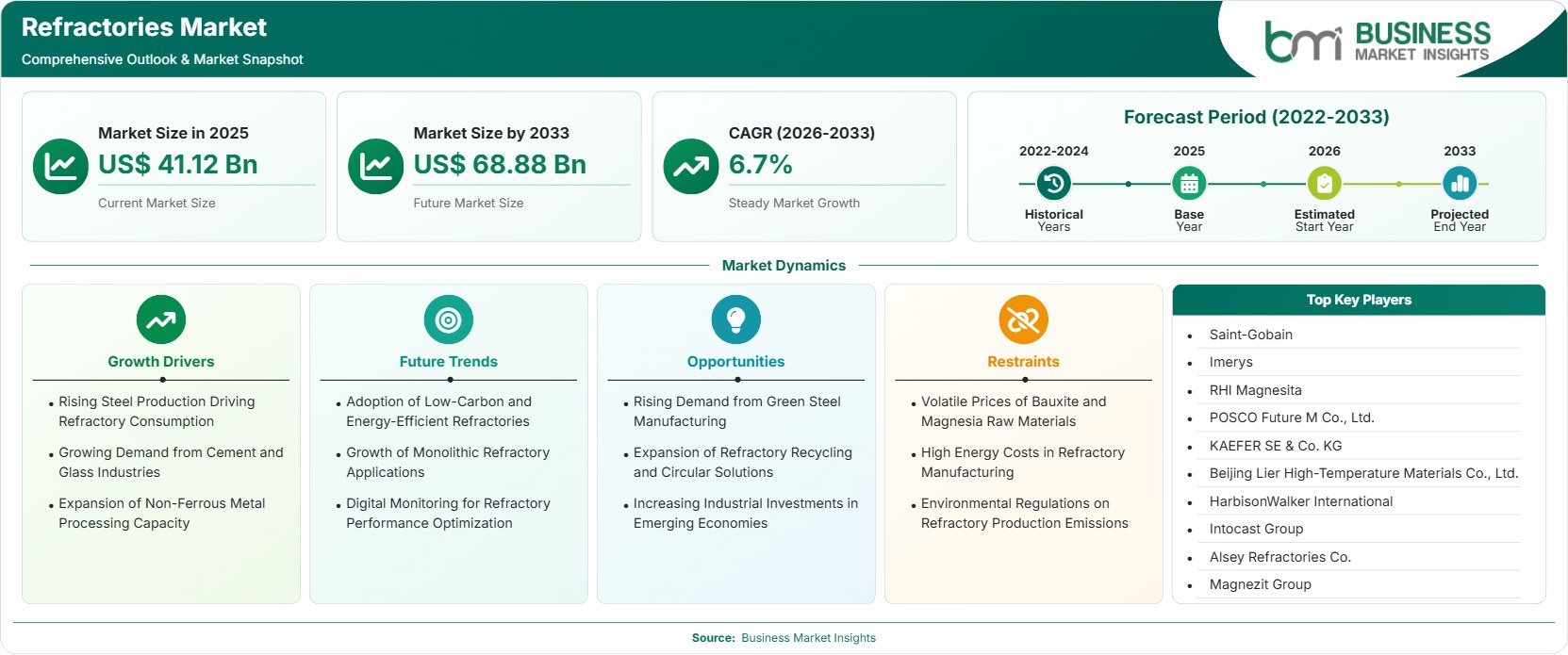
The Refractories Market size was valued at US$ 41.12 Billion in 2025 and is projected to reach US$ 68.88 Billion by 2033, growing at a CAGR of 6.66% during 2026–2033. Rising steel production, increasing industrialization, growing infrastructure investments, and expanding demand for high-temperature industrial processes are supporting market growth. Opportunities are emerging from energy-efficient refractory technologies, monolithic product adoption, and modernization of industrial production facilities.

Report Coverage
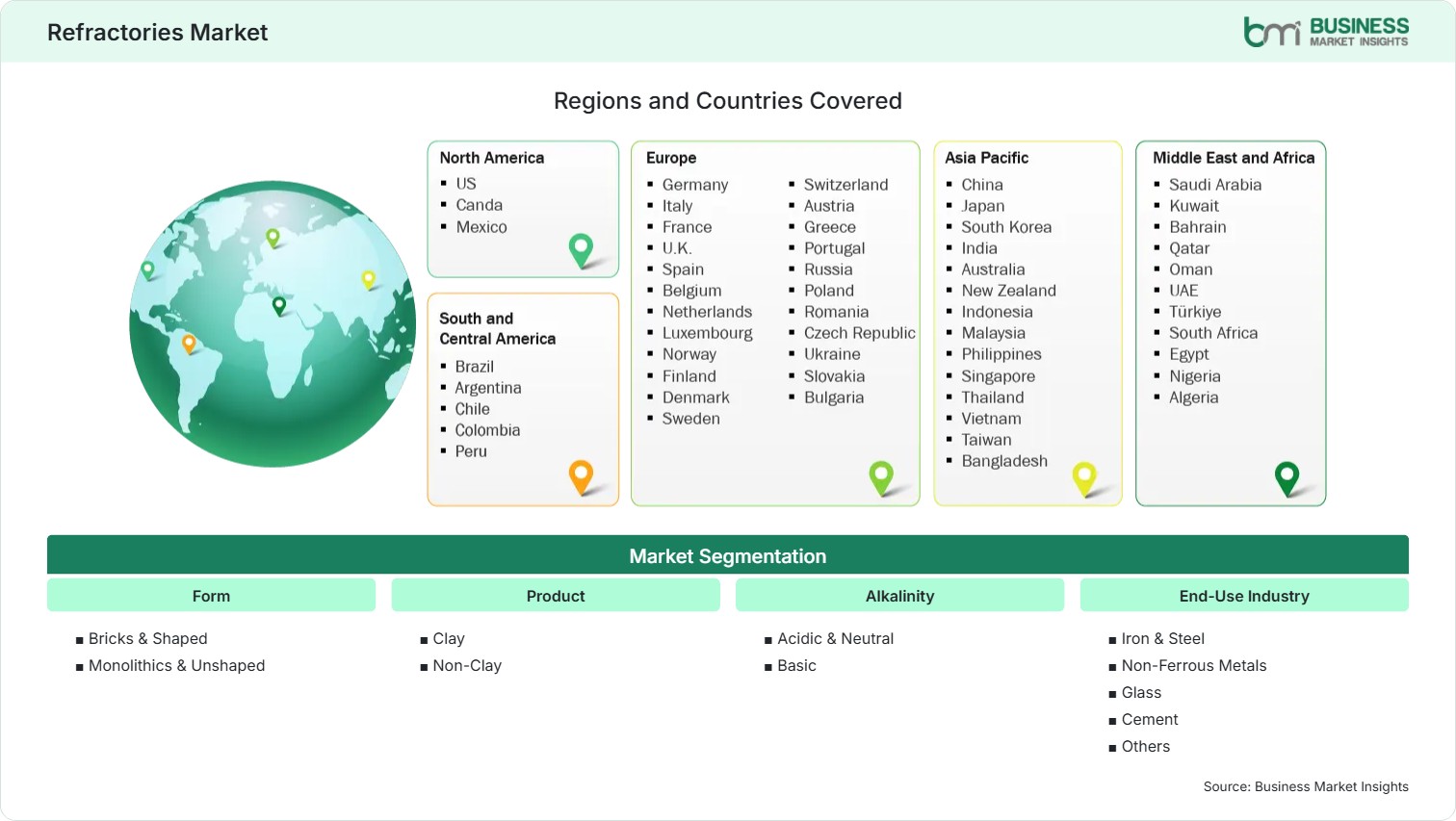
  • Form: Bricks & Shaped, Monolithics & Unshaped
  • Product: Clay, Non-Clay
  • Alkalinity: Acidic & Neutral, Basic
  • End-Use Industry: Iron & Steel, Non-Ferrous Metals, Glass, Cement, Others
US$ 41.12 Bn Market size in 2025
US$ 68.88 Bn Market Size by 2033
6.7% CAGR, 2026 - 2033
2026-2033 Forecast Period

01 AI Overview

Refractories Market Summary

  • North America Region: North America holds a refractories market share of 17%–20% in 2025 and is projected to grow at a CAGR of 6.0%–7.0% during 2026–2033. Demand is supported by industrial modernization, steel production activities, and investments in manufacturing infrastructure. The US market is projected to grow at a CAGR of 6.2%–7.2% through 2033.
  • Fastest Growing Region: Asia Pacific accounts for 45%–48% share in 2025 and is expected to grow at a CAGR of 7.2%–8.2% during the forecast period. Rapid industrialization, expanding steel production, and infrastructure development continue driving regional growth.
  • Leading Segment: Bricks & Shaped Refractories represent 54%–57% share in 2025 and are projected to grow at a CAGR of 6.3%–7.3% through 2033. Their widespread use across steel, cement, and glass manufacturing industries continues supporting market leadership.
  • High Growth Segment: Monolithics & Unshaped Refractories hold 43%–46% share in 2025 and are projected to grow at a CAGR of 7.5%–8.5% during 2026–2033. Their ease of installation, reduced maintenance requirements, and enhanced operational efficiency are accelerating adoption.
  • Key Market Opportunity: Growing adoption of advanced refractory solutions designed to improve energy efficiency, reduce downtime, and enhance furnace lifespan is creating significant opportunities across industrial sectors.
  • Major Market Players: Saint-Gobain, Imerys, RHI Magnesita, POSCO Future M Co., Ltd., KAEFER SE & Co. KG, Beijing Lier High-Temperature Materials Co., Ltd., HarbisonWalker International, Intocast Group, Alsey Refractories Co., and Magnezit Group.
02 Strategic Insights

Refractories Market: Strategic Insights

Refractories Market Strategic Framework
FREE PDF
Request your free sample
Request free sample
03 Stakeholder View

Key Takeaways

  • Bricks & Shaped products remain the largest segment due to extensive utilization in steelmaking, cement manufacturing, and glass production.
  • Monolithic refractories represent the fastest-growing segment due to installation flexibility and improved operational efficiency.
  • Asia Pacific remains the dominant regional market supported by large-scale industrial production and infrastructure development.
  • The iron & steel industry continues to account for the largest share of refractory consumption globally.
  • Manufacturers are increasingly focusing on durable, energy-efficient, and environmentally sustainable refractory solutions.
  • Industrial modernization programs are generating replacement demand for advanced refractory materials.
  • The market analysis highlights increasing opportunities in high-performance non-clay refractory products.
  • Automation and digital monitoring technologies are supporting more efficient refractory maintenance strategies.
  • Demand for longer-lasting refractory linings is increasing as industries seek to minimize downtime and maintenance costs.
  • The Refractories Market forecast remains favorable due to steady growth across core industrial and infrastructure sectors.
04 Geographic Outlook

Refractories Market Regional Highlights

North America Refractories Market

North America accounted for a 17%–20% share in 2025 and is projected to expand at a CAGR of 6.0%–7.0% during 2026–2033. The region benefits from ongoing industrial modernization, strong steel production activities, growing infrastructure investments, and increasing focus on energy-efficient manufacturing operations. The Refractories Market share remains supported by replacement demand from aging industrial facilities and continuous upgrades across metals, glass, and cement industries.

  • Steel manufacturers are increasingly investing in advanced refractory solutions to improve furnace performance, enhance productivity, and reduce maintenance-related downtime.
  • Industrial operators are prioritizing energy-efficient production processes, increasing demand for high-performance refractory linings with improved thermal insulation properties.
  • The cement and glass sectors continue generating steady consumption through plant modernization and capacity expansion projects.
  • Manufacturers are adopting advanced monitoring technologies to optimize refractory performance and maintenance planning.
  • Demand for premium refractory materials is rising as industrial facilities seek longer service life and lower lifecycle costs.

US Refractories Market

The US represented a 14%–17% share in 2025 and is estimated to grow at a CAGR of 6.2%–7.2% through 2033. Strong industrial activity, increasing infrastructure development, and continuous investments in steel and manufacturing operations support market expansion. The Refractories Market growth in the US is driven by modernization of production facilities, growing demand for durable furnace linings, and increasing focus on operational efficiency.

  • Steel producers are adopting advanced refractory technologies to support higher production efficiency and equipment reliability.
  • Glass and cement manufacturers continue investing in plant upgrades that require replacement and installation of new refractory systems.
  • Energy-intensive industries are focusing on refractory solutions that support fuel savings and emissions reduction.
  • Growing industrial automation is encouraging adoption of specialized refractory products optimized for high-performance manufacturing environments.

Europe Refractories Market

Europe held a 22%–25% share in 2025 and is expected to grow at a CAGR of 5.8%–6.8% from 2026–2033. Germany, France, and Italy represent major markets due to significant industrial manufacturing activities, strong metallurgical sectors, and increasing sustainability initiatives. Germany is estimated to expand at 6.3%–7.3% CAGR, supported by industrial modernization and demand for high-performance materials.

  • Steel and non-ferrous metal industries continue driving significant demand for advanced refractory products capable of supporting high-temperature operations.
  • Germany is witnessing increased adoption of energy-efficient refractory systems aligned with industrial sustainability goals.
  • Industrial operators are replacing conventional materials with advanced solutions offering longer durability and improved thermal performance.
  • Glass manufacturing facilities continue investing in high-quality refractory linings to improve operational reliability.
  • Environmental regulations are encouraging development and adoption of more sustainable refractory products and production processes.

Asia Pacific Refractories Market

Asia Pacific accounted for a 45%–48% share in 2025 and is projected to register a CAGR of 7.2%–8.2% during 2026–2033. China, India, Japan, and South Korea are leading markets due to rapid industrialization, large-scale steel production, infrastructure development, and expanding manufacturing activities. China is expected to grow at 7.5%–8.5% CAGR, while India demonstrates strong growth potential with a CAGR of 7.8%–8.8% during the forecast period.

  • Large-scale steel production activities continue generating substantial demand for refractory materials across the region.
  • China remains the largest consumer due to extensive industrial infrastructure and ongoing capacity upgrades.
  • India is witnessing increasing demand from steel, cement, and glass industries supported by infrastructure investments.
  • Industrial expansion across Southeast Asia is creating new opportunities for refractory manufacturers and suppliers.
  • Growing focus on manufacturing efficiency is increasing adoption of advanced monolithic and non-clay refractory solutions.

Rest of World Refractories Market

Rest of World accounted for a 12%–15% share in 2025 and is expected to grow at a CAGR of 6.0%–7.0% through 2033. Latin America, the Middle East, and Africa are witnessing growing demand driven by infrastructure projects, industrial development, and expansion of metals and cement production facilities. Brazil, Saudi Arabia, and South Africa represent important growth markets for refractory suppliers.

  • Infrastructure and construction activities are supporting increased cement production and associated refractory consumption.
  • Saudi Arabia is investing in industrial diversification initiatives that are creating demand for advanced high-temperature materials.
  • Mining and metals industries across Africa continue supporting steady consumption of refractory products.
  • Industrial modernization projects in Latin America are generating replacement demand for durable refractory systems.
  • Regional manufacturers are focusing on cost-effective and high-performance products to address expanding industrial requirements.
Global Market Geography
FREE PDF
Request your free sample
Request free sample
05 Segment Analysis

Refractories Market Segmentation

Form

Form-based segmentation remains an important factor influencing refractory selection across industrial applications. Product performance requirements, installation flexibility, maintenance schedules, and operating conditions determine demand across different refractory forms. Bricks & Shaped Refractories accounted for 54%–57% share in 2025 and are projected to grow at a CAGR of 6.3%–7.3% through 2033 due to their extensive utilization in steel, cement, glass, and non-ferrous metal production facilities.

  • Bricks & Shaped: This segment dominates the refractories market owing to its high structural strength, established usage patterns, and suitability for furnaces, kilns, converters, and ladles operating under extreme temperatures. Strong demand from steel plants continues supporting segment leadership.
  • Monolithics & Unshaped: The fastest-growing segment, projected to expand at a CAGR of 7.5%–8.5% through 2033. These products provide easier installation, lower maintenance requirements, reduced downtime, and greater flexibility in complex industrial environments.

Product

Product segmentation reflects differences in raw material composition, thermal resistance, and industrial applicability. Clay Refractories represented 51%–54% share in 2025 and are expected to grow at a CAGR of 6.0%–7.0% through 2033 due to cost-effectiveness and widespread industrial usage.

  • Clay: Widely used across cement, glass, and general industrial applications because of their affordability, availability, and reliable thermal performance under moderate operating conditions.
  • Non-Clay: Expected to register stronger growth with a CAGR of 7.2%–8.2% through 2033. These include high-performance materials such as magnesia, alumina, zirconia, and silicon carbide-based products designed for demanding industrial processes requiring superior durability and chemical resistance.

Alkalinity

Alkalinity classification significantly influences refractory selection depending on furnace chemistry, operating temperature, and process requirements. Acidic & Neutral Refractories held 57%–60% share in 2025 and are projected to expand at a CAGR of 6.2%–7.2% during the forecast period.

  • Acidic & Neutral: These refractories are broadly utilized in glass furnaces, cement kilns, boilers, and numerous industrial processing units due to their versatility and compatibility with diverse operating environments.
  • Basic: Growing steadily as steelmakers increasingly utilize basic oxygen furnaces and electric arc furnaces requiring enhanced resistance to alkaline slags and corrosive process conditions.

End-Use Industry

Demand patterns are heavily influenced by industrial production levels, infrastructure investment, and manufacturing activity. Iron & Steel accounted for 61%–64% share in 2025 and is projected to grow at a CAGR of 6.5%–7.5% through 2033, maintaining its position as the largest consumer of refractory products globally.

  • Iron & Steel: The leading segment due to extensive refractory usage in blast furnaces, converters, electric arc furnaces, ladles, and continuous casting systems. Rising steel production continues driving demand.
  • Non-Ferrous Metals: Supported by expanding aluminum, copper, zinc, and nickel production activities across global industrial markets.
  • Glass: Demand remains strong due to increasing production of architectural glass, automotive glass, containers, and specialty glass products requiring high-performance furnace linings.
  • Cement: Growth is driven by increasing infrastructure development, construction activity, and capacity expansion projects across emerging economies.
  • Others: Includes petrochemicals, ceramics, power generation, incineration systems, and other high-temperature industrial operations requiring specialized refractory solutions.
06 Market Forces

Refractories Market Dynamics

Key Market Drivers

Rising Steel Production Driving Refractory Consumption

The steel industry remains the largest consumer of refractory materials due to the extensive use of high-temperature furnaces, ladles, converters, and continuous casting systems. With rising global demand for steel production due to its use in building construction, automobile manufacturing, and machinery manufacturing, there is an ever-increasing demand for refractories as well. Modern-day steel plants need high-tech refractories that can withstand harsh temperatures and mechanical pressures. Producers are increasingly adopting high-performance materials that offer longer service life, reduced maintenance requirements, and improved productivity. Capacity expansion projects, modernization of existing steel facilities, and rising production volumes are expected to sustain strong demand for refractory products over the forecast period.

Growing Demand from Cement and Glass Industries

Cement and glass manufacturing processes rely heavily on refractory linings to maintain operational stability under continuous high-temperature conditions. Growing construction activity, urbanization, and infrastructure development projects are increasing cement demand worldwide, while the glass industry continues expanding to serve construction, automotive, consumer goods, and packaging applications. These industries require durable refractory materials capable of providing thermal insulation, corrosion resistance, and operational reliability. Manufacturers are increasingly investing in advanced products that improve furnace performance and reduce energy consumption. The ongoing expansion of cement kilns and glass production facilities is creating consistent demand for refractory solutions across global refractories market.

Expansion of Non-Ferrous Metal Processing Capacity

Increasing production of aluminum, copper, nickel, zinc, and other non-ferrous metals is generating additional demand for refractory materials across smelting, refining, and processing operations. The growth of renewable energy systems, electric vehicles, power transmission infrastructure, and advanced manufacturing industries is driving consumption of these metals globally. Non-ferrous metal producers require specialized refractory products capable of resisting aggressive chemical environments and extreme operating temperatures. Investments in new smelting facilities, processing capacity expansions, and modernization projects are contributing to greater refractory consumption. As global demand for strategic and industrial metals continues increasing, refractory suppliers are expected to benefit from expanding opportunities within the non-ferrous metals sector.

Key Market Opportunities

Rising Demand from Green Steel Manufacturing

The transition toward lower-carbon steel production presents significant opportunities for refractory manufacturers. Steel producers are increasingly adopting emerging technologies such as hydrogen-based reduction, electric arc furnace operations, and other low-emission manufacturing processes aimed at reducing environmental impact. These technologies require advanced refractory systems capable of operating under new process conditions while maintaining efficiency and durability. Companies that develop innovative refractory materials tailored to green steel applications can benefit from increasing industry investments in decarbonization initiatives. The evolution of sustainable steelmaking technologies is expected to create a new generation of demand for high-performance refractory products.

Expansion of Refractory Recycling and Circular Solutions

Sustainability objectives and resource conservation efforts are encouraging increased adoption of refractory recycling practices. Industrial operators are seeking ways to recover valuable materials from spent refractories and reduce waste generation while lowering procurement costs. Recycling technologies enable the reuse of certain refractory materials in new production processes, supporting circular economy goals and improving resource efficiency. Manufacturers are investing in collection, processing, and recycling capabilities to address growing customer interest in sustainable solutions. The expansion of refractory recycling programs is expected to create new business opportunities while improving environmental performance across the refractories market.

Increasing Industrial Investments in Emerging Economies

Emerging economies continue investing heavily in manufacturing, infrastructure, metals production, cement capacity, and industrial development projects. These investments are creating significant opportunities for refractory suppliers serving high-temperature industrial operations. Rapid industrialization across Asia, the Middle East, Africa, and parts of Latin America is increasing demand for steel plants, cement facilities, glass manufacturing operations, and non-ferrous metal processing infrastructure. As industrial capacity expands, consumption of refractory products is expected to rise steadily. Companies with strong regional distribution networks and cost-effective product portfolios are well positioned to capitalize on these growth opportunities.

Market Restraints and Challenges

Volatile Prices of Bauxite and Magnesia Raw Materials

Factor: Refractory manufacturing depends heavily on critical raw materials such as bauxite, magnesia, alumina, and other mineral inputs. Price fluctuations caused by supply-chain disruptions, mining constraints, geopolitical developments, and changing demand patterns can significantly affect production costs.

Impact: Raw material price volatility creates uncertainty for manufacturers and may reduce profit margins if increased costs cannot be transferred to customers. Companies must manage procurement risks, diversify sourcing strategies, and optimize production processes to maintain competitiveness. Sustained fluctuations in key mineral prices can complicate long-term planning and influence investment decisions across the industry.

High Energy Costs in Refractory Manufacturing

Factor: Production of refractory materials involves energy-intensive processes including calcination, firing, sintering, and thermal treatment. Rising electricity and fuel costs can substantially increase manufacturing expenses and affect overall production economics.

Impact: Higher energy costs place pressure on profitability and may contribute to increased product prices. Manufacturers are increasingly investing in energy-efficient technologies, process optimization initiatives, and alternative energy solutions to reduce operating costs. The ability to improve energy efficiency while maintaining product quality remains a critical factor influencing long-term competitiveness within the refractory industry.

07 Company Analysis

Competitive Landscape

The Refractories Market analysis is characterized by competition among global refractory manufacturers, industrial materials suppliers, and high-temperature solutions providers. Companies are focusing on product durability, energy efficiency, refractory recycling capabilities, advanced monolithic technologies, and customized industrial solutions to strengthen their market positions. Strategic investments in sustainable manufacturing, raw material security, and digital monitoring solutions are becoming increasingly important as industrial customers seek longer refractory life and reduced maintenance costs.

Company Name

Overview

Products and Services Relevant to this Market

Saint-Gobain

Global leader in construction and high-performance materials.

Refractory products, kiln linings, thermal insulation solutions, and industrial performance materials.

Imerys

Industrial minerals and specialty materials company.

Alumina-based refractories, monolithic solutions, and high-temperature industrial materials.

RHI Magnesita

One of the world's largest refractory manufacturers.

Basic refractories, monolithic products, steel industry solutions, and refractory recycling services.

POSCO Future M Co., Ltd.

Advanced materials company serving industrial applications.

Refractory products, industrial materials, and steelmaking support solutions.

KAEFER SE & Co. KG

Industrial services and insulation solutions provider.

Thermal insulation, refractory installation, maintenance services, and industrial furnace solutions.

Beijing Lier High-Temperature Materials Co., Ltd.

Major supplier of refractory products for heavy industries.

Steel refractories, monolithic products, and high-temperature industrial materials.

HarbisonWalker International

Refractory solutions provider serving multiple industrial sectors.

Shaped refractories, monolithics, kiln linings, and furnace maintenance solutions.

Intocast Group

Manufacturer of refractory systems and casting technologies.

Monolithic refractories, flow control products, and steel industry solutions.

Alsey Refractories Co.

US-based refractory manufacturer.

Fireclay refractories, high-temperature products, and industrial furnace materials.

Magnezit Group

Refractory producer focused on metallurgical and industrial applications.

Magnesia-based refractories, kiln solutions, and high-temperature industrial products.


10 Trust & Transparency

Research Methodology

The market analysis combines proprietary research with secondary data from government agencies, company disclosures, regulatory filings, industry databases and expert interviews. Market estimates are validated through data triangulation, cross-market benchmarking and analyst review.

View Full Research Methodology

11 Questions Answered

Frequently Asked Questions

What opportunities exist for refractory manufacturers?

Major opportunities include green steel manufacturing, refractory recycling solutions, emerging market industrialization, energy-efficient furnace technologies, and high-performance specialty refractory products.

Why does Asia Pacific lead the market?

Asia Pacific leads due to large-scale steel production, rapid industrialization, infrastructure development, cement manufacturing expansion, and strong growth in industrial output.

Which segment is growing the fastest?

Monolithics & Unshaped refractories are the fastest-growing segment owing to their easier installation, reduced downtime, lower maintenance requirements, and superior operational flexibility.

Which form segment dominates the market?

Bricks & Shaped refractories dominate the market due to their extensive use in steel plants, cement kilns, glass furnaces, and other high-temperature industrial applications.

What is driving growth in the refractories market report?

Growth is driven by rising steel production, increasing demand from cement and glass industries, expansion of non-ferrous metal processing, and growing industrial infrastructure investments worldwide.

Access the Full Refractories Market Report

Get segment-level forecasts, regional estimates, competitive benchmarking, company profiles and downloadable Excel datasets.

Access the full Refractories Market Report
350 pages PDF & Excel | 2026-08-03