
Recombinant Vaccines Market Outlook: Size, Share, Trends, Growth Analysis, Competitive Landscape & Forecast, 2026-2033

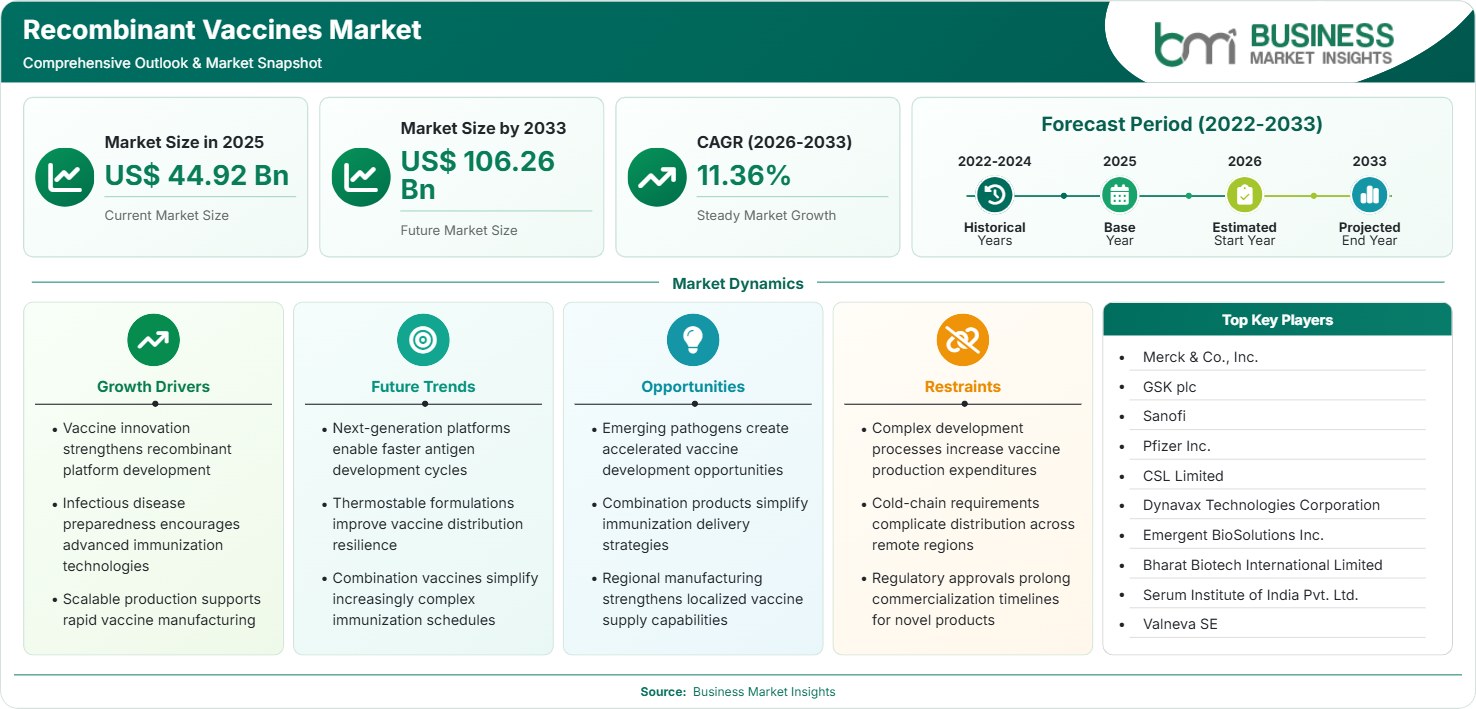
The Recombinant Vaccines Market size was valued at US$ 44.92 Billion in 2025 and is projected to reach US$ 106.26 Billion by 2033, growing at a CAGR of 11.36% during 2026–2033, supported by expanding immunization programs, rising HPV and hepatitis prevention initiatives, technological advances in recombinant platforms, and increasing investments in next-generation vaccine manufacturing.

Report Coverage
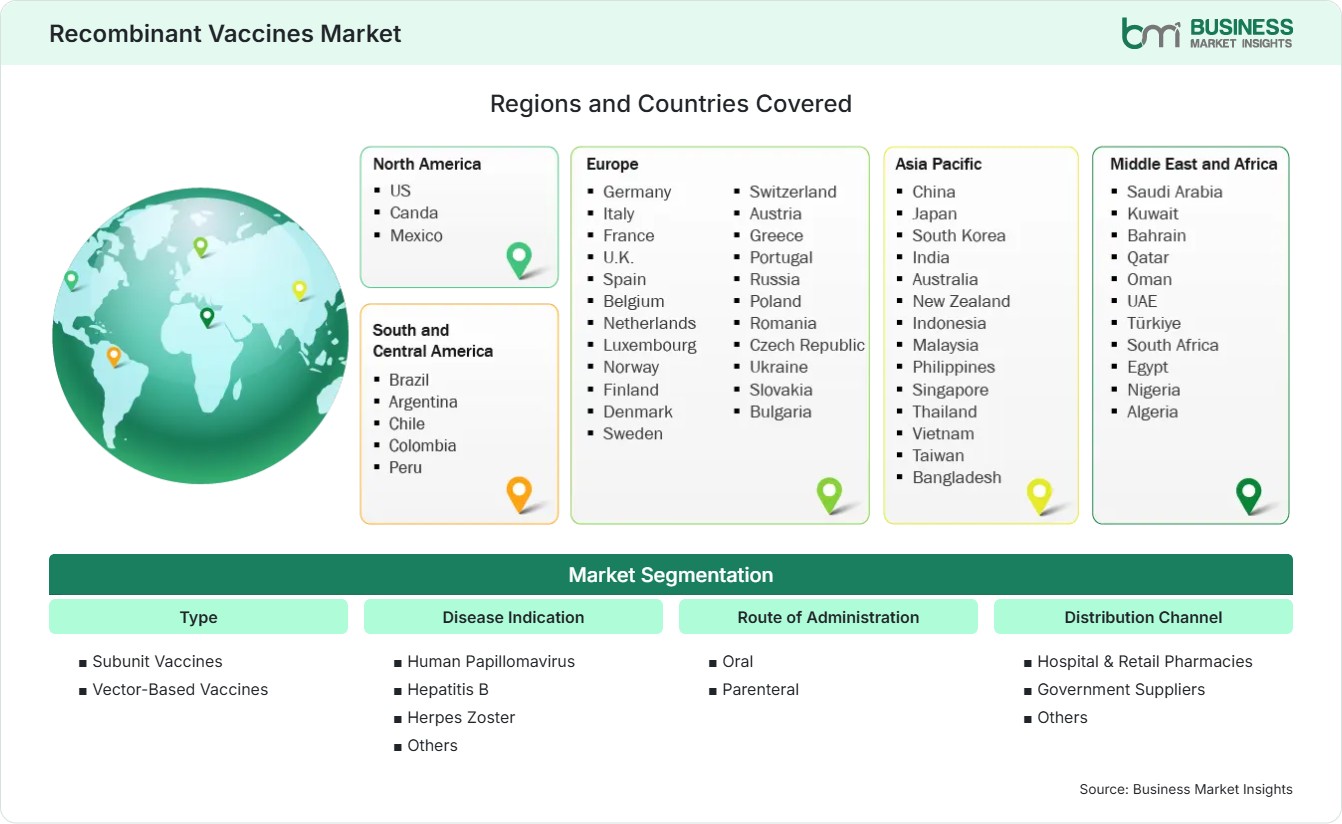
  • Type: Subunit Vaccines, Vector-Based Vaccines
  • Disease Indication: Human Papillomavirus, Hepatitis B, Herpes Zoster, Others
  • Route of Administration: Oral, Parenteral
  • Distribution Channel: Hospital & Retail Pharmacies, Government Suppliers, Others
US$ 44.92 Bn Market size in 2025
US$ 106.26 Bn Market Size by 2033
11.36% CAGR, 2026 - 2033
2026-2033 Forecast Period

AI Overview

Recombinant Vaccines Market Summary

  • North America Region: North America holds a market share of 38%–41% in 2025, growing at a CAGR of 10.5%–11.2% during 2026–2033, driven by established immunization programs, strong biologics manufacturing capabilities, advanced vaccine procurement systems, growing adult vaccination rates, government stockpiling initiatives, and continued innovation across recombinant antigen platforms. The U.S. market benefits from large-scale vaccine adoption, strong reimbursement frameworks, and an estimated CAGR of 10.8%–11.5%.
  • Fastest Growing Region: Asia Pacific holds a market share of 24%–27% in 2025, growing at a CAGR of 12.8%–13.6% during 2026–2033, supported by expanding public immunization coverage, increasing healthcare expenditures, local vaccine manufacturing investments, improving distribution infrastructure, rising disease awareness, larger target populations, and favorable regulatory pathways.
  • Leading Segment: Subunit Vaccines account for 62%–66% share in 2025 and are expected to grow at a CAGR of 10.8%–11.4%, supported by proven safety profiles, broader regulatory acceptance, extensive use in hepatitis and HPV prevention programs, scalable production processes, and increasing physician preference.
  • High Growth Segment: Vector-Based Vaccines hold 34%–38% share in 2025 and are projected to register a CAGR of 12.5%–13.3%, driven by platform innovation, rapid antigen development capabilities, enhanced immunogenicity, emerging infectious disease preparedness strategies, and expanding clinical development activities.
  • Key Market Opportunity: Expansion of adult immunization programs, regional manufacturing hubs, thermostable vaccine technologies, and combination vaccine development creates significant opportunities for producers seeking broader coverage, improved accessibility, and long-term revenue diversification.
  • Major Market Players: Merck & Co., Inc.; GSK plc; Sanofi; Pfizer Inc.; CSL Limited; Dynavax Technologies Corporation; Emergent BioSolutions Inc.; Bharat Biotech International Limited; Serum Institute of India Pvt. Ltd.; Valneva SE.
Strategic Insights

Recombinant Vaccines Market: Strategic Insights

Recombinant Vaccines Market Strategic Framework
FREE PDF
Request your free sample
Request free sample
Stakeholder View

Key Takeaways

  • The value chain increasingly integrates recombinant antigen discovery, contract manufacturing, fill-finish operations, cold-chain logistics, and government procurement programs, creating a highly collaborative commercial ecosystem.
  • Adult vaccination programs targeting HPV, hepatitis B, and herpes zoster represent some of the strongest long-term growth opportunities across developed and emerging healthcare systems.
  • Technological innovation is moving toward scalable expression platforms, AI-assisted antigen design, improved adjuvant systems, and thermostable formulations that enhance vaccine accessibility.
  • Asia Pacific presents a compelling investment case due to expanding immunization coverage, increasing biologics production capacity, and supportive domestic manufacturing policies.
  • Strategic collaborations, manufacturing partnerships, and capacity expansion projects continue to attract investment as governments prioritize vaccine security and self-sufficiency.
  • Vaccine developers with diversified portfolios and flexible manufacturing capabilities are better positioned to address evolving disease-prevention priorities and procurement requirements.
Geographic Outlook

Recombinant Vaccines Market Regional Highlights

North America Recombinant Vaccines Market

North America maintains leadership with approximately 38%–41% share in 2025 and is forecast to grow at a 10.5%–11.2% CAGR through 2033. Strong government purchasing programs, advanced vaccine R&D infrastructure, and broad adoption of HPV and hepatitis vaccines support market expansion. The Recombinant Vaccines Market share remains concentrated among major global manufacturers with extensive commercialization capabilities. Adult immunization initiatives and favorable reimbursement structures continue supporting demand across healthcare systems.

  • High HPV vaccination awareness supports consistent procurement volumes.
  • Strong biologics manufacturing ecosystem accelerates innovation and commercialization.
  • Public health preparedness programs encourage strategic vaccine stockpiling.
  • Advanced clinical research infrastructure supports next-generation platform development.

US Recombinant Vaccines Market

The United States accounts for approximately 78%–82% of North American Recombinant Vaccines Market revenue and is expected to expand at a 10.8%–11.5% CAGR. Need is fueled by the existence of a robust vaccination infrastructure, strong insurance coverage, and sustained funding of vaccine research. Commercialization covers both children and adults, whereas the federal vaccination programs ensure continuity in procurement and market visibility.

  • Robust CDC-backed vaccination recommendations support market penetration.
  • Strong biotechnology investment promotes innovation in antigen development.
  • Growing elderly population increases herpes zoster vaccine demand.
  • Large-scale manufacturing capacity strengthens supply reliability.

Europe Recombinant Vaccines Market

Europe accounts for 27%–30% Recombinant Vaccines Market share in 2025 and is projected to grow at a 10.7%–11.4% CAGR. The regional demand is facilitated by structured immunization programs, adult vaccinations, and efficient public healthcare infrastructure. Germany continues to be one of the major markets, but the Eastern European nations show faster growth owing to better availability of vaccines and improvements in the healthcare sector.

  • Germany leads regional revenue generation and vaccine procurement.
  • France benefits from strong public immunization policies.
  • Central and Eastern Europe show accelerating uptake rates.
  • Government-funded vaccination campaigns sustain long-term demand.

Asia Pacific Recombinant Vaccines Market

Asia Pacific represents 24%–27% Recombinant Vaccines Market share in 2025 and records the fastest expansion with a 12.8%–13.6% CAGR. Healthcare investment, large populations, manufacturing ability, and greater awareness regarding vaccinations all indicate considerable growth potential. China and Japan are the two leading markets, while India is one of the markets showing the most growth due to its increased vaccination efforts.

  • Local manufacturers are expanding production capacity rapidly.
  • National vaccination programs improve penetration across rural populations.
  • Growing healthcare budgets enhance procurement capabilities.
  • India and Southeast Asia attract significant vaccine investments.

Rest of World Recombinant Vaccines Market

The Rest of World region accounts for 8%–11% share in 2025 and is expected to grow at a 11.5%–12.3% CAGR. South and Central America benefit from expanding vaccination access and public health initiatives. Middle East and Africa markets are supported by improving healthcare infrastructure, international funding programs, and broader disease-prevention strategies.

  • Brazil leads South and Central American vaccine demand.
  • GCC countries invest heavily in healthcare modernization.
  • International immunization partnerships improve vaccine accessibility.
  • Regional production initiatives support long-term supply stability.
Global Market Geography
FREE PDF
Request your free sample
Request free sample
Segment Analysis

Recombinant Vaccines Market Segmentation

Type

Type remains a critical determinant of product adoption and commercialization strategies. The segment accounts for diverse technology approaches addressing distinct immunization requirements. This segment represents substantial Recombinant Vaccines Market scope, with Subunit Vaccines holding approximately 62%–66% share in 2025 while the overall category expands at 10.8%–13.3% CAGR depending on platform maturity and application.

  • Subunit Vaccines: Widely adopted due to strong safety characteristics, proven clinical performance, extensive regulatory acceptance, and established use in hepatitis B and HPV prevention programs worldwide.
  • Vector-Based Vaccines: Benefit from rapid antigen delivery capabilities, platform flexibility, strong immune responses, and growing interest in emerging infectious disease preparedness initiatives.

Disease Indication

Disease indication demand remains influenced by public immunization priorities, disease burden, and regulatory recommendations. HPV vaccines constitute the largest indication category, supported by expanding adolescent vaccination programs. The segment demonstrates stable growth prospects and increasing penetration across developing healthcare systems.

  • Human Papillomavirus (HPV): Strongly supported by government vaccination mandates, cancer prevention initiatives, and increasing awareness regarding long-term disease burden reduction.
  • Hepatitis B: Benefits from neonatal immunization programs, established public health recommendations, and broad incorporation into national vaccination schedules.
  • Herpes Zoster: Growth is supported by aging populations, increased adult immunization awareness, and wider clinical recommendations for preventive vaccination.

Route of Administration

Route of administration influences patient compliance, supply logistics, and healthcare delivery models. Parenteral administration remains dominant due to established efficacy and broad product availability. Technological innovation is gradually supporting alternative delivery approaches.

  • Oral: Offers convenience, improved patient acceptance, and potential advantages in mass immunization campaigns where administration efficiency is critical.
  • Parenteral: Continues to dominate due to established clinical performance, extensive provider familiarity, and broad regulatory approvals across vaccine categories.

Distribution Channel

Distribution channels influence accessibility, procurement efficiency, and vaccination coverage. Government procurement remains a major purchasing pathway, while retail and hospital pharmacies increasingly contribute to adult vaccine distribution.

  • Hospital & Retail Pharmacies: Support vaccine accessibility through direct patient engagement, routine healthcare interactions, and expanding adult immunization services.
  • Government Suppliers: Drive large-volume procurement through immunization programs, public healthcare campaigns, and national vaccination initiatives.
Market Forces

Recombinant Vaccines Market Dynamics

Key Market Drivers

Expansion of Global Immunization Programs

Vaccination programs by the WHO and growing immunization coverage across nations have led to a high demand for recombinant vaccines. Several nations are focusing on introducing HPV vaccines, strengthening their efforts against hepatitis, and providing more vaccines for their children and adults. Increased awareness about diseases that can be prevented through vaccination has also increased the number of people being vaccinated. Recombinant vaccines offer several benefits in safety, effectiveness, and production, making them ideal for mass vaccination programs. Governments have been increasingly focusing on preventive healthcare measures. These developments continue supporting Recombinant Vaccines Market growth through wider vaccine coverage, larger procurement programs, increasing healthcare budgets, and stronger policy support for immunization.

Advancements in Recombinant DNA Technologies

Advancements in the expression systems, antigen design, adjuvants, and bioprocessing techniques are enhancing the efficacy and manufacturability of the vaccines. The current recombinant vaccine platforms have the potential to shorten the product development process while enabling large-scale manufacturing necessary for implementing vaccination campaigns at both national and international levels. Increased accuracy in antigen design will enhance the immune response while facilitating the development of advanced generation vaccines for different illnesses. These technological improvements are strengthening the Recombinant Vaccines Market trends related to production efficiency, scalability, and faster response capabilities for emerging infectious diseases and evolving healthcare needs.

Growing Demand for Adult Vaccination

Healthcare systems are increasingly recognizing the medical and economic benefits of adult immunization. Aging populations are contributing to higher demand for vaccines that protect against diseases such as herpes zoster, hepatitis, influenza, and other preventable conditions. Expanded recommendations for booster doses and preventive healthcare programs are creating sustained commercial opportunities for vaccine manufacturers. Employers, insurance providers, and public health authorities are also emphasizing disease prevention strategies to reduce long-term treatment costs and improve population health outcomes. These factors are supporting market growth by expanding target populations and increasing vaccination frequency across multiple disease categories. Greater awareness among adults regarding preventive healthcare is expected to further strengthen demand in the coming years.

Key Market Opportunities

Regional Manufacturing Localization

Many governments across regions are making significant investments in local vaccine production to ensure independence from external vaccine supplies. Technology transfer deals, manufacturing capacity expansion ventures, and local production encouragements are providing an environment that is conducive to businesses that seek entry into emerging markets. Local production approaches can increase the efficiency of purchasing processes. Recombinant Vaccines Market Forecasts increasingly reflect these regional self-sufficiency initiatives, which are expected to support long-term investment opportunities. Companies establishing localized manufacturing networks may benefit from procurement preferences, regulatory support, reduced transportation costs, and faster access to important markets while strengthening relationships with public healthcare systems.

Development of Combination Vaccines

Combination vaccines offer the chance to improve patient compliance and to make immunization schedules more efficient by decreasing the number of individual injections that are needed. Due to advances in recombinant technology it is now possible to include several antigens in a single vaccine without compromising its safety or efficacy. Healthcare providers are becoming more inclined to choose simplified vaccination programs since these reduce the complexity of administration and increase patient convenience. Combination vaccines can also contribute to lower healthcare costs by improving the efficiency of logistics and reducing the number of clinic visits. The fact that this trend exists offers promising opportunities for the development of premium products and for achieving a distinct market position. Manufacturers who successfully create effective combination vaccines will be able to strengthen their relationships with healthcare providers and achieve greater acceptance within national immunization programs.

Expansion in Emerging Economies

In parts of Asia, Africa, and Latin America, there are large groups of people who have not been vaccinated, offering considerable potential for long-term growth in the market. Rising incomes, improved access to healthcare, and greater public investment in immunization programs are all helping to boost demand for vaccines in these areas. In addition to that, governments and health care institutions are now improving their disease prevention measures through extensive vaccination drives and awareness programs. With advances in the cold chain system, transportation, and the health care distribution system, vaccines have become easier to access for many people. This situation is creating opportunities for manufacturers who want to earn revenue from somewhere else. Firms that will develop good relationships with the locals and an effective distribution channel will take advantage of the increased demand for vaccines in developing countries.

Market Restraints and Challenges

Complex Manufacturing Requirements

The production of recombinant vaccines demands advanced bioprocessing facilities, skilled staff, and strict quality controls. As a result, operating costs rise and rapid expansion of capacity is hindered. Manufacturers have to make substantial investments in validation, compliance, and process optimization. Because of the high level of capital required, smaller companies often encounter obstacles when it comes to commercialization. If production is disrupted, then supply reliability is affected, which in turn hampers timely responses to market needs and raises procurement risks for healthcare systems that rely on a steady supply of vaccines.

Pricing and Accessibility Constraints

The fact is that cost pressures remain considerable in lower-income healthcare markets, as budget constraints influence purchasing decisions. As a result, difficulties with affordability may reduce vaccination coverage and cause a delay in the introduction of new products. Purchasing agencies often focus on cost efficiency, which in turn increases the competition among manufacturers. Moreover, the limited healthcare infrastructure in some areas hampers access and leads to inequalities in vaccine use, even as demand rises and public health goals advance.

Company Analysis

Competitive Landscape

The competitive environment reflects strong innovation and commercialization capabilities. Ongoing Recombinant Vaccines Market analysis indicates that established vaccine manufacturers retain advantages through scale, regulatory expertise, and diversified product portfolios.

Company Name

Overview

Products and Services relevant to this market

Merck & Co., Inc.

Global biopharmaceutical leader with extensive vaccine portfolio and broad commercial reach.

HPV vaccines, recombinant vaccine research, immunization solutions, manufacturing capabilities.

GSK plc

Major vaccine innovator with strong preventive healthcare presence worldwide.

Recombinant vaccines, adjuvant technologies, vaccine development and commercialization.

Sanofi

Diversified healthcare company with extensive vaccine operations.

Preventive vaccines, recombinant platforms, manufacturing and distribution services.

Pfizer Inc.

Global pharmaceutical innovator with vaccine development expertise.

Recombinant vaccine research, infectious disease prevention products.

CSL Limited

International biotechnology company operating significant vaccine businesses.

Influenza and specialty vaccine development and manufacturing services.

Dynavax Technologies Corporation

Biotechnology specialist focused on vaccine technologies.

Hepatitis B vaccine solutions and adjuvant technologies.

Emergent BioSolutions Inc.

Public health and biodefense focused healthcare company.

Vaccine manufacturing, development support, biologics services.

Bharat Biotech International Limited

Vaccine-focused biotechnology company with global distribution footprint.

Recombinant vaccines, preventive healthcare solutions, manufacturing services.

Serum Institute of India Pvt. Ltd.

One of the world's largest vaccine manufacturers by volume.

Affordable vaccine production and global supply capabilities.

Valneva SE

Specialty vaccine company serving international markets.

Vaccine R&D, infectious disease prevention products and services.

Trust & Transparency

Research Methodology

The market analysis combines proprietary research with secondary data from government agencies, company disclosures, regulatory filings, industry databases and expert interviews. Market estimates are validated through data triangulation, cross-market benchmarking and analyst review.

View Full Research Methodology

Questions Answered

Frequently Asked Questions

Why is a Recombinant Vaccines Market Report important for stakeholders?

It helps manufacturers, investors, distributors, and healthcare organizations evaluate growth opportunities, competitive positioning, emerging technologies, procurement trends, and regional investment priorities.

What factors support long-term market expansion?

Adult vaccination adoption, government immunization funding, technological innovations, domestic manufacturing investments, and broader access initiatives are key contributors to long-term industry development.

Which region offers the strongest future expansion potential?

Asia Pacific presents the highest growth potential due to rising healthcare investments, expanding immunization programs, increasing vaccine production capacity, and growing public awareness.

What makes recombinant vaccines different from conventional vaccines?

They use genetic engineering techniques to produce specific antigens instead of relying on whole pathogens, supporting strong safety profiles, manufacturing consistency, and targeted immune responses.

Which disease indication generates the highest demand for recombinant vaccines?

HPV vaccines represent one of the strongest revenue-generating categories due to broad immunization campaigns, cancer prevention initiatives, and increasing global vaccination coverage among adolescents and young adults.

Access the Full Recombinant Vaccines Market Report

Get segment-level forecasts, regional estimates, competitive benchmarking, company profiles and downloadable Excel datasets.

Access the full Recombinant Vaccines Market Report
350 pages PDF & Excel | 2026-09-21
Similar Research

Related Market Reports