
Print Equipment Market Outlook: Size, Share, Trends, Growth Analysis, Competitive Landscape & Forecast, 2026-2033

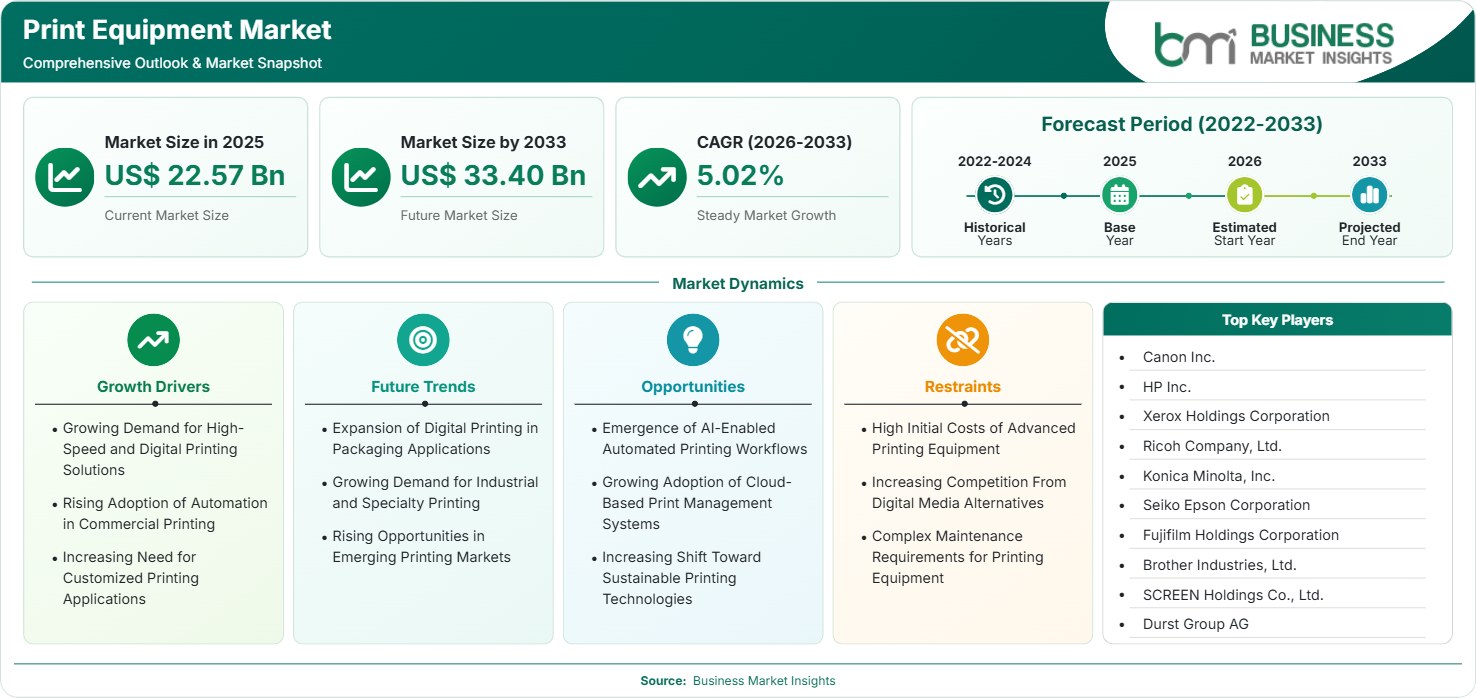
The Print Equipment Market size was valued at US$ 22.57 billion in 2025 and is projected to reach US$ 33.40 billion by 2033, growing at a CAGR of 5.02% during 2026–2033, driven by digitalization, automation, customized production, packaging demand, workflow software, and sustainable printing technologies.

Report Coverage
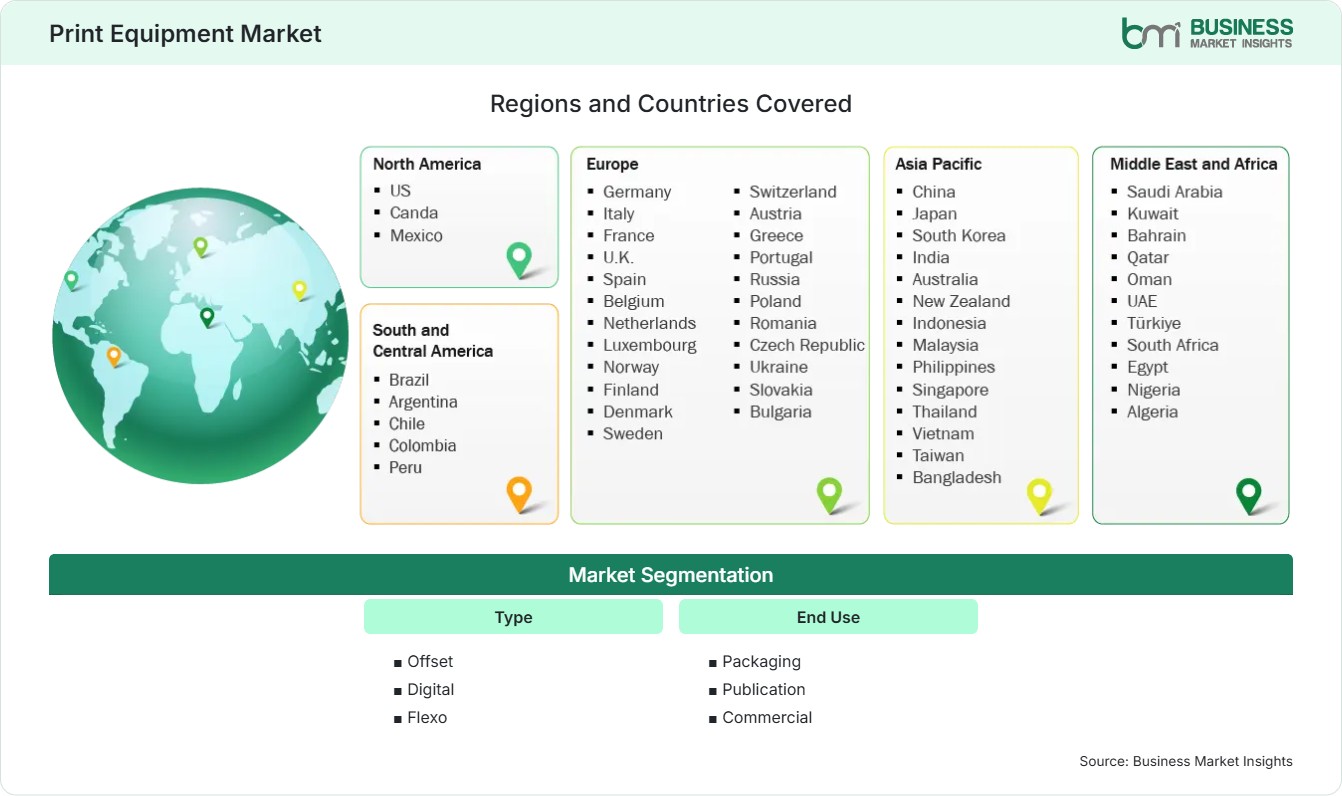
  • Type: Offset, Digital, Flexo
  • End Use: Packaging, Publication, Commercial
US$ 22.57 Bn Market size in 2025
US$ 33.40 Bn Market Size by 2033
5.02% CAGR, 2026 - 2033
2026-2033 Forecast Period

AI Overview

Print Equipment Market Summary

  • North America Region: North America holds a 27%–31% share in 2025, growing with a CAGR of 4.0%–5.0%, influenced by digital print adoption, commercial automation, packaging investment, variable-data applications, and replacement of aging equipment. The US market is expanding at a CAGR of 3.8%–4.8%, supported by packaging conversion, commercial digital printing, automated workflows, and demand for shorter production runs.
  • Fastest Growing Region: Asia Pacific holds a 34%–38% share in 2025, growing with a CAGR of 6.0%–7.0%, supported by expanding packaging manufacturing, e-commerce fulfillment, industrialization, commercial print modernization, and rising investment in digitally enabled production equipment.
  • Leading Segment: Digital printing holds a 36%–40% share in 2025, growing with a CAGR of 6.0%–7.0%, driven by shorter print runs, variable customization, faster turnaround, reduced setup requirements, and increasing demand for on-demand production.
  • High Growth Segment: Packaging holds a 43%–47% share in 2025, growing with a CAGR of 6.0%–7.0%, supported by e-commerce, flexible packaging, brand differentiation, product personalization, shorter campaigns, and increasing demand for premium printed packaging.
  • Key Market Opportunity: AI-enabled workflows, cloud-connected production management, and sustainable printing equipment create opportunities for suppliers to improve automation, operational efficiency, resource utilization, and customer-specific production capabilities.
  • Major Market Players: Canon Inc., HP Inc., Xerox Holdings Corporation, Ricoh Company, Ltd., Konica Minolta, Inc., Seiko Epson Corporation, Fujifilm Holdings Corporation, Brother Industries, Ltd., SCREEN Holdings Co., Ltd., and Durst Group AG.
Strategic Insights

Print Equipment Market: Strategic Insights

Print Equipment Market Strategic Framework
FREE PDF
Request your free sample
Request free sample
Stakeholder View

Key Takeaways

  • The industry value chain is increasingly integrating equipment manufacturers, consumables suppliers, workflow software providers, finishing specialists, and service organizations, creating competitive advantages for vendors offering comprehensive production ecosystems.
  • Digital printing offers the strongest structural growth opportunity as commercial and packaging customers prioritize shorter runs, personalization, rapid turnaround, and lower setup requirements.
  • Automation is moving from individual machine functions toward connected workflows involving prepress, printing, finishing, quality control, predictive maintenance, and production scheduling.
  • Asia Pacific provides the strongest regional investment case as packaging manufacturing expands and print service providers modernize equipment to meet e-commerce, consumer goods, and industrial demand.
  • Strategic partnerships and technology acquisitions are increasingly focused on workflow software, industrial inkjet, automation, cloud connectivity, and specialty applications rather than conventional hardware alone.
  • Equipment suppliers with strong aftermarket service networks, consumables ecosystems, and software capabilities can generate more resilient customer relationships and improve revenue visibility beyond initial machine sales.
Geographic Outlook

Print Equipment Market Regional Highlights

North America Print Equipment Market

North America held a 27%–31% share in 2025 and is projected to grow at a 4.0%–5.0% CAGR during 2026–2033. The regional market is supported by mature commercial printing infrastructure and growing packaging requirements. Print Equipment Market share remains substantial because established print service providers continue replacing aging systems with digitally connected equipment. Automation, workflow integration, variable-data production, and high-value specialty printing are strengthening investment opportunities across the region.

  • Commercial printers are increasingly replacing conventional equipment with digital systems capable of producing customized jobs economically while reducing setup requirements and supporting faster delivery schedules.
  • Packaging converters are investing in advanced printing and finishing technologies to address shorter production runs, brand personalization, and increasingly complex packaging formats.
  • Automated workflow software is improving production planning, job scheduling, quality control, and equipment utilization, helping printers manage labor shortages and increasingly complex customer requirements.
  • Sustainability initiatives are encouraging equipment upgrades that reduce material waste, improve energy efficiency, and support digital production models with lower setup-related resource consumption.

US Print Equipment Market

The US represented a 24%–28% share in 2025 and is expected to expand at a 3.8%–4.8% CAGR through 2033. The market benefits from sophisticated commercial printing infrastructure, strong packaging activity, and widespread adoption of workflow automation. Print Equipment Market growth is supported by digital press investment, specialty printing, customized production, and equipment replacement. Demand is increasingly concentrated around productivity-enhancing technologies rather than simple capacity expansion.

  • US print service providers are adopting digital presses to economically manage shorter runs, variable content, customized marketing materials, and rapid turnaround requirements.
  • Packaging demand is supporting investment in high-performance equipment capable of handling diverse substrates, premium graphics, shorter campaigns, and increasingly personalized product formats.
  • Cloud-connected workflow platforms are improving remote monitoring, job management, production visibility, and equipment utilization across distributed commercial printing operations.
  • Specialty applications, including labels, industrial graphics, décor, and direct-to-object printing, are creating opportunities beyond traditional commercial and publication markets.

Europe Print Equipment Market

Europe accounted for a 22%–26% share in 2025 and is projected to grow at a 3.5%–4.5% CAGR through 2033. Germany leads regional demand, while Italy and the UK remain important printing and packaging markets. Germany is projected to grow at a 3.8%–4.8% CAGR, while Poland is expected to expand at a 5.0%–6.0% CAGR. Sustainability requirements, packaging innovation, and equipment modernization are supporting investment.

  • Germany's advanced manufacturing base supports demand for automated printing equipment serving packaging, industrial applications, commercial production, and specialty print requirements.
  • Poland is emerging as a faster-growing European production location as packaging manufacturing expands and companies invest in modern equipment and automated production capabilities.
  • European sustainability priorities are encouraging printers to reduce material waste, improve energy efficiency, optimize ink consumption, and adopt more resource-efficient production processes.
  • Digital printing is gaining traction for customized and shorter-run applications, while offset and flexographic technologies retain strong positions in high-volume production environments.

Asia Pacific Print Equipment Market

Asia Pacific held a 34%–38% share in 2025 and Asia Pacific Print Equipment Market forecast to grow at a 6.0%–7.0% CAGR through 2033. China leads regional demand, while India represents a high-growth opportunity. China is projected to grow at a 5.5%–6.5% CAGR, whereas India is expected to expand at a 7.0%–8.0% CAGR. Packaging expansion, e-commerce, industrialization, and modernization of print production infrastructure are supporting regional investment.

  • China benefits from extensive packaging manufacturing capacity and a large commercial printing ecosystem increasingly investing in automation, digital production, and high-productivity equipment.
  • India's expanding consumer economy and e-commerce activity are supporting packaging production while encouraging printers to upgrade equipment for faster, more flexible manufacturing.
  • Southeast Asian manufacturing hubs are attracting packaging and industrial production investment, creating opportunities for equipment suppliers serving regional converters and multinational supply chains.
  • Digital technologies are gaining adoption as printers seek economical solutions for shorter runs, customized output, variable data, and rapid market response.

Rest of World Print Equipment Market

South and Central America represented a 7%–9% share in 2025 and are projected to grow at a 4.5%–5.5% CAGR through 2033, supported by packaging and consumer goods production. Brazil leads regional demand, while Mexico benefits from manufacturing integration. Middle East and Africa accounted for a 4%–6% share and are expected to grow at a 4.0%–5.0% CAGR, led by packaging modernization.

  • Brazil's large food, beverage, and consumer goods industries support continued demand for packaging printing equipment and production technologies capable of handling high-volume applications.
  • Mexico benefits from manufacturing and export activity, creating opportunities for industrial and packaging printers serving automotive, consumer goods, food, and multinational production networks.
  • Gulf markets are investing in packaging and specialty printing capabilities as consumer industries expand and manufacturers seek greater localization of production activities.
  • African markets offer longer-term opportunities as retail modernization, packaged food consumption, and local manufacturing expansion gradually increase demand for commercial and packaging print capabilities.
Global Market Geography
FREE PDF
Request your free sample
Request free sample
Segment Analysis

Print Equipment Market Segmentation

Type

Digital printing held a 36%–40% share in 2025 and is projected to grow at a 6.0%–7.0% CAGR during 2026–2033. Demand is supported by personalization, shorter runs, rapid turnaround, and lower setup requirements. Offset remains essential for high-volume commercial production, while flexographic equipment benefits from packaging applications. Print Equipment Market scope increasingly encompasses digitally connected systems combining presses, workflow software, automation, and finishing technologies.

  • Offset: Offset remains important for high-volume publication and commercial applications where consistent quality, productivity, and favorable unit economics support continued equipment utilization.
  • Digital: Digital presses enable shorter production runs, variable-data printing, personalization, rapid turnaround, and reduced setup requirements, supporting adoption across commercial, packaging, and specialty applications.
  • Flexo: Flexographic printing remains essential for packaging applications, offering high-speed production across flexible substrates, labels, corrugated materials, and other high-volume packaging formats.

End Use

Packaging held a 43%–47% share in 2025 and is projected to grow at a 6.0%–7.0% CAGR through 2033. E-commerce, consumer goods, premiumization, and shorter product cycles are increasing demand for flexible printing capabilities. Publication demand remains influenced by digital media substitution, while commercial printing is evolving toward personalized marketing and on-demand production. Print Equipment Market trends increasingly favor flexible equipment supporting multiple substrates and production requirements.

  • Packaging: Packaging represents the strongest growth application as brands demand high-quality graphics, shorter production cycles, customized formats, and printing technologies compatible with diverse substrates.
  • Publication: Publication printing remains supported by books, educational materials, catalogs, and specialty publications, although digital media continues influencing production volumes and equipment investment decisions.
  • Commercial: Commercial printers increasingly adopt digital and automated equipment to deliver personalized marketing materials, variable-data campaigns, short runs, and rapid turnaround services.
Market Forces

Print Equipment Market Dynamics

Key Market Drivers

Growing Demand for High-Speed and Digital Printing Solutions

Print buyers are looking for shorter turn-around times, variable content, customized printing, and cost-effective short-run operations. Manufacturers are speeding up development of high-speed digital presses, feeding equipment, ink-jet technology and finishing systems. Printers can use digital technology to save time on setups and adapt to changes in their customers' needs more quickly. The growth of Print Equipment Market is defined by a mixed technology setting that combines rapid expansion of digital technology with the continued relevancy of traditional technology at high volumes.

Rising Adoption of Automation in Commercial Printing

Commercial printers face pressure to improve throughput, reduce manual intervention, and manage increasingly complex job mixes with limited skilled labor availability. Automation is becoming a central equipment purchasing criterion, driving adoption of automated setup, job sequencing, quality inspection, robotic material handling, and integrated finishing. Connected workflows allow printers to reduce operational bottlenecks and improve machine utilization. The trend is creating opportunities for established vendors and technology providers capable of delivering end-to-end automated production environments.

Increasing Need for Customized Printing Applications

Brands increasingly use packaging and printed communications as tools for differentiation, personalization, and targeted customer engagement. Printers require flexible equipment capable of producing customized output without substantial setup penalties or production delays. Digital printing is benefiting from this shift because variable-data capabilities enable unique designs, regionalized campaigns, personalized packaging, and short-run production. Commercial applications are also expanding toward customized marketing materials and on-demand products. The growing emphasis on personalization is strengthening demand for technologies that combine production speed, image quality, substrate flexibility, and economical short-run economics.

Key Market Opportunities

Emergence of AI-Enabled Automated Printing Workflows

AI-enabled workflow can help in production planning, color management, quality control, predictive maintenance, and job scheduling. It becomes possible to apply the capabilities of machine learning straight into the print production process, not viewing AI as an independent software option. Automated systems will be able to analyze the collected operational data, find out where the bottlenecks appear, how the equipment can be used more effectively and what maintenance it will require. The equipment vendors can generate continuous revenue from software and services related to their intelligent capabilities.

Growing Adoption of Cloud-Based Print Management Systems

Cloud-based management platforms are creating opportunities to connect distributed printing operations, monitor equipment remotely, centralize production data, and improve workflow visibility. These systems can help commercial printers manage multiple facilities and coordinate jobs across available production capacity. Cloud connectivity also supports predictive maintenance, remote diagnostics, software updates, and performance benchmarking. Equipment manufacturers can use these capabilities to move toward service-oriented revenue models that extend beyond machine sales. Smaller printers can benefit from scalable solutions that reduce the need for extensive onsite information technology infrastructure.

Increasing Shift Toward Sustainable Printing Technologies

Sustainability is creating opportunities for equipment manufacturers to develop systems that reduce material waste, energy consumption, emissions, and production inefficiencies. Digital printing can minimize setup waste for short runs, while advanced automation can improve material utilization and reduce production errors. Equipment suppliers are also developing technologies compatible with lower-impact inks, recyclable substrates, and more efficient drying processes. The opportunity extends beyond equipment design to lifecycle services, refurbishment, energy monitoring, and resource optimization. Printers increasingly require measurable environmental performance alongside productivity improvements.

Market Restraints and Challenges

High Initial Costs of Advanced Printing Equipment

Factor: Digital printing equipment, high-speed inkjet machines, automated finishing devices, and overall production processes require significant upfront investments, which may be difficult for small to medium printing companies due to their financial situation. Impact: The high price of equipment may lead to postponement of the process of its updating or replacement due to higher financial costs and difficulties in implementing the installation and additional investments in software.

Increasing Competition from Digital Media Alternatives

Factor: The ongoing trend of transitioning from print newspapers, magazines, catalogs, brochures, and other forms of traditional communications to the use of digital channels is limiting the demand for selected publications and commercial printing applications. Impact: Decreasing print runs for such sectors may limit equipment usage and affect replacement demand, compelling printing firms to explore the possibility of venturing into packaging, labeling, specialty print, and personalized printing sectors. It follows that print equipment suppliers have to concentrate on applications where print holds an edge, such as specialty print.

Company Analysis

Competitive Landscape

The print equipment market analysis indicates that competitive environment is shaped by global equipment manufacturers offering offset, digital, inkjet, commercial, industrial, and specialty printing solutions. Companies increasingly compete through automation, workflow integration, software capabilities, consumables, and aftermarket services. The strongest vendors are broadening their portfolios to address packaging, labels, industrial printing, and customized applications alongside traditional commercial markets.

Company Name

Overview

Products and Services relevant to this market

Canon Inc.

Global imaging technology company serving commercial, production, industrial, and professional printing markets.

Production digital presses, inkjet systems, commercial printers, workflow solutions, finishing, and print management technologies.

HP Inc.

Major technology company with extensive digital printing solutions across commercial, industrial, and packaging applications.

Digital presses, industrial inkjet systems, packaging printers, workflow software, and production printing solutions.

Xerox Holdings Corporation

Established provider of digital printing, production technology, document management, and workflow solutions.

Production printers, digital presses, workflow automation, print management, software, and managed print services.

Ricoh Company, Ltd.

Global imaging and workplace technology provider with expanding production and industrial printing capabilities.

Production printers, digital presses, inkjet systems, workflow software, automation, and professional printing services.

Konica Minolta, Inc.

Imaging technology company offering production printing and digital workflow solutions for commercial applications.

Digital production presses, industrial inkjet systems, workflow software, automation, and print management solutions.

Seiko Epson Corporation

Printing technology company with strong expertise in inkjet and commercial printing systems.

Industrial inkjet printers, commercial printing systems, digital textile printers, inks, and production technologies.

Fujifilm Holdings Corporation

Diversified technology company with advanced digital printing, inkjet, and graphic communications capabilities.

Digital presses, inkjet systems, printing plates, inks, workflow solutions, and commercial print technologies.

Brother Industries, Ltd.

Global printing and imaging manufacturer serving office, commercial, industrial, and specialized applications.

Printers, labeling systems, industrial printing equipment, consumables, and connected workflow solutions.

SCREEN Holdings Co., Ltd.

Technology company specializing in high-speed inkjet and production printing equipment for commercial markets.

Production inkjet presses, digital printing systems, workflow technologies, and high-speed commercial printing solutions.

Durst Group AG

Specialized manufacturer focused on digital printing technologies for packaging, labels, commercial, and industrial applications.

Digital presses, packaging printers, label systems, inkjet technologies, workflow software, and industrial printing solutions.

Trust & Transparency

Research Methodology

The market analysis combines proprietary research with secondary data from government agencies, company disclosures, regulatory filings, industry databases and expert interviews. Market estimates are validated through data triangulation, cross-market benchmarking and analyst review.

View Full Research Methodology

Questions Answered

Frequently Asked Questions

Why will offset and flexographic printing remain relevant?

Offset and flexographic technologies remain competitive in high-volume applications where production speed, print consistency, substrate compatibility, and unit economics are critical.

Which technologies are likely to influence future equipment development?

AI-enabled workflows, cloud connectivity, industrial inkjet, predictive maintenance, automated quality control, and advanced finishing are likely to influence future equipment development.

What role does automation play in Print Equipment Market report?

Automation reduces manual intervention across job preparation, equipment setup, production scheduling, quality inspection, and finishing.

Why is packaging an important application for print equipment manufacturers?

Packaging provides opportunities because consumer goods, e-commerce, and brand differentiation require continuous production of high-quality printed materials.

How is digitalization changing print equipment purchasing decisions?

Digitalization is shifting purchasing criteria from standalone machine specifications toward workflow integration, automation, connectivity, variable-data capabilities, and total operating efficiency.

Access the Full Print Equipment Market Report

Get segment-level forecasts, regional estimates, competitive benchmarking, company profiles and downloadable Excel datasets.

Access the full Print Equipment Market Report
350 pages PDF & Excel | 2026-08-10