
Prepreg Market Outlook: Size, Share, Trends, Growth Analysis, Competitive Landscape & Forecast, 2026-2033

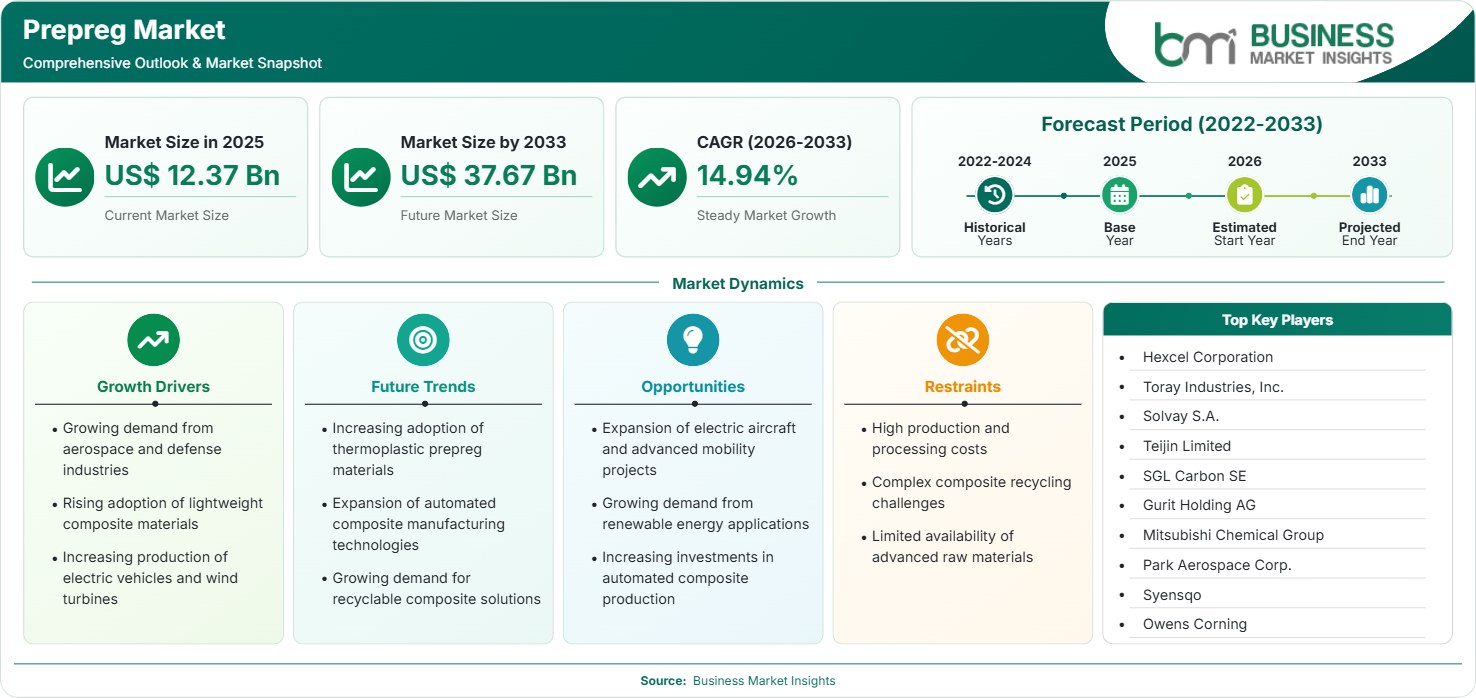
The Prepreg Market size was valued at US$ 12.37 Billion in 2025 and is projected to reach US$ 37.67 Billion by 2033, growing at a CAGR of 14.94% during 2026–2033, driven by aerospace demand, lightweight composites adoption, electric mobility expansion, renewable energy investments, and automated manufacturing advancements.

Report Coverage
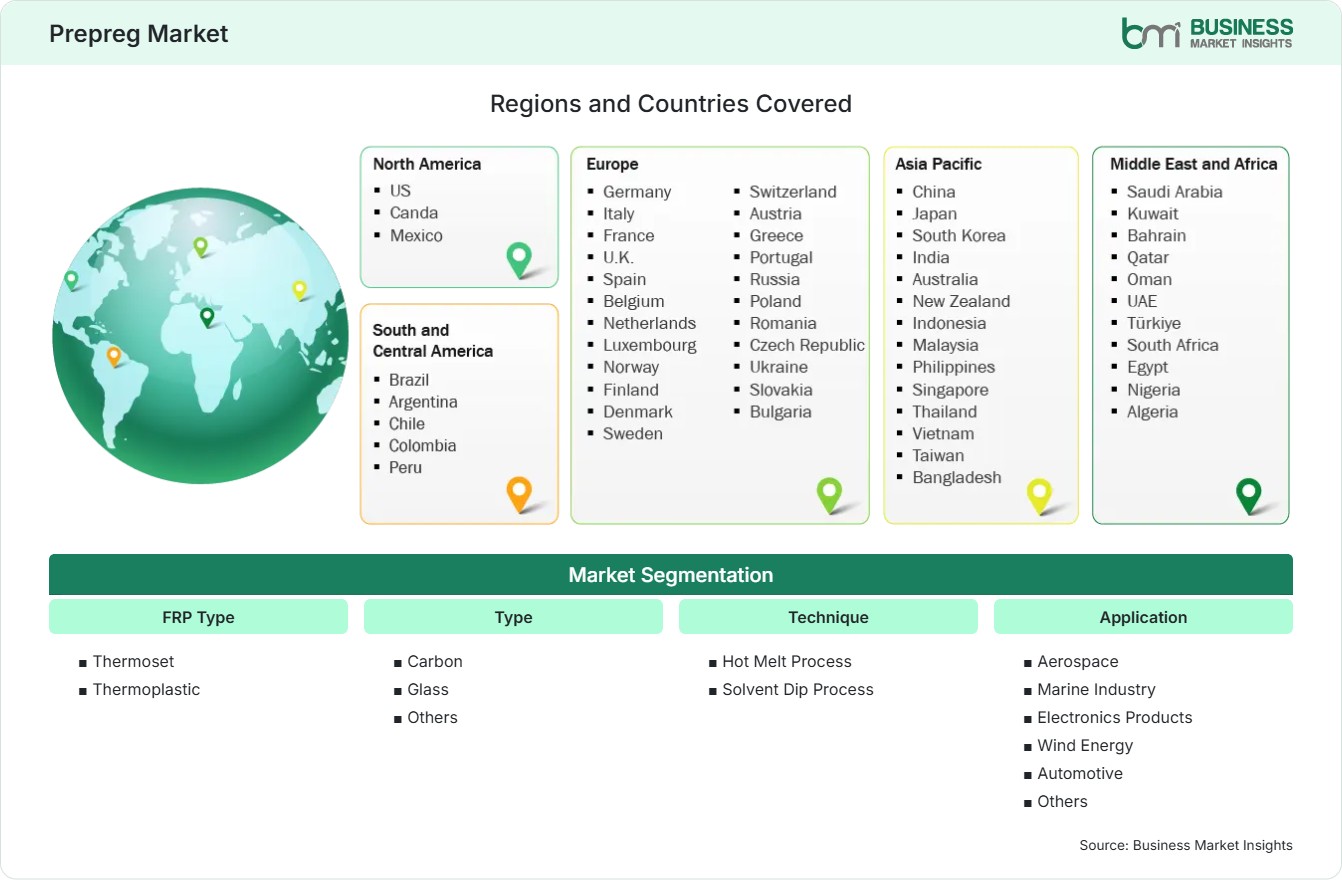
  • FRP Type: Thermoset, Thermoplastic
  • Type: Carbon, Glass, Others
  • Technique: Hot Melt Process, Solvent Dip Process
  • Application: Aerospace, Marine Industry, Electronics Products, Wind Energy, Automotive, Others
US$ 12.37 Bn Market size in 2025
US$ 37.67 Bn Market Size by 2033
14.94% CAGR, 2026 - 2033
2026-2033 Forecast Period

AI Overview

Prepreg Market Summary

  • North America Region: North America holds a 35%–39% share in 2025, growing with a CAGR of 14.5%–15.5% during 2026–2033, influenced by aerospace manufacturing, defense modernization, composite innovation, and electric vehicle development. The US market demonstrates strong demand from aerospace structures, defense applications, and advanced manufacturing sectors, supported by a CAGR of 14.7%–15.7% between 2026 and 2033.
  • Fastest Growing Region: Asia Pacific holds a 30%–34% share in 2025, expanding at a CAGR of 15.2%–16.2% during 2026–2033, supported by aerospace production expansion, automotive electrification, renewable energy installations, and increasing composite manufacturing capabilities.
  • Leading Segment: Carbon prepreg holds a 55%–60% share in 2025, progressing with a CAGR of 15.0%–15.8% during 2026–2033, driven by high strength-to-weight requirements, aerospace applications, electric vehicles, and advanced industrial components.
  • High Growth Segment: Thermoplastic prepreg holds a 18%–22% share in 2025, advancing at a CAGR of 16.0%–17.0% during 2026–2033, supported by recyclability advantages, faster processing capabilities, automotive applications, and lightweight structural requirements.
  • Key Market Opportunity: Opportunities are emerging through electric aircraft development, renewable energy expansion, automated composite production, advanced mobility projects, and increasing adoption of high-performance lightweight materials.
  • Major Market Players: Hexcel Corporation, Toray Industries, Inc., Solvay S.A., Teijin Limited, SGL Carbon SE, Gurit Holding AG, Mitsubishi Chemical Group, Park Aerospace Corp., Syensqo, Owens Corning.
Strategic Insights

Prepreg Market: Strategic Insights

Prepreg Market Strategic Framework
FREE PDF
Request your free sample
Request free sample
Stakeholder View

Key Takeaways

  • The market ecosystem is evolving through collaboration among fiber manufacturers, resin suppliers, composite processors, aerospace companies, automotive manufacturers, and renewable energy developers.
  • Carbon-based prepreg materials represent a major growth opportunity due to increasing demand for lightweight structures in aerospace, electric vehicles, and performance-driven applications.
  • Innovation is shifting toward thermoplastic composites, automated production methods, improved curing technologies, and recyclable composite material solutions.
  • Asia Pacific presents a strong investment opportunity due to expanding aerospace production, electric vehicle manufacturing, renewable energy installations, and composite material infrastructure development.
  • Strategic partnerships and capacity expansions are increasing as companies seek stronger positions in advanced composites, sustainable materials, and high-value manufacturing applications.
  • Automation adoption is becoming a critical competitive factor as manufacturers focus on reducing production time, improving consistency, and lowering composite processing complexity.
Geographic Outlook

Prepreg Market Regional Highlights

North America Prepreg Market

North America accounted for a 35%–39% share in 2025 and is projected to grow at a CAGR of 14.5%–15.5% during 2026–2033. The region maintains a strong position due to aerospace leadership, defense investments, composite technology development, and advanced manufacturing capabilities. The Prepreg Market share is supported by demand from aircraft structures, military applications, and electric mobility programs. The growth is influenced by lightweight material adoption, research investments, and increasing composite integration across industries.

  • The United States dominates regional demand due to established aerospace manufacturers, defense programs, and continuous investment in advanced composite material technologies.
  • Canada is witnessing growth through aerospace manufacturing capabilities, renewable energy projects, and increasing adoption of lightweight composite materials.
  • Aerospace companies are increasing composite usage to improve fuel efficiency, reduce structural weight, and enhance aircraft performance.
  • Automotive manufacturers are exploring prepreg materials for electric vehicle structures requiring improved strength and weight reduction.

US Prepreg Market

The US accounted for a 29%–33% share within North America in 2025 and is expected to register a CAGR of 14.7%–15.7% during 2026–2033. The country remains a major innovation center due to aerospace production, defense applications, and advanced composite research. The market in the US is supported by aircraft modernization programs, electric vehicle development, and increasing demand for high-performance materials.

  • Aerospace manufacturers are adopting carbon fiber prepregs to improve aircraft efficiency, structural performance, and manufacturing reliability.
  • Defense applications are increasing demand for advanced composites used in lightweight military platforms and specialized equipment.
  • Electric vehicle manufacturers are exploring composite materials to improve battery efficiency through reduced vehicle weight.
  • Research institutions and manufacturers are developing automated composite production methods to improve scalability and reduce processing limitations.

Europe Prepreg Market

Europe represented a 24%–28% share in 2025 and is expected to expand at a CAGR of 14.2%–15.2% during 2026–2033. The region benefits from strong aerospace manufacturing, renewable energy development, automotive innovation, and sustainability-focused material adoption. Germany, France, and the United Kingdom are leading markets due to advanced industrial capabilities and composite technology expertise. The Prepreg Market share in Europe is supported by demand for lightweight structures, fuel-efficient aircraft, electric mobility solutions, and high-performance engineering applications.

  • Germany remains a key market due to its automotive manufacturing strength, aerospace capabilities, and increasing use of advanced composite materials in industrial applications.
  • France contributes significantly through aerospace production, aircraft component manufacturing, and investments in lightweight material technologies for aviation applications.
  • The United Kingdom is expanding through aerospace innovation, renewable energy projects, and development of advanced composite manufacturing capabilities.
  • European manufacturers are investing in sustainable composite solutions to reduce environmental impact and improve material efficiency.
  • Research organizations and industry players are developing recyclable composite technologies to address future sustainability requirements.

Asia Pacific Prepreg Market

Asia Pacific accounted for a 30%–34% share in 2025 and is projected to grow at a CAGR of 15.2%–16.2% during 2026–2033. The region represents the fastest-growing market due to expanding aerospace production, electric vehicle manufacturing, renewable energy investments, and increasing composite material capabilities. China, Japan, South Korea, and India are major contributors supported by industrial development and infrastructure expansion. The Prepreg Market growth in Asia Pacific is driven by lightweight material adoption across automotive, aerospace, and energy sectors.

  • China leads regional growth through aerospace manufacturing expansion, electric vehicle production, and significant investments in composite material technologies.
  • Japan is advancing through aerospace innovation, automotive lightweighting initiatives, and expertise in high-performance carbon fiber manufacturing.
  • South Korea is increasing adoption through electric vehicle development, renewable energy projects, and advanced industrial composite applications.
  • India provides emerging opportunities through aerospace sector expansion, infrastructure development, and increasing investment in advanced manufacturing.
  • Regional manufacturers are improving production capabilities to support rising demand for lightweight and durable composite materials.

Rest of World Prepreg Market

Latin America and Middle East & Africa accounted for a 5%–9% share in 2025 and are projected to grow at a CAGR of 13.5%–14.5% during 2026–2033. These regions are developing through renewable energy investments, aerospace modernization, and industrial diversification. Brazil, Mexico, UAE, and Saudi Arabia are emerging markets due to increasing infrastructure development and advanced material adoption. The Prepreg Market share remains comparatively lower but provides opportunities through wind energy projects, aviation expansion, and industrial applications.

  • Brazil is witnessing opportunities through renewable energy development, aerospace activities, and increasing demand for lightweight industrial materials.
  • Mexico benefits from automotive manufacturing capabilities and integration of composite materials into export-oriented production facilities.
  • UAE is investing in aerospace infrastructure, advanced manufacturing projects, and lightweight material applications across transportation sectors.
  • Saudi Arabia is expanding composite adoption through renewable energy projects and industrial transformation initiatives.
  • Regional markets require improved manufacturing capabilities, technical expertise, and supply chain development to accelerate composite material adoption.
Global Market Geography
FREE PDF
Request your free sample
Request free sample
Segment Analysis

Prepreg Market Segmentation

FRP Type

The FRP Type segment is led by Thermoset prepregs, which accounted for a 70%–75% share in 2025 and is projected to grow at a CAGR of 14.5%–15.5% between 2026–2033. Demand is increasing due to the need for lightweight, durable, and high-performance composite materials across aerospace, automotive, and energy applications. The Prepreg Market scope is expanding through advancements in resin technology, manufacturing automation, and material performance improvements. Thermoset materials currently maintain wider adoption due to established processing advantages.

  • Thermoset: Thermoset prepregs dominate due to high mechanical strength, temperature resistance, and extensive aerospace and industrial applications.
  • Thermoplastic: Thermoplastic prepregs are gaining adoption through recyclability benefits, faster processing cycles, and increasing automotive lightweighting requirements.

Type

The Type segment is dominated by Carbon prepregs, which accounted for a 55%–60% share in 2025 and is expected to grow at a CAGR of 14.5%–15.5% between 2026–2033. Material selection is influenced by strength requirements, application performance, and cost considerations. Carbon prepregs maintain leadership due to superior mechanical properties, while glass-based materials continue supporting cost-sensitive applications. The trends indicate increasing demand for advanced fibers across transportation and energy sectors.

  • Carbon: Carbon prepregs lead adoption due to lightweight properties, high strength, and extensive use in aerospace and performance applications.
  • Glass: Glass prepregs support industrial applications through affordability, durability, and suitability for large-scale composite structures.

Technique

The Technique segment is led by the Hot Melt Process, which accounted for a 65%–70% share in 2025 and is projected to grow at a CAGR of 14.5%–15.5% between 2026–2033. Manufacturing techniques influence production efficiency, material consistency, and application suitability. The Prepreg Market trends indicate increasing adoption of automated processing methods to improve quality and reduce manufacturing limitations. Hot Melt Process remains widely used due to production efficiency and compatibility with advanced composite applications.

  • Hot Melt Process: Hot Melt Process is widely adopted due to solvent-free processing, improved material quality, and suitability for high-performance composite manufacturing.
  • Solvent Dip Process: Solvent Dip Process supports specific applications requiring controlled resin distribution and specialized composite material characteristics.

Application

The Application segment is led by Aerospace, which accounted for a 35%–40% share in 2025 and is projected to grow at a CAGR of 14.5%–15.5% between 2026–2033. Increasing demand for lightweight, durable, and high-strength materials is expanding prepreg adoption across multiple industries. Aerospace remains the leading application due to strict performance requirements, while automotive and wind energy applications are gaining momentum. The Prepreg Market scope continues expanding through electrification, renewable energy growth, and advanced mobility development.

  • Aerospace: Aerospace applications dominate due to extensive use of lightweight composites for aircraft structures, components, and performance improvement requirements.
  • Marine Industry: Marine applications utilize prepregs for durable, corrosion-resistant structures requiring high strength and reduced weight.
  • Electronics Products: Electronics applications adopt prepregs for advanced components requiring thermal stability, precision, and reliable performance.
  • Wind Energy: Wind energy applications are increasing through demand for lightweight and durable turbine blade materials supporting renewable power expansion.
  • Automotive: Automotive applications are growing due to electric vehicle development, lightweighting requirements, and improved energy efficiency targets.
Market Forces

Prepreg Market Dynamics

Key Market Drivers

Growing demand from aerospace and defense industries

Growing demand from the aerospace and defense industries is a major driver of prepreg adoption, as manufacturers seek materials that offer high strength, reduced weight, and improved structural performance. There is an increased use of carbon fiber composites in the wing, fuselage structure, and interiors of aircrafts to enhance fuel economy and performance. Advanced composites are being used in the construction of light weight military vehicles and specialized equipment as well. High levels of production of aircrafts, modernization of fleets, and defense spending have contributed to the growth of high-quality prepreg products. The increase in the use of advanced composites is driven by innovation in the aerospace industry and need for durable composite materials.

Rising adoption of lightweight composite materials

Growing usage of lightweight composites is becoming more prevalent in the automotive, aerospace, and industrial segments due to the need for greater efficiency and effectiveness. Composite materials offer some benefits over conventional materials like high strength-to-weight ratio, resistance to corrosion, and flexibility in design. There is growing use of composites in the automotive industry to make cars lighter and increase their range as electric vehicles. There is also growing usage of composite materials in the industrial sector where durability and maintenance are necessary. Prepreg Market trends indicate increasing investment in advanced fibers, improved resin technologies, and automated manufacturing methods to support broader adoption of composites.

Increasing production of electric vehicles and wind turbines

The increasing production of electric vehicles and wind turbines is driving significant demand for prepreg materials due to their lightweight and high-performance requirements. Electric vehicle manufacturers are using composite materials to reduce structural weight, improve battery efficiency, and enhance vehicle performance. Advanced composites are being utilized by the wind energy sector for blades that need to be strong and able to withstand the elements. The increasing installation of renewables and electrification around the world are motivating composite manufacturers to increase their capabilities. Electrification along with renewables is opening new application possibilities for prepregs companies. Advanced materials technology is being invested in by companies to make their process efficient and lower costs.

Key Market Opportunities

Expansion of electric aircraft and advanced mobility projects

Development in electric aircraft and advanced mobility initiatives has opened up new avenues for the prepreg suppliers owing to the fact that future vehicles will be made using light yet durable materials. Electric aircraft companies are seeking ways to reduce structural weight to improve efficiency, range, and performance. Advanced mobility projects, including urban air mobility initiatives, have increased the need for high-performing composites with consistent quality and reliability. Prepreg materials offer superior mechanical properties, design, and production capabilities. The Prepreg Market Forecasts indicate that investments in electric aviation and advanced mobility technologies will create long-term opportunities for composite suppliers.

Growing demand from renewable energy applications

Growing demand from renewable energy applications is creating opportunities for prepreg manufacturers as wind energy projects require stronger, lighter, and more durable composite materials. The manufacture of wind turbines has been increasing the application of advanced composites to enhance efficiency, effectiveness, and longevity. The development of renewable energy systems in both developed and emerging economies will facilitate an increase in demand for composite material solutions. Prepreg technology helps in manufacturing of larger structural parts with better performance properties. Firms which create affordable and sustainable composite solutions have much to gain from investments in renewable energy systems. The rise in offshore wind farms and larger wind turbines should increase the demand for advanced prepregs in the energy sector.

Increasing investments in automated composite production

Increased investment in the automation of composite fabrication is providing new opportunities by improving manufacturing efficiency, reducing production time, and increasing material uniformity. The application of automation technologies enables manufacturers to increase composite material output while maintaining the high standards of quality required for aerospace, automotive and industrial applications. Automated fiber placement, robot processing and digital manufacturing are used by companies to increase their productivity. Automation technologies help address the challenges of labour-intensive composite manufacturing and increase production levels. Increased investment in automation also provides opportunities to create new composite structures that will be used in the construction of electric cars, aircrafts and renewable energy systems.

Market Restraints and Challenges

High production and processing costs

Factor: Advanced fibers, specialized resin systems, controlled manufacturing environments, and complex processing requirements increase production expenses compared with conventional materials. Impact: Higher costs can limit adoption in automotive, industrial, and commercial applications where affordability remains a key purchasing consideration. Process optimization, automation, and improved supply chain management have been considered to reduce costs. It is very important for companies to ensure that they have developed cost-effective material solutions without compromising on performance. Even though high costs are acceptable in the premium and aerospace industries, cost reductions should be improved production efficiency and competitive pricing strategies.

Complex composite recycling challenges

Factor: The combination of advanced fibers and polymer matrices creates technical challenges for efficient recycling and material recovery processes. Impact: Recycling limitations can increase environmental concerns, affect sustainability goals, and restrict adoption among industries prioritizing circular material solutions. Recyclable composites, advanced resins, and recovery are among the strategies employed by producers in tackling the issues. Regulations that encourage the production of sustainable materials have helped in fostering creativity in the composite industry. The development of sustainable recycling systems and effective recovery procedures will be key in boosting the adoption of prepreg materials.

Company Analysis

Competitive Landscape

The Prepreg Market analysis highlights a competitive environment shaped by advanced composite development, aerospace demand, renewable energy expansion, electric mobility adoption, and manufacturing technology advancements. Leading companies are focusing on carbon fiber innovation, sustainable composite solutions, production capacity expansion, and automation capabilities to strengthen their market positions.

Company Name

Overview

Products and Services relevant to this market

Hexcel Corporation

Global advanced composite materials company serving aerospace, defense, and industrial markets with specialized solutions.

Provides carbon fiber prepregs, composite materials, and advanced manufacturing solutions for aerospace and industrial applications.

Toray Industries, Inc.

Japanese materials company specializing in advanced fibers, chemicals, and composite technologies.

Offers carbon fiber prepregs, composite materials, and high-performance solutions for aerospace and automotive sectors.

Solvay S.A.

Global specialty materials company focused on advanced composites and high-performance applications.

Develops composite prepregs, aerospace materials, and advanced resin systems for industrial applications.

Teijin Limited

Technology-driven materials company providing advanced fibers and composite solutions worldwide.

Supplies carbon fiber prepregs and composite materials for aerospace, automotive, and industrial applications.

SGL Carbon SE

Manufacturer specializing in carbon-based materials and composite solutions.

Provides carbon fiber materials, prepregs, and composite solutions for mobility and industrial markets.

Gurit Holding AG

Composite material supplier serving wind energy, marine, and industrial applications.

Offers prepreg materials, composite technologies, and manufacturing solutions for renewable energy and marine sectors.

Mitsubishi Chemical Group

Global chemical company developing advanced materials and composite technologies.

Provides carbon fiber composites, prepreg solutions, and specialty materials for various industries.

Park Aerospace Corp.

Aerospace composite manufacturer specializing in advanced material solutions.

Develops aerospace-grade prepregs, composite structures, and related manufacturing technologies.

Syensqo

Advanced materials company focused on specialty solutions and composite innovations.

Provides advanced composite materials and technologies supporting aerospace and industrial applications.

Owens Corning

Global building and materials company producing fiberglass and composite solutions.

Supplies glass fiber composite materials and prepreg-related solutions for industrial applications.

Trust & Transparency

Research Methodology

The market analysis combines proprietary research with secondary data from government agencies, company disclosures, regulatory filings, industry databases and expert interviews. Market estimates are validated through data triangulation, cross-market benchmarking and analyst review.

View Full Research Methodology

Questions Answered

Frequently Asked Questions

What role does automation play in prepreg manufacturing?

Automation improves production consistency, reduces processing time, supports higher manufacturing volumes, and enables advanced composite structures for aerospace, automotive, and renewable energy applications.

How are companies addressing composite recycling limitations in Prepreg Market?

Companies are developing recyclable resin systems, advanced recovery technologies, and sustainable composite solutions to improve material circularity and reduce environmental challenges.

Why is carbon prepreg widely used in aerospace applications?

Carbon prepreg is preferred in aerospace because it provides high strength-to-weight performance, corrosion resistance, structural efficiency, and reliability under demanding operating conditions.

How are thermoplastic prepregs gaining market attention?

Thermoplastic prepregs are gaining attention due to recyclability benefits, faster processing capabilities, improved impact resistance, and suitability for automotive and advanced mobility applications.

What factors are increasing adoption of materials in Prepreg Market report?

Adoption is increasing due to demand for lightweight structures, aerospace modernization, electric vehicle production, renewable energy expansion, and improved composite manufacturing technologies.

Access the Full Prepreg Market Report

Get segment-level forecasts, regional estimates, competitive benchmarking, company profiles and downloadable Excel datasets.

Access the full Prepreg Market Report
350 pages PDF & Excel | 2026-08-31
Similar Research

Related Market Reports