
Power Monitoring Market Outlook: Size, Share, Trends, Growth Analysis, Competitive Landscape & Forecast, 2026-2033

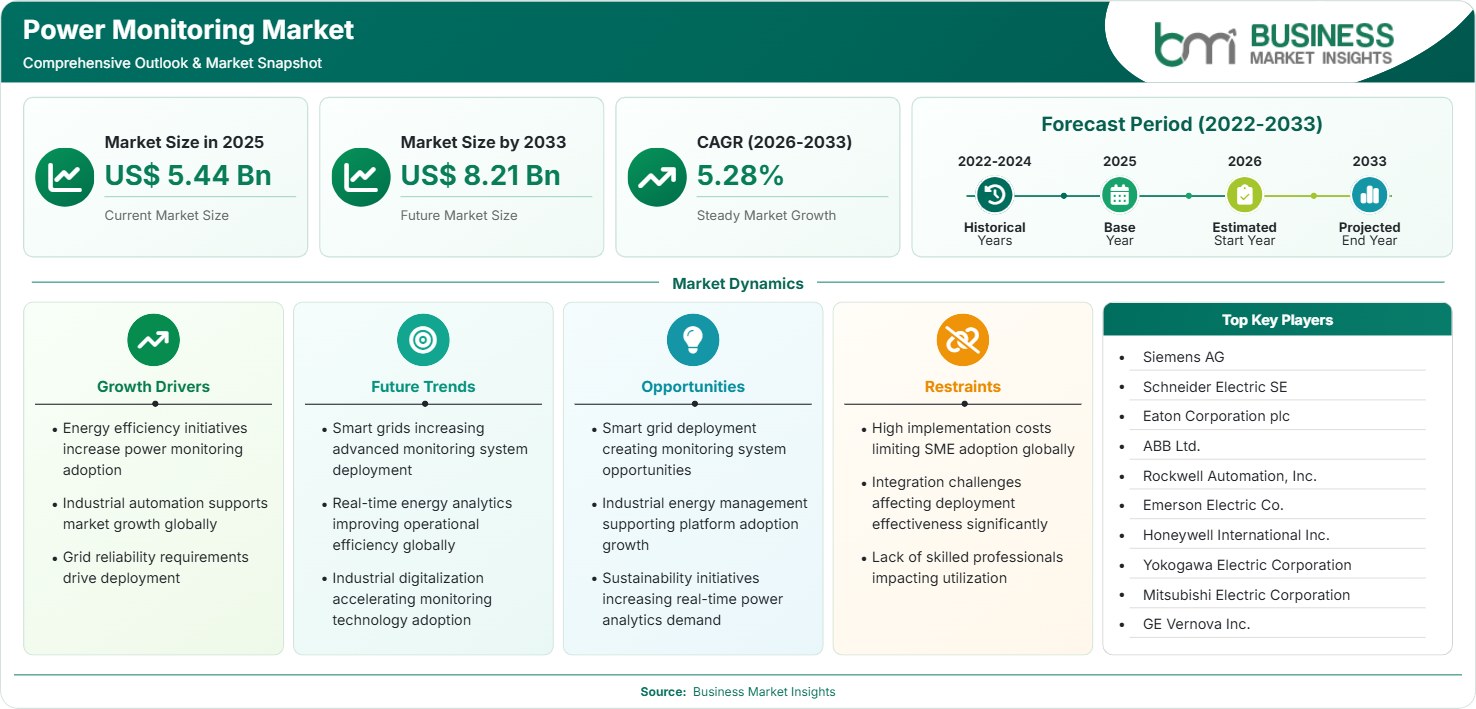
The Power Monitoring Market size was valued at US$ 5.44 Billion in 2025 and is projected to reach US$ 8.21 Billion by 2033, growing at a CAGR of 5.28% during 2026–2033, driven by grid modernization, industrial electrification, data-center expansion, renewable integration, power-quality requirements, and intelligent energy management adoption.

Report Coverage
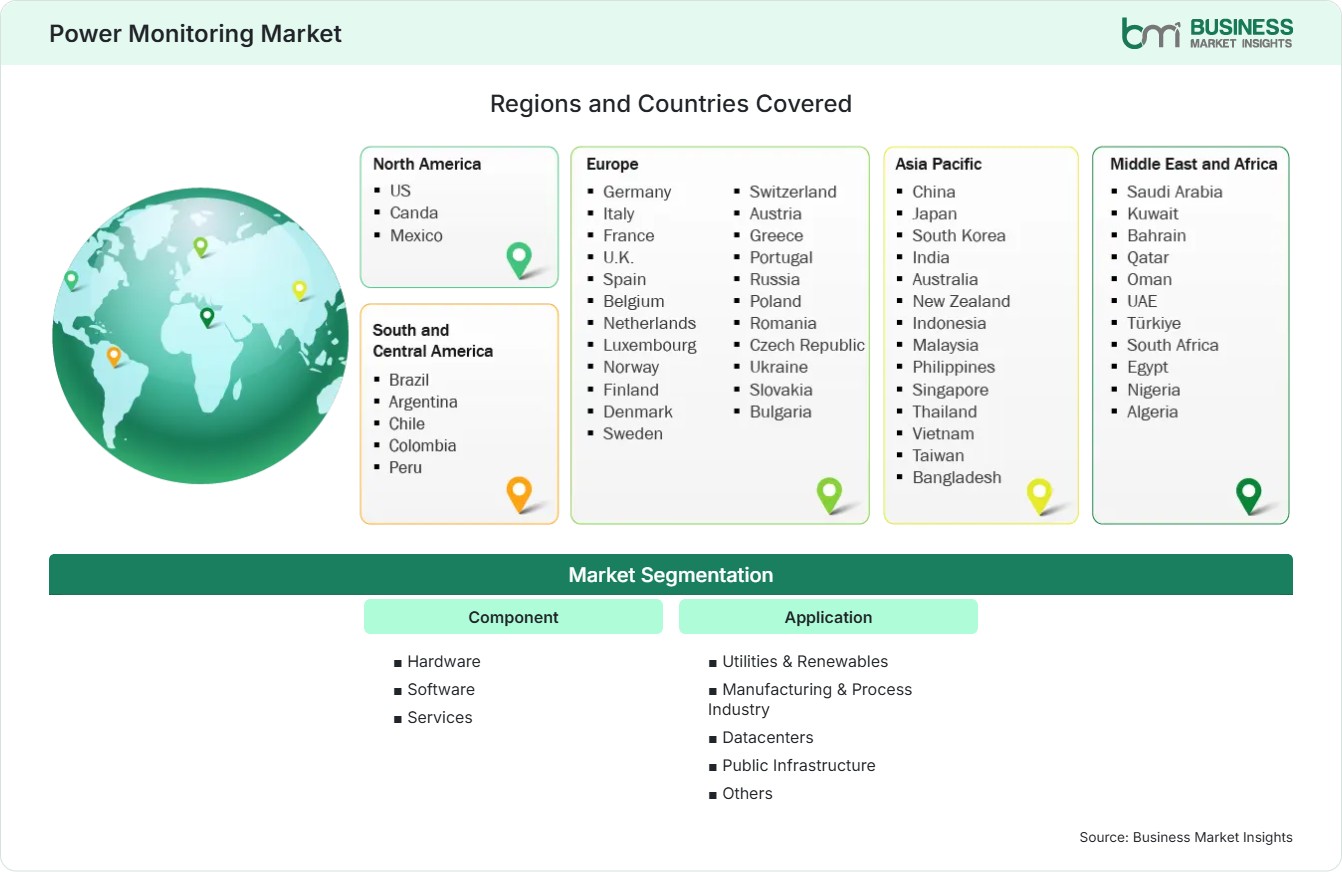
  • Component: Hardware, Software, Services
  • Application: Utilities & Renewables, Manufacturing & Process Industry, Datacenters, Public Infrastructure, Others
US$ 5.44 Bn Market size in 2025
US$ 8.21 Bn Market Size by 2033
5.28% CAGR, 2026 - 2033
2026-2033 Forecast Period

AI Overview

Power Monitoring Market Summary

  • North America Region: holds a 36%–39% share in 2025, growing with a 4.7%–5.2% CAGR, influenced by data-center expansion, grid modernization, industrial automation, resilience investments, power-quality requirements, distributed energy resources, and federal infrastructure programs.
  • Fastest Growing Region: Asia Pacific holds a 25%–29% share in 2025, growing with a 6.1%–6.7% CAGR, supported by industrial expansion, renewable deployment, smart-grid investment, electrification, semiconductor manufacturing, and accelerating data-center construction across major economies.
  • Leading Segment: Utilities & Renewables holds a 31%–34% share in 2025, growing with a 5.4%–5.9% CAGR, supported by renewable integration, grid balancing, distributed generation, transmission modernization, storage deployment, reliability requirements, and increasing visibility across complex power networks.
  • High Growth Segment: Data centers hold a 16%–19% Power Monitoring Market share in 2025, growing with a 7.0%–7.8% CAGR, supported by artificial intelligence workloads, hyperscale expansion, power-density increases, uptime requirements, advanced cooling, renewable procurement, and increasingly sophisticated electrical infrastructure.
  • Key Market Opportunity: Demand for granular electrical visibility is expanding as utilities, manufacturers, and data centers combine meters, sensors, analytics, and software to optimize capacity, reliability, efficiency, maintenance, and renewable integration.
  • Major Market Players: Siemens AG, Schneider Electric SE, Eaton Corporation plc, ABB Ltd., Rockwell Automation, Inc., Emerson Electric Co., Honeywell International Inc., Yokogawa Electric Corporation, Mitsubishi Electric Corporation, and GE Vernova Inc.
Strategic Insights

Power Monitoring Market: Strategic Insights

Power Monitoring Market Strategic Framework
FREE PDF
Request your free sample
Request free sample
Stakeholder View

Key Takeaways

  • The value chain is progressing towards integrated monitoring ecosystems such that meters, sensors, communications, analytics, control platforms, engineering services, and lifecycle support are increasingly being bought as coordinated solutions rather than as separate components.
  • Data centers have one of the best potential for growth since AI computing increases load density, speeds up demand variability, and raises the cost of undetected power-quality disturbances, which makes detailed monitoring strategically important.
  • As customers look for features such as anomaly detection, predictive maintenance, automated reporting, asset benchmarking, demand forecasting, and integration with management platforms for buildings, industry, utilities, and data centers, the importance of software differentiation is increasing.
  • The strongest regional opportunity for expansion is offered by Asia Pacific since, in China, India, Japan, South Korea, and Southeast Asia, manufacturing capacity, the deployment of renewable energy, semiconductor investment, digital infrastructure, and electrification are all advancing at the same time.
  • More of the investment is now being directed towards digital grid capabilities, energy intelligence, storage management, and industrial optimization. Latest information from suppliers shows that there is a greater focus on AI-enabled analytics, software-as-a-service, and interoperable monitoring architectures.
  • Since customers are increasingly likely to assess monitoring as part of their resilience and operational intelligence initiatives, vendors who combine electrical measurement accuracy with cybersecurity, open communications, edge computing, and scalable analytics are able to secure larger budgets.
Geographic Outlook

Power Monitoring Market Regional Highlights

North America Power Monitoring Market

North America held a 36%–39% share in 2025 and is projected to expand at a 4.7%–5.2% CAGR through 2033. The region benefits from mature industrial automation, extensive data-center investment, aging electrical infrastructure, and strong emphasis on reliability. The Power Monitoring Market share remains supported by utility modernization and commercial energy-management programs.

  • The demand for branch-level measurements, power-quality analysis, thermal correlation, and continuous electrical diagnostics is growing in data-center construction within high-density computing environments.
  • There is now a growing demand for network visibility, distributed-energy monitoring, outage intelligence, and advanced analytics to enable more flexible grid operations and the integration of renewable energy.
  • More industrial users are linking power monitoring with their automation systems to detect production losses, abnormal consumption, equipment degradation, and opportunities for demand management.
  • Organizations are being encouraged by resilience investments to continuously monitor their electrical assets rather than depending only on periodic inspections, in particular within critical infrastructure and in mission-critical facilities.

US Power Monitoring Market

The US represented a substantial portion of North American demand in 2025 and is projected to grow at a 4.6%–5.1% CAGR through 2033. The Power Monitoring Market is benefiting from expanding data centers, manufacturing reshoring, grid investment, and electrification.

  • The federal investment in the grid is making the business case for advanced measurement and operational visibility stronger, especially in those cases where utilities require more transmission capacity, resilience, and asset utilization.
  • With rapid changes in load, there is a greater demand for high-speed power-quality monitoring because the electrical stresses that they cause may not be picked up by conventional periodic measurement.
  • The expansion in manufacturing is aiding the installation of monitoring systems in the sectors of semiconductors, automobiles, chemicals, food processing, and other advanced industrial establishments since energy intensity and uptime have a direct effect on operating economics.

Europe Power Monitoring Market

Europe held a 23%–26% share in 2025 and is projected to expand at a 4.9%–5.4% CAGR through 2033. The Power Monitoring Market share is reinforced by industrial efficiency programs, renewable integration, carbon-management priorities, and energy-cost optimization.

  • Germany has both a big industrial base and a strong emphasis on energy efficiency, which in turn leads to a demand for precise electrical measurements in manufacturing plants, in logistics equipment, and in commercial buildings.
  • The United Kingdom is making use of grid flexibility, the integration of renewable energy, electrification, and the growing need for better visibility with regard to distributed energy resources.
  • France gains the advantages of electrification, the modernization of its nuclear power generation, the expansion of renewable energy sources, and the digitalization of its industry, leading to a demand for reliable measurement and power-quality management.
  • The Netherlands is well placed to achieve faster adoption due to its data centers, logistics infrastructure, advanced manufacturing, and its function as a hub for interconnected European electricity and digital infrastructure.

Asia Pacific Power Monitoring Market

Asia Pacific held a 25%–29% Power Monitoring Market share in 2025 and is projected to achieve the fastest 6.1%–6.7% CAGR through 2033. China remains the largest market, while India, Japan, South Korea, Singapore, and Southeast Asian economies provide strong incremental demand.

  • By combining its vast manufacturing capacity with renewable energy generation, battery production, and the expansion of its grid, China has created wide-ranging monitoring needs covering factories, utilities, renewable energy assets, and infrastructure.
  • India is generating a strong demand as a result of industrialization, the construction of data centers, the addition of renewable capacity, electrification, and the modernization of its infrastructure throughout its rapidly growing urban and manufacturing areas.
  • Both Japan and South Korea place importance on reliability, advanced manufacturing, semiconductor production, and energy efficiency, and this is reflected in their provision of sophisticated monitoring systems in situations where power quality and operational continuity are essential.
  • Southeast Asia is becoming a region of high growth since Singapore, Malaysia, Indonesia, Thailand, and Vietnam are expanding their data centers, manufacturing capacity, renewable energy generation, and digital infrastructure.

Rest of World Power Monitoring Market

South and Central America represented approximately 6%–8% of global Power Monitoring Market demand in 2025, while the Middle East and Africa accounted for roughly 4%–5%. South America is projected to grow at a 5.4%–6.0% CAGR, supported by renewable generation and industrial modernization.

  • Through renewable energy generation, rising industrial demand, the development of the transmission system, and the need on the part of large commercial facilities for greater energy visibility and better control of their operating costs, Brazil is increasing the range of its monitoring opportunities.
  • Chile has the potential for attractive growth due to its use of solar energy, the electrification of its mining operations, the introduction of energy storage systems, and the establishment of industrial facilities in remote areas where the reliability of electricity has a direct impact on the continuity of production.
  • Saudi Arabia and the United Arab Emirates are putting money into smart infrastructure, data centers, industrial projects, and the modernization of utilities, which is leading to a demand for digital monitoring and grid intelligence.
  • There are opportunities in South Africa in the areas of industrial energy management, distributed generation, improved reliability, and in regard to facilities that want greater control over their electricity consumption and over power-quality disturbances.
Global Market Geography
FREE PDF
Request your free sample
Request free sample
Segment Analysis

Power Monitoring Market Segmentation

Component

The Component segment accounted for the majority of Power Monitoring Market demand in 2025, supported by installed measurement infrastructure and recurring software and services requirements. Hardware represented the foundational layer, while software captured increasing value through analytics and visualization.

  • Hardware: Intelligent meters, sensors, analyzers, gateways, and communication devices provide real-time electrical measurements across facilities, enabling monitoring of voltage, current, demand, harmonics, energy consumption, and equipment conditions.
  • Software: Analytics platforms convert electrical measurements into actionable information through dashboards, alarms, benchmarking, forecasting, anomaly detection, reporting, and integration with industrial, building, utility, and data-center systems.
  • Services: Consulting, installation, integration, commissioning, maintenance, calibration, cybersecurity, and optimization services support deployment quality while helping customers sustain monitoring performance across changing electrical infrastructure.

Application

Application demand is led by utilities and renewable assets because grid complexity requires continuous measurement across generation, transmission, distribution, storage, and distributed resources. Datacenters represent the fastest-growing Power Monitoring Market opportunity as AI increases electrical density and variability.

  • Utilities & Renewables: Grid operators use monitoring to measure voltage, frequency, power flows, disturbances, and renewable output, supporting reliability, distributed resources, storage coordination, and operational planning.
  • Manufacturing & Process Industry: Energy-intensive plants deploy monitoring to identify consumption patterns, production losses, harmonics, equipment stress, and peak-demand exposure while integrating electrical data with automation platforms.
  • Datacenters: Mission-critical facilities require continuous measurement across switchgear, UPS systems, generators, cooling infrastructure, racks, and distribution paths to maintain uptime and manage rapidly changing computational loads.
  • Public Infrastructure: Airports, hospitals, transportation facilities, campuses, and municipal assets use monitoring to improve reliability, energy efficiency, maintenance planning, and visibility across complex electrical networks.
Market Forces

Power Monitoring Market Dynamics

Key Market Drivers

AI Data Centers Are Increasing Electrical Monitoring Requirements

The growth is increasingly connected to AI-driven data-center expansion. The IEA estimates global data-center electricity consumption will more than double to approximately 945 TWh by 2030, while AI-focused facilities grow faster than conventional computing environments. Higher rack densities, accelerated computing, cooling loads, and rapid load changes require measurement beyond basic energy consumption. Monitoring systems increasingly combine power-quality analysis, branch-level measurement, event detection, thermal information, and analytics. As AI infrastructure scales, the Power Monitoring Market trends are therefore shifting toward high-frequency measurement, automated diagnostics, and integration with data-center infrastructure management systems.

Grid Modernization Is Expanding Monitoring Across Distributed Assets

Electricity systems are becoming more decentralized as solar, wind, batteries, electric vehicles, and flexible loads connect to distribution networks. Monitoring provides the measurement layer needed to understand bidirectional power flows, voltage behavior, frequency conditions, and asset loading. The IEA reports that global grid investment is around US$400 billion annually, but spending needs to rise to maintain electricity security as demand and renewable deployment increase. The Power Monitoring Market growth therefore benefits from the convergence of grid expansion, distributed generation, storage, and digital utility transformation.

Industrial Electrification Is Raising the Value of Energy Visibility

Industrial facilities are incorporating electrification along with automation, robotics, variable-speed drives, electric heating, and distributed generation. These modifications make the production systems more sensitive to voltage disturbances, harmonics, transient events, and demand peaks. By monitoring, they allow manufacturers to link electrical conditions with production events, to detect abnormal consumption, and to prioritize the measures that will correct the problem. Energy-intensive industries can make use of detailed measurements to aid their efficiency programs and demand management, while process industries are able to benefit from continuous oversight of their key electrical assets.

Key Market Opportunities

Energy Intelligence Platforms Can Expand Software Revenue

Software provides an opportunity to derive ongoing value from the measurement infrastructure that is already in place. Although many organizations collect electrical data, they lack the tools to translate the measurements into operational decisions. Sophisticated platforms can combine meter data with production schedules, weather inputs, equipment condition, utility tariffs, and asset records to detect avoidable costs and abnormal behavior. Analytics enabled by AI can furthermore automate the processes of anomaly detection, forecasting, root-cause analysis, and the provision of maintenance recommendations.

Data-Center Power Quality Creates High-Value Monitoring Applications

The quick growth of AI infrastructure provides an opportunity for specialized monitoring systems to be developed for use with high-density computing. Since AI workloads result in more variable electrical demand and, as a result of the use of more sophisticated cooling and power-conversion equipment, there are more critical electrical interfaces that need to be monitored. Monitoring companies can meet this situation by using high-speed event capture, carrying out power-quality analytics, providing predictive alarms, taking measurements at the branch level, and offering automated capacity reporting.

Renewable and Storage Integration Supports New Monitoring Demand

The increasing use of renewable energy and battery storage is leading to more dynamic power networks, in which the direction of power flow, output variations, and the need to coordinate assets must be continuously monitored. The International Energy Agency expects additions of almost 4,600 GW of renewable capacity between 2025 and 2030, with solar power making up nearly 80% of the global expansion of renewable capacity. As a result, there will be a demand for monitoring at all kinds of sites, including large-scale power plants, distributed solar installations, storage systems, substations, and industrial microgrids.

Market Restraints and Challenges

High Integration Complexity Can Delay Deployment

The electrical environment often includes old meters, proprietary communication protocols, outdated switchgear, incompatible communication systems, and equipment supplied by various manufacturers. This can lead to higher engineering costs, longer commissioning times, and a delay in obtaining the monitoring benefits. In the case of large industrial facilities and utility companies, it may be necessary to use specially designed gateways, carry out protocol conversion, conduct cybersecurity reviews, and perform thorough validation before the new monitoring systems can gain access to operational data.

Cybersecurity and Data Governance Increase Solution Requirements

The fact is that connected monitoring systems are now communicating via operational technology networks, cloud platforms, remote services, and enterprise applications, which in turn brings about further cybersecurity and data-governance requirements. As a result, carrying out security assessments, implementing segmentation, setting up access controls, using encryption, applying patches, carrying out authentication, and conducting regulatory reviews can lead to higher deployment costs and longer procurement times. Utilities and operators of critical infrastructure are especially careful since if the monitoring infrastructure is compromised, it could reveal operational information or provide a means of gaining access to other systems.

Company Analysis

Competitive Landscape

The competitive environment combines electrical equipment manufacturers, automation companies, industrial technology providers, measurement specialists, and grid software suppliers. Power Monitoring Market analysis indicates that differentiation is increasingly based on the ability to connect accurate electrical measurement with analytics, automation, cybersecurity, and lifecycle services.

Company Name

Overview

Products and Services relevant to this market

Siemens AG

Global industrial technology company with extensive capabilities across electrification, automation, grid software, and industrial digitalization.

Power meters, power-quality monitoring, energy-management software, grid monitoring, automation, analytics, and lifecycle services.

Schneider Electric SE

Energy-management and automation provider serving buildings, industry, infrastructure, utilities, and data centers globally.

Power monitoring, intelligent meters, EcoStruxure platforms, energy analytics, power-quality solutions, digital grid software, and services.

Eaton Corporation plc

Intelligent power-management company with strong exposure to electrical infrastructure, data centers, industry, and grid applications.

Power-quality monitoring, electrical meters, Brightlayer digital solutions, energy management, UPS monitoring, and electrical services.

ABB Ltd.

Electrification and automation specialist supplying industrial, utility, infrastructure, and energy-management technologies.

Energy-management systems, power-quality solutions, digital substations, monitoring, analytics, automation, and electrical equipment.

Rockwell Automation, Inc.

Industrial automation provider integrating control, information, networking, and analytics across manufacturing environments.

Industrial energy monitoring, power measurement, automation software, data analytics, control integration, and industrial services.

Emerson Electric Co.

Industrial technology provider focused on automation, process control, power, water, and energy applications.

Energy-management software, SCADA, power automation, asset monitoring, analytics, control systems, and optimization services.

Honeywell International Inc.

Diversified technology company with strong capabilities in industrial automation, buildings, process management, and digital operations.

Energy monitoring, building management, industrial automation, asset analytics, power-management integration, and digital services.

Yokogawa Electric Corporation

Measurement and industrial automation specialist with deep expertise in precision measurement and process operations.

Power analyzers, measurement systems, plant monitoring, industrial analytics, automation, and engineering services.

Mitsubishi Electric Corporation

Diversified electrical and automation supplier serving industrial, infrastructure, energy, and building applications.

Energy-management systems, power measurement, monitoring controllers, automation, power electronics, and digital optimization.

GE Vernova Inc.

Energy technology company focused on power generation, electrification, grid modernization, and digital grid software.

Grid monitoring, SCADA, grid orchestration, asset monitoring, utility analytics, and digital grid management solutions.

Trust & Transparency

Research Methodology

The market analysis combines proprietary research with secondary data from government agencies, company disclosures, regulatory filings, industry databases and expert interviews. Market estimates are validated through data triangulation, cross-market benchmarking and analyst review.

View Full Research Methodology

Questions Answered

Frequently Asked Questions

Which applications offer the strongest future opportunity?

Utilities and renewable assets provide a broad structural opportunity because distributed generation and storage increase network complexity. Datacenters offer particularly strong growth potential because AI workloads are increasing electricity demand, power density, and requirements for continuous monitoring, resilience, and capacity optimization.

What role does software play in power monitoring?

Software connects measurement devices with operational decisions. It supports dashboards, alarms, benchmarking, energy reporting, demand forecasting, anomaly detection, asset analytics, and integration with automation or infrastructure-management systems. Recurring software models can also provide vendors with longer customer relationships than hardware-only deployments.

How is artificial intelligence changing monitoring solutions?

AI is shifting monitoring from passive measurement toward automated interpretation. Modern platforms can identify abnormal patterns, prioritize events, support predictive maintenance, correlate electrical conditions with operational activity, and provide natural-language access to energy information, reducing the time required to interpret large datasets.

Why are data centers becoming an important application?

The Power Monitoring Market Report highlights that Data centers operate highly sensitive electrical infrastructure where interruptions can affect large volumes of computing activity. AI workloads also increase power density and load variability, creating demand for detailed monitoring across switchgear, UPS systems, cooling systems, distribution equipment, and computing environments.

What is driving demand for power monitoring solutions?

Demand is being driven by grid modernization, industrial electrification, renewable integration, data-center expansion, power-quality requirements, and the need to reduce electrical losses. AI data centers are particularly important because higher power density and variable workloads increase the value of continuous electrical visibility.

Access the Full Power Monitoring Market Report

Get segment-level forecasts, regional estimates, competitive benchmarking, company profiles and downloadable Excel datasets.

Access the full Power Monitoring Market Report
350 pages PDF & Excel | 2026-10-26
Similar Research

Related Market Reports