
Power Distribution Component Market Size, Share, Trends & Forecast Report, 2026–2033

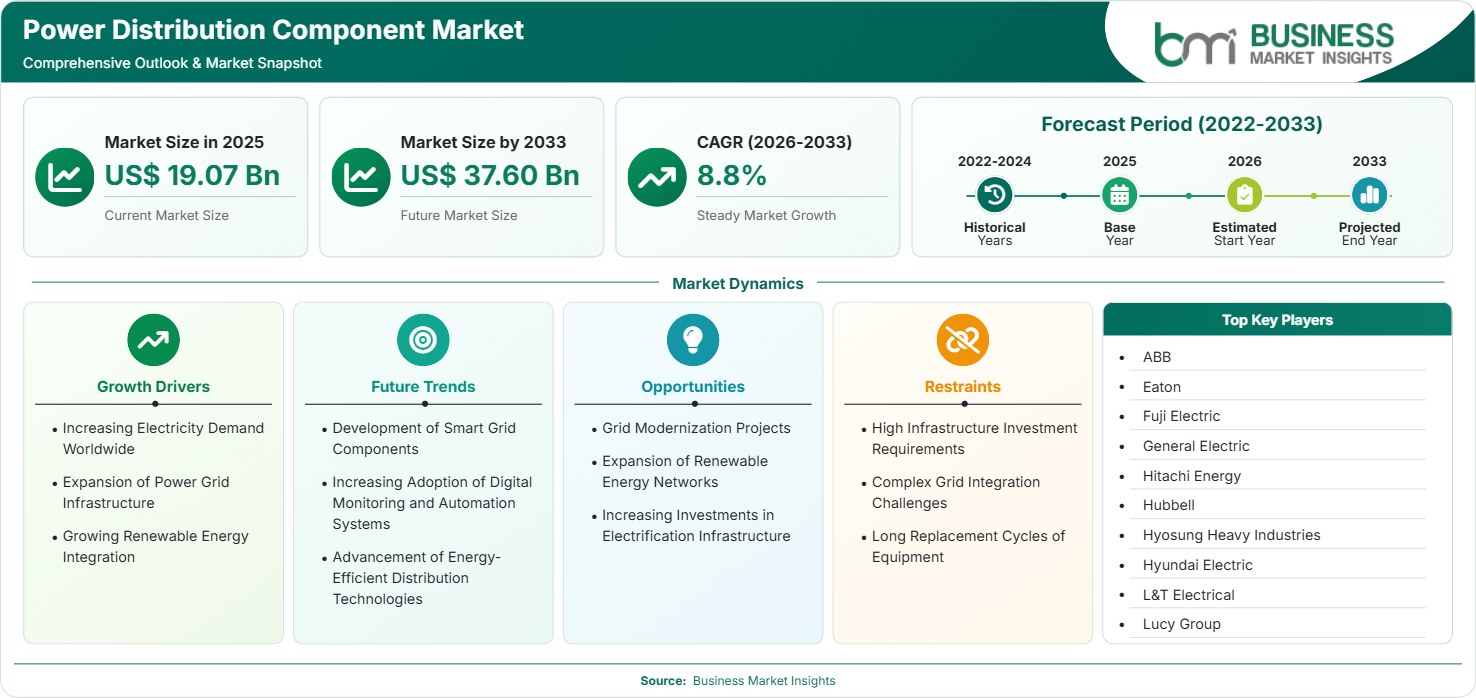
The Power Distribution Component Market size was valued at US$ 19.07 billion in 2025 and is projected to reach US$ 37.60 billion by 2033, growing at a CAGR of 8.8% during 2026–2033, driven by rising electricity consumption, grid modernization initiatives, renewable integration, and increasing electrification investments worldwide.

Report Coverage
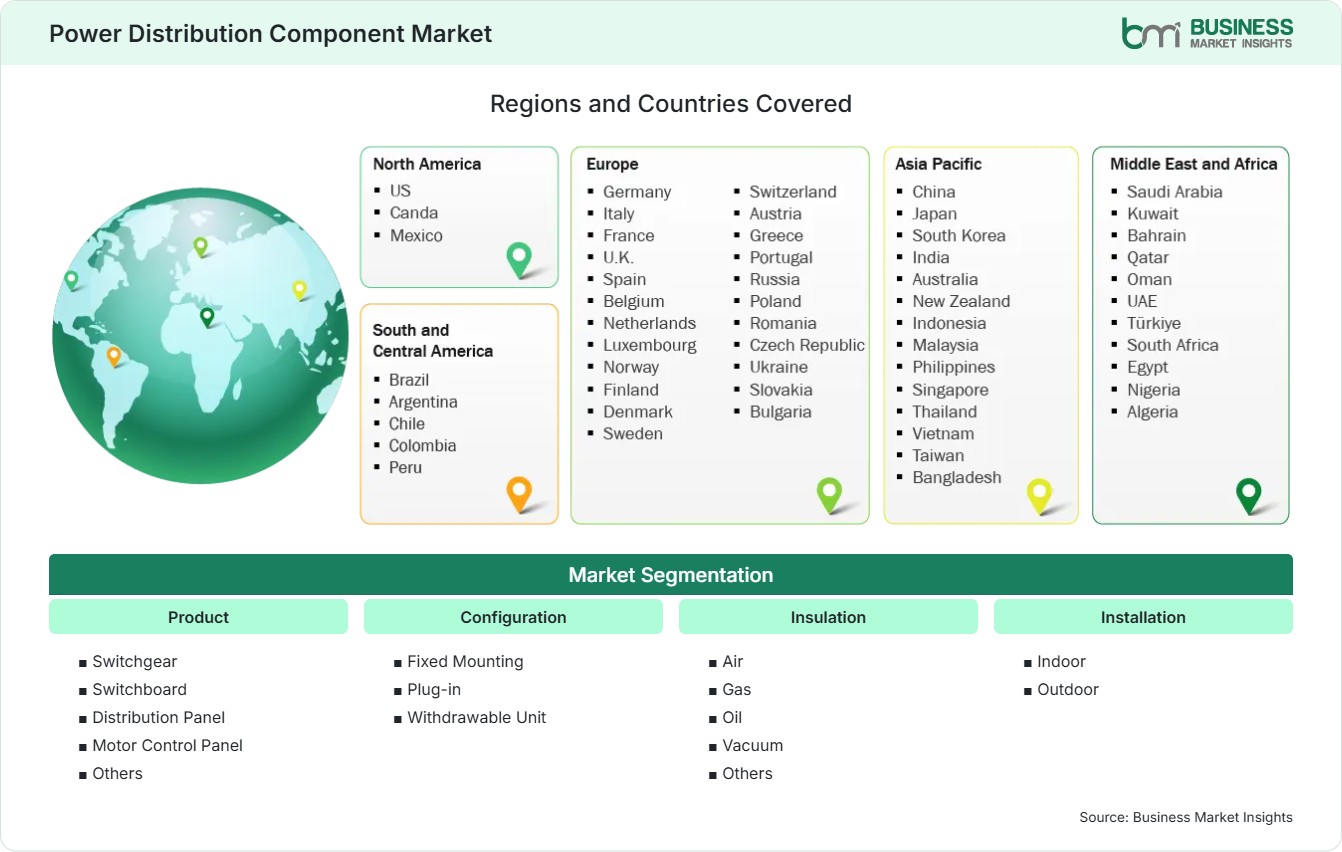
  • Product: Switchgear, Switchboard, Distribution Panel, Motor Control Panel, Others
  • Configuration: Fixed Mounting, Plug-in, Withdrawable Unit
  • Insulation: Air, Gas, Oil, Vacuum, Others
  • Installation: Indoor, Outdoor
  • Application: Residential, Commercial, Industrial, Utility
US$ 19.07 Bn Market size in 2025
US$ 37.60 Bn Market Size by 2033
8.8% CAGR, 2026 - 2033
2026-2033 Forecast Period

01 AI Overview

Power Distribution Component Market Summary

  • North America Region: North America holds a 28%–31% share in 2025, expanding at a CAGR of 8.0%–8.5% during 2026–2033, supported by aging grid replacement programs, renewable energy deployment, and digital power infrastructure investments. The US market analysis indicates growth at a CAGR of 8.2%–8.7% between 2026 and 2033, driven by utility modernization and distributed energy expansion.
  • Fastest Growing Region: Asia Pacific accounts for a 34%–38% share in 2025, recording a CAGR of 9.2%–9.8% during 2026–2033, supported by rapid urbanization, industrial expansion, renewable power additions, and government-led electricity access initiatives across developing economies.
  • Leading Segment: Switchgear represents a 32%–36% share in 2025, growing at a CAGR of 8.5%–9.0% during 2026–2033, supported by utility infrastructure upgrades, safety requirements, fault protection needs, and increasing adoption of advanced electrical distribution systems.
  • High Growth Segment: Motor Control Panel demonstrates a 12%–15% share in 2025, advancing at a CAGR of 9.0%–9.5% during 2026–2033, supported by industrial automation, manufacturing expansion, and demand for efficient motor management solutions.
  • Key Market Opportunity: Expansion of smart grids, renewable power networks, and electrification infrastructure creates opportunities through intelligent distribution equipment, digital monitoring systems, and advanced protection technologies.
  • Major Market Players: ABB, Eaton, Fuji Electric, General Electric, Hitachi Energy, Hubbell, Hyosung Heavy Industries, Hyundai Electric, L&T Electrical, and Lucy Group.
02 Strategic Insights

Power Distribution Component Market: Strategic Insights

power-distribution-component-market-market-strategic-framework
FREE PDF
Request your free sample
Request free sample
03 Stakeholder View

Key Takeaways

  • Power distribution ecosystems are shifting toward integrated digital infrastructure, where traditional electrical components are increasingly combined with monitoring, automation, and communication capabilities to improve network performance.
  • Utility applications remain a major demand driver, while industrial automation, renewable energy facilities, and commercial infrastructure provide additional growth opportunities for advanced distribution components.
  • Product innovation is moving toward compact designs, enhanced safety features, smart protection technologies, and equipment capable of managing variable power flows from distributed renewable sources.
  • Asia Pacific presents a strong investment opportunity due to rapid urban development, expanding electricity access programs, and extensive renewable energy infrastructure deployment across emerging markets.
  • Strategic partnerships, acquisitions, and technology collaborations are increasing as electrical equipment companies seek to strengthen smart grid capabilities and expand their presence in high-growth regions.
  • Electrification trends across transportation, buildings, and industrial operations are creating long-term demand for reliable distribution components capable of supporting higher electricity loads and complex energy networks.
04 Geographic Outlook

Power Distribution Component Market Regional Highlights

North America Power Distribution Component Market

North America accounted for 28%–31% of the global market in 2025 and is projected to expand at a CAGR of 8.0%–8.5% during 2026–2033. The Power Distribution Component Market share in the region is supported by aging grid replacement, smart grid deployment, and increasing renewable energy integration. Utilities are accelerating investments in resilient electrical infrastructure to enhance grid reliability, improve outage management, and accommodate distributed energy resources while supporting long-term electrification initiatives.

  • Federal investments in transmission modernization and grid resilience are increasing demand for intelligent switchgear, distribution panels, and protection equipment across utility-scale infrastructure projects.
  • Growing deployment of battery energy storage systems requires advanced distribution components capable of supporting bidirectional power flows, voltage regulation, and enhanced grid stability.
  • Commercial buildings are increasingly adopting digital electrical distribution systems integrated with energy management platforms to improve operational efficiency and reduce maintenance costs.
  • Industrial modernization programs continue to strengthen demand for high-performance motor control panels and switchboards designed for automated manufacturing facilities and process industries.

US Power Distribution Component Market

The United States represented 22%–25% of the global market in 2025 and is expected to record a CAGR of 8.2%–8.7% during 2026–2033. Infrastructure modernization, renewable power integration, and industrial electrification continue to strengthen investment in advanced power distribution systems.

  • Federal funding programs supporting grid modernization are accelerating the replacement of aging electrical infrastructure throughout transmission and distribution networks.
  • Rapid renewable energy deployment requires flexible distribution equipment capable of managing intermittent electricity generation while maintaining network stability.
  • Data center expansion continues to increase demand for high-reliability switchgear, distribution panels, and backup power distribution systems.
  • Manufacturing investments are encouraging adoption of digitally connected motor control solutions that improve operational reliability and predictive maintenance capabilities.

Europe Power Distribution Component Market

Europe accounted for 24%–27% of the market in 2025 and is anticipated to expand at a CAGR of 8.1%–8.6% through 2026–2033. Energy transition policies, decarbonization initiatives, and transmission modernization projects continue to support regional demand. Germany remains the leading market, while Eastern European countries represent the fastest-growing investment destinations due to expanding electricity infrastructure and renewable integration projects.

  • Germany leads regional adoption through investments in smart substations, industrial automation, and renewable electricity infrastructure modernization.
  • France continues strengthening electricity distribution reliability through modernization of utility assets and digital monitoring technologies.
  • Poland is among the fastest-growing national markets, supported by electricity infrastructure expansion and industrial development initiatives.
  • Offshore wind integration is driving demand for advanced switchgear and protection systems across European transmission networks.

Asia Pacific Power Distribution Component Market

Asia Pacific held the largest 34%–38% market share in 2025 and is projected to grow at the highest CAGR of 9.2%–9.8% during 2026–2033. Rapid urbanization, industrial expansion, renewable energy deployment, and government-supported electrification initiatives are strengthening the Power Distribution Component Market growth outlook. China remains the largest regional market, while India represents the fastest-growing country due to extensive grid expansion and infrastructure investments.

  • China continues investing in ultra-high-voltage transmission, smart grids, and renewable energy integration, supporting strong demand for advanced electrical distribution equipment.
  • India is recording robust growth through transmission expansion, rural electrification, and increasing renewable generation capacity.
  • Southeast Asian economies are upgrading electricity networks to improve energy access and accommodate industrial development.
  • Industrial automation across regional manufacturing hubs continues increasing demand for intelligent motor control panels and switchboards.
  • Government-backed renewable energy targets are accelerating deployment of modern distribution infrastructure capable of integrating distributed generation sources.

Rest of World Power Distribution Component Market

Rest of the World accounted for 10%–13% of the market in 2025 and is expected to register a CAGR of 8.4%–8.9% during 2026–2033. South & Central America are benefiting from transmission upgrades and renewable investments, while the Middle East & Africa continue expanding electricity infrastructure through utility modernization and industrial diversification programs.

Brazil remains the leading South American market through renewable expansion and distribution upgrades. Saudi Arabia represents one of the fastest-growing Middle Eastern markets owing to smart city developments, industrial diversification, and investments in high-capacity electrical infrastructure.

  • Brazil continues investing in transmission expansion to improve renewable energy connectivity and electricity reliability across growing demand centers.
  • Saudi Arabia is strengthening utility modernization through digital substations and advanced distribution equipment deployment.
  • The United Arab Emirates is increasing investments in smart grid infrastructure supporting urban expansion and clean energy integration.
  • South Africa continues upgrading aging electricity infrastructure to improve network reliability and industrial power availability.
  • Mining, oil and gas, and infrastructure developments across Africa and Latin America are supporting demand for durable outdoor power distribution systems.
global-market-geography
FREE PDF
Request your free sample
Request free sample
05 Segment Analysis

Power Distribution Component Market Segmentation

Product

Product segment accounted for the largest share of the market, with Switchgear leading at 32%–36% in 2025 and projected to grow at a CAGR of 8.5%–9.0% during 2026–2033. Rising investments in grid modernization, industrial automation, and renewable energy integration continue to strengthen the Power Distribution Component Market scope, driving demand for reliable protection and distribution equipment across utility and industrial applications.

  • Switchgear: Widely deployed across transmission, distribution, and industrial facilities for circuit protection, fault isolation, and operational safety. Growing smart grid deployments and renewable integration continue to support product demand.
  • Switchboard: Essential for centralized electrical power distribution in commercial, industrial, and utility facilities. Increasing infrastructure modernization and building electrification projects are expanding adoption across diverse end-use environments.
  • Distribution Panel: Growing construction of residential and commercial buildings is increasing the installation of advanced distribution panels offering improved safety, monitoring capabilities, and efficient electrical load management.
  • Motor Control Panel: Rising industrial automation, manufacturing expansion, and process optimization initiatives are strengthening demand for intelligent motor control systems with digital monitoring and predictive maintenance capabilities.

Configuration

Configuration solutions are evolving to improve operational flexibility, maintenance efficiency, and system reliability. Fixed Mounting remained the dominant configuration with a 48%–52% market share in 2025 and is expected to register a CAGR of 8.2%–8.7% through 2033 due to its cost-effectiveness and widespread deployment in conventional electrical installations.

  • Fixed Mounting: Preferred across commercial buildings and utility installations because of its robust construction, lower installation cost, and dependable long-term operation.
  • Plug-in: Increasingly adopted where faster installation, simplified maintenance, and operational flexibility are required, particularly in commercial infrastructure and industrial facilities.
  • Withdrawable Unit: Gaining traction in mission-critical industrial applications by enabling safer maintenance, reduced downtime, and enhanced operational continuity.

Insulation

Insulation continues to dominate owing to its broad applicability, lower operating cost, and straightforward maintenance requirements. The segment accounted for 44%–48% of the market in 2025 and is projected to grow at a CAGR of 8.1%–8.6% during the forecast period as utilities upgrade medium- and low-voltage distribution systems.

  • Air: Preferred for low- and medium-voltage installations because of economical operation, ease of maintenance, and proven reliability.
  • Gas: Increasing demand for compact installations in urban substations is driving the adoption of gas-insulated equipment, offering high reliability and reduced footprint.
  • Oil: Continues serving selected heavy-duty and utility applications requiring established insulation performance under demanding operating conditions.
  • Vacuum: Growing rapidly in medium-voltage switchgear due to superior arc interruption capability, lower maintenance needs, and longer service life.

Installation

Installations represented the leading category with a 58%–62% market share in 2025 and are anticipated to register a CAGR of 8.4%–8.9% through 2033. Commercial developments, industrial automation, and digital substations continue increasing deployment of compact and intelligent indoor electrical distribution equipment.

  • Indoor: Preferred across commercial buildings, manufacturing plants, hospitals, and data centers due to enhanced protection, operational safety, and simplified maintenance.
  • Outdoor: Growing investments in renewable energy projects, substations, and transmission infrastructure continue supporting the adoption of weather-resistant outdoor distribution equipment.

Application

Applications accounted for the largest 34%–38% market share in 2025 and are forecast to expand at a CAGR of 8.6%–9.1% during 2026–2033. Expanding electricity demand, modernization of transmission and distribution infrastructure, and renewable energy integration continue driving investment in advanced electrical distribution systems.

  • Residential: Rising urban housing developments, electrification initiatives, and smart home adoption continue supporting demand for reliable low-voltage distribution equipment.
  • Commercial: Office complexes, hospitals, retail facilities, and educational institutions increasingly require intelligent electrical distribution systems for efficient power management.
  • Industrial: Manufacturing automation, mining operations, and process industries continue investing in advanced distribution components supporting uninterrupted operations and higher electrical safety.
  • Utility: Expansion of transmission infrastructure, renewable energy integration, and digital substations remain the primary growth drivers supporting utility investments in modern distribution equipment.
06 Market Forces

Power Distribution Component Market Dynamics

Key Market Drivers

Increasing Electricity Demand Worldwide

The global demand for electricity is constantly growing owing to rapid urbanization, industrialization, digitization, and the electrification of transportation systems and buildings. Global electricity demand has been growing steadily year by year, which is significantly driving the Power Distribution Component Market; hence, there is a need for utilities to invest more in their networks of distribution and transmission lines. The increase in the number of electric vehicles, data centers, and energy-intensive manufacturing plants has put pressure on the electrical networks. This has necessitated that utilities and industries invest in sophisticated switchgear, distribution panels, and control devices that offer reliability, fewer outages, and increased efficiency.

Expansion of Power Grid Infrastructure

The government and utility companies are focusing on constructing new infrastructure for transmission and distribution of electricity so that they can cope with increasing electricity demand and increase the robustness of the existing power grids. The expansion of urbanization in large cities, industrialization zones, and rural electrification projects needs modern electrical distribution systems that could handle greater loads and enhance the reliability of the networks. The investment in high-voltage substations, smart distribution networks, and automatic switching technologies is driving demand for advanced electrical components.

Growing Renewable Energy Integration

The rapid development of solar, wind, hydroelectric, and distributed energy sources is changing power distribution systems worldwide, driving growth in the Power Distribution Component Market. Renewable energy production has brought about the phenomenon of two-way power flow and variable power supply, necessitating the use of advanced distribution systems that have proper protection and automation. Smart switches, digital substations, and automated control systems are being installed by utility companies to ensure voltage regulation and greater grid flexibility. The addition of battery energy storage systems is increasing demand for advanced distribution systems.

Key Market Opportunities

Grid Modernization Projects

Large-scale grid modernization projects offer great prospects for equipment suppliers, as they replace outdated electrical infrastructure with modernized systems. A key Power Distribution Component Market trend is the increasing investment by North American, European, and Asia Pacific governments in developing resilient transmission and distribution grids that can meet rising electricity production and consumption demands. Smart substations, automatic distribution grids, and intelligent protective equipment will become the focus of such modernization projects. Investment in digital equipment and technology will provide companies with a competitive edge.

Expansion of Renewable Energy Networks

Power Distribution Component Market forecasts huge opportunities arising from the growth of renewable energy generation capacity. Electrical infrastructure that will be used in utility-scale solar parks, offshore wind farms, and other renewable energy sources should provide a high level of reliability and help maintain the stability of operation in the electrical grid. The incorporation of battery energy storage and microgrids makes the need for smart switchgear, distribution panels, and protection systems even higher. Companies providing their products with these characteristics should enjoy huge market growth.

Increasing Investments in Electrification Infrastructure

Electricity-powered transport, buildings, industries, and public utilities have necessitated significant investments in modern electrical distribution systems. The authorities and private investors have been investing in projects such as electric car charging networks, industrial electricity-powered projects, digital infrastructure, and smart cities, creating significant growth opportunities for the Power Distribution Component Market. All these necessitate switchboards, motor control boards, distribution boards, and intelligent protection systems that can accommodate large amounts of electricity. Companies that are increasing their manufacturing capacity and digital capabilities will have an edge to benefit from the increased electrification needs across the world.

Market Restraints and Challenges

High Infrastructure Investment Requirements

Factor: Modern power distribution projects require substantial capital expenditure for advanced electrical equipment, substations, digital communication systems, and network upgrades.

Impact: High initial costs of investment could hinder the execution of such projects, especially in developing nations that have limited budgets to fund their ventures. Energy utilities prefer incremental upgrades to infrastructure replacement, which delays the procurement process and hinders market growth. The companies could experience a longer sales cycle and more competition when bidding for infrastructure projects by the government.

Complex Grid Integration Challenges

Factor: Integration of renewable energy, distributed generation, battery storage, and digital technologies significantly increases operational complexity within modern electricity networks.

Impact: Utilities require advanced protection systems, intelligent monitoring platforms, and highly compatible distribution components to ensure stable grid performance. Technical interoperability, cybersecurity concerns, and evolving regulatory requirements increase project complexity and engineering costs. Manufacturers must continuously invest in product innovation, testing, and international standards compliance to address changing utility requirements while maintaining reliability across increasingly decentralized electricity systems.

07 Company Analysis

Competitive Landscape

The Power Distribution Component Market analysis indicates a competitive environment characterized by established global electrical equipment manufacturers competing through technological innovation, digital grid solutions, strategic partnerships, and regional manufacturing expansion.

Company Name

Overview

Products and Services Relevant to this Market

ABB

Global leader in electrification and automation technologies serving utilities and industries.

Switchgear, switchboards, motor control centers, digital substations, distribution automation solutions.

Eaton

Diversified power management company with extensive electrical infrastructure portfolio.

Circuit protection, switchboards, distribution panels, smart power management systems.

Fuji Electric

Japanese electrical equipment manufacturer focused on industrial and utility solutions.

Medium-voltage switchgear, motor control equipment, industrial electrical systems.

General Electric

Multinational technology company serving global energy and grid markets.

Grid automation systems, protection equipment, switchgear, digital grid technologies.

Hitachi Energy

Leading provider of power transmission and distribution technologies.

Gas-insulated switchgear, substations, grid automation, digital energy management solutions.

Hubbell

Electrical infrastructure manufacturer serving commercial and utility customers.

Distribution products, connectors, enclosures, utility power equipment.

Hyosung Heavy Industries

South Korean manufacturer specializing in power equipment and industrial systems.

High-voltage switchgear, transformers, GIS solutions, substation equipment.

Hyundai Electric

Global electrical equipment supplier supporting utilities and industries.

Switchgear, circuit breakers, motor control systems, power distribution equipment.

L&T Electrical

Major provider of electrical and automation products across industrial sectors.

Low-voltage switchgear, control panels, distribution systems, industrial automation solutions.

Lucy Group

International supplier of secondary power distribution solutions.

Ring main units, switchgear, distribution automation, grid reliability products.

08 Industry Activity

Recent Developments

July 2026

ABB Ltd. signed a pan-EMEA distribution agreement with Arrow Electronics to expand the availability of ABB Electrification's critical power portfolio, initially covering uninterruptible power supply (UPS) solutions with plans to extend to additional power distribution technologies for enterprise and data center applications.

June 2026

Hitachi Energy Ltd. announced the acquisition of Canduct Group Inc., a Canadian manufacturer of transformer insulation and component solutions. The acquisition strengthens Hitachi Energy's North American transformer component manufacturing and supply chain capabilities.

May 2026

ABB Ltd. announced a US$75 million investment in India to expand manufacturing and R&D capacity for electrification products supporting grid infrastructure, including transformer-related technologies and power distribution equipment.

October 2025

ABB Ltd. completed the acquisition of Gamesa Electric's power electronics business from Siemens Gamesa, strengthening ABB's portfolio of power conversion technologies used in grid integration, renewable energy, and power distribution applications.

10 Trust & Transparency

Research Methodology

The market analysis combines proprietary research with secondary data from government agencies, company disclosures, regulatory filings, industry databases and expert interviews. Market estimates are validated through data triangulation, cross-market benchmarking and analyst review.

View Full Research Methodology

11 Questions Answered

Frequently Asked Questions

What does the Power Distribution Component Market Report cover?

The market provides a comprehensive analysis of market size, segmentation, regional outlook, competitive landscape, growth drivers, opportunities, restraints, technological trends, recent developments, and forecasts through 2033.

What are the major challenges facing manufacturers?

Manufacturers face challenges, including high infrastructure investment requirements, integration of renewable energy into existing grids, compliance with evolving electrical standards, cybersecurity concerns, and increasing pressure to improve energy efficiency while reducing lifecycle costs.

Which product segment accounts for the largest market share?

Switchgear remains the leading product segment because it provides essential protection, switching, and control functions for electrical networks across utility, industrial, commercial, and infrastructure applications.

Which region dominates the market?

Asia Pacific holds the largest regional share due to rapid urbanization, extensive power infrastructure development, industrial expansion, increasing renewable energy installations, and government investments in electricity transmission and distribution networks.

What is driving the growth of the Power Distribution Component Market?

The market is primarily driven by increasing global electricity demand, modernization of aging transmission and distribution infrastructure, rapid renewable energy integration, industrial automation, and expanding electrification projects across residential, commercial, industrial, and utility sectors.

Access the Full Power Distribution Component Market Report

Get segment-level forecasts, regional estimates, competitive benchmarking, company profiles and downloadable Excel datasets.

Access the full Power Distribution Component Market Report
350 pages PDF & Excel | 2026-07-30