Market Summary
Executive Summary and Global Market Analysis
Powder induction and dispersion systems are process-engineering solutions designed to incorporate dry powders into liquids quickly, uniformly, and with minimal agglomeration or air entrainment. These systems are used where manufacturers need precise wetting, dispersion, and homogenization of functional ingredients during production. Their operational relevance is strongest in applications involving difficult-to-disperse solids, sanitary processing standards, and repeatable formulation outcomes. As process industries place more weight on efficiency and product consistency, these systems are becoming more central to liquid manufacturing workflows.
Market expansion is being shaped by the need to reduce batch variability, improve throughput, and minimize material loss during powder handling. Manual addition methods can introduce dust, clumping, inconsistent hydration, and longer processing times, especially in formulations with stabilizers, rheology modifiers, and fine active powders. Powder induction and dispersion systems address these production constraints by enabling more controlled ingredient incorporation with cleaner and faster execution. This strengthens their relevance in industries where formulation precision and line productivity directly affect commercial performance.
Segment behavior reflects a shift toward more efficient and scalable process configurations. Inline mixing is gaining stronger commercial attention because it supports controlled powder wetting within continuous and recirculating workflows, while in-tank mixing remains relevant for flexible plant operations and legacy processing environments. By process, continuous systems are increasingly favored where manufacturers seek repeatability, shorter production cycles, and easier scale-up. Application demand is strongest in food and beverages, pharmaceuticals, personal care, and chemicals, where dispersion quality materially affects finished product stability and performance.
Technology development is advancing through high-shear dispersion, vacuum expansion, single-pass wetting, and more compact system integration. Equipment innovation is focused on faster hydration of difficult powders, lower air incorporation, improved cleanability, and better compatibility with modern manufacturing lines. These advances allow processors to improve product uniformity while reducing rework and processing downtime. The result is a market increasingly defined by engineered performance rather than simple mixing capability.
Competitive conditions are shaped by application breadth, sanitary design, and the ability to deliver reliable performance across batch and continuous operations. Suppliers are differentiating through inline platforms, single-pass dispersion capability, and systems tailored to high-value formulation environments. The market therefore reflects a broader shift toward precision-oriented and productivity-led liquid processing infrastructure.
Segment Analysis
Powder Induction and Dispersion Systems Market Segmentation
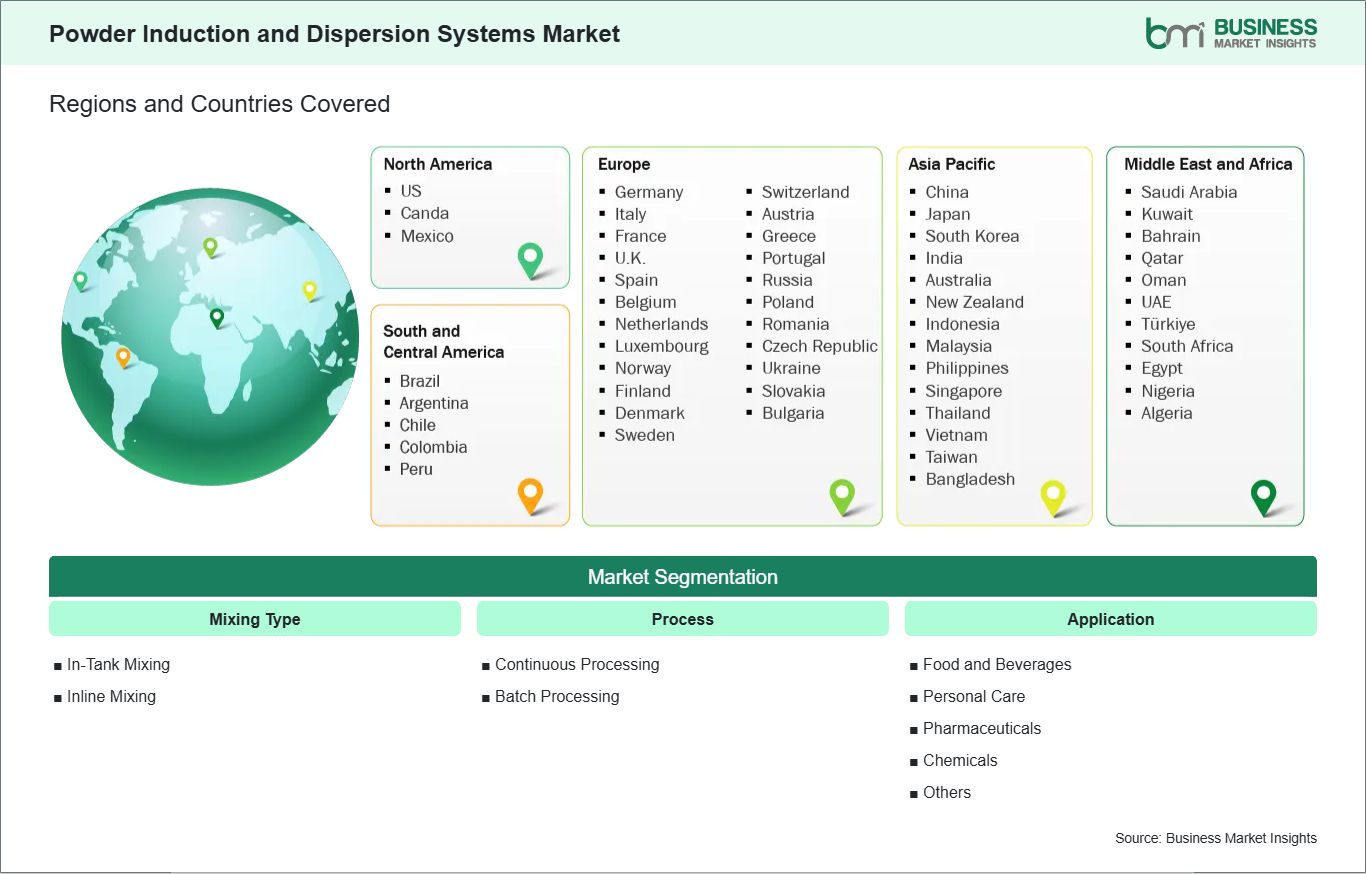
The Powder Induction and Dispersion Systems Market is segmented based on mixing type, process, application, highlighting distinct operational priorities and evolving deployment strategies across various end uses.
By Mixing Type
- In-Tank Mixing: Supports flexible processing in plants using vessel-based production setups.
- Inline Mixing: Enables controlled powder wetting with stronger process continuity.
By Process
- Continuous Processing: Improves throughput consistency and supports scalable production environments.
- Batch Processing: Suits formulation flexibility and variable production scheduling.
By Application
- Food and Beverages: Requires uniform ingredient dispersion for texture and stability control.
- Personal Care: Uses precision mixing to maintain formulation consistency and appearance.
- Pharmaceuticals: Prioritizes sanitary dispersion and accurate ingredient incorporation.
- Chemicals: Applies high-shear systems for reactive and performance-sensitive formulations.
- Others: Covers additional industries with liquid-solid mixing requirements.
Market Forces
Powder Induction and Dispersion Systems Market Drivers and Opportunities
Need for Faster, Cleaner, and More Consistent Powder Incorporation
Manufacturers handling powdered ingredients are under pressure to improve production efficiency without compromising formulation quality. Conventional manual charging and basic mixing methods often lead to agglomeration, dust generation, inconsistent wetting, and longer production cycles, especially with challenging powders. This creates a strong need for systems that can induct, hydrate, and disperse solids with better control and less operator intervention. Powder induction and dispersion systems meet that requirement by streamlining one of the most sensitive stages in liquid processing.
The production impact is especially relevant in sanitary and quality-sensitive industries where formulation repeatability directly affects product acceptance. Food processors, pharmaceutical manufacturers, and personal care producers increasingly value systems that reduce batch inconsistency while supporting cleaner ingredient handling. These benefits make advanced dispersion platforms more relevant in facilities seeking tighter process discipline and reduced material waste. This context strengthens market momentum across both established manufacturers and plants undergoing process modernization.
Inline High-Shear Systems for Continuous and High-Value Formulations
A significant opportunity lies in the broader use of inline high-shear dispersion technology across continuous and performance-sensitive production environments. Manufacturers increasingly require systems that can handle difficult-to-wet powders, thickeners, and functional solids in a single pass while limiting air entrainment and rework. This creates strong relevance for compact inline platforms that combine powder induction, wetting, and homogenization within one integrated process step. Such systems are particularly well aligned with food, pharmaceutical, chemical, and personal care applications where formulation precision has commercial importance.
Future scope expands as processors pursue more automated, scalable, and cleanable systems for complex formulations. Continuous processing architectures, sanitary designs, and higher-efficiency dispersion methods create room for wider deployment in plants seeking better control over cycle time and product uniformity. As production lines become more quality-sensitive and ingredient systems more technically demanding, advanced inline dispersion platforms can capture a stronger role in capital investment decisions.
Size and Share Analysis
Powder Induction and Dispersion Systems Market Size and Share Analysis
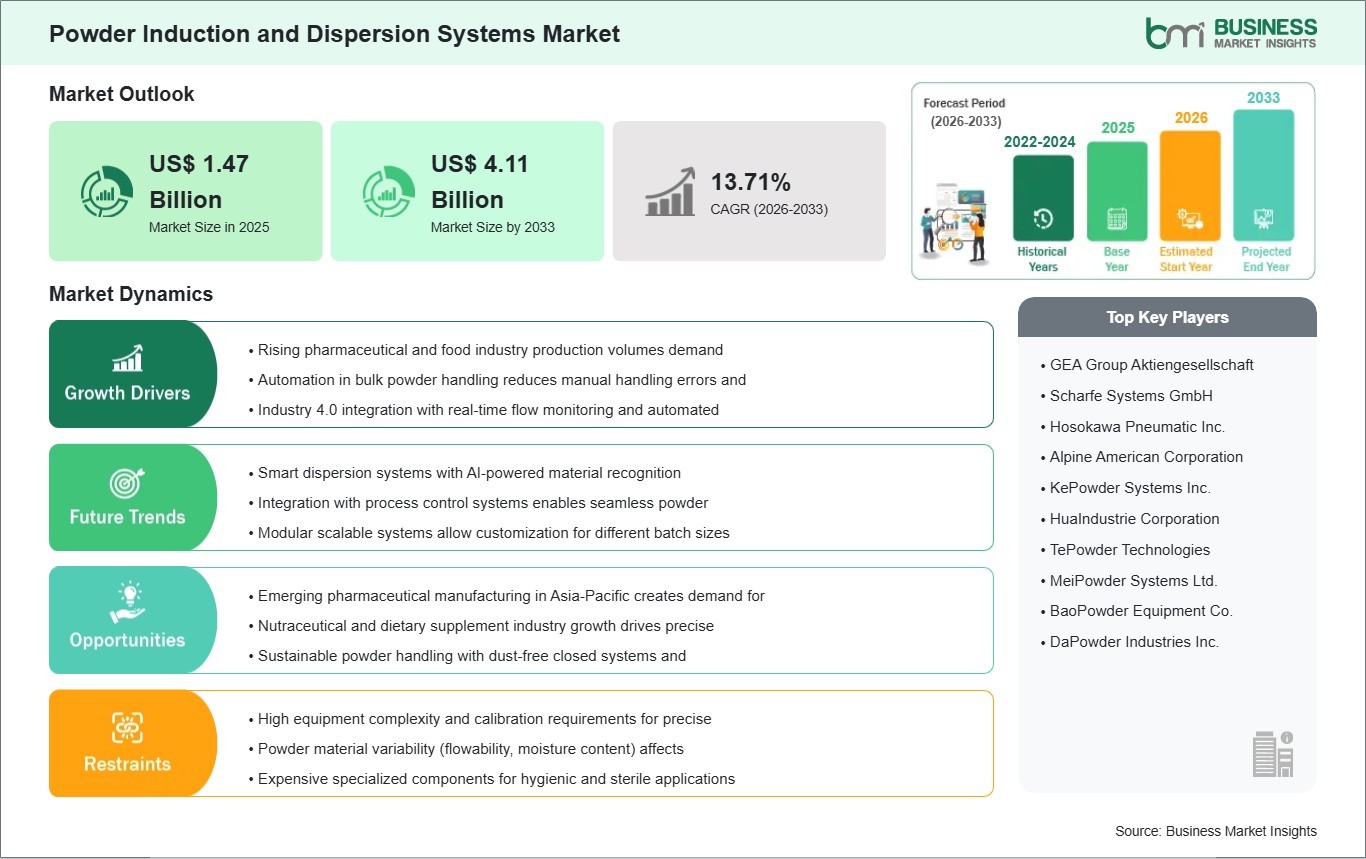
The Powder Induction and Dispersion Systems Market is projected to grow from US$ 1.47 billion in 2025 to US$ 4.11 billion by 2033. The market is estimated to record a CAGR of 13.71% from 2026 to 2033.
This trajectory indicates a market supported by broader process automation, higher formulation complexity, and stronger demand for efficient powder-to-liquid incorporation. Growth also reflects the operational value of reducing waste, clumping, and mixing variability during production.
By mixing type and process, inline systems hold strong strategic importance because they align with modern processing goals centered on continuity, control, and lower manual intervention. Continuous processing also carries a compelling commercial position where manufacturers prioritize scale, repeatability, and shorter production cycles. In-tank and batch systems remain relevant where flexibility and plant-specific operating practices shape equipment choice.
By application, food and beverages and pharmaceuticals represent especially important demand centers because dispersion quality directly affects product stability, texture, compliance, and processing efficiency. Personal care and chemical applications also maintain strong market relevance where ingredient hydration and uniformity influence final formulation performance. These end uses collectively reinforce the market’s role within precision liquid manufacturing.
Report Coverage
Powder Induction and Dispersion Systems Market Report Coverage and Deliverables
The "Market Size and Forecast (2022–2033)" report provides a detailed analysis of the market covering below areas:
- Market size and forecast at global, regional, and country levels for all the key market segments covered under the scope
- Market trends, as well as market dynamics such as drivers, restraints, and key opportunities
- Market analysis covering key market trends, global and regional framework, major players, regulations, and recent market developments
- Industry landscape and competition analysis covering market concentration, heat map analysis, prominent players, and recent developments for the market
- Detailed company profiles, including SWOT analysis
Geographic Insights
Powder Induction and Dispersion Systems Market Geographic Insights
The Powder Induction and Dispersion Systems market shows diverse regional adoption patterns influenced by process automation priorities, sanitary manufacturing standards, formulation complexity, and end-use industry mix. Across the global industry, demand is strongest where manufacturers require precise powder incorporation, reduced waste, and tighter control over product consistency. Regional variation reflects differences in production scale, quality expectations, and investment in advanced liquid processing systems.
North America remains a key market because the region combines a strong pharmaceutical, food, and chemical processing base with high interest in efficient and sanitary production technology. Manufacturers in the region increasingly prioritize equipment that shortens processing time while reducing clumping and manual handling inefficiencies. This makes inline and advanced dispersion systems particularly relevant in facilities seeking better formulation control and scalable operations.
Asia Pacific presents a strong expansion environment due to industrial production growth, rising processed food output, and broader investment in pharmaceutical and chemical manufacturing capability. The region offers substantial potential for both inline and in-tank systems as producers modernize plants and pursue better throughput with lower formulation variability. Application diversity across food, personal care, and specialty chemicals further strengthens the market opportunity.
Europe reflects an engineering-led market shaped by process optimization, quality assurance, and efficient use of raw materials in sophisticated manufacturing settings. Demand in the region is reinforced by the presence of advanced mixing technology suppliers and strong interest in high-shear, energy-conscious dispersion platforms. Beyond these major regions, emerging markets offer selective opportunity as process industries upgrade equipment to improve productivity and formulation reliability.
Industry Activity
Recent Developments
The Powder Induction and Dispersion Systems Market is evaluated by gathering qualitative and quantitative data post primary and secondary research, which includes important corporate publications, association data, and databases. Recent developments and news in the market include:
- In March 2026, SPX FLOW expanded its high-shear rotor–stator and inline dispersion systems, focusing on faster powder wetting, reduced processing time, and improved batch consistency for food, dairy, and chemical applications.
- In March 2026, IKA Werke advanced its modular mixing and dispersion systems, enabling flexible configuration for lab-to-industrial scale powder induction applications, particularly in pharmaceuticals and specialty chemicals.
Trust & Transparency
Research Methodology
The market analysis combines proprietary research with secondary data from government agencies, company disclosures, regulatory filings, industry databases and expert interviews. Market estimates are validated through data triangulation, cross-market benchmarking and analyst
review.
View Full Research Methodology
Key Sources Referred:
World Bank – Global Trade IndicatorsWorld Trade Organization (WTO)International Monetary Fund (IMF)International Energy Agency (IEA)International Trade Administration (ITA)Company WebsitesCompany Annual ReportsCompany Investor Presentations