
Porcelain Market Outlook: Size, Share, Trends, Growth Analysis, Competitive Landscape & Forecast, 2026-2033

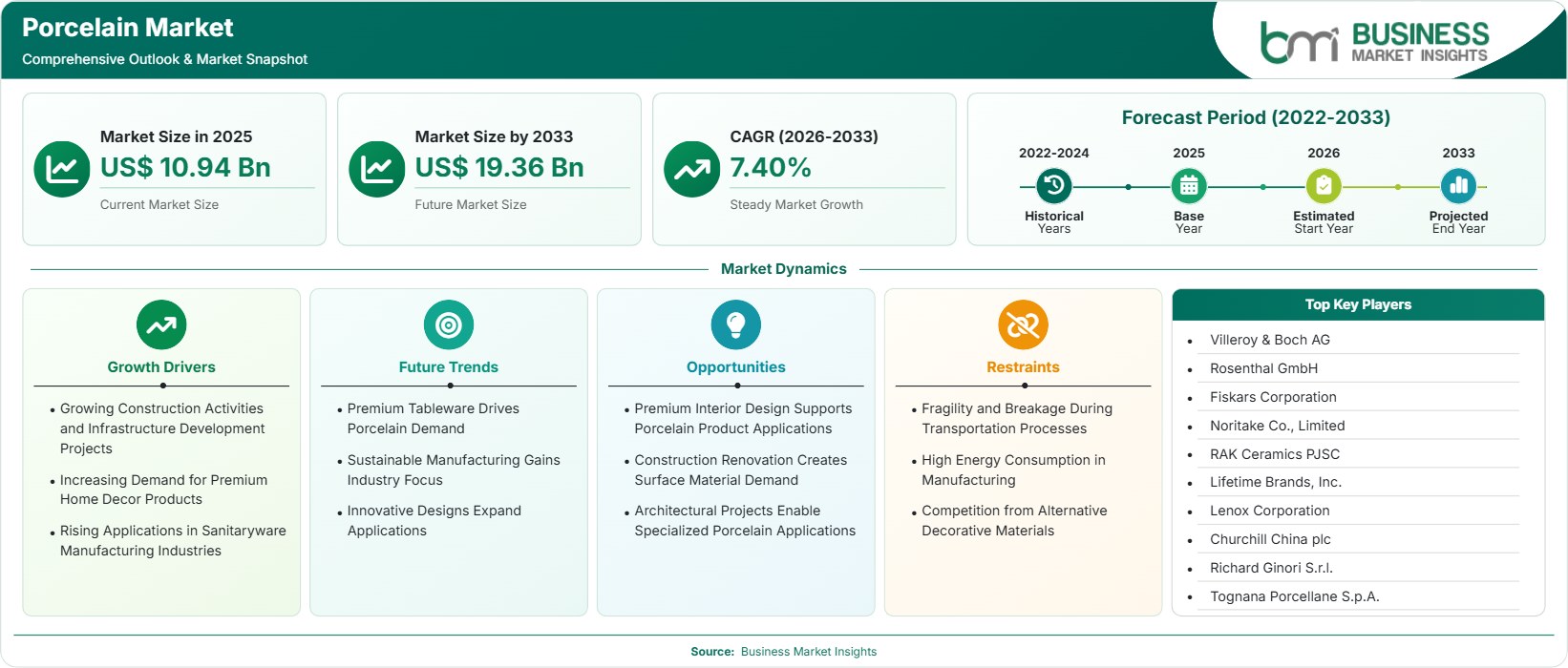
The Porcelain Market size was valued at US$ 10.94 Billion in 2025 and is projected to reach US$ 19.36 Billion by 2033, growing at a CAGR of 7.4% during 2026–2033. Rising premium dining preferences, hospitality expansion, urban housing growth, e-commerce penetration, and innovation in durable decorative porcelain products create strong long-term demand and commercial opportunities.

Report Coverage
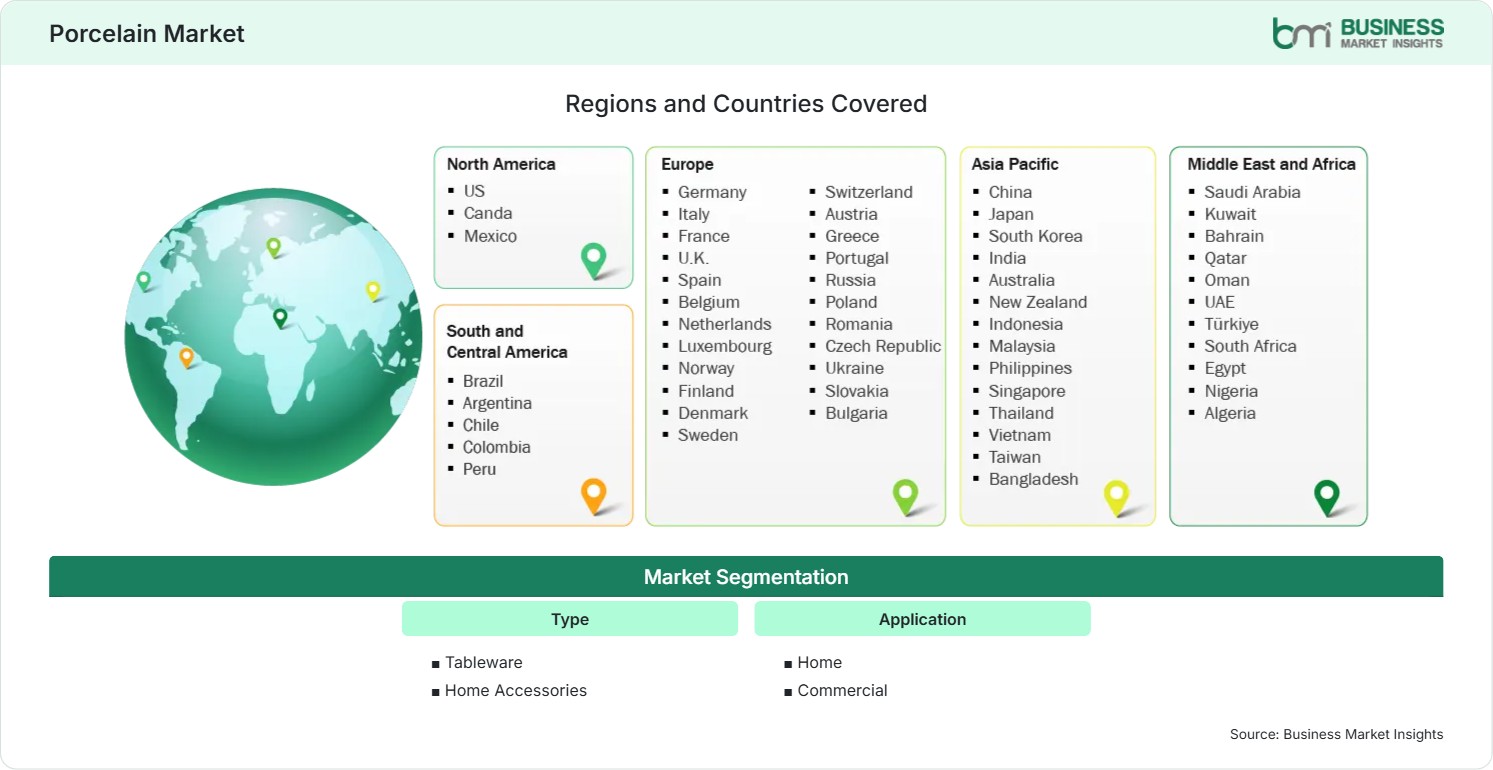
  • Type: Tableware, Home Accessories
  • Application: Home, Commercial
US$ 10.94 Bn Market size in 2025
US$ 19.36 Bn Market Size by 2033
7.40% CAGR, 2026 - 2033
2026-2033 Forecast Period

AI Overview

Porcelain Market Summary

  • North America Region: North America holds a market share of 34%–37% in 2025, growing at a CAGR of 6.5%–7.0% during 2026–2033. Growth is supported by premium home décor purchases, hospitality refurbishment programs, higher consumer spending, online retail expansion, sustainable product adoption, design-focused collections, luxury gifting demand, and replacement purchasing cycles. The U.S. market benefits from strong premium tableware demand and hospitality investments, advancing at an estimated 6.7%–7.2% CAGR.
  • Fastest Growing Region: Asia Pacific holds a Porcelain Market share of 28%–31% in 2025, expanding at a CAGR of 8.3%–8.8% during 2026–2033. Growth stems from rising middle-class spending, expanding hospitality infrastructure, urbanization, premium lifestyle adoption, tourism recovery, manufacturing advantages, domestic brand development, digital retail penetration, and increasing dining culture sophistication.
  • Leading Segment: Tableware accounts for 68%–72% share in 2025 and advances at 7.1%–7.6% CAGR. Demand is supported by household replacement cycles, commercial dining expansion, premium restaurant concepts, wedding gifting demand, designer collections, lifestyle branding, online merchandising, and durability advantages over alternative materials across regions.
  • High Growth Segment: Commercial application represents 38%–42% share in 2025 and records 8.0%–8.5% CAGR. Growth is encouraged by hospitality investments, restaurant expansion, institutional procurement, tourism recovery, brand differentiation initiatives, premium guest experiences, durable product requirements, and long operating lifecycle benefits.
  • Key Market Opportunity: Growing demand for customized luxury dining collections, sustainable manufacturing methods, digitally enabled direct-to-consumer channels, and premium hospitality projects creates attractive avenues for product differentiation, margin enhancement, geographic expansion, and long-term brand positioning.
  • Major Market Players: Villeroy & Boch AG, Rosenthal GmbH, Fiskars Corporation, Noritake Co., Limited, RAK Ceramics PJSC, Lifetime Brands, Inc., Lenox Corporation, Churchill China plc, Richard Ginori S.r.l., Tognana Porcellane S.p.A.
Strategic Insights

Porcelain Market: Strategic Insights

Porcelain Market Strategic Framework
FREE PDF
Request your free sample
Request free sample
Stakeholder View

Key Takeaways

  • The industry value chain increasingly integrates raw material sourcing, advanced kiln processing, digital decoration, distribution, and direct-to-consumer channels, creating stronger control over quality and margins.
  • Commercial end-use presents significant upside as restaurants, hotels, cafés, resorts, and institutional dining operators prioritize durable premium tableware investments.
  • Advanced glazing technologies, lightweight porcelain formulations, and digitally customized designs are reshaping product innovation strategies and supporting premium pricing.
  • Asia Pacific offers the strongest long-term investment potential due to urbanization, hospitality expansion, manufacturing scale advantages, and rising middle-income consumption.
  • Strategic acquisitions and luxury brand collaborations continue improving portfolio diversification, strengthening access to premium consumers and international distribution networks.
  • Sustainability initiatives focused on resource efficiency, lower-energy firing systems, and recyclable packaging are becoming major competitive differentiators.
Geographic Outlook

Porcelain Market Regional Highlights

North America Porcelain Market

North America accounted for 34%–37% of the porcelain market share in 2025 and is projected to advance at 6.5%–7.0% CAGR through 2033. Demand is driven by premium household consumption, luxury gifting trends, hospitality procurement, and remodeling activity. Consumers increasingly favor high-quality dining products with durability and design appeal. E-commerce platforms continue expanding premium product accessibility. Commercial demand from hotels and restaurants remains robust, supporting replacement purchases and customized collections.

  • Premium dining and home entertaining trends support higher adoption of designer collections and luxury tableware products across affluent consumer demographics.
  • Hospitality operators increasingly replace conventional dinnerware with durable premium materials to improve guest experience and operational longevity.
  • Strong online retail penetration improves product availability and supports direct-to-consumer strategies for established brands.
  • Sustainability initiatives are encouraging manufacturers to adopt energy-efficient production and environmentally responsible packaging solutions.

US Porcelain Market

The United States represented approximately 78%–82% of North American revenue in 2025 and is anticipated to grow at 6.7%–7.2% CAGR. Residential premiumization, wedding gifting demand, hospitality refurbishment programs, and luxury retail performance support category expansion. Design-conscious consumers increasingly seek curated dining experiences. Growth also benefits from digital commerce and higher spending on decorative home products.

  • Premium department stores and online channels strengthen market visibility and improve access to differentiated collections.
  • Hotels and restaurants increasingly emphasize brand identity through customized table settings and premium presentation solutions.
  • Growth in home remodeling activity supports demand for complementary decorative and functional dining accessories.
  • Consumer preference for long-lasting products favors premium ceramic and porcelain alternatives.

Europe Porcelain Market

Europe held a 29%–32% share in 2025 and is forecast to expand at 6.8%–7.3% CAGR. Germany, France, Italy, and the United Kingdom remain important consumption centers due to strong heritage brands and established dining traditions. Premium craftsmanship and luxury positioning contribute to value growth. Germany remains the leading market, while Eastern European markets demonstrate comparatively faster expansion.

  • Heritage manufacturers continue benefiting from strong brand recognition and premium consumer loyalty.
  • Luxury hospitality investments support commercial replacement demand across key tourism destinations.
  • Germany remains a leading country, while Poland and Romania exhibit higher growth trajectories.
  • Sustainable manufacturing practices are becoming increasingly important in procurement decisions.
  • Designer collaborations contribute to premium product differentiation and export competitiveness.

Asia Pacific Porcelain Market

The Asia Pacific region held a 28% to 31% market share in 2025, making it the fastest-growing region with a CAGR of 8.3% to 8.8%. China, Japan, India, and South Korea are the key contributors in this region. Urbanization, rising numbers of middle-income households, the development of the tourism industry, and robust manufacturing industries are among the factors fueling growth in this region. Premium dining culture and online retail sales continue to strengthen regional demand. China leads revenue generation, while India records one of the strongest growth profiles.

  • Hospitality and tourism infrastructure projects create substantial commercial procurement opportunities.
  • Manufacturing advantages enable competitive export positioning and large-scale production capacity.
  • India benefits from rapid urbanization and rising discretionary spending on lifestyle products.
  • E-commerce ecosystems accelerate consumer access to domestic and international brands.
  • Premium restaurant expansion supports recurring replacement demand from foodservice operators.

Rest of World Porcelain Market

Rest of World held an 8%-11% share in 2025 and is estimated to register a CAGR of 7.2%-7.8%. South and Central America gain an advantage due to increasing hospitality and premium consumer spending. The Middle East & Africa have been favored due to investments in the tourism sector, luxury hospitality projects, and urban residential buildings. Gulf countries continue to be major contributors, alongside certain African countries, indicating growth opportunities.

  • UAE and Saudi Arabia are key demand centers due to luxury hospitality investments and tourism initiatives.
  • Brazil remains a leading Latin American market, supported by urban middle-class consumption.
  • Tourism infrastructure development improves commercial procurement opportunities across several countries.
  • Premium lifestyle adoption encourages demand for branded home dining collections.
  • International brands increasingly expand distribution partnerships across developing markets.
Global Market Geography
FREE PDF
Request your free sample
Request free sample
Segment Analysis

Porcelain Market Segmentation

Type

Type segmentation holds the largest source of revenue, with tableware accounting for around 68%–72% market share by 2025 and growing at a CAGR of 7.1%–7.6%. The scope of the Porcelain Market is further increasing owing to its uses in fine dining, décor-driven consumption, procurement by hospitality services, and gifting. Innovation in design, durability, and sustainability remains central to segment expansion.

  • Tableware: Strong consumer preference for premium dining experiences, gifting practices, and hospitality procurement continues supporting adoption. Design innovation, durability benefits, online sales growth, and premium branding strengthen long-term demand.
  • Home Accessories: Decorative products benefit from rising interior design spending, luxury residential projects, aesthetic customization preferences, and premium lifestyle trends. Retail expansion and designer collaborations further support segment advancement.

Application

The application dynamics will be driven by evolving consumer behavior. Residential applications account for around 58%-62% of the market share in 2025 and register a CAGR of 6.9%-7.4%, whereas commercial applications have higher growth momentum due to hospitality spending and tourism-driven demand. The Porcelain Market trends show a preference towards premium and customized options.

  • Home: Increasing household expenditure on premium dining products, decorative collections, gifting purchases, and lifestyle-oriented upgrades supports sustained demand across mature and emerging economies.
  • Commercial: Hotels, restaurants, cafés, institutional kitchens, and catering operators increasingly prefer durable premium products that support brand presentation and operational efficiency.
Market Forces

Porcelain Market Dynamics

Key Market Drivers

Expansion of Global Hospitality and Foodservice Industries

The hospitality sector continues to be a primary driver of demand. According to tourism and industry recovery indicators from major international organizations, hotel occupancy levels and restaurant investments have improved across several regions. High-end restaurants demand sturdy, appealing products, thereby encouraging more purchases. Businesses have made considerable expenditure on quality tableware to create a unique experience for their customers. Mass tourism destinations in the Asia-Pacific and Middle Eastern regions are also one of the sources of institutional buyers. The rise in the number of restaurant chains and boutique hotels is another reason for repeated purchases.

Premiumization of Household Consumption Patterns

Dining products are increasingly perceived as a means of making a lifestyle statement and enhancing interior design. The increase in disposable incomes in developing countries contributes to the purchase of luxury products. Increased spending on home entertainment, gift-giving, and decoration with dining ware stimulates its adoption. Media and lifestyle-based retail marketing increase the desire for specially created collections. Producers react to this trend by introducing unique designs, limited edition pieces, and premium finishes. This trend is especially noticeable in the behavior of urban consumers seeking quality, durability, and visual sophistication, supporting steady value growth across residential channels.

Technological Improvements in Manufacturing Efficiency

The advanced kiln systems, digital printers, automatic inspection systems, and resource management software are helping to improve efficiency by reducing error rates, improving consistency, and enabling higher production volumes. Organizations are becoming more conscious of the need to use energy-efficient systems to save money and meet sustainability targets. The digital decorating system is flexible for customization and fast production. Advanced manufacturing techniques are helping organizations to become innovative and present products in a premium way. These improvements are contributing to organizational efficiency and product differentiation globally.

Key Market Opportunities

Luxury Hospitality Expansion in Emerging Economies

Construction of hotels, development of mixed-use tourism projects, and premium dining facilities are growing rapidly in Asia, the Middle East, and some regions of Latin America. Long-term purchasing agreements are considered potential sources of income for suppliers. Porcelain Market Forecasts suggest that commercial demand will grow due to tourism investment, airport development, international events, and diversification of hospitality services. The use of premium products will allow the operator to distinguish itself from competitors. Companies able to produce customizable, durable, and consistent products are likely to secure larger institutional contracts and expand their geographic reach.

Growth of Direct-to-Consumer Digital Commerce

Through digital retail platforms, companies can directly engage with their customers without relying on conventional distributors or retailers. This is achieved through various sophisticated functions, such as improved product visualization, recommendation engines, and omnichannel experience integration. Through e-commerce marketplaces and their own online stores, companies can offer their high-end product range to a larger, more diverse market. Cross-border sales through online channels can also help expand market reach and accessibility. By integrating digital marketing, data analytics, and storytelling, companies can achieve higher sales, more loyal customers, and greater consumer intelligence.

Sustainable and Energy-Efficient Product Development

Environmental sustainability is increasingly influencing purchasing decisions among both consumers and commercial buyers. Manufacturers that invest in energy-efficient firing technologies, eco-friendly packaging, and responsibly sourced raw materials can enhance their market reputation and competitive advantage. These green manufacturing practices align with the sustainability goals of hospitality operators, retailers, and other business customers. In addition, products with strong environmental credentials can command premium pricing, strengthen customer loyalty, and improve brand differentiation. As sustainability becomes a key market driver, innovation in environmentally responsible product development offers significant growth opportunities for established manufacturers and emerging brands alike.

Market Restraints and Challenges

Volatility in Energy and Raw Material Costs

The manufacturing process in the industry requires intensive use of energy and specialized materials, making firms highly sensitive to cost changes. Increased costs of fuel, power, and material inputs can affect the bottom line and complicate price determination. It is common for firms to have difficulty maintaining competitive prices while ensuring production quality and efficiency. Energy costs are extremely important for the operation of high-temperature kilns. Small firms, with lower economies of scale, are especially vulnerable, potentially impacting capacity utilization, profitability, expansion plans, and long-term investment decisions.

Competition from Alternative Materials

Customers and business purchasers are now comparing ceramic ware with other products such as stoneware, glass, melamine, metal, and even modern composites. The competition is getting tougher because of these competitors, especially in the economically sensitive market segments, where cost factors in the decision factor. There are many alternatives that seem to offer advantages in cost-effectiveness, weight, durability, or even functional capabilities. To stay competitive, ceramic producers should emphasize the durability, attractiveness, craftsmanship, heritage, and high quality of their products. Continuous innovation, product differentiation, and strong branding strategies are essential to sustain market share and customer loyalty.

Company Analysis

Competitive Landscape

The Porcelain Market analysis reflects competition among heritage brands, global manufacturers, hospitality-focused suppliers, and premium lifestyle companies.

Company Name

Overview

Products and Services relevant to this market

Villeroy & Boch AG

European ceramics leader with strong global brand recognition and premium dining portfolio.

Porcelain tableware, hospitality collections, luxury dining products, decorative accessories.

Rosenthal GmbH

German premium porcelain specialist known for designer collaborations and luxury positioning.

High-end tableware, giftware, decorative porcelain, hospitality solutions.

Fiskars Corporation

Owner of premium lifestyle brands serving global home and dining markets.

Premium tableware, dining collections, home décor products.

Noritake Co., Limited

International Japanese manufacturer with strong hospitality and residential presence.

Fine porcelain tableware, commercial dining solutions, gift collections.

RAK Ceramics PJSC

Large-scale ceramics producer serving residential and commercial customers globally.

Porcelain tableware, hospitality products, specialty ceramic solutions.

Lifetime Brands, Inc.

Consumer products company with diversified kitchen and dining brands.

Dinnerware, tabletop products, home dining accessories.

Lenox Corporation

Established premium American dining and gifting brand.

Fine china, porcelain tableware, collectibles, giftware.

Churchill China plc

Leading supplier to hospitality and foodservice operators worldwide.

Professional tableware, restaurant collections, durable porcelain products.

Richard Ginori S.r.l.

Italian luxury porcelain manufacturer emphasizing craftsmanship and design.

Luxury tableware, decorative porcelain, premium hospitality offerings.

Tognana Porcellane S.p.A.

Italian company serving residential and commercial dining segments.

Porcelain dinnerware, cookware-adjacent dining products, décor items.

Trust & Transparency

Research Methodology

The market analysis combines proprietary research with secondary data from government agencies, company disclosures, regulatory filings, industry databases and expert interviews. Market estimates are validated through data triangulation, cross-market benchmarking and analyst review.

View Full Research Methodology

Questions Answered

Frequently Asked Questions

What does the Porcelain Market Report typically evaluate?

It assesses industry structure, regional performance, growth drivers, competitive positioning, segment dynamics, investment opportunities, supply chain developments, and future demand outlook.

How does sustainability affect purchasing decisions?

Buyers increasingly evaluate energy-efficient production methods, responsible sourcing practices, product durability, and environmentally conscious packaging when selecting suppliers.

Why do commercial applications grow faster than residential demand?

Hotels, restaurants, cafés, and institutional dining operators undertake recurring replacement purchases and increasingly prioritize premium guest experiences, creating consistent procurement requirements.

Which region offers the strongest future growth potential?

Asia Pacific presents the strongest growth outlook due to urban population expansion, rising disposable incomes, hospitality investments, and growing premium lifestyle consumption patterns.

What factors most influence demand across the industry?

Demand is primarily influenced by hospitality expansion, premium household consumption, tourism activity, gifting purchases, urbanization, and consumer interest in aesthetically differentiated dining experiences.

Access the Full Porcelain Market Report

Get segment-level forecasts, regional estimates, competitive benchmarking, company profiles and downloadable Excel datasets.

Access the full Porcelain Market Report
350 pages PDF & Excel | 2026-09-04