
Polyurethane Market Outlook: Size, Share, Trends, Growth Analysis, Competitive Landscape & Forecast, 2026-2033

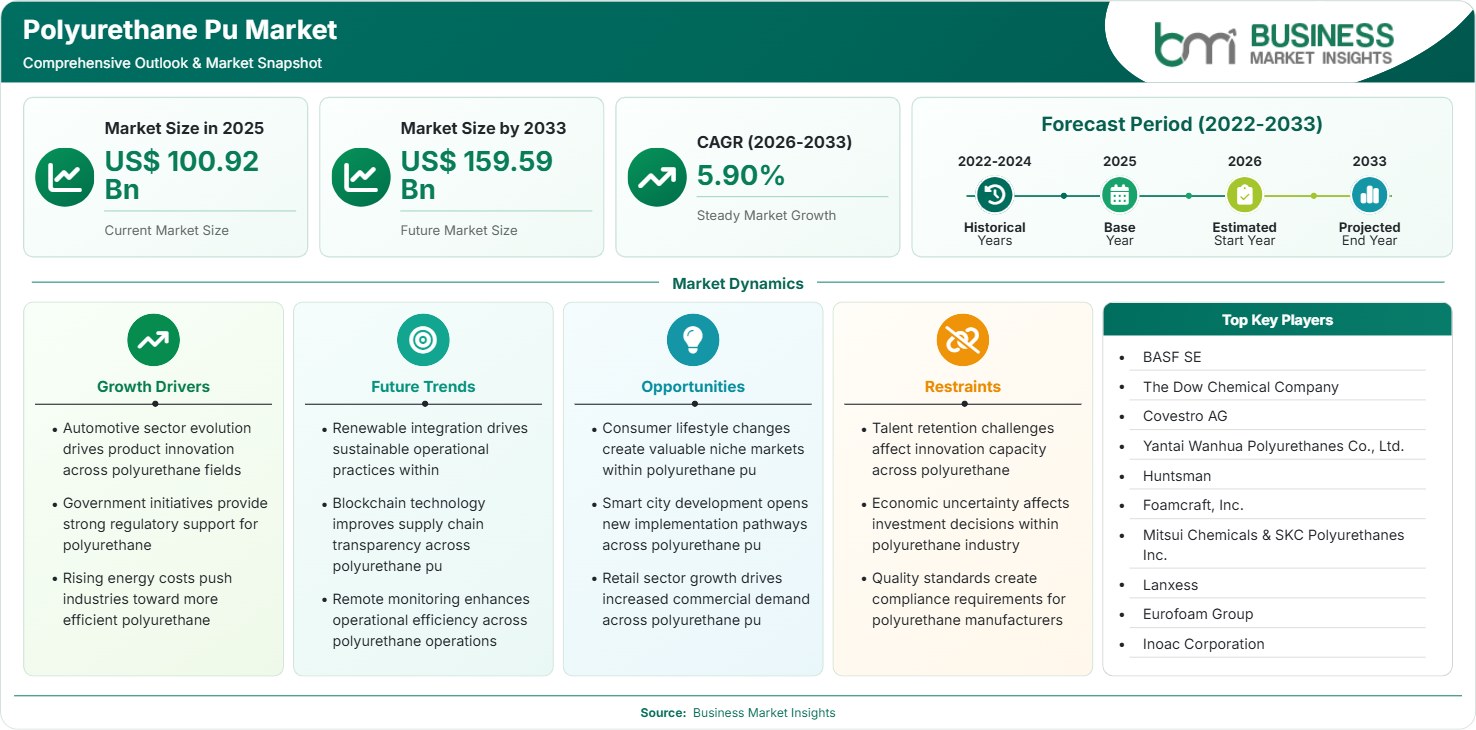
The Polyurethane Market size was valued at US$ 100.92 Billion in 2025 and is projected to reach US$ 159.59 Billion by 2033, growing at a CAGR of 5.90% during 2026–2033. Rising construction insulation demand, lightweight automotive materials, sustainable foam innovations, expanding furniture manufacturing, and bio-based polyurethane investments continue creating significant growth opportunities across developed and emerging economies.

Report Coverage
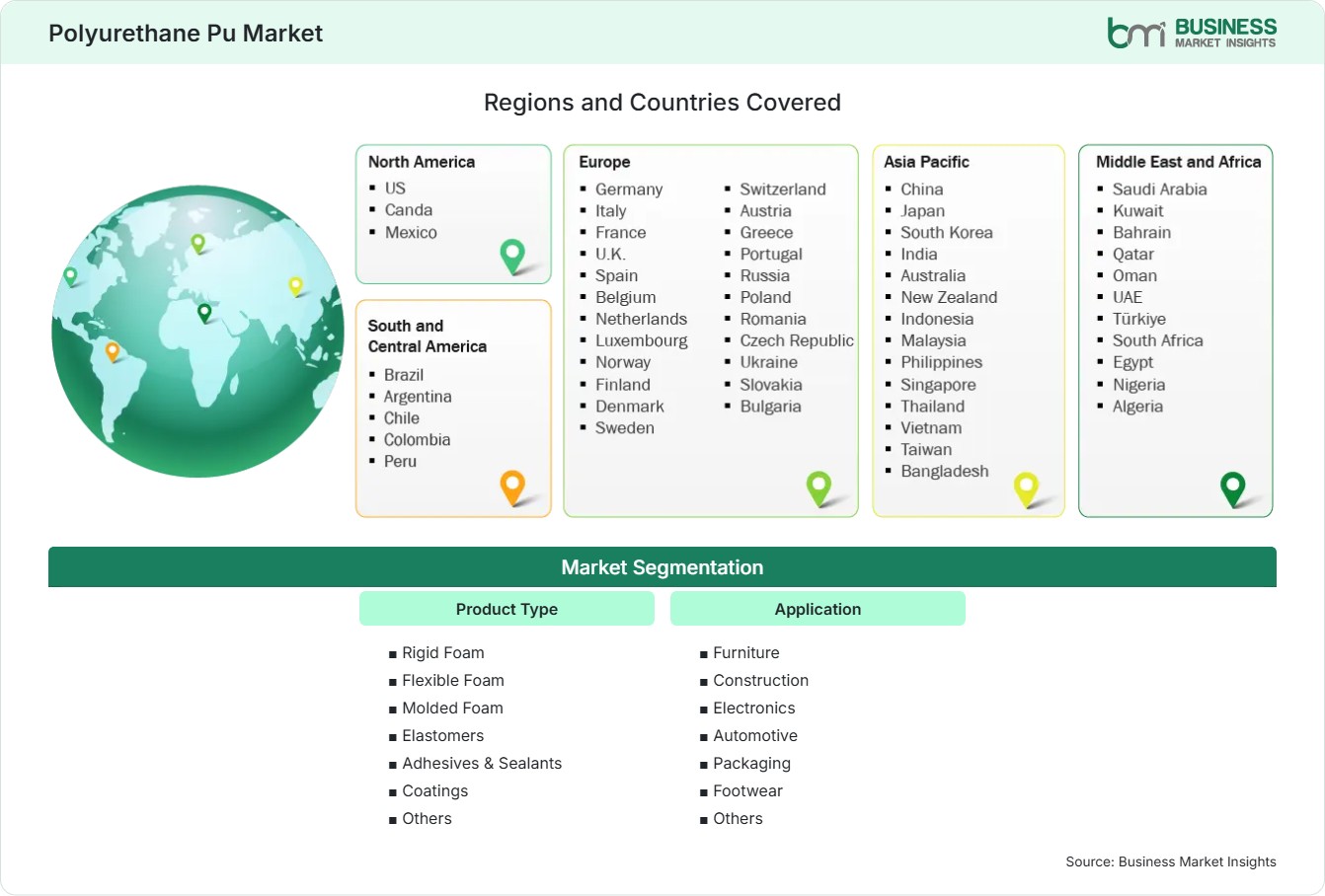
  • Product Type: Rigid Foam, Flexible Foam, Molded Foam, Elastomers, Adhesives & Sealants, Coatings, Others
  • Application: Furniture, Construction, Electronics, Automotive, Packaging, Footwear, Others
US$ 100.92 Bn Market size in 2025
US$ 159.59 Bn Market Size by 2033
5.90% CAGR, 2026 - 2033
2026-2033 Forecast Period

AI Overview

Polyurethane Market Summary

  • North America Region: North America holds a market share of 29%–32% in 2025, growing with a CAGR of 5.1%–5.6% during 2026–2033. Growth is supported by energy-efficient construction mandates, automotive lightweighting initiatives, advanced insulation applications, manufacturing modernization programs, bio-based material development, industrial refurbishment projects, and rising infrastructure investments across multiple end-use sectors. The U.S. market benefits from industrial construction activity and advanced manufacturing investments, expanding at a CAGR of 5.2%–5.7%.
  • Fastest Growing Region: Asia Pacific holds a market share of 41%–44% in 2025, growing with a CAGR of 6.7%–7.2% during 2026–2033. Expansion is supported by urbanization, electronics manufacturing growth, automotive production, residential development, industrialization initiatives, appliance manufacturing expansion, government infrastructure spending, and increasing adoption of advanced insulation materials.
  • Leading Segment: Flexible Foam holds a market share of 27%–30% in 2025, growing with a CAGR of 5.8%–6.3% during 2026–2033. Demand remains supported by furniture production, bedding applications, transportation seating requirements, comfort-oriented consumer products, durability advantages, customization capabilities, and replacement demand across mature economies.
  • High Growth Segment: Construction holds a market share of 22%–25% in 2025, growing with a CAGR of 6.6%–7.1% during 2026–2033. Energy efficiency regulations, commercial infrastructure projects, insulation adoption, green building initiatives, renovation activities, industrial facility construction, and thermal performance requirements continue accelerating consumption globally.
  • Key Market Opportunity: Growing adoption of bio-based polyols, circular manufacturing models, advanced insulation systems, electric vehicle components, and sustainable building materials creates substantial long-term opportunities for material suppliers and converters globally.
  • Major Market Players: BASF SE, The Dow Chemical Company, Covestro AG, Wanhua Chemical Group Co., Ltd., Huntsman Corporation, Foamcraft, Inc., Mitsui Chemicals & SKC Polyurethanes Inc., LANXESS AG, Eurofoam GmbH, and INOAC Corporation.
Strategic Insights

Polyurethane Market: Strategic Insights

Polyurethane Market Strategic Framework
FREE PDF
Request your free sample
Request free sample
Stakeholder View

Key Takeaways

  • The industry value chain is becoming increasingly integrated, with chemical producers investing in downstream foam, coating, and elastomer manufacturing capabilities to strengthen supply security and improve profitability.
  • Construction insulation and advanced building envelope applications present the strongest medium-term demand opportunity as governments pursue energy-efficiency targets and green building standards.
  • Innovation is increasingly focused on bio-based polyols, recyclable polyurethane technologies, low-VOC formulations, and advanced lightweight materials for transportation and electronics applications.
  • Asia Pacific offers the most compelling regional investment opportunity due to large-scale infrastructure projects, expanding manufacturing capacity, and rising household consumption across developing economies.
  • Strategic partnerships, capacity expansions, and sustainability-focused acquisitions are reshaping competition as companies seek access to specialty technologies and environmentally responsible production methods.
  • Supply chain resilience and feedstock diversification are becoming strategic priorities amid volatility in petrochemical raw material pricing and evolving environmental regulations.
Geographic Outlook

Polyurethane Market Regional Highlights

North America Polyurethane Market

North America accounts for approximately 29%–32% of global Polyurethane Market demand in 2025 and is projected to expand at a CAGR of 5.1%–5.6% through 2033. Demand remains closely linked to residential renovation activity, industrial construction, automotive manufacturing, and appliance production. Stringent energy-efficiency standards continue encouraging adoption of high-performance insulation materials. The region maintains strong innovation capabilities through advanced research programs and established chemical manufacturing infrastructure. Increasing sustainability commitments are also accelerating investments in recycled and bio-based polyurethane technologies.

  • Energy-efficient building retrofits continue driving insulation demand as federal and state programs encourage reduced energy consumption and improved thermal performance across commercial and residential structures.
  • Automotive manufacturers increasingly utilize lightweight polyurethane components to improve fuel efficiency, enhance passenger comfort, and support electrification strategies across passenger and commercial vehicle platforms.
  • Sustainable polyurethane development is gaining momentum through investments in recycled content technologies, chemical recycling processes, and renewable feedstock integration across production networks.
  • Industrial automation and manufacturing modernization programs are expanding demand for specialty elastomers, coatings, and protective materials in industrial applications.

US Polyurethane Market

The United States represents approximately 72%–76% of regional consumption and is forecast to grow at a CAGR of 5.2%–5.7% through 2033. Strong construction spending, appliance manufacturing, furniture production, and automotive investments continue supporting consumption. Federal incentives for energy-efficient buildings and domestic manufacturing initiatives further strengthen Polyurethane Market fundamentals. Demand is increasingly shifting toward sustainable formulations that align with corporate environmental objectives and evolving regulatory requirements.

  • Residential renovation and remodeling expenditures continue supporting demand for insulation products, sealants, and coatings used in energy-performance upgrades.
  • Electric vehicle manufacturing investments are creating new opportunities for lightweight components, battery protection materials, and thermal management applications.
  • Domestic production capacity expansions are improving supply chain resilience while supporting demand from industrial and consumer end-use sectors.
  • Research initiatives focused on low-emission and recyclable materials continue enhancing product performance and environmental compatibility.

Europe Polyurethane Market

Europe captures approximately 23%–26% of global demand and is expected to expand at a CAGR of 4.8%–5.3% through 2033. Regional growth is supported by stringent energy-performance regulations, sustainable construction initiatives, and industrial modernization programs. Germany remains the leading Polyurethane Market, while Eastern European economies exhibit faster expansion rates driven by infrastructure investment and manufacturing growth. Decarbonization objectives are accelerating development of circular polyurethane technologies and renewable feedstocks.

  • Building renovation programs under European sustainability objectives continue supporting extensive insulation material deployment across residential and commercial structures.
  • Germany maintains regional leadership through advanced manufacturing capabilities, automotive production, and strong chemical industry infrastructure.
  • Poland and Romania demonstrate elevated growth potential due to industrial expansion and increasing construction activity.
  • Circular economy initiatives encourage investment in recycling technologies and lower-carbon polyurethane production systems.
  • Growing electric vehicle production supports demand for lightweight components and thermal insulation applications.

Asia Pacific Polyurethane Market

Asia Pacific holds the largest Polyurethane Market share at approximately 41%–44% in 2025 and is anticipated to record a CAGR of 6.7%–7.2% through 2033. China dominates regional consumption, while India and Southeast Asian countries exhibit the strongest growth trajectories. Rapid urbanization, manufacturing expansion, rising disposable incomes, and infrastructure development continue supporting demand. Expanding electronics production and appliance manufacturing further strengthen long-term consumption prospects across multiple application categories.

  • China remains the largest regional consumer due to extensive construction activity, furniture manufacturing, and industrial production capacity.
  • India benefits from urban infrastructure investment, residential development programs, and expanding automotive manufacturing capabilities.
  • Southeast Asia is attracting production investments due to favorable manufacturing economics and growing domestic demand.
  • Electronics and appliance manufacturing growth continues generating substantial demand for insulation and protective material applications.
  • Government infrastructure spending supports long-term consumption across transportation, industrial, and residential sectors.

Rest of World Polyurethane Market

Rest of World accounts for approximately 7%–10% of global market demand and is projected to expand at a CAGR of 5.7%–6.2% through 2033. South and Central America benefit from industrial development and housing activity, while Middle East and Africa markets are supported by infrastructure modernization and economic diversification initiatives. Construction, transportation, and industrial applications remain primary demand drivers. Increasing investment in manufacturing capabilities and logistics infrastructure continues enhancing regional growth potential.

  • Brazil leads South and Central American consumption through automotive production, furniture manufacturing, and construction sector activity.
  • Mexico benefits from industrial nearshoring trends and manufacturing expansion linked to North American supply chains.
  • Saudi Arabia supports growth through large-scale infrastructure projects and industrial diversification programs.
  • The United Arab Emirates continues investing in energy-efficient construction and advanced building materials.
  • Expanding industrialization across Africa is creating long-term opportunities for insulation, coatings, and elastomer applications.
Global Market Geography
FREE PDF
Request your free sample
Request free sample
Segment Analysis

Polyurethane Market Segmentation

Product Type

The Product Type segment represented approximately 100% of total industry demand in 2025, with flexible and rigid foam categories accounting for the majority of consumption. Demand patterns are increasingly shaped by energy-efficiency requirements, lightweight material adoption, and sustainability initiatives. The Polyurethane Market scope continues expanding across insulation, transportation, industrial, and consumer applications. The segment is projected to advance at a CAGR of 5.8%–6.3% through 2033 as manufacturers prioritize high-performance formulations and circular production technologies.

  • Rigid Foam: Rigid foam remains essential for thermal insulation in buildings, refrigeration equipment, and industrial facilities, supported by rising energy-performance standards and increasing adoption of advanced insulation systems globally.
  • Flexible Foam: Flexible foam maintains strong demand from furniture, bedding, transportation seating, and comfort-focused consumer products, benefiting from durability, cushioning performance, and customization capabilities across end-use industries.
  • Molded Foam: Molded foam applications continue expanding in automotive seating, headrests, and ergonomic products due to enhanced design flexibility, comfort performance, and lightweight structural properties.
  • Elastomers: Polyurethane elastomers are widely utilized in industrial rollers, wheels, seals, and mechanical components where abrasion resistance, durability, and operational efficiency remain critical requirements.
  • Adhesives & Sealants: Growing construction, automotive assembly, and industrial manufacturing activities support adoption of polyurethane adhesives and sealants that deliver strong bonding performance and environmental resistance.
  • Coatings: Protective coatings benefit from increasing infrastructure investment and industrial maintenance requirements, providing durability, corrosion protection, chemical resistance, and long service life.

Application

The application segment demonstrates broad diversification across construction, furniture, automotive, electronics, packaging, and footwear industries. Construction accounts for approximately 22%–25% of market demand in 2025 and represents the fastest-growing application category, advancing at a CAGR of 6.6%–7.1% through 2033. Polyurethane Market trends indicate increasing utilization of advanced insulation systems, lightweight materials, and environmentally optimized formulations that support regulatory compliance and sustainability objectives.

  • Furniture: Furniture manufacturing remains a major consumption area due to extensive use of flexible foam in mattresses, seating products, cushions, and comfort-oriented residential furnishings.
  • Construction: Construction applications continue expanding through insulation panels, spray foams, sealants, and coatings that improve thermal efficiency, structural durability, and building sustainability performance.
  • Electronics: Electronics manufacturers increasingly utilize polyurethane materials for insulation, encapsulation, vibration control, and protection of sensitive electronic components.
  • Automotive: Automotive demand is driven by lightweighting strategies, passenger comfort requirements, acoustic insulation needs, and electric vehicle production expansion.
  • Packaging: Protective packaging solutions utilize polyurethane materials to safeguard sensitive equipment and high-value products during transportation and storage operations.
  • Footwear: Footwear manufacturers adopt polyurethane systems for midsoles, cushioning components, and performance-enhancing designs that improve comfort and durability.
Market Forces

Polyurethane Market Dynamics

Key Market Drivers

Expansion of Energy-Efficient Building Construction

Efficiency policies backed by the government and targets aimed at reducing carbon dioxide continue to drive up the demand for insulators globally. As per the International Energy Agency, there is considerable energy consumption from buildings worldwide; therefore, the usage of high-performance thermal insulation material is promoted. Rigid foam made of polyurethane provides excellent insulating properties as opposed to other materials. Polyurethane Market growth is increasingly linked to renovation programs focused on reducing heating and cooling energy requirements. Demand is particularly strong in North America, Europe, China, and emerging Asian economies, where stricter building codes emphasize energy performance, sustainability, and lifecycle efficiency across new construction and retrofit activities.

Growing Demand for Lightweight Automotive Materials

The automotive industry is continuously on the lookout for lightweight solutions for improving fuel efficiency and enhancing the range of electric vehicles. The polyurethane family offers a balanced set of properties of strength, comfort, insulating capability, and weight-saving features. Increasing use of polyurethane technology can be seen in vehicle seat structures, interior parts, acoustic and thermal insulations. Growth in the production of electric vehicles also helps boost their consumption. Polyurethane Market trends are closely associated with transportation electrification, evolving emission standards, and consumer demand for enhanced vehicle comfort. Major automotive production centers across Asia Pacific, Europe, and North America continue supporting steady material adoption.

Advancements in Sustainable Polyurethane Technologies

Manufacturers are accelerating investments in bio-based polyols, recycled feedstocks, and circular production models to meet sustainability objectives. Environmental regulations and corporate carbon-reduction commitments are encouraging the adoption of lower-emission materials. The novel formulations are now incorporating renewable feedstock while retaining the same performance criteria that are necessary in all kinds of applications. The recycling techniques are also gaining momentum in increasing efficiency and minimizing wastage. Sustainable products are now increasingly being used to create a competitive advantage, especially in the construction industry, automotive, and consumer goods sectors.

Key Market Opportunities

Rapid Adoption of Bio-Based Polyurethane Feedstocks

Polyurethane technologies based on biological sources present a huge potential for material manufacturers looking to distinguish themselves and gain a sustainable advantage. Vegetable oil- and biomass-based renewable sources have become increasingly important for material manufacturers looking to reduce carbon footprints. Investment activity is increasing across Europe, North America, and the Asia Pacific, where sustainability regulations continue evolving. Polyurethane Market Forecasts indicate that there is increasing commercial feasibility for renewable formulas due to advancements in manufacturing processes and economies of scale. Those companies that will be able to produce competitive bio-products while ensuring performance standards will be able to benefit from increasing prospects in the automotive, building, furniture, and consumer sectors.

Growth of Green Building and Retrofit Programs

Large-scale building renovation initiatives are creating sustained demand for advanced insulation materials. The performance and advantages of polyurethane insulating systems are well-suited to these policy goals. The increased spending on upgrading commercial buildings, retrofitting homes, and improving industrial facilities results in a conducive demand situation. Another factor contributing to adoption is increasing energy prices and the growing realization of the benefits of efficiency in buildings. The suppliers of such high-performing insulating systems stand to gain from this trend.

Expanding Applications in Electric Vehicles and Batteries

Electric vehicle production growth is creating new application areas for polyurethane materials. Battery systems require thermal management, impact protection, vibration control, and lightweight structural solutions that align with polyurethane performance capabilities. Manufacturers are increasingly using specialized formulas within battery packs and car interior products. Increased production of electric vehicles due to government incentive schemes and consumer trends will bolster future demand expectations. With the advent of new technologies within battery production, potential opportunities for innovative polyurethane products are likely to increase. Innovation within materials and cooperation with auto manufacturers will continue to be important.

Market Restraints and Challenges

Volatility in Petrochemical Feedstock Prices

Factor: Polyurethane production remains heavily dependent on petrochemical derivatives, including isocyanates and polyols, whose pricing is influenced by crude oil fluctuations, geopolitical events, and supply disruptions.

Impact: Feedstock volatility creates uncertainty in manufacturing costs and compresses profit margins across the value chain. Producers frequently face challenges in passing cost increases to customers, particularly in highly competitive markets. Disruptions within the supply chain can exacerbate pricing instabilities even further. Sourcing decisions on the long-term, diversifying supplies, and the utilization of renewable raw materials have become vital in overcoming challenges in volatile raw material environments.

Environmental Compliance and End-of-Life Waste Concerns

Factor: Increasing regulatory scrutiny regarding emissions, chemical safety, and waste management places additional compliance obligations on manufacturers and downstream users.

Impact: Businesses have to spend a lot on adopting clean technologies, reformulating their products, setting up recycling facilities, and environmental accounting processes. These compliance expenses can affect operational costs and increase time in developing their products. Issues like material wastage and recycling also matter for customers in different sectors. Organizations unable to adapt to evolving environmental expectations risk losing competitiveness, while proactive sustainability investments become necessary to maintain market access and regulatory alignment.

Company Analysis

Competitive Landscape

The Polyurethane Market analysis highlights competition centered on feedstock integration, sustainable polyurethane development, low-emission formulations, and capacity expansion across Asia Pacific, Europe, and North America.

Company Name

Overview

Products and Services Relevant to this Market

BASF SE

Global chemical leader with extensive polyurethane manufacturing capabilities and strong innovation in sustainable materials.

Polyurethane systems, MDI, TDI, rigid foams, flexible foams, insulation materials, coatings, and specialty polyurethane solutions.

The Dow Chemical Company

Major producer serving construction, automotive, and industrial sectors through integrated chemical operations.

Polyols, isocyanates, polyurethane foams, adhesives, sealants, coatings, and performance materials.

Covestro AG

Leading supplier focused on circular economy initiatives and advanced polyurethane technologies.

Polyurethane raw materials, insulation solutions, elastomers, coatings, and specialty foam systems.

Yantai Wanhua Polyurethanes Co., Ltd.

Significant Asian producer with large-scale MDI manufacturing and expanding global footprint.

MDI, TDI, polyurethane systems, thermoplastic polyurethanes, coatings, and specialty chemicals.

Huntsman Corporation

Diversified chemical manufacturer with strong presence across industrial and consumer polyurethane applications.

Polyurethanes, performance products, insulation materials, adhesives, elastomers, and composite solutions.

Foamcraft, Inc.

Specialized foam producer serving packaging, healthcare, and consumer product industries.

Flexible foam products, cushioning materials, engineered foam solutions, and custom fabrication services.

Mitsui Chemicals & SKC Polyurethanes Inc.

Joint venture supporting advanced polyurethane technologies throughout Asia.

Polyurethane systems, specialty foams, elastomers, coatings, and industrial application materials.

LANXESS AG

Specialty chemicals company emphasizing high-performance materials and sustainable innovation.

Polyurethane intermediates, additives, specialty chemicals, and industrial performance solutions.

Eurofoam Group

European foam specialist supplying furniture, bedding, and mobility sectors.

Flexible polyurethane foams, comfort solutions, mattress components, and cushioning materials.

Inoac Corporation

Established Japanese manufacturer with diversified foam and polymer technologies.

Polyurethane foams, automotive components, industrial materials, bedding products, and insulation solutions.

Trust & Transparency

Research Methodology

The market analysis combines proprietary research with secondary data from government agencies, company disclosures, regulatory filings, industry databases and expert interviews. Market estimates are validated through data triangulation, cross-market benchmarking and analyst review.

View Full Research Methodology

Questions Answered

Frequently Asked Questions

What insights does a Polyurethane Market Report provide to stakeholders?

A Polyurethane Market Report helps stakeholders evaluate competitive positioning, demand patterns, technology developments, regional opportunities, investment priorities, and long-term market potential.

How does Asia Pacific influence industry development?

Asia Pacific benefits from rapid industrialization, strong manufacturing ecosystems, expanding infrastructure investment, and increasing consumption of consumer goods, making it a key growth center.

Which application segment offers the strongest long-term opportunity?

Construction remains a highly attractive segment because polyurethane insulation contributes to energy efficiency targets, green building initiatives, and regulatory compliance across developed and emerging economies.

How is sustainability influencing polyurethane manufacturing?

Manufacturers are increasingly investing in recycled feedstocks, bio-based polyols, circular economy programs, and lower-emission production technologies to meet environmental targets and customer requirements.

What is driving demand for polyurethane products across industries?

Construction modernization, automotive lightweighting, furniture consumption, insulation requirements, and growing use of high-performance materials continue to expand polyurethane adoption across global industrial value chains.

Access the Full Polyurethane Market Report

Get segment-level forecasts, regional estimates, competitive benchmarking, company profiles and downloadable Excel datasets.

Access the full Polyurethane Market Report
350 pages PDF & Excel | 2026-08-24
Similar Research

Related Market Reports