
Polymethyl Methacrylate Market Outlook: Size, Share, Trends, Growth Analysis, Competitive Landscape & Forecast, 2026-2033

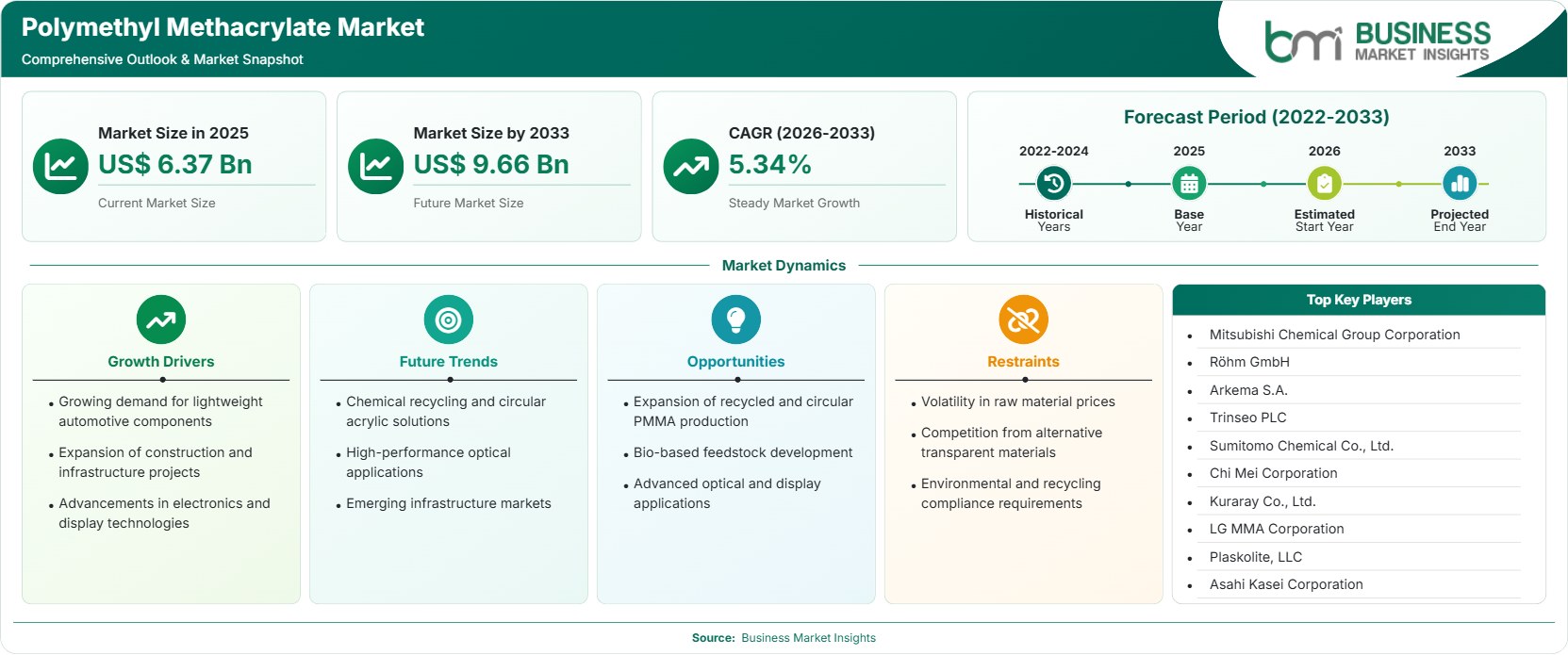
The Polymethyl Methacrylate Market size was valued at US$ 6.37 Billion in 2025 and is projected to reach US$ 9.66 Billion by 2033, growing at a CAGR of 5.34% during 2026–2033. Growth is supported by rising lightweight material demand, expanding signage applications, automotive glazing adoption, electronics miniaturization, sustainable acrylic innovations, and increasing infrastructure investments across emerging economies.

Report Coverage
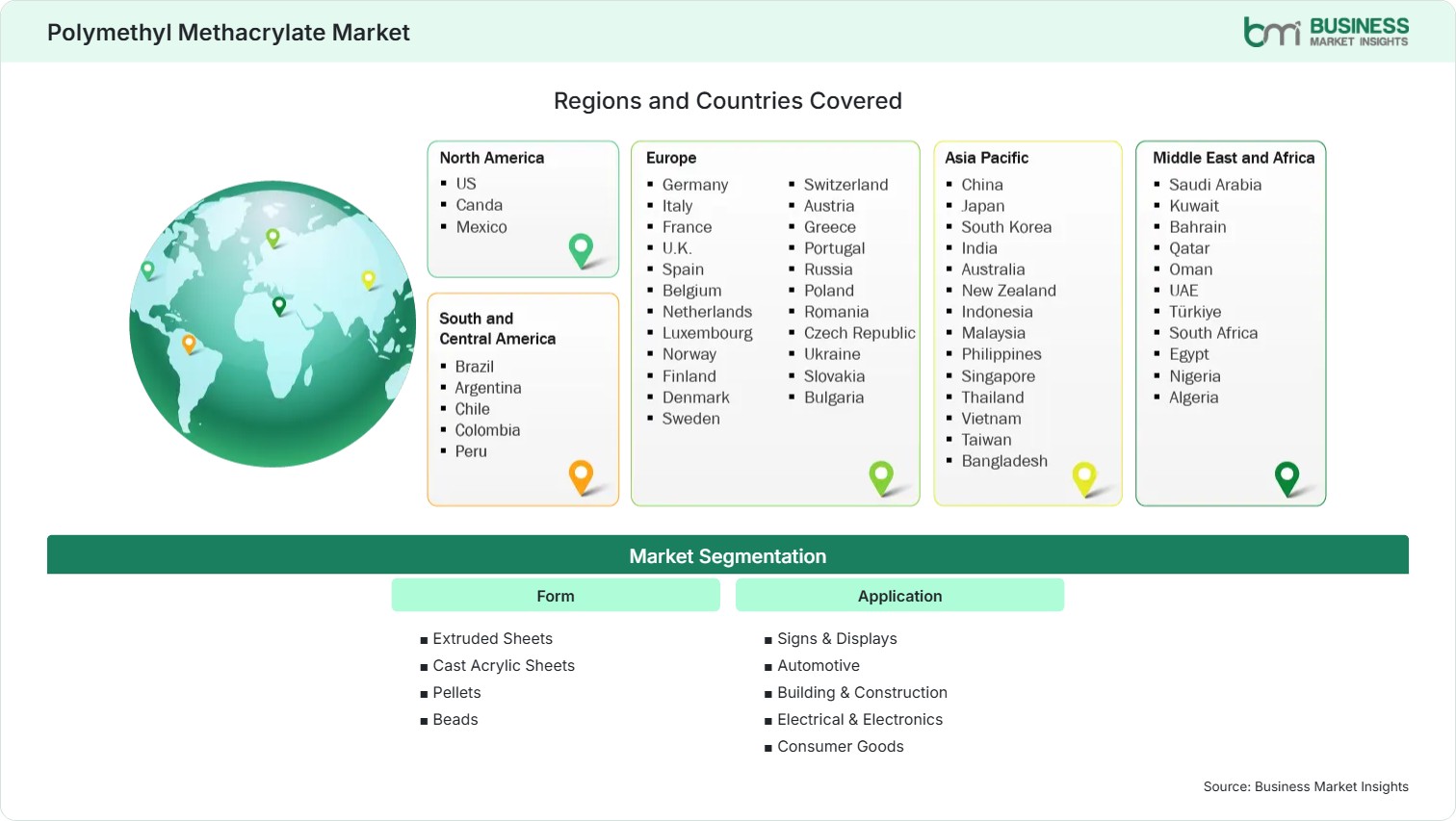
  • Form: Extruded Sheets, Cast Acrylic Sheets, Pellets, Beads
  • Application: Signs & Displays, Automotive, Building & Construction, Electrical & Electronics, Consumer Goods
US$ 6.37 Bn Market size in 2025
US$ 9.66 Bn Market Size by 2033
5.34% CAGR, 2026 - 2033
2026-2033 Forecast Period

AI Overview

Polymethyl Methacrylate Market Summary

  • North America Region: Holds 22%–25% share in 2025, growing at a CAGR of 4.6%–5.0% during 2026–2033. Demand is supported by automotive lighting, premium construction materials, display applications, sustainability initiatives, advanced manufacturing investment, recycling innovations, medical-grade acrylic adoption, infrastructure refurbishment, aerospace applications, and durable glazing demand. US market benefits from strong construction renovation and specialty acrylic manufacturing, advancing at 4.7%–5.1% CAGR.
  • Fastest Growing Region: Asia Pacific holds 43%–46% share in 2025 and advances at 5.9%–6.4% CAGR. Expansion is driven by electronics manufacturing growth, urban infrastructure spending, vehicle production, consumer appliances demand, industrial development, export-oriented production, optical-grade materials adoption, and capacity additions.
  • Leading Segment: Cast Acrylic Sheets account for 34%–37% share in 2025 with CAGR of 5.0%–5.4%. Growth is supported by superior optical clarity, weather resistance, architectural usage, premium signage demand, transportation applications, fabrication flexibility, durability requirements, customized solutions, and decorative construction projects.
  • High Growth Segment: Automotive represents 17%–20% share in 2025 and expands at 6.2%–6.8% CAGR. Demand stems from electric vehicles, lightweight component integration, advanced lighting systems, panoramic glazing, fuel-efficiency objectives, design flexibility, sustainability targets, durability improvements, and safety-enhancing transparent materials.
  • Key Market Opportunity: Chemical recycling technologies, circular acrylic production pathways, bio-based feedstocks, premium optical applications, and smart infrastructure projects are creating attractive long-term value opportunities for manufacturers, converters, and material innovators globally.
  • Major Market Players: Mitsubishi Chemical Group Corporation, Röhm GmbH, Arkema S.A., Trinseo PLC, Sumitomo Chemical Co., Ltd., Chi Mei Corporation, Kuraray Co., Ltd., LG MMA Corporation, Plaskolite, LLC, Asahi Kasei Corporation.
Strategic Insights

Polymethyl Methacrylate Market: Strategic Insights

Polymethyl Methacrylate Market Strategic Framework
FREE PDF
Request your free sample
Request free sample
Stakeholder View

Key Takeaways

  • The value chain is becoming more integrated, with producers strengthening monomer supply access, recycling partnerships, and downstream sheet manufacturing capabilities.
  • Automotive lighting, EV glazing systems, architectural facades, and premium display solutions present the strongest medium-term expansion opportunities.
  • Product innovation increasingly focuses on recycled content, optical-grade performance, scratch resistance, UV durability, and lightweight engineering applications.
  • India, Southeast Asia, and selected Gulf economies offer compelling investment potential due to infrastructure expansion and manufacturing localization strategies.
  • Strategic partnerships, capacity expansions, and sustainability-oriented acquisitions are reshaping competition among global acrylic material suppliers.
  • Circular economy business models are emerging as a differentiating factor for companies seeking premium positioning and regulatory alignment.
Geographic Outlook

Polymethyl Methacrylate Market Regional Highlights

North America Polymethyl Methacrylate Market

North America accounts for approximately 22%–25% of global demand in 2025 and is projected to advance at a CAGR of 4.6%–5.0% through 2033. Strong adoption within architectural glazing, transportation, medical devices, and premium display applications underpins regional demand. The Polymethyl Methacrylate Market share remains supported by mature manufacturing infrastructure and technological capabilities. Sustainability initiatives and acrylic recycling investments increasingly influence procurement decisions across end-use industries.

  • Infrastructure renovation projects continue supporting glazing and architectural sheet consumption across commercial construction applications.
  • Growth in advanced vehicle lighting enhances transparent polymer usage in mobility-related manufacturing.
  • Medical equipment and protective barrier applications maintain demand for specialty-grade acrylic materials.
  • Growing emphasis on recycled content encourages development of circular supply chains.
  • Aerospace and defense sectors create stable demand for high-performance transparent materials.

US Polymethyl Methacrylate Market

The United States represents roughly 78%–82% of North American Polymethyl Methacrylate Market demand is projected to register a CAGR of 4.7%–5.1%. The growth will be dominated by construction renovation, automotive innovations, healthcare infrastructure, and premium consumer products. Local manufacturers are focusing on investing in value addition of acrylic products and recycling of acrylics without compromising on quality.

  • Automotive lighting innovation supports broader adoption of transparent engineered materials.
  • Commercial modernization projects drive specification of durable glazing solutions.
  • Medical and laboratory applications support demand for specialty acrylic grades.
  • Sustainability goals encourage interest in chemically recycled acrylic products.

Europe Polymethyl Methacrylate Market

Europe contributes 24%–27% market share in 2025 and is forecast to expand at 4.8%–5.2% CAGR. Modernization, efficient construction, premium transport applications, and sustainable regulations support regional development. Germany is leading the way on consumption, but Eastern European manufacturing centers show comparatively higher growth rates close to 5.4%-5.8% CAGR.

  • EU circular economy policies accelerate investment in recycled acrylic technologies.
  • Germany remains the largest regional producer and consumer base.
  • Energy-efficient building projects support glazing demand growth.
  • Automotive innovation promotes lightweight material integration.
  • Industrial design applications continue generating stable specialty demand.

Asia Pacific Polymethyl Methacrylate Market

Asia Pacific commands 43%–46% share in 2025 and remains the fastest-growing region, advancing at 5.9%–6.4% CAGR. China leads production and consumption, while India and Southeast Asia exhibit the strongest expansion momentum. Electronics manufacturing, urban construction, transportation growth, and consumer appliances substantially contribute to regional Polymethyl Methacrylate Market growth prospects.

  • China maintains leadership through integrated manufacturing ecosystems.
  • India records strong demand from infrastructure and electronics sectors.
  • Japan remains influential in high-performance acrylic innovation.
  • Southeast Asia benefits from industrial investment relocation trends.
  • Consumer goods manufacturing supports consistent material demand.

Rest of World Polymethyl Methacrylate Market

Rest of World represents 8%–11% share and is expected to expand at 5.3%–5.8% CAGR. South and Central America benefit from infrastructure upgrades and automotive assembly activities. Meanwhile, Middle East and Africa markets gain support from commercial construction, tourism-linked projects, and industrial diversification initiatives. Brazil leads Latin America, while Saudi Arabia and the UAE demonstrate stronger growth momentum.

  • Brazilian construction and signage sectors support acrylic sheet demand.
  • GCC infrastructure investment stimulates premium glazing consumption.
  • Industrial diversification programs encourage local materials processing.
  • Retail modernization drives demand for display applications.
  • Growing urban populations support long-term construction activity.
Global Market Geography
FREE PDF
Request your free sample
Request free sample
Segment Analysis

Polymethyl Methacrylate Market Segmentation

Form

Form segment dynamics are influenced by application-specific performance requirements, conversion efficiency, and end-user customization. The segment holds the largest revenue contribution, accounting for 52%–55% share in 2025 and advancing at 5.2%–5.6% CAGR. The Polymethyl Methacrylate Market scope continues to expand as manufacturers introduce specialized grades for optical, automotive, and architectural purposes.

  • Extruded Sheets: Widely used in displays and construction due to cost efficiency, dimensional consistency, and high-volume production suitability.
  • Cast Acrylic Sheets: Preferred for premium applications requiring superior optical clarity, weather resistance, and fabrication flexibility.
  • Pellets: Extensively consumed in injection molding operations supporting electronics, automotive, and consumer product manufacturing.
  • Beads: Utilized in specialty coatings, additives, decorative products, and niche industrial formulations requiring transparency.

Application

Applications remain diversified across transportation, infrastructure, electronics, and consumer industries. This segment recorded approximately 45%–48% revenue concentration in key industrial applications during 2025 while demonstrating CAGR potential of 5.3%–5.8%. Emerging Polymethyl Methacrylate Market trends indicate accelerating demand from mobility and advanced display technologies.

  • Signs & Displays: Retail visualization, commercial branding, and illuminated advertising continue supporting steady acrylic material consumption.
  • Automotive: Lightweight design priorities, advanced lighting systems, and electric vehicle development create strong growth momentum.
  • Building & Construction: Architectural glazing, partitions, decorative structures, and daylighting applications sustain long-term demand.
  • Electrical & Electronics: Optical components, screens, and precision housings support technology-sector usage.
  • Consumer Goods: Household products, furniture, décor items, and lifestyle accessories contribute diversified revenue opportunities.
Market Forces

Polymethyl Methacrylate Market Dynamics

Key Market Drivers

Growing Demand for Lightweight Automotive Components

Automotive manufacturers continue prioritizing weight reduction to improve efficiency and extend electric vehicle range. PMMA has advantages of being transparent, weather-resistant, and lighter in weight than the usual glass options. The greater use of the product in lighting, instrument panels, and glazing structures will fuel the growth in consumption. The International Energy Agency has stated that the increasing use of electric vehicles is making the need for lighter materials in new vehicle designs a reality. Increasing production of high-end automobiles and advanced lighting systems is an added strength to the acrylic material needs in the automotive industry chain.

Expansion of Construction and Infrastructure Projects

Rapid urbanization and commercial infrastructure development continue supporting consumption across architectural glazing, partitions, facades, and decorative applications. Acrylics' durability, resistance to UV rays, and versatility in design give them an edge over other materials when used in the construction environment. There is more public infrastructure investment taking place in Asia and the Middle East regions. This means that the demand for high-performance building materials with longevity attributes is growing. Construction and remodeling activities in hospitals, airports, commercial and retail areas have also contributed to the increase in consumption of acrylic materials.

Advancements in Electronics and Display Technologies

Electronics manufacturing increasingly requires high-clarity materials compatible with modern display systems and precision components. Acrylic polymer solutions that have high transparency are extensively used in displays, protective shields, optical components, and consumer electronics assembly. The increase in production numbers in Asia, along with technological developments in display technology, is behind the growth in demand for acrylics. The increased optical, processability, and durability properties make it competitive in the electronics industry. The increasing trends of digitalization and the usage of smart devices ensure long-term material needs.

Key Market Opportunities

Chemical Recycling and Circular Acrylic Solutions

Circular economy strategies are creating opportunities for manufacturing companies willing to invest in depolymerization and recycling. Monomers recovered from the process can be reintegrated into the production chain and will minimize the burden on the environment while fulfilling sustainability goals. Manufacturing companies building recycling capacity will have access to better-quality customers who need low-carbon-footprint materials. Long-term Polymethyl Methacrylate Market Forecasts increasingly incorporate circular production pathways as a differentiating competitive factor capable of generating both environmental and commercial benefits.

High-Performance Optical Applications

Growing demand for optical precision across healthcare, telecommunications, electronics, and transportation sectors presents significant opportunity. Acrylic grades that offer improved transparency, light transmissivity, and flexibility in design provide scope for their application in some special fields. Companies that concentrate on producing superior quality products can make better profits and customer involvement. New technologies, which include sensors, superior lighting, and optical equipment, will be generating new market segments. The ability to customize and improve performance further adds to the business prospects.

Emerging Infrastructure Markets

Urban development initiatives across India, Southeast Asia, Latin America, and Gulf economies generate expanding demand for advanced construction materials. Massive transport terminals, business centers, tourist resorts, and public works need to use high-quality transparent building materials. As economies develop, so does the desire for attractive architecture and efficient design. Manufacturers that set up distribution channels and production sites in such regions can enjoy favorable demographic and industrial conditions. Such an investment can bring many benefits in the coming consumer markets.

Market Restraints and Challenges

Volatility in Raw Material Prices

Factor: Acrylic monomer pricing remains influenced by petrochemical feedstock fluctuations, energy costs, and regional supply-demand imbalances. Impact: Production planning becomes complicated, and margin stability will be compromised when there is a lot of cost change. Manufacturers have difficulties passing on higher cost of inputs to consumers who have entered into price-fixed contracts. Being subject to the global energy markets conditions is another source of uncertainty. Integration may help in reducing the risk, but small firms are more at risk.

Competition from Alternative Transparent Materials

Factor: Polycarbonate, specialty glass, and emerging engineered polymers continue competing for applications requiring transparency and durability. Impact: Factors such as pricing pressures and the threat of substitution may inhibit adoption in certain end-use markets. Alternative materials may be capable of offering superior performance features such as improved impact resistance or special processability qualities. Companies need to keep innovating in order to maintain their competitive advantage and value propositions. The growing emphasis of customers on cost-performance balance creates greater competition.

Company Analysis

Competitive Landscape

The competitive environment reflects a mix of integrated chemical producers and specialty acrylic manufacturers. This Polymethyl Methacrylate Market analysis indicates growing emphasis on sustainability, recycling technologies, and high-performance grades.

Company Name

Overview

Products and Services relevant to this market

Mitsubishi Chemical Group Corporation

Global chemical leader with integrated acrylic value chain and significant international manufacturing footprint.

PMMA resins, acrylic sheets, specialty compounds, optical materials.

Röhm GmbH

Major methacrylate specialist known for strong innovation and PLEXIGLAS portfolio.

PMMA molding compounds, sheets, recycling initiatives, specialty grades.

Arkema S.A.

Specialty materials company with extensive acrylic solutions presence worldwide.

ALTUGLAS acrylic resins, sheets, sustainable material solutions.

Trinseo PLC

Global materials producer serving transportation and industrial customers.

PMMA resins, engineered plastics, performance materials.

Sumitomo Chemical Co., Ltd.

Diversified chemical manufacturer with advanced materials expertise.

Optical-grade PMMA, specialty polymers, industrial materials.

Chi Mei Corporation

Leading Asian polymer producer with broad manufacturing capabilities.

PMMA resins, molding materials, consumer and industrial grades.

Kuraray Co., Ltd.

High-performance materials provider focused on innovation-driven markets.

Specialty acrylic materials, transparent engineered products.

LG MMA Corporation

Significant MMA and PMMA producer supporting Asian demand.

PMMA resins, acrylic feedstocks, industrial materials.

Plaskolite, LLC

Major acrylic sheet manufacturer serving North America.

Acrylic sheets, glazing materials, display solutions.

Asahi Kasei Corporation

Diversified technology company active in advanced materials markets.

Functional acrylic materials, specialty polymer solutions.

Trust & Transparency

Research Methodology

The market analysis combines proprietary research with secondary data from government agencies, company disclosures, regulatory filings, industry databases and expert interviews. Market estimates are validated through data triangulation, cross-market benchmarking and analyst review.

View Full Research Methodology

Questions Answered

Frequently Asked Questions

What does this Polymethyl Methacrylate Market Report highlight for investors?

It highlights regional demand shifts, sustainability-driven opportunities, emerging applications, competitive positioning, and long-term growth prospects across the acrylic materials value chain.

How does recycling influence industry competitiveness?

Advanced recycling enables lower-carbon material production, supports sustainability objectives, improves regulatory alignment, and creates differentiation among suppliers.

Which region offers the strongest future expansion potential?

Asia Pacific offers the strongest growth outlook due to infrastructure development, electronics manufacturing expansion, and rising automotive production across major economies.

What makes cast acrylic sheets commercially important?

They deliver superior clarity, environmental durability, fabrication flexibility, and premium appearance, making them attractive for architectural and display applications.

What factors are driving demand for PMMA in transportation?

Lightweighting requirements, LED lighting adoption, EV development, weather resistance, and design flexibility are increasing use across modern vehicle platforms.

Access the Full Polymethyl Methacrylate Market Report

Get segment-level forecasts, regional estimates, competitive benchmarking, company profiles and downloadable Excel datasets.

Access the full Polymethyl Methacrylate Market Report
350 pages PDF & Excel | 2026-09-02
Similar Research

Related Market Reports