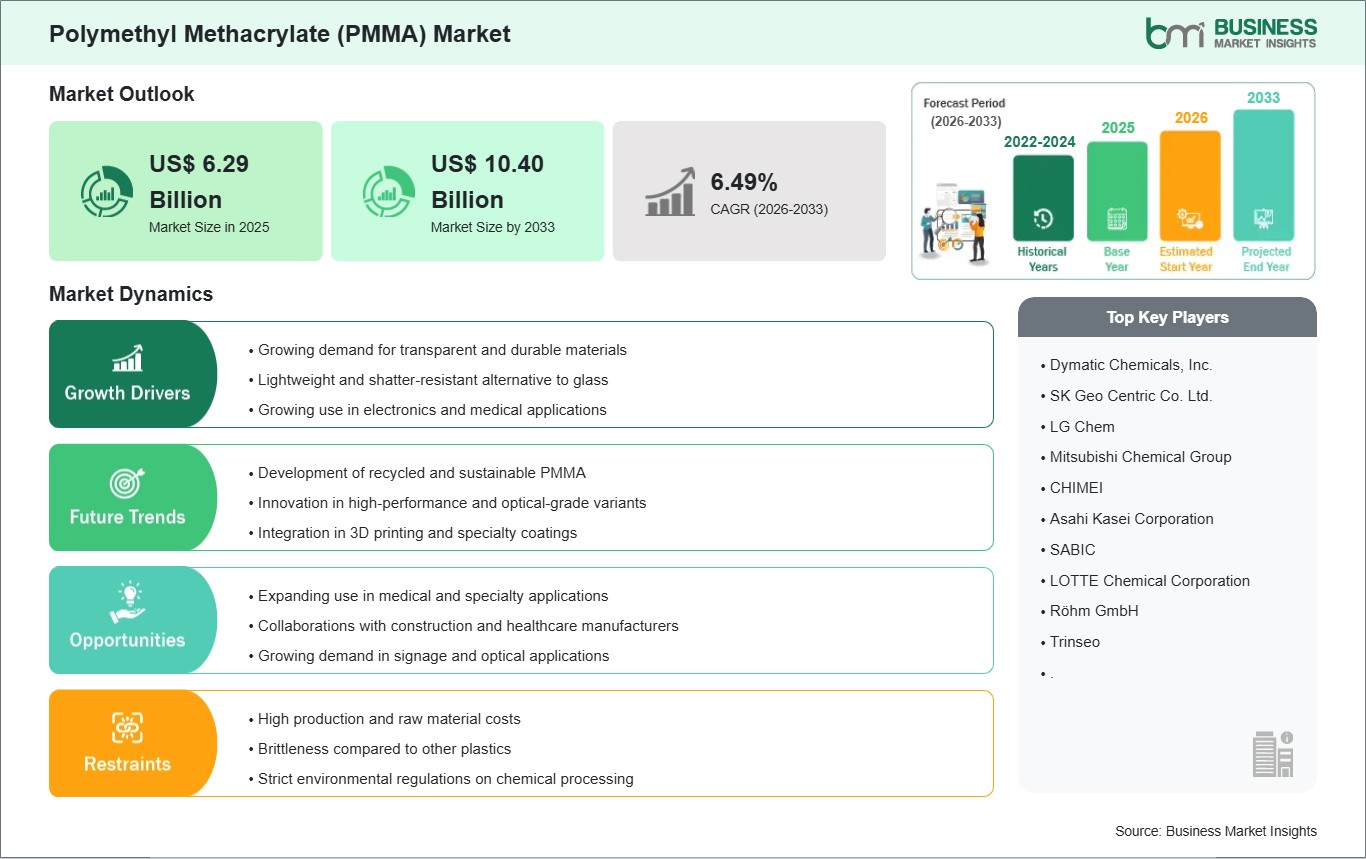
The Polymethyl Methacrylate (PMMA) Market size is expected to reach US$ 10.4 billion by 2033 from US$ 6.29 billion in 2025. The market is estimated to record a CAGR of 6.49% from 2026 to 2033.
The PMMA industry is growing steadily throughout their rise in demand from companies needing a reliable, yet lightweight and durable alternative to traditional glass and other plastic materials. Some of the attractive qualities of PMMA include transparency, resistance to UV rays, chemical stability, and high surface hardness; thus, companies plan to use PMMA extensively in many industries, such as automotive, construction, electronics, signage, lighting, and consumer goods. Due to their versatility, designers and engineers using PMMA will be able to create aesthetically pleasing and durable products while reducing energy consumption; hence, making PMMA suitable for use in both functional and decorative applications.
Moreover, advances in polymer processing and product development have accelerated market growth. New grades of PMMA have been developed and marketed for use in applications where performance is important, such as automotive lighting and electronic displays, using various processes, such as cast sheets, extruded films, and specialty optical resins.
Furthermore, there is a growing amount of research on the use of "bio" based PMMA and recyclable formulations because of the continued global pressures and regulations aimed at reducing the environmental impact. In both automotive and transportation industries, PMMA helps achieve energy efficiency with its lightweight nature; thereby, making it very attractive as fuel economy and reduced emissions continue to be priorities for manufacturers. As a result, the competitive dynamics within the PMMA to differentiate their products from others to improve market share, expand geographically, or collaborate through strategic partnerships with other companies. To continue to dominate in the PMMA market, leading chemical producers are utilizing their proprietary polymerization technology, the breadth of their product lines, and the depth of their distribution channels on a global basis.

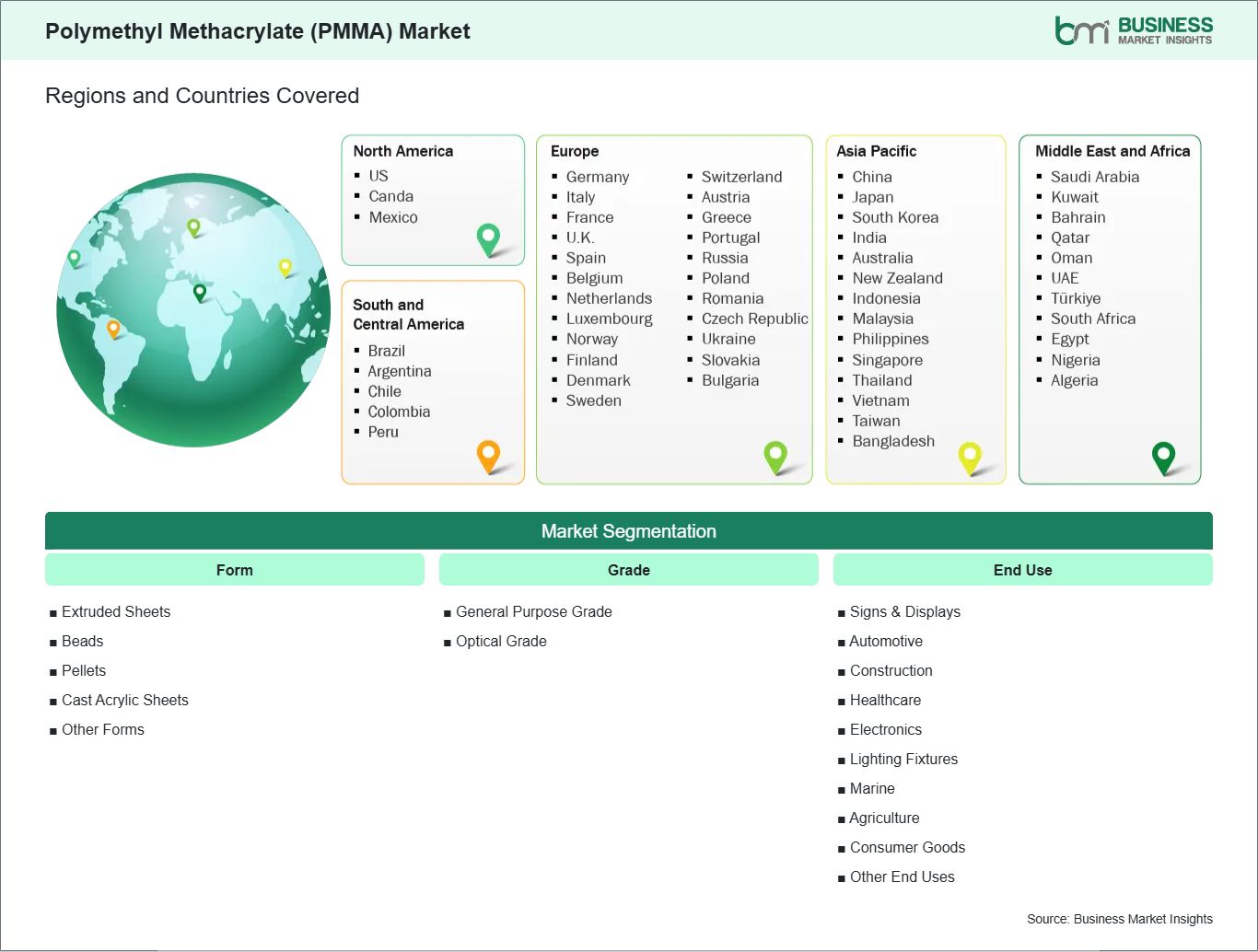
Key segments that contributed to the derivation of the polymethyl methacrylate market analysis are form, grade, and end use.
The global market for PMMA is growing, driven by the demand for a transparent, lightweight, and strong material to replace glass and other traditional plastics in various applications. PMMA is a transparent material with good resistance to weathering and high impact strength, which makes it a good choice for many applications in construction, automotive, and electronics, among other areas. Modern plastic producers are using PMMA in window, screen, lighting, and protective parts where high optical quality and strength are required. The material is versatile, and designers and engineers can use it to make products that are functional and aesthetically pleasing, which helps in promoting innovation in many fields.
In construction and architecture, PMMA is a material of choice due to its high transparency, high strength, and resistance to weathering. It is used in skylights, facades, and other architectural features where glass would be heavy or difficult to work with. The material is easy to work with, which helps in creating unique and creative structures, a quality that many architects look for in building modern constructions with high integrity. In automotive, PMMA is used in lighting parts and interior trim, where its lightweight properties are beneficial in improving its performance and look.
PMMA’s durability and clarity also make it attractive in consumer electronics, medical devices, and displays. The ability to resist yellowing, scratching, and chemical exposure ensures that products maintain their appearance and functionality over time. As industries continue to prioritize quality, longevity, and design flexibility, PMMA is increasingly recognized as a reliable material choice, supporting global market growth and adoption in high-performance applications.
The use of PMMA in medical, optical, and other specialty products is becoming more popular due to its compatibility, transparency, and stability. PMMA is used in medical devices such as lenses, implants, and in dental products. The use of PMMA in these products has been significant due to its stability, resistance to degradation, transparency, and precision. PMMA has shown positive performance in these specialty industries, helping to increase its market share globally in other industries aside from the traditional ones. The use of PMMA in specialty industries such as optics, electronics, signs, lenses, light guides, display panels, and protective screens has been significant. The use of PMMA in these industries has been driven by its transparency, durability, and resistance to environmental factors. The fact that PMMA can easily be molded has helped in the development of innovative products that can perform specific functions. PMMA has shown positive performance in these industries due to its visual appeal, strength, and reliability.
Sustainability and recycling are emerging considerations for PMMA as industries look to reduce environmental impact. Advances in recycling and eco-friendly formulations are making PMMA an attractive choice for companies aiming to align with green initiatives while maintaining performance. The material’s versatility, long-term reliability, and adaptability position PMMA as a strategic component for industries seeking high-quality, durable, and innovative solutions across construction, automotive, electronics, and medical sectors worldwide.

The polymethyl methacrylate market demonstrates steady growth, with size and share analysis highlighting evolving trends and competitive dynamics among key players. The report examines subsegments categorized within form, grade, and end use, offering insights into their contribution to overall market performance.
By Form, the extruded sheets subsegment dominated the market in 2025, driven by its widespread usage in signage, display panels, and architectural applications.
Based on Grade, the general purpose grade subsegment dominated the market in 2025, owing to its versatility, cost‑effectiveness, and balanced performance across a wide range of applications.
On the Basis of End Use, the signs & displays subsegment dominated the market in 2025, supported by strong demand for visually appealing and durable promotional and retail display solutions.
| Report Attribute | Details |
|---|---|
| Market size in 2025 | US$ 6.29 Billion |
| Market Size by 2033 | US$ 10.40 Billion |
| Global CAGR (2026 - 2033) | 6.49% |
| Historical Data | 2022-2024 |
| Forecast period | 2026-2033 |
| Segments Covered | By Form
|
|
Regions and Countries Covered
| |
| North America | US, Canada, Mexico |
| Europe | Belgium, Austria, Finland, Denmark, Greece, Poland, Romania, Russia, Ukraine, Czech Republic, Slovakia, Bulgaria, Italy, Luxembourg, Germany, Switzerland, France, Netherlands, Norway, Portugal, Spain, Sweden, United Kingdom |
| Asia-Pacific | Australia, China, India, Japan, South Korea, Indonesia, Malaysia, Philippines, Singapore, Thailand, Vietnam, Bangladesh, New Zealand, Taiwan |
| South and Central America | Brazil, Argentina, Peru, Chile, Colombia |
| Middle East and Africa | Bahrain, Kuwait, Oman, Qatar, Saudi Arabia, United Arab Emirates, Turkiye, South Africa, Egypt, Algeria, Nigeria |
| Market leaders and key company profiles |
|
The "Polymethyl Methacrylate (PMMA) Market Size and Forecast (2022 - 2033)" report provides a detailed analysis of the market covering below areas:
The geographical scope of the Polymethyl Methacrylate (PMMA) Market report is divided into North America, Asia Pacific, Europe, Middle East & Africa, and South & Central America. North America held the largest share in 2025.
Regionally, the PMMA market displays distinct growth trends influenced by industrial capacity, end-use demand, and technological adoption. North America dominates, driven by strong automotive, electronics, and construction sectors. The U.S. leads in high-performance PMMA adoption, including specialty optical grades for LED displays, automotive lighting, and architectural applications. Advanced manufacturing capabilities, R&D infrastructure, and regulatory support for energy-efficient materials reinforce the region’s market leadership.
In the Asia Pacific, rapid urbanization, growing automotive production, and rising consumer electronics demand drive PMMA adoption. China, Japan, South Korea, and India are investing in production capacity for cast and extruded PMMA sheets. The region benefits from cost-effective manufacturing, expanding domestic demand, and increasing export potential, making it a key driver of global market growth.
Europe emphasizes sustainability, high-quality engineering materials, and regulatory compliance. Germany, France, and Italy lead adoption in automotive, building, and signage sectors. The development of recyclable and bio-based PMMA, combined with strategic OEM partnerships, is increasing adoption of high-value applications across the region.
The Middle East & Africa market is emerging, with demand driven by construction, signage, and industrial applications. Countries such as the UAE, Saudi Arabia, and South Africa are gradually increasing PMMA usage, supported by infrastructure expansion and adoption of durable, aesthetic polymers in commercial and industrial projects. South & Central America is developing steadily, led by Brazil and Argentina. Growth is supported by automotive, signage, and construction applications, alongside collaborations with European and North American PMMA producers to secure supply chains and technical expertise.

The Polymethyl Methacrylate (PMMA) Market is evaluated by gathering qualitative and quantitative data post primary and secondary research, which includes important corporate publications, association data, and databases. A few of the key developments in the polymethyl methacrylate (PMMA) market are:
The Polymethyl Methacrylate (PMMA) Market is valued at US$ 6.29 Billion in 2025, it is projected to reach US$ 10.40 Billion by 2033.
As per our report Polymethyl Methacrylate (PMMA) Market, the market size is valued at US$ 6.29 Billion in 2025, projecting it to reach US$ 10.40 Billion by 2033. This translates to a CAGR of approximately 6.49% during the forecast period.
The Polymethyl Methacrylate (PMMA) Market report typically cover these key segments-
The historic period, base year, and forecast period can vary slightly depending on the specific market research report. However, for the Polymethyl Methacrylate (PMMA) Market report:
The Polymethyl Methacrylate (PMMA) Market is populated by several key players, each contributing to its growth and innovation. Some of the major players include:
The Polymethyl Methacrylate (PMMA) Market report is valuable for diverse stakeholders, including:
Essentially, anyone involved in or considering involvement in the Polymethyl Methacrylate (PMMA) Market value chain can benefit from the information contained in a comprehensive market report.
Please tell us your area of interest
(Market Segments/ Regions and Countries/ Companies)