
Polycarbonate Market Outlook: Size, Share, Trends, Growth Analysis, Competitive Landscape & Forecast, 2026-2033

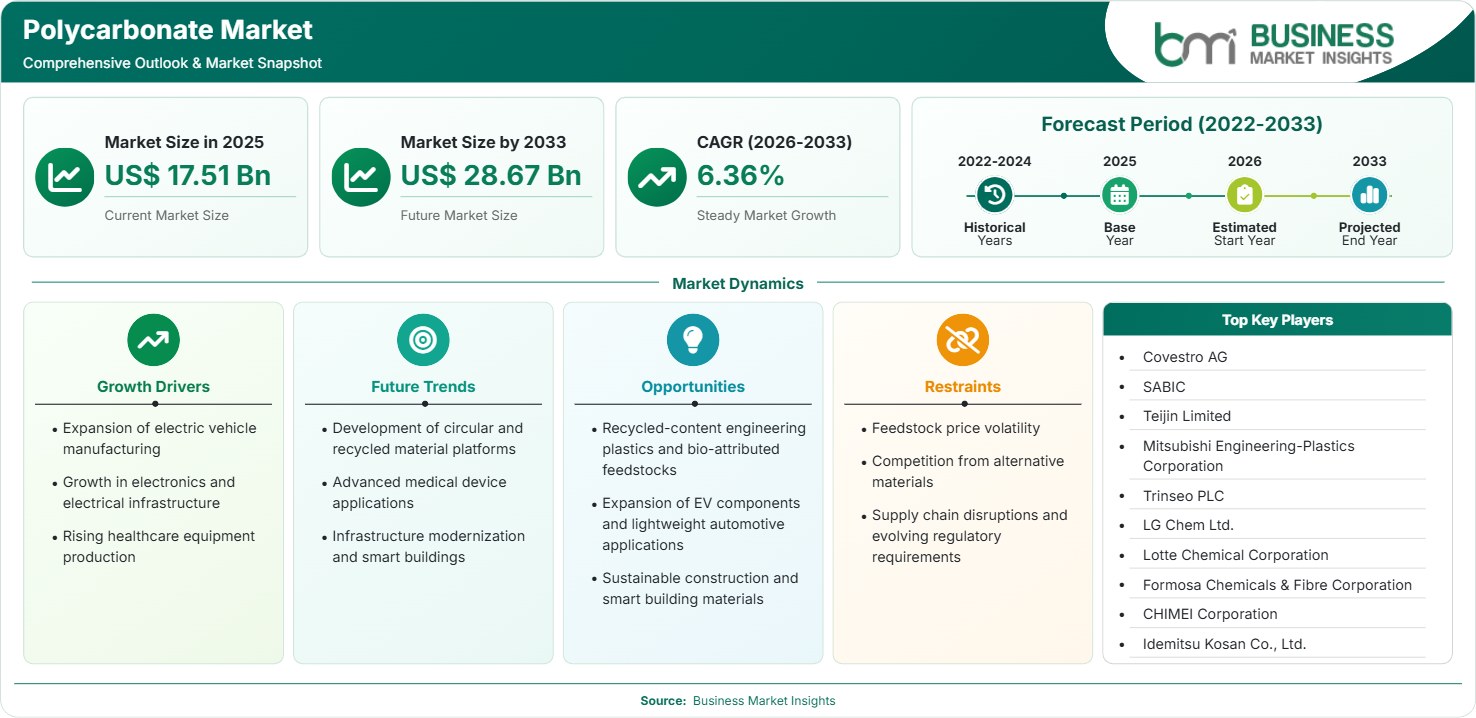
The Polycarbonate Market size was valued at US$ 17.51 Billion in 2025 and is projected to reach US$ 28.67 Billion by 2033, growing at a CAGR of 6.36% during 2026–2033. Key drivers include lightweight automotive materials, expanding electronics manufacturing, healthcare-grade plastics demand, and infrastructure applications. Opportunities are emerging in EV components, circular materials, and sustainable resin technologies.

Report Coverage
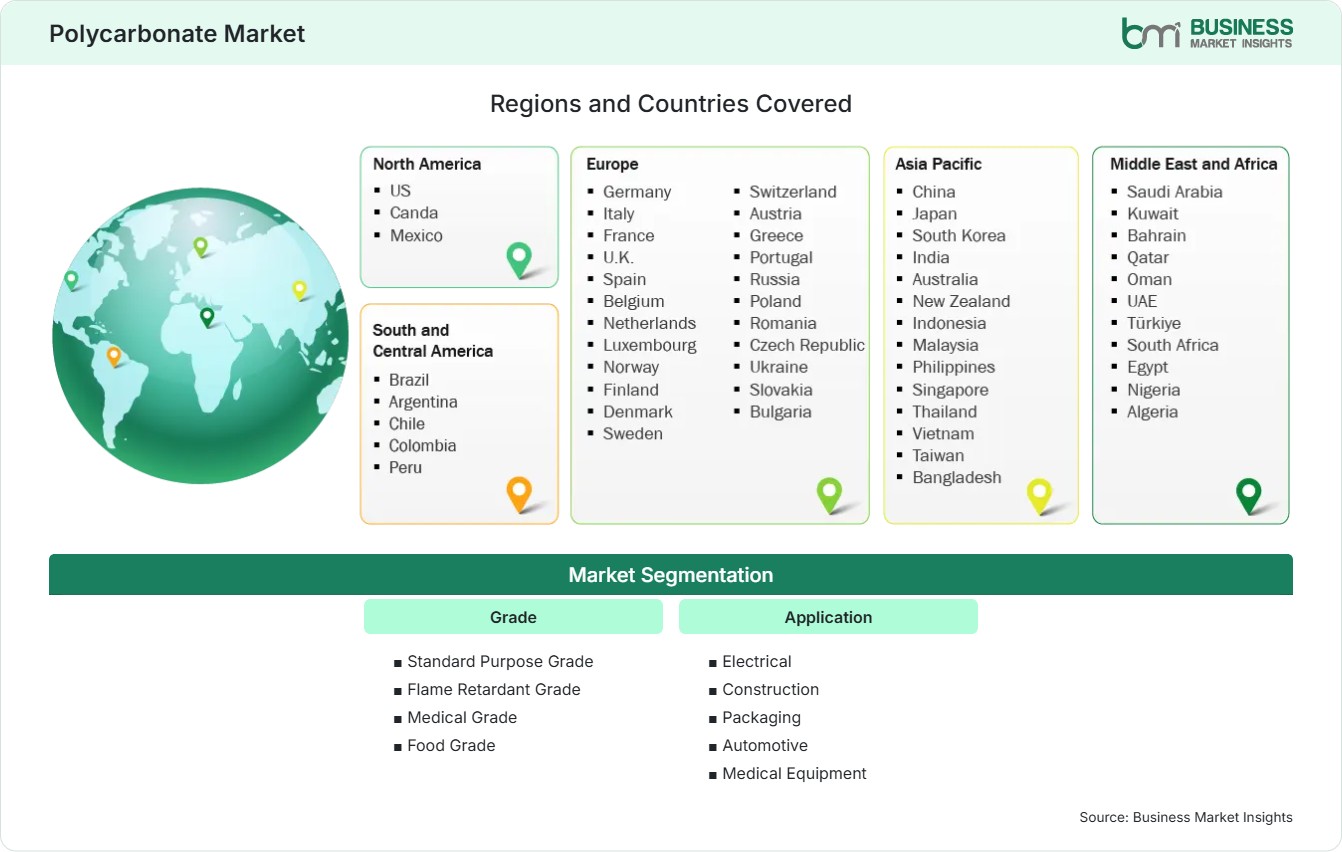
  • Grade: Standard Purpose Grade, Flame Retardant Grade, Medical Grade, Food Grade
  • Application: Electrical, Construction, Packaging, Automotive, Medical Equipment
US$ 17.51 Bn Market size in 2025
US$ 28.67 Bn Market Size by 2033
6.36% CAGR, 2026 - 2033
2026-2033 Forecast Period

AI Overview

Polycarbonate Market Summary

  • North America Region: Holds a market share of 22%–25% in 2025, growing at a CAGR of 5.4%–5.9% during 2026–2033. Demand is supported by medical devices, electrical equipment, sustainable construction materials, reshoring investments, and advanced manufacturing activity across industrial sectors. US market benefits from electronics and healthcare manufacturing, advancing at an estimated 5.5%–6.0% CAGR.
  • Fastest Growing Region: Asia Pacific accounts for 48%–52% share in 2025 and is projected to expand at 7.0%–7.6% CAGR. Growth stems from electronics production, EV manufacturing, infrastructure investment, urbanization, and increasing consumption of engineering plastics throughout emerging manufacturing economies.
  • Leading Segment: Standard Purpose Grade represents 38%–42% share in 2025 with 5.8%–6.3% CAGR. Adoption remains high across consumer goods, industrial components, electrical housings, glazing applications, and durable products requiring balanced performance and cost efficiency.
  • High Growth Segment: Medical Grade captures 8%–11% share in 2025 while advancing at 7.5%–8.2% CAGR. Expansion is supported by sterilization compatibility, transparency, regulatory compliance, healthcare infrastructure investment, diagnostic equipment demand, and advanced medical device production.
  • Key Market Opportunity: Rapid adoption of recyclable engineering thermoplastics in electric vehicles and sustainable construction creates opportunities for premium grades, circular production models, and bio-attributed resin development across global supply chains.
  • Major Market Players: Covestro AG, SABIC, Teijin Limited, Mitsubishi Engineering-Plastics Corporation, Trinseo PLC, LG Chem Ltd., Lotte Chemical Corporation, Formosa Chemicals & Fibre Corporation, CHIMEI Corporation, Idemitsu Kosan Co., Ltd.
Strategic Insights

Polycarbonate Market: Strategic Insights

Polycarbonate Market Strategic Framework
FREE PDF
Request your free sample
Request free sample
Stakeholder View

Key Takeaways

  • The value chain is becoming increasingly integrated, linking petrochemical producers, compounders, processors, and OEMs to improve cost efficiency and supply reliability.
  • Medical equipment and electrical applications offer the strongest upside due to stringent performance requirements and growing investment in healthcare and electronics infrastructure.
  • Product innovation is shifting toward recycled-content materials, bio-attributed feedstocks, and specialty grades with enhanced thermal, optical, and flame-retardant performance.
  • India and Southeast Asia present compelling expansion opportunities due to manufacturing relocation trends and rapid investment in consumer electronics ecosystems.
  • Industry participants are pursuing partnerships, licensing agreements, and capacity optimization strategies to strengthen competitive positioning and regional market access.
  • Sustainability metrics are increasingly influencing procurement decisions, encouraging development of circular and lower-carbon material solutions.
Geographic Outlook

Polycarbonate Market Regional Highlights

North America Polycarbonate Market

North America accounted for approximately 22%–25% Polycarbonate Market share in 2025 and is expected to expand at 5.4%–5.9% CAGR through 2033. Healthcare devices, electrical systems, and construction materials remain key demand centers. Investments in domestic manufacturing and advanced industrial production support consumption. Sustainability goals are accelerating adoption of recycled-content materials.

  • Healthcare equipment manufacturing continues creating demand for sterilizable, transparent engineering thermoplastics.
  • Electrification and grid modernization projects support application growth in electrical housings and connectors.
  • Sustainable construction initiatives encourage adoption of lightweight glazing and roofing materials.
  • Regional producers are investing in lower-carbon production technologies and recycling programs.

US Polycarbonate Market

The United States represents 72%–76% share of North American demand and is projected to grow at 5.5%–6.0% CAGR. Medical technologies, electronics assemblies, and industrial manufacturing remain the strongest end-use sectors. Continued reshoring of production capacity supports domestic material consumption.

  • Growing diagnostic and monitoring equipment production strengthens healthcare demand.
  • EV manufacturing expansion supports lightweight component adoption.
  • Advanced electronics production increases utilization in durable enclosures.
  • Infrastructure modernization programs support industrial applications.

Europe Polycarbonate Market

Europe maintains 20%–23% share in 2025 and is forecast to register 5.0%–5.6% CAGR. Germany remains the leading country, while Eastern European markets demonstrate faster expansion. Circular-economy policies accelerate investment in recyclable materials and sustainable manufacturing processes.

  • Germany leads regional consumption supported by automotive and industrial sectors.
  • Poland and Czech Republic exhibit above-regional growth through manufacturing investments.
  • Stringent environmental regulations promote recycled-content solutions.
  • Medical and electronics industries remain significant application areas.

Asia Pacific Polycarbonate Market

Asia Pacific holds 48%–52% share in 2025 and records the strongest Polycarbonate Market growth at 7.0%–7.6% CAGR. China leads regional consumption, while India and Vietnam display the fastest expansion rates. Electronics manufacturing, urbanization, and EV production remain key growth catalysts.

  • China retains leadership through extensive electronics and automotive manufacturing activity.
  • India benefits from infrastructure spending and domestic manufacturing programs.
  • Southeast Asian countries attract investment from relocating supply chains.
  • Consumer electronics production remains a major demand generator.
  • Construction and transportation sectors continue expanding material requirements.

Rest of World Polycarbonate Market

The Rest of World region accounts for 8%–11% share and is forecast to grow at 5.8%–6.5% CAGR. South and Central America benefit from industrial development, while Middle East and Africa gain momentum from infrastructure and diversification initiatives.

  • Brazil leads regional demand in South and Central America.
  • Saudi Arabia demonstrates strong growth through petrochemical integration strategies.
  • Infrastructure investment supports construction-related applications.
  • Healthcare modernization programs increase consumption of specialty grades.
  • Diversification strategies stimulate manufacturing investments.
Global Market Geography
FREE PDF
Request your free sample
Request free sample
Segment Analysis

Polycarbonate Market Segmentation

Grade

Grade segment represents the foundation of product differentiation. The category contributed nearly 100% of market demand, with Standard Purpose Grade remaining dominant at 38%–42% share and growth near 5.8%–6.3% CAGR. The Polycarbonate Market scope continues expanding through specialized formulations designed for healthcare, food-contact, electronics, and safety-critical applications.

  • Standard Purpose Grade: Widely utilized in electronics housings, industrial equipment, and construction products due to balanced durability, transparency, processability, and cost effectiveness.
  • Flame Retardant Grade: Preferred in electrical systems and consumer electronics requiring compliance with stringent fire-safety standards and enhanced thermal performance.
  • Medical Grade: Increasingly adopted for diagnostic devices, surgical equipment, and healthcare components because of sterilization compatibility and regulatory acceptance.
  • Food Grade: Supports food containers, beverage applications, and processing equipment where transparency, durability, and compliance with contact regulations are critical.

Application

Application demand is led by Electrical end uses with approximately 24%–28% share in 2025 and a projected 6.1%–6.7% CAGR. Evolving Polycarbonate Market trends indicate increasing penetration across medical equipment, automotive lightweighting, and sustainable construction solutions.

  • Electrical: Growing demand for connectors, switchgear, housings, and insulation components supports continuous consumption.
  • Construction: Adoption in glazing, roofing, and architectural products benefits from impact resistance and design flexibility.
  • Packaging: Usage expands in reusable, durable, and transparent packaging applications requiring performance reliability.
  • Automotive: Lightweight design strategies and EV manufacturing accelerate utilization in interior and exterior components.
  • Medical Equipment: Demand rises from diagnostic systems, protective devices, and advanced healthcare technology applications.
Market Forces

Polycarbonate Market Dynamics

Key Market Drivers

Expansion of Electric Vehicle Manufacturing

Electric vehicles require lightweight materials that contribute to battery efficiency and vehicle range. The polycarbonate polymer is highly impact-resistant, optically clear, and has great design freedom. Its applications range from lighting and interior automotive parts to batteries and electronic housing parts. The use of electric vehicles all around the world continues to increase due to government efforts in ensuring that carbon emissions are reduced, and manufacturers producing electric vehicles are increasing production capacities. The need to reduce weight in automobiles without compromising on durability makes engineering thermoplastics more relevant.

Growth in Electronics and Electrical Infrastructure

The expansion of consumer electronics, industrial automation, renewable energy systems, and smart-grid infrastructure is driving strong demand for advanced insulating polymers. These materials are increasingly utilized in connectors, enclosures, display components, cables, and electrical protection systems due to their transparency, durability, and excellent insulation performance. Rising digitalization, significant investments in data centers, and the rapid growth of electronics manufacturing across Asia further support market expansion. Their superior thermal stability, dimensional precision, and efficient processing capabilities make them a preferred choice over many conventional plastics, and ongoing advances in industrial automation continue to accelerate adoption across diverse electrical and electronic applications.

Rising Healthcare Equipment Production

Healthcare systems worldwide continue to invest heavily in diagnostic devices, patient monitoring instruments, and advanced medical technologies to improve healthcare outcomes. Durability, safety, and better performance make transparent and sterilizable materials popular for the manufacturing of medical instruments. Aging population, increased spending on health care services, and increased access to medical treatment are driving the demand for medical devices. Besides, the preference for materials that are easy to process is a significant consideration for producers. These are some of the factors driving the application of advanced technologies in healthcare settings.

Key Market Opportunities

Development of Circular and Recycled Material Platforms

Rising sustainability commitments are driving strong demand for recycled-content engineering plastics and chemically recycled feedstocks. Companies that adopt circular material platforms and recycling programs will be able to improve their environmental track records and stay up-to-date with the emerging regulations. The recent breakthroughs in the field of recycling have made it possible to recycle polycarbonate and other engineering plastics that provide sufficient performance for demanding use cases. Besides, companies' sustainable business models and customer preferences drive investment in collection, sorting, and recovery facilities. Consequently, circularity becomes an important competitive advantage for premium pricing and enhanced brand value in polycarbonate market.

Advanced Medical Device Applications

The healthcare sector is increasingly adopting advanced portable diagnostics, wearable medical technologies, and minimally invasive devices, driving demand for high-performance materials. Such technologies demand a distinctive blend of transparency, sterilization tolerance, strength, and biocompatibility in order to be safe and effective. Companies that create specialized materials can capitalize on higher prices and greater profits. In addition to this, the expansion of the healthcare infrastructure and growing healthcare investments in developing countries are increasing the number of consumers.

Infrastructure Modernization and Smart Buildings

Governments worldwide are actively promoting infrastructure modernization and the development of energy-efficient smart buildings to support sustainability goals. Transparent durable products have become increasingly relevant in roofing, glazing, safety barriers, skylights, and other areas of architecture because of their strength, flexibility, and aesthetics. Urbanization, increased environmental restrictions, and requirements for green buildings are additional factors that contribute to the popularity of such products. Innovations that ensure improved weather resistance, heat insulation, and durability create new growth opportunities in the market.

Market Restraints and Challenges

Feedstock Price Volatility

Factor: Dependence on petrochemical raw materials exposes producers to significant fluctuations in feedstock and energy prices. Changes in crude oil prices, natural gas costs, supply availability, geopolitical conditions, and global energy demand can directly influence the cost of key raw materials. Supply chain disruptions, trade restrictions, and changes in international energy markets can further intensify input cost volatility and make production planning more difficult for manufacturers.

Impact: In addition to lowering organizations' profit margins, feedstock cost volatility will complicate price setting and create uncertainty for producers, processors, and consumers. It might become challenging for organizations to set constant prices for their products amid volatile changes in feedstock costs, especially amid stiff competition. Among the ways that firms try to address this problem is by entering into long-term supply contracts, employing diversification strategies, and improving production efficiency. Nevertheless, volatility in feedstock costs is an ongoing issue.

Competition from Alternative Materials

Factor: Engineered materials like acrylics, ABS, polypropylene, and many others continue to present competition for traditional materials in various uses. This is because these materials have certain advantages like being cheaper, lightweight, durable, and also processability among others. As such, material suppliers face competitive pressures when manufacturers and consumers must choose among various material options based on performance and cost considerations.

Impact: Growing options for alternatives could curb any increases in demand, thus creating pressure on the producer to remain competitive on price and performance. With more consumers looking at the cost of owning an item throughout its life cycle, producers need to offer differentiation by being innovative. They need to invest in special grades, more sustainable attributes, increased recyclability, increased functionality, and improved material performance. Failure to keep up with product development is likely to create more substitution challenges for the producer.

Company Analysis

Competitive Landscape

The competitive environment reflects ongoing innovation, sustainability investments, and regional expansion. This Polycarbonate Market analysis highlights leading participants across the value chain.

Company Name

Overview

Products and Services relevant to this market

Covestro AG

Global polymer manufacturer with strong engineering plastics portfolio and extensive international footprint.

Makrolon polycarbonate resins, specialty grades, sustainable material solutions.

SABIC

Major petrochemical producer serving automotive, electronics, and industrial customers globally.

LEXAN polycarbonate resins, sheets, films, specialty compounds.

Teijin Limited

Diversified materials company focused on advanced polymer technologies and performance materials.

Polycarbonate compounds, engineering plastics, industrial material solutions.

Mitsubishi Engineering-Plastics Corporation

Specialized engineering plastics producer serving advanced industrial applications.

Polycarbonate resins, blends, automotive and electronics materials.

Trinseo PLC

Performance materials company emphasizing specialty polymer technologies.

Polycarbonate technologies, compounds, engineered material solutions.

LG Chem Ltd.

Leading chemical company with broad advanced materials portfolio.

Engineered plastics and specialty polycarbonate materials.

Lotte Chemical Corporation

Integrated petrochemical manufacturer with growing global presence.

Polycarbonate resins for automotive and electronics applications.

Formosa Chemicals & Fibre Corporation

Large-scale producer serving multiple industrial markets worldwide.

Polycarbonate and engineering plastic products.

CHIMEI Corporation

Taiwan-based materials specialist supporting electronics and industrial sectors.

Polycarbonate resins and application-specific compounds.

Idemitsu Kosan Co., Ltd.

Japanese industrial group active in advanced materials development.

High-performance polycarbonate materials and specialty solutions.

Trust & Transparency

Research Methodology

The market analysis combines proprietary research with secondary data from government agencies, company disclosures, regulatory filings, industry databases and expert interviews. Market estimates are validated through data triangulation, cross-market benchmarking and analyst review.

View Full Research Methodology

Questions Answered

Frequently Asked Questions

How are sustainability goals influencing industry strategies?

Manufacturers are investing in recycling technologies, bio-attributed feedstocks, energy-efficient production processes, and circular business models to meet customer and regulatory expectations.

What does a Polycarbonate Market Report typically evaluate?

A market report generally examines market size, segmentation, regional performance, competitive positioning, technology developments, regulatory impacts, and future demand patterns.

Which region offers the strongest expansion potential?

Asia Pacific presents the strongest opportunity due to large-scale electronics production, infrastructure spending, urbanization, and increasing automotive manufacturing investments.

What makes medical-grade materials a fast-growing category?

Medical-grade variants combine transparency, sterilization compatibility, durability, and regulatory compliance, making them suitable for advanced diagnostics, monitoring systems, and healthcare devices.

What factors are shaping demand over the Polycarbonate Market forecast period?

Demand is being influenced by EV production, electronics manufacturing, healthcare equipment expansion, lightweight construction materials, and sustainability initiatives focused on recyclable engineering plastics.

Access the Full Polycarbonate Market Report

Get segment-level forecasts, regional estimates, competitive benchmarking, company profiles and downloadable Excel datasets.

Access the full Polycarbonate Market Report
350 pages PDF & Excel | 2026-08-31