
Plywood Market Outlook: Size, Share, Trends, Growth Analysis, Competitive Landscape & Forecast, 2026-2033

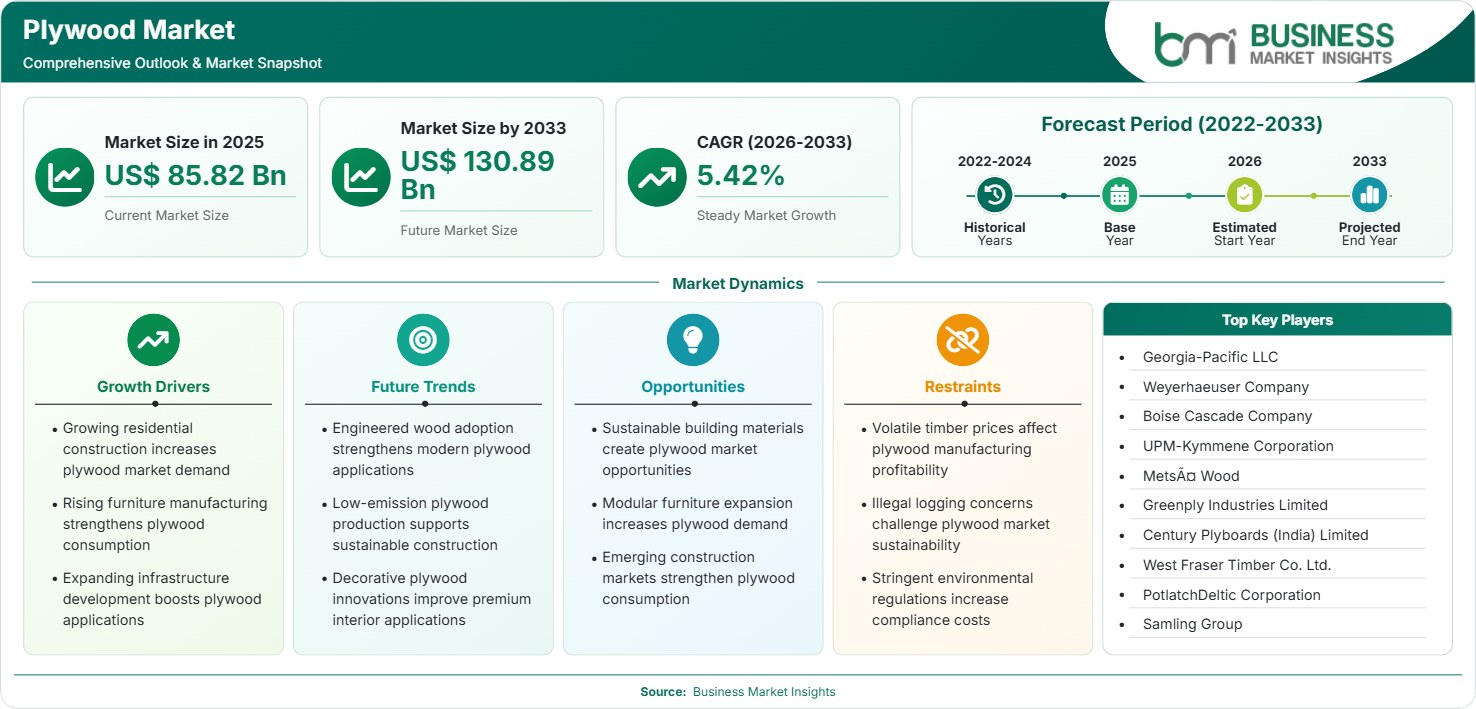
The Plywood Market size was valued at US$ 85.82 billion in 2025 and is projected to reach US$ 130.89 billion by 2033, registering a CAGR of 5.42% during 2026–2033The market is expected to continue experiencing steady growth due to the rise in residential construction, furniture manufacture, and infrastructural development around the globe. Plywood is among the engineered wood products that are commonly used since they are strong, dimensionally stable, economical, and versatile in both residential and commercial construction. Urbanization and developments in residential and modern construction are expected to propel the market forward.

Report Coverage
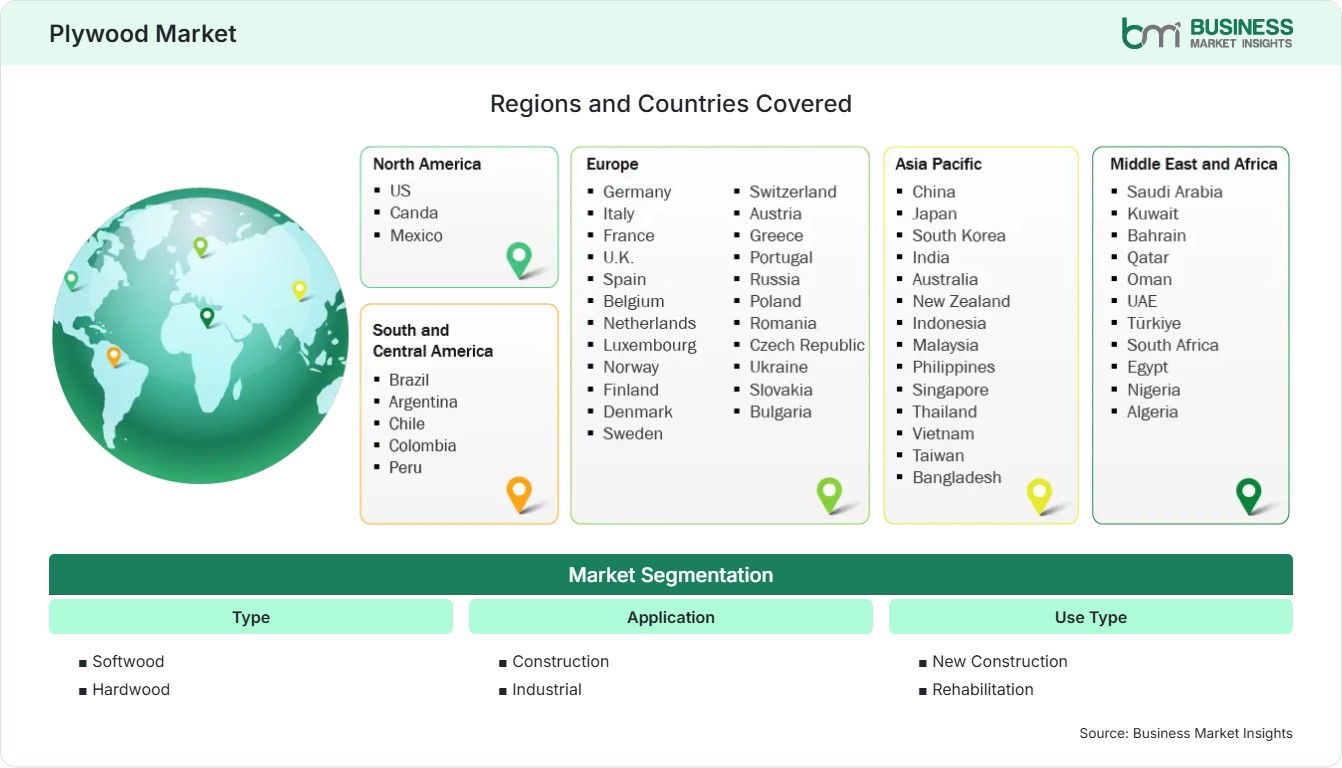
  • Type: Softwood, Hardwood
  • Application: Construction, Industrial
  • Use Type: New Construction, Rehabilitation
US$ 85.82 Bn Market size in 2025
US$ 130.89 Bn Market Size by 2033
5.42% CAGR, 2026 - 2033
2026-2033 Forecast Period

AI Overview

Plywood Market Summary

  • North America Region: North America accounted for 25%–28% of global revenue in 2025 and is projected to register a CAGR of 5.1%–5.6% during 2026–2033. Strong residential construction activity, remodeling projects, furniture manufacturing, and demand for engineered wood products continue supporting regional market growth. The United States contributes approximately 84%–87% of regional revenue and is expected to register a CAGR of 5.2%–5.7% owing to increasing housing development, infrastructure investments, and renovation activities.
  • Fastest Growing Region: Asia Pacific represented 43%–46% of global revenue in 2025 and is projected to register the highest CAGR of 5.9%–6.4% during the forecast period. Rapid urbanization, expanding construction activities, increasing furniture manufacturing, and strong infrastructure investments continue driving regional market expansion.
  • Leading Segment: Softwood accounted for 58%–61% of market revenue in 2025 and is projected to register a CAGR of 5.4%–5.9% during the assessment period owing to its cost-effectiveness, ease of processing, structural performance, and widespread utilization across construction applications.
  • High Growth Segment: Construction represented 66%–69% of total market revenue in 2025 and is projected to expand at a CAGR of 5.7%–6.2% driven by increasing residential development, commercial construction, infrastructure modernization, and public investment projects.
  • Key Market Opportunity: Sustainable building materials, modular furniture expansion, and emerging construction markets continue creating significant opportunities for plywood manufacturers.
  • Major Market Players: Georgia-Pacific LLC, Weyerhaeuser Company, Boise Cascade Company, UPM-Kymmene Corporation, Metsä Wood, Greenply Industries Limited, Century Plyboards (India) Limited, West Fraser Timber Co. Ltd., PotlatchDeltic Corporation, Samling Group.
Strategic Insights

Plywood Market: Strategic Insights

Plywood Market Strategic Framework
FREE PDF
Request your free sample
Request free sample
Stakeholder View

Key Takeaways

  • The market continues benefiting from growing residential construction, rising furniture manufacturing, expanding infrastructure development, and increasing adoption of engineered wood products.
  • The strongest Plywood Market Growth opportunities continue emerging from sustainable building materials, modular furniture expansion, emerging construction markets, green buildings, and prefabricated construction systems.
  • Softwood remains the dominant type segment owing to its affordability, structural strength, easy availability, and extensive utilization across residential and commercial construction.
  • Asia Pacific is projected to witness the fastest growth owing to rapid urbanization, increasing infrastructure investments, expanding furniture manufacturing, and strong housing development activities.
  • Manufacturers are increasingly investing in sustainable forestry practices, certified wood sourcing, low-emission adhesives, moisture-resistant plywood, and advanced manufacturing technologies to strengthen market competitiveness.
  • Companies focusing on eco-friendly plywood products, premium engineered wood panels, modular construction materials, and innovative wood processing technologies are expected to strengthen their competitive positioning.
Geographic Outlook

Plywood Market Regional Highlights

North America Plywood Market

North America accounted for 25%–28% of global revenue in 2025 and is projected to register a CAGR of 5.1%–5.6% during 2026–2033. The region continues maintaining a significant market position owing to strong residential construction, growing renovation activities, expanding commercial infrastructure, and increasing demand for engineered wood products. The Plywood Market Share remains robust as builders, contractors, and furniture manufacturers increasingly utilize plywood for structural applications, flooring, roofing, cabinetry, and interior finishing.

  • The United States remains the largest regional market owing to sustained housing construction, remodeling projects, and growing demand for sustainable building materials.
  • Canada continues supporting regional growth through expanding residential development, commercial construction, and forestry-based manufacturing industries.
  • Increasing adoption of certified wood products and environmentally responsible building materials continues strengthening market demand.
  • Growing investments in infrastructure rehabilitation and public construction projects continue supporting long-term plywood consumption.

US Plywood Market

The United States accounted for approximately 84%–87% of North American revenue in 2025 and is projected to register a CAGR of 5.2%–5.7% during the forecast period. Rising residential housing demand, expanding home renovation activities, and increasing investments in commercial construction continue driving domestic market growth.

  • Homebuilders continue utilizing plywood extensively across flooring, roofing, wall sheathing, and structural framing applications.
  • Remodeling and repair activities continue supporting steady demand for premium plywood products.
  • Furniture manufacturers continue expanding production of cabinets, wardrobes, office furniture, and interior décor products using engineered wood panels.
  • Increasing emphasis on green building certifications continues encouraging adoption of sustainably sourced plywood.

Europe Plywood Market

Europe represented 24%–27% of global revenue in 2025 and is expected to expand at a CAGR of 5.0%–5.5% during 2026–2033. The region continues benefiting from sustainable construction practices, advanced furniture manufacturing, and increasing adoption of certified engineered wood products. Germany remains the largest regional market, while Poland is projected to register the fastest growth with a CAGR of 5.8%–6.3% owing to expanding construction activities, furniture exports, and industrial investments.

  • Germany continues leading regional demand through its advanced construction sector, premium furniture manufacturing, and sustainable building initiatives.
  • Poland continues witnessing robust growth through increasing residential construction, furniture production, and export-oriented wood processing industries.
  • France continues supporting market expansion through commercial construction, renovation projects, and growing adoption of environmentally certified building materials.
  • European sustainability regulations continue encouraging the use of responsibly sourced timber and low-emission wood products.
  • Investments in energy-efficient buildings and modular construction continue strengthening long-term regional demand.

Asia Pacific Plywood Market

Asia Pacific accounted for 43%–46% of global revenue in 2025 and is projected to register the highest CAGR of 5.9%–6.4% during the forecast period. Rapid urbanization, expanding housing construction, increasing infrastructure investments, and growing furniture manufacturing continue driving regional market expansion. China remains the leading regional market, while India is projected to register the fastest growth with a CAGR of 6.3%–6.8% owing to rising residential construction, infrastructure modernization, and expanding organized furniture production.

  • China continues dominating regional demand through its large-scale construction industry, furniture manufacturing capacity, and engineered wood production.
  • India continues witnessing strong growth through affordable housing projects, infrastructure development, and rising demand for modular furniture.
  • Japan continues supporting premium plywood demand through high-quality construction standards and advanced engineered wood applications.
  • Southeast Asian countries continue contributing through expanding wood processing industries and export-oriented plywood manufacturing.
  • Government investments in urban infrastructure and smart city development continue supporting long-term regional market expansion.

Rest of World Plywood Market

The Rest of World accounted for 5%–7% of global revenue in 2025 and is projected to register a CAGR of 5.3%–5.8% during 2026–2033. Latin America, the Middle East, and Africa continue strengthening market growth through increasing residential construction, commercial infrastructure projects, and improving industrial development.

Growing investments in affordable housing, tourism infrastructure, commercial buildings, and public works continue creating new opportunities for plywood manufacturers across emerging economies.

  • Brazil continues supporting regional demand through expanding residential construction and growing furniture manufacturing.
  • Mexico continues strengthening market growth through commercial building development and industrial expansion.
  • Saudi Arabia continues witnessing increasing plywood consumption through infrastructure modernization and large-scale real estate projects.
  • South Africa continues contributing through commercial construction and increasing demand for engineered wood products.
  • Expanding construction activities, urban development programs, and investments in sustainable buildings continue supporting long-term market growth across emerging regions.
Global Market Geography
FREE PDF
Request your free sample
Request free sample
Segment Analysis

Plywood Market Segmentation

Type

The Type segment accounted for 58%–61% of market revenue in 2025 and is projected to register a CAGR of 5.4%–5.9% during the forecast period. Increasing construction activities, furniture manufacturing, and industrial wood product consumption continue supporting market expansion. The Plywood Market Trends indicate rising preference for durable, lightweight, and structurally reliable plywood products capable of meeting modern building and furniture requirements.

  • Softwood: Softwood remains the dominant segment owing to its affordability, excellent strength-to-weight ratio, ease of processing, and extensive use across residential construction, roofing, flooring, wall sheathing, and structural applications.
  • Hardwood: Hardwood continues witnessing strong demand across premium furniture manufacturing, cabinetry, decorative interiors, flooring, and applications requiring superior durability, surface finish, and load-bearing performance.

Application

The Application segment represented 66%–69% of total market revenue in 2025 and is expected to expand at a CAGR of 5.7%–6.2% throughout the assessment period.

  • Construction: Construction remains the leading application owing to increasing utilization of plywood in residential buildings, commercial projects, bridges, roofing systems, flooring, wall panels, concrete formwork, and structural frameworks.
  • Industrial: Industrial applications continue gaining momentum through increasing demand for plywood in packaging, transportation equipment, machinery components, storage systems, and various engineered wood products.

Use Type

The Use Type segment continues expanding alongside global investments in residential housing, commercial real estate, infrastructure modernization, and renovation projects. The Plywood Market Scope continues broadening as plywood products are increasingly utilized in both new developments and rehabilitation activities.

  • New Construction: New Construction remains the dominant segment owing to rising residential housing projects, commercial complexes, educational institutions, healthcare facilities, industrial buildings, and infrastructure development worldwide.
  • Rehabilitation: Rehabilitation continues witnessing healthy growth through increasing renovation of aging residential buildings, commercial properties, public infrastructure, hotels, offices, and institutional facilities requiring durable engineered wood materials.
Market Forces

Plywood Market Dynamics

Key Market Drivers

Growing residential construction increases plywood market demand

Urbanization, population growth, and investments in residential housing keep fueling the global plywood demand. Plywood is widely used in roofing, flooring, wall sheathing, partitioning, doors, cabinets, and other purposes, since it is durable, stable, and inexpensive. Government programs aimed at building cheap housing and private residential constructions will keep growing plywood demand in the long run. Growing demand for modern interior design, module homes, and space-saving housing solutions is pushing up plywood consumption in residential constructions as well. Plywood is favored by builders and contractors, since it is easy to install, has high carrying capacities, can resist moisture (when used in appropriate grades), and is compatible with various kinds of finishes. Growing popularity of prefabricated and engineered wood buildings technologies keeps increasing plywood demand as well.

Rising furniture manufacturing strengthens plywood consumption

An increased consumer requirement for residential, commercial, and office furniture results in an increase in the consumption of plywood in the global furniture manufacturing industry. Manufacturers use plywood in the production of wardrobes, kitchen cabinets, tables, office furniture, shelves, and modular furniture due to its high strength, design ability, smoothness in the surface finish, and easy processability. Growth in the real estate, hospitality, educational, and corporate sectors leads to continuous demand for durable and attractive furniture products. The use of plywood facilitates precise cutting, molding, lamination, and surface finish with effective mass production processes. There is an increased preference for ready-to-assemble and customized furniture with the rise of the e-commerce industry.

Expanding infrastructure development boosts plywood applications

Growing investments in transportation infrastructure, commercial buildings, education, health care, airport, and utility industries are creating greater opportunities for plywood use around the globe. Plywood finds extensive use in formwork for concrete, scaffolding, flooring, wall panels, partitions, and construction temporary structures, which ensures consistent demand in infrastructure construction projects. Increasing investments in infrastructure, industrial, and commercial constructions are creating a need for construction materials that can fulfil strict requirements in construction projects. High-grade plywood is witnessing increased preference for repetitive concrete formwork because of dimensional stability, smooth surface finish, and durability of these products. In addition, growing investments in smart city, public infrastructure, and sustainable constructions are likely to drive plywood demand in global infrastructure and construction industry in the future.

Key Market Opportunities

Sustainable building materials create plywood market opportunities

Growing emphasis on environmentally responsible construction practices is creating significant opportunities for sustainably manufactured plywood products. Increasing adoption of certified timber, low-emission adhesives, recyclable materials, and green building standards continues encouraging manufacturers to develop eco-friendly plywood solutions that meet evolving environmental regulations and customer preferences.

Modular furniture expansion increases plywood demand

Rapid growth of modular furniture manufacturing across residential and commercial sectors continues creating substantial opportunities for plywood producers. Lightweight construction, ease of machining, design flexibility, and compatibility with automated manufacturing processes make plywood a preferred material for modular kitchens, wardrobes, office furniture, and customized interior solutions.

Emerging construction markets strengthen plywood consumption

Expanding urbanization, rising disposable incomes, infrastructure modernization, and increasing government investments in affordable housing across emerging economies continue strengthening plywood consumption. Manufacturers are expanding production capacity, strengthening regional distribution networks, and introducing cost-effective engineered wood products to capitalize on growing construction activity in developing markets.

Market Restraints and Challenges

Volatile timber prices affect plywood manufacturing profitability

Factor: Plywood production depends heavily on a stable supply of timber and wood veneers. Fluctuations in timber prices caused by changing forest policies, supply-demand imbalances, transportation costs, weather conditions, and international trade restrictions continue creating cost uncertainty for manufacturers.

Impact: Rising timber costs can reduce manufacturer profit margins, increase finished product prices, and affect long-term procurement strategies. Companies are addressing this challenge by strengthening sustainable sourcing partnerships, improving manufacturing efficiency, optimizing material utilization, and diversifying timber procurement across multiple regions.

Illegal logging concerns challenge plywood market sustainability

Factor: Illegal logging continues posing significant challenges to the global plywood industry by disrupting sustainable forest management practices, reducing certified timber availability, and increasing regulatory scrutiny. Governments and environmental organizations continue strengthening regulations to promote responsible forestry and traceable wood sourcing.

Impact: Compliance with sustainable forestry standards and timber traceability requirements can increase operational costs and certification expenses for manufacturers. Companies are increasingly investing in certified wood sourcing, responsible forest management, digital supply chain traceability, and environmentally responsible production practices to strengthen long-term sustainability and maintain market credibility.

Company Analysis

Competitive Landscape

Competition within the plywood industry is driven by sustainable timber sourcing, manufacturing efficiency, product quality, distribution networks, engineered wood innovation, and value-added product offerings. The Plywood Market Analysis indicates that leading companies continue investing in environmentally certified plywood, advanced production technologies, premium decorative panels, and expanded manufacturing capacity to strengthen their competitive positions.

Company Name

Overview

Products and Services relevant to this market

Georgia-Pacific LLC

Leading manufacturer of wood and building products serving residential and commercial construction markets.

Structural plywood, sheathing panels, engineered wood products, and construction-grade plywood.

Weyerhaeuser Company

Global forestry and wood products company with extensive timberland operations.

Softwood plywood, engineered wood panels, structural panels, and sustainable wood products.

Boise Cascade Company

Major manufacturer and distributor of building materials and engineered wood products.

Construction plywood, industrial plywood, wood panels, and structural building materials.

UPM-Kymmene Corporation

Finnish forest industry company specializing in sustainable wood products.

Hardwood plywood, engineered wood panels, specialty plywood, and sustainable building materials.

Metsä Wood

Global producer of engineered wood solutions and plywood products.

Birch plywood, spruce plywood, construction panels, and industrial wood products.

Greenply Industries Limited

Leading Indian manufacturer of plywood and decorative wood products.

Hardwood plywood, decorative plywood, structural plywood, and interior wood panels.

Century Plyboards (India) Limited

Major manufacturer of premium plywood and engineered wood products.

Commercial plywood, marine plywood, decorative plywood, laminates, and veneer products.

West Fraser Timber Co. Ltd.

Global wood products manufacturer serving construction and industrial sectors.

Softwood plywood, structural panels, engineered wood products, and construction materials.

PotlatchDeltic Corporation

Integrated timberland and wood products company.

Construction plywood, industrial panels, structural wood products, and timber solutions.

Samling Group

Diversified forestry and wood products company operating across international markets.

Hardwood plywood, industrial plywood, decorative panels, and engineered wood products.

Trust & Transparency

Research Methodology

The market analysis combines proprietary research with secondary data from government agencies, company disclosures, regulatory filings, industry databases and expert interviews. Market estimates are validated through data triangulation, cross-market benchmarking and analyst review.

View Full Research Methodology

Questions Answered

Frequently Asked Questions

How do market forecasts support strategic planning?

Plywood Market Forecasts help manufacturers, construction companies, furniture producers, distributors, investors, architects, and building material suppliers evaluate future demand, identify growth opportunities, optimize production strategies, and support long-term business planning.

What does the market report include?

The Plywood Market Report provides comprehensive insights covering market size, competitive landscape, segmentation analysis, regional outlook, industry trends, investment opportunities, competitive benchmarking, and future growth prospects.

What factors are market expansion?

Growing residential construction, rising furniture manufacturing, expanding infrastructure development, increasing modular construction, and growing demand for sustainable engineered wood products continue driving market growth.

Which application is expected to witness significant growth?

Construction is expected to remain the fastest-growing application due to increasing residential development, commercial construction, infrastructure modernization, and public investment projects.

Which type dominates the market?

Softwood represents the leading type segment owing to its affordability, structural strength, easy availability, and extensive utilization across residential and commercial construction projects.

Access the Full Plywood Market Report

Get segment-level forecasts, regional estimates, competitive benchmarking, company profiles and downloadable Excel datasets.

Access the full Plywood Market Report
350 pages PDF & Excel | 2026-08-07
Similar Research

Related Market Reports