
Phosphates Market Outlook: Size, Share, Trends, Growth Analysis, Competitive Landscape & Forecast, 2026-2033

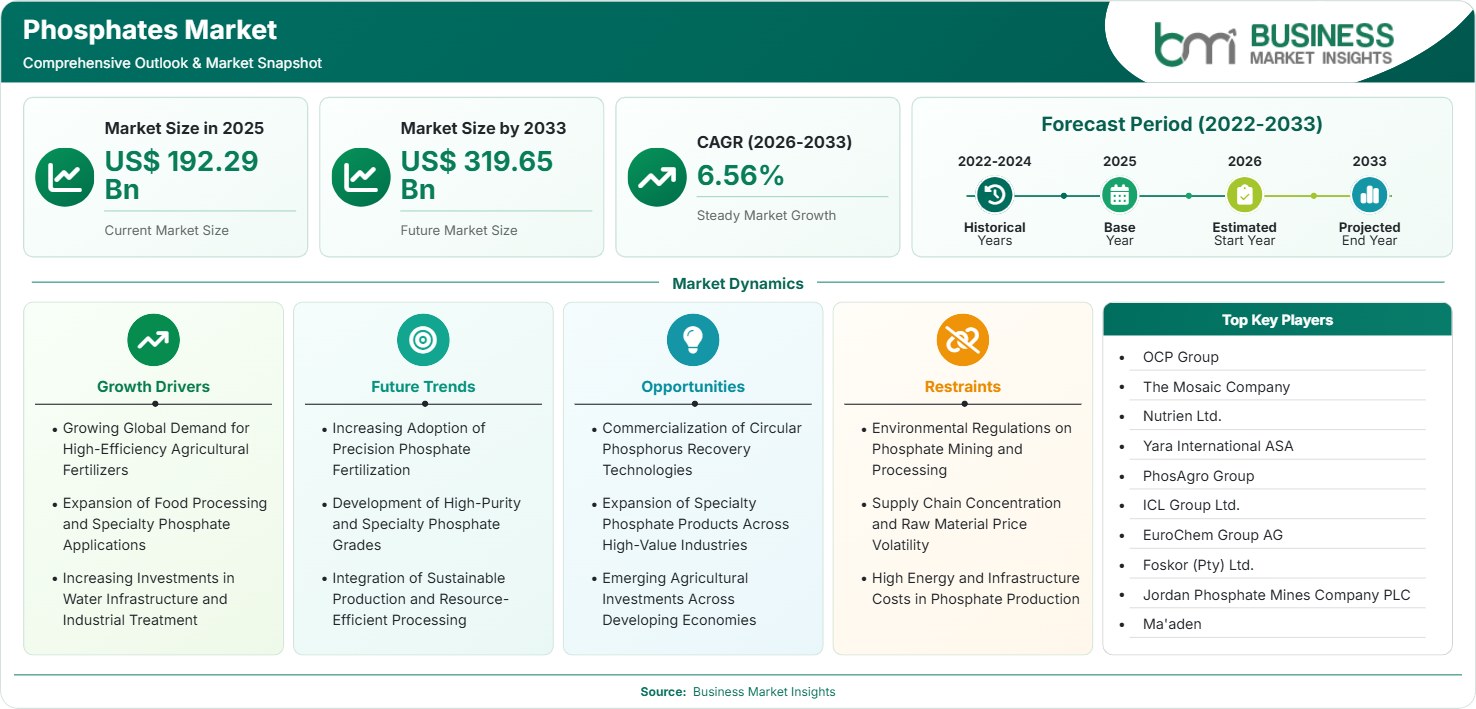
The Phosphates Market size was valued at US$ 192.29 Billion in 2025 and is projected to reach US$ 319.65 Billion by 2033, growing at a CAGR of 6.56% during 2026–2033, driven by expanding fertilizer consumption, food-grade phosphate demand, sustainable nutrient management initiatives, industrial water treatment investments, and increasing opportunities.

Report Coverage
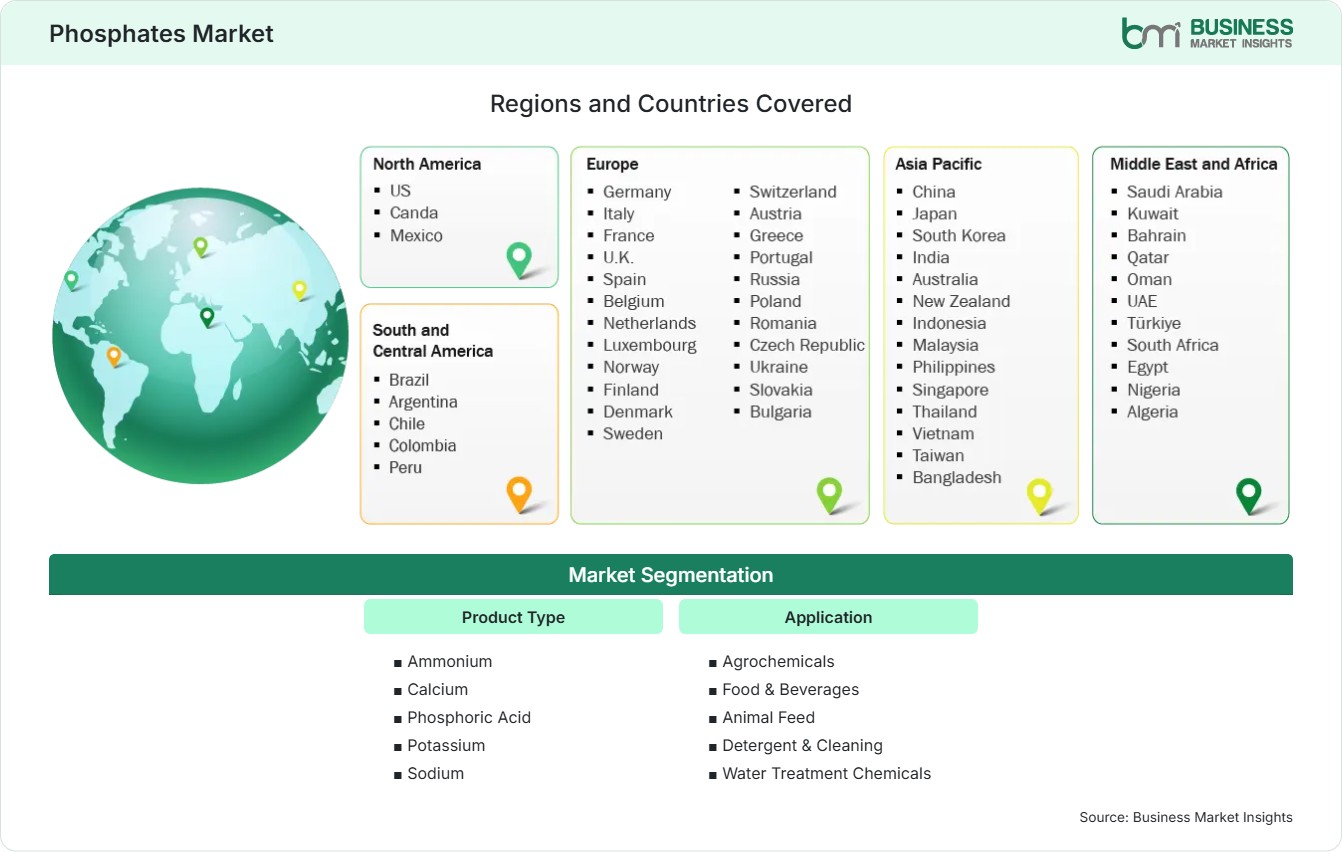
  • Product Type: Ammonium, Calcium, Phosphoric Acid, Potassium, Sodium
  • Application: Agrochemicals, Food & Beverages, Animal Feed, Detergent & Cleaning, Water Treatment Chemicals
US$ 192.29 Bn Market size in 2025
US$ 319.65 Bn Market Size by 2033
6.56% CAGR, 2026 - 2033
2026-2033 Forecast Period

AI Overview

Phosphates Market Summary

  • North America Region: North America holds a 22%–25% market share in 2025 and is projected to grow at a 5.6%–6.2% CAGR during 2026–2033, supported by precision agriculture, phosphate fertilizer optimization, industrial water treatment expansion, food processing innovation, regulatory compliance, mining modernization, and opportunities across sustainable phosphorus recycling and specialty phosphate manufacturing applications.
    U.S. market analysis: The United States leads regional demand through advanced fertilizer production, food-grade phosphates, and water treatment investments, expanding at an estimated 5.8%–6.3% CAGR during 2026–2033.
  • Fastest Growing Region: Asia Pacific accounts for 34%–37% market share in 2025 while advancing at a 7.3%–7.9% CAGR during 2026–2033, supported by agricultural intensification, rising food production, industrial chemical investments, expanding livestock sectors, phosphate processing capacity additions, and increasing infrastructure development across emerging economies.
  • Leading Segment: Agrochemicals represent 51%–54% market share in 2025 and are projected to expand at a 6.5%–7.0% CAGR through 2033, driven by fertilizer consumption, nutrient efficiency improvements, crop productivity initiatives, government support programs, sustainable farming investments, and growing global food security priorities.
  • High Growth Segment: Water Treatment Chemicals account for 10%–13% market share in 2025 while progressing at a 7.5%–8.1% CAGR during 2026–2033, encouraged by industrial wastewater treatment expansion, municipal infrastructure upgrades, corrosion control requirements, environmental regulations, and increasing investments in advanced water purification technologies.
  • Key Market Opportunity: Circular phosphorus recovery technologies, specialty phosphate formulations, wastewater nutrient recycling, precision fertilizer development, industrial decarbonization initiatives, and sustainable mining investments collectively create attractive long-term commercialization and infrastructure expansion opportunities across developed and emerging economies.
  • Major Market Players: OCP Group, The Mosaic Company, Nutrien Ltd., Yara International ASA, PhosAgro Group, ICL Group Ltd., EuroChem Group AG, Foskor (Pty) Ltd., Jordan Phosphate Mines Company PLC, Ma'aden.
Strategic Insights

Phosphates Market: Strategic Insights

Phosphates Market Strategic Framework
FREE PDF
Request your free sample
Request free sample
Stakeholder View

Key Takeaways

  • The industry value chain is becoming increasingly integrated, with mining companies expanding into phosphoric acid production and downstream specialty chemicals to strengthen supply security, improve margins, and reduce dependence on commodity price fluctuations.
  • Opportunities for commercial success are surfacing in fertilizer usage, chemicals used for water treatment, and food-grade phosphates since the governments have begun focusing more on agricultural productivity, sustainability in industry, and health regulations.
  • Innovations are made with regard to improved efficiency fertilizers, phosphorus recycling technology, digital mine optimization, and environmentally-friendly processes that minimize emissions and increase nutrient uptake in agriculture.
  • Asia Pacific offers the most compelling investment environment owing to expanding agricultural output, industrialization, rising livestock production, and government initiatives supporting domestic phosphate manufacturing and fertilizer self-sufficiency.
  • Strategic partnerships, mining asset acquisitions, and downstream integration continue reshaping competitive positioning as producers seek stable raw material access, diversified product portfolios, and stronger regional distribution capabilities.
Geographic Outlook

Phosphates Market Regional Highlights

North America Phosphates Market

North America accounts for approximately 22%–25% of global demand in 2025 and is forecast to expand at a 5.6%–6.2% CAGR during 2026–2033. The Phosphates Market share remains supported by integrated mining operations, fertilizer manufacturing capacity, advanced food processing industries, and growing investments in municipal water treatment infrastructure. Stable agricultural production, precision farming adoption, and regulatory support for nutrient management continue strengthening regional competitiveness while encouraging innovation in sustainable phosphorus utilization.

  • Fertilizer manufacturers continue investing in enhanced nutrient efficiency products, digital agronomy platforms, and environmentally responsible fertilizer formulations that improve crop productivity while reducing phosphorus runoff into sensitive ecosystems.
  • Water utilities increasingly utilize phosphate-based corrosion inhibitors to improve drinking water infrastructure performance, supported by federal infrastructure investments and stricter environmental compliance requirements across municipalities.
  • Food manufacturers continue adopting high-purity phosphate ingredients for processed foods, bakery products, dairy applications, and beverages, benefiting from strong consumer demand for packaged food products.

US Phosphates Market

The United States Phosphates Market represents approximately 68%–72% of North American demand while advancing at a 5.8%–6.3% CAGR during the forecast period. Strong phosphate rock resources, integrated fertilizer production facilities, and advanced agricultural practices sustain long-term market expansion.

  • Large-scale fertilizer producers continue expanding value-added phosphate products designed for precision agriculture, improving nutrient efficiency while reducing environmental losses across major crop-producing regions.
  • Municipal water infrastructure modernization supports increasing consumption of phosphate-based corrosion control chemicals that extend pipeline life and improve drinking water quality.
  • Strong research collaboration among universities, agricultural organizations, and fertilizer companies accelerates commercialization of advanced nutrient management technologies supporting sustainable agricultural productivity.
  • Food-grade phosphate demand remains resilient due to expanding processed food production, bakery innovation, dairy manufacturing, and beverage processing investments throughout the country.

Europe Phosphates Market

Europe contributes approximately 18%–21% of global Phosphates Market demand in 2025 and is expected to register a 5.4%–6.0% CAGR during 2026–2033. Germany and France remain leading consuming markets, while Poland demonstrates one of the fastest growth trajectories with an estimated 6.2%–6.8% CAGR supported by agricultural modernization and industrial investments.

  • European Union nutrient management regulations encourage efficient phosphorus utilization while promoting recycling technologies that recover phosphorus from wastewater treatment facilities and industrial waste streams.
  • Specialty phosphate demand continues expanding across pharmaceutical manufacturing, food ingredients, and industrial chemicals supported by stringent product quality standards.
  • Investments in sustainable fertilizer technologies improve nutrient efficiency while supporting broader environmental objectives under regional climate and agricultural policies.
  • Industrial water treatment projects increasingly adopt phosphate-based formulations to improve corrosion control, equipment longevity, and operational efficiency across manufacturing sectors.

Asia Pacific Phosphates Market

Asia Pacific represents the largest regional market with approximately 34%–37% of global demand in 2025 and is projected to expand at a 7.3%–7.9% CAGR through 2033. Rapid agricultural intensification, population growth, industrialization, and fertilizer production investments continue supporting the strongest Phosphates Market growth globally. China leads regional consumption, while India records one of the fastest expansion rates at approximately 7.8%–8.3% CAGR due to agricultural development initiatives.

  • Government initiatives supporting domestic fertilizer manufacturing reduce import dependence while encouraging mining investments and integrated phosphate processing facilities.
  • Expanding livestock industries increase demand for phosphate feed additives that improve animal nutrition, productivity, and commercial farming efficiency.
  • Urbanization and industrial growth stimulate phosphate consumption across detergents, water treatment chemicals, and industrial processing applications throughout emerging economies.
  • Precision agriculture adoption improves fertilizer utilization efficiency while encouraging premium phosphate formulations designed for higher crop productivity and reduced environmental impacts.

Rest of World Phosphates Market

The Rest of World region accounts for approximately 18%–21% of global Phosphates Market demand and is projected to advance at a 6.4%–7.0% CAGR during the forecast period.

South and Central America continue benefiting from expanding commercial agriculture, fertilizer consumption, and export-oriented crop production. Brazil remains the leading regional consumer, while Argentina demonstrates robust agricultural investment supporting phosphate demand.

The Middle East and Africa benefit from abundant phosphate rock reserves, integrated mining investments, and downstream fertilizer manufacturing expansion. Saudi Arabia leads industrial investments, whereas Morocco continues strengthening its global phosphate production leadership through export-oriented processing capacity expansion.

  • Major mining investments improve phosphate rock production capacity while supporting integrated fertilizer manufacturing across resource-rich economies.
  • Export-oriented fertilizer production strengthens regional competitiveness by supplying agricultural markets throughout Asia, Europe, and Latin America.
  • Water scarcity encourages wider adoption of efficient fertilizer technologies and advanced irrigation practices requiring optimized phosphate nutrient management.
  • Government industrial diversification programs encourage downstream phosphoric acid production, specialty phosphate chemicals, and value-added export opportunities.
Global Market Geography
FREE PDF
Request your free sample
Request free sample
Segment Analysis

Phosphates Market Segmentation

Product Type

The Product Type segment accounted for approximately 100% of the overall market, with calcium- and ammonium-based phosphates contributing the largest revenue share across agricultural and industrial applications. The segment is projected to expand at a 6.3%–6.9% CAGR during 2026–2033, supported by increasing fertilizer production, food ingredient applications, water treatment demand, and specialty chemical manufacturing. The Phosphates Market scope continues expanding as product innovation improves nutrient efficiency and industrial performance.

  • Ammonium: Widely utilized in phosphate fertilizers because of its high phosphorus availability and balanced nutrient composition. Demand continues increasing through precision agriculture, higher crop productivity requirements, and sustainable nutrient management initiatives worldwide.
  • Calcium: Calcium phosphates remain essential across fertilizers, food fortification, pharmaceuticals, and animal nutrition. Their excellent mineral composition, safety profile, and multifunctional characteristics support growing adoption across multiple industrial applications.
  • Phosphoric Acid: Phosphoric acid serves as the primary intermediate for phosphate fertilizer manufacturing while supporting food preservation, industrial chemicals, beverage production, and metal treatment processes requiring consistent product quality.
  • Potassium: Potassium phosphate products experience increasing utilization in specialty fertilizers, food processing, biotechnology, and industrial formulations because of their high solubility, buffering capacity, and compatibility with precision nutrient delivery systems.
  • Sodium: Sodium phosphates maintain significant demand in detergents, processed foods, water treatment, and industrial cleaning formulations due to their emulsifying, buffering, dispersing, and corrosion-control properties across diverse end-use industries.

Application

The Application segment reflects diversified consumption patterns across agriculture, food processing, industrial manufacturing, and environmental management. Agrochemicals remain the dominant application with a 51%–54% market share in 2025 and are anticipated to register a 6.5%–7.0% CAGR through 2033. The Phosphates Market trends indicate accelerating adoption of specialty phosphate formulations supporting sustainable agriculture, clean water infrastructure, and high-value industrial applications.

  • Agrochemicals: Represent the largest application owing to extensive utilization in phosphate fertilizers that improve crop yield, nutrient uptake, and soil fertility while supporting global food production and sustainable agricultural development.
  • Food & Beverages: Food-grade phosphates enhance texture, moisture retention, acidity regulation, and product stability across bakery, dairy, meat processing, beverages, and convenience food manufacturing with strict quality compliance requirements.
  • Animal Feed: Feed phosphates improve phosphorus availability, skeletal development, reproductive performance, and feed conversion efficiency in poultry, swine, aquaculture, and ruminant nutrition, supporting expanding global livestock production.
  • Detergent & Cleaning: Phosphate-based cleaning formulations continue serving institutional and industrial applications requiring superior water softening, stain removal, emulsification, and cleaning performance despite regulatory limitations in selected consumer detergent markets.
  • Water Treatment Chemicals: Increasing investments in municipal and industrial water infrastructure drive phosphate demand for corrosion inhibition, scale prevention, pipeline protection, and operational efficiency across drinking water and wastewater treatment systems.
Market Forces

Phosphates Market Dynamics

Key Market Drivers

Growing Global Demand for High-Efficiency Agricultural Fertilizers

Global population growth, shrinking arable land per capita, and the need to improve crop productivity continue driving phosphate fertilizer consumption. The Food and Agriculture Organization (FAO) states that there is a need for an increase in food production worldwide because of growing demand, leading to adoption of nutrient-efficient fertilizer strategies by both governments and farmers. Phosphate fertilizers are still essential for proper root formation, ripening of crops, and increase in yields among cereals, oilseeds, fruits, and vegetables. Precision agriculture techniques have also enabled better phosphorus absorption in crops, thus making sure of minimal losses and maximizing profits from farming. Such structural trends in agriculture will continue driving Phosphates Market growth.

Expansion of Food Processing and Specialty Phosphate Applications

The rapid expansion of processed food manufacturing continues increasing consumption of food-grade phosphates worldwide. Phosphates function as stabilizers, emulsifiers, acidity regulators, moisture retainers, and leavening agents in dairy products, processed meats, bakery products, beverages, and convenience foods. Urbanization trends, changing eating patterns, and disposable incomes are driving the Phosphates Market growth in packaged foods in Asia-Pacific, Latin America, and some parts of Africa. Food safety regulations also contribute to the use of high purity phosphates as food ingredients. The constant innovation in products by food ingredients producers contributes to their functionality and compliance with clean label trends, ensuring continuous demand beyond traditional fertilizer uses.

Increasing Investments in Water Infrastructure and Industrial Treatment

Municipalities and industrial operators continue investing in water treatment infrastructure to comply with increasingly stringent environmental regulations. Phosphate compounds serve critical functions in applications of corrosion prevention, scale prevention, and pipe protection in drinking water distribution networks and industrial settings. Based on the World Health Organization (WHO), ensuring universal access to clean water continues to be an infrastructural goal at the international level, hence prompting governments to upgrade treatment facilities. Various industries such as the electricity generation, chemical, mining, and manufacturing industries make use of water treatment compositions that contain phosphates in order to increase efficiency and reduce maintenance costs.

Key Market Opportunities

Commercialization of Circular Phosphorus Recovery Technologies

Growing concerns regarding finite phosphate rock reserves and nutrient sustainability are accelerating investment in phosphorus recovery technologies. Municipal water treatment facilities, farming practices, and industries are increasingly adopting technologies to recover phosphorus from crystallization, biological processes, and recycling methods. Circular economy strategies being advocated for in Europe, North America, and Asia provide a means of ensuring efficiency and independence from mining of virgin phosphates. Technology companies and fertilizer producers are developing full-scale recovery facilities that can produce recycled phosphate products of high quality. Phosphates Market Forecasts indicates phosphorus recycling as a business opportunity that can secure supply chain needs as well as environmental targets.

Expansion of Specialty Phosphate Products Across High-Value Industries

Demand for high-purity phosphate compounds continues expanding beyond conventional agriculture into pharmaceuticals, biotechnology, personal care, food ingredients, electronics, and specialty industrial chemicals. The emphasis on customization of phosphate-based products offering better purity, functionality, and performance is steadily increasing. The production of drugs entails the use of pharmaceutical phosphates that comply with regulatory standards, whereas biotechnology applications are adopting phosphate buffers in their processes. Premium specialty phosphates offer much better profit margins as compared to commodity fertilizers, and therefore producers are encouraged to venture into downstream manufacturing.

Emerging Agricultural Investments Across Developing Economies

Governments across Asia, Africa, and Latin America persist in emphasizing agricultural modernization, irrigation systems, fertilizer availability, and self-production of food. International development organizations, like the World Bank, invest in agricultural productivity projects that enhance nutrient usage and the ability of farmers to have access to modern tools. Growing commercial agriculture, mechanization, and advanced agrotechnology use will continue to increase the phosphate fertilizer usage in developing countries. Mining of phosphates, the production of phosphoric acid, and manufacturing of fertilizers decrease dependence on imports while ensuring stability of supply within the region. These Phosphates Market trends create investment opportunities for mining and fertilizer firms, along with other businesses related to agriculture.

Market Restraints and Challenges

Environmental Regulations on Phosphate Mining and Processing

Factor: Increasing environmental regulations governing phosphate mining, beneficiation, emissions, waste management, and wastewater discharge continue raising compliance costs across the industry.

Impact: The production process requires substantial investments in pollution control equipment, energy-saving technology, water recycling, and environmental monitoring programs to comply with changing requirements. Environmental impact assessment and community engagement result in extended permit times and more investment needs in mining facilities. In some developed countries, more stringent requirements about nutrient runoff and phosphate discharge affect the practice of fertilizer use further down the line.

Supply Chain Concentration and Raw Material Price Volatility

Factor: Global phosphate rock reserves remain geographically concentrated, creating exposure to geopolitical developments, export restrictions, transportation disruptions, and fluctuations in mining production.

Impact: Fertilizer manufacturers and downstream chemical producers face uncertainties with regard to the cost of procuring the raw materials used for manufacturing, which impacts their economics and pricing. Higher energy prices increase mining, processing, phosphoric acid production, and logistical costs on the global supply chain. Continued volatility can create uncertainty in investments, affect margins, and defer expansion projects, especially those belonging to small fertilizer manufacturers with limited financial slack and limited sources of procurement of raw materials.

Company Analysis

Competitive Landscape

The competitive environment remains moderately consolidated, with leading producers strengthening their positions through mining integration, phosphoric acid production, specialty phosphate manufacturing, and global distribution networks. The Phosphates Market analysis indicates that companies are increasingly investing in sustainable mining practices, downstream value-added products, digital operations, and phosphorus recovery technologies to improve long-term competitiveness while addressing evolving environmental regulations and food security requirements.

Company Name

Overview

Products and Services Relevant to this Market

OCP Group

World's largest phosphate producer with vertically integrated mining, fertilizer production, and global export operations serving more than 160 countries through diversified phosphate value chains.

Phosphate rock, phosphoric acid, phosphate fertilizers, specialty fertilizers, customized crop nutrition solutions, research-driven agricultural services, and sustainable nutrient management technologies.

The Mosaic Company

Leading integrated producer of concentrated phosphate and potash fertilizers with extensive mining assets, manufacturing facilities, and global agricultural distribution networks.

Phosphate fertilizers, feed phosphates, crop nutrition products, phosphoric acid, fertilizer blends, agronomic advisory services, and nutrient management solutions.

Nutrien Ltd.

Global agricultural input company combining fertilizer manufacturing with one of the world's largest retail agricultural service networks supporting farmers worldwide.

Phosphate fertilizers, blended fertilizers, crop nutrition products, precision agriculture solutions, agronomic consulting, and digital farming technologies.

Yara International ASA

International crop nutrition company emphasizing sustainable fertilizer innovation, precision farming, and environmentally responsible agricultural productivity improvement through integrated nutrient management.

Specialty phosphate fertilizers, crop nutrition solutions, precision farming services, digital agronomy platforms, and sustainable agricultural technologies.

PhosAgro Group

Major phosphate fertilizer manufacturer with vertically integrated mining operations and extensive production facilities serving domestic and international agricultural markets.

Phosphate rock, phosphoric acid, mineral fertilizers, feed phosphates, water-soluble fertilizers, and premium crop nutrition products.

ICL Group Ltd.

Global specialty minerals and specialty chemicals producer supplying agricultural, food, industrial, and engineered material markets through diversified operations worldwide.

Specialty phosphates, food phosphates, industrial phosphates, fertilizer products, water treatment chemicals, and performance ingredient solutions.

EuroChem Group AG

International fertilizer manufacturer operating integrated mining, production, logistics, and global distribution assets supporting agricultural productivity across multiple continents.

Phosphate fertilizers, phosphoric acid, crop nutrition products, fertilizer blends, mining services, and integrated agricultural input solutions.

Foskor (Pty) Ltd.

South African phosphate mining and processing company supplying phosphoric acid and phosphate products to domestic and export markets through integrated operations.

Phosphate rock, phosphoric acid, granular fertilizers, fertilizer raw materials, industrial phosphates, and mining-related services.

Jordan Phosphate Mines Company PLC

Leading Middle Eastern phosphate mining company with extensive export capabilities and integrated fertilizer production partnerships supporting global agricultural markets.

Phosphate rock, phosphoric acid, phosphate fertilizers, mining operations, export logistics, and downstream phosphate processing solutions.

Ma'aden

Saudi Arabian mining company expanding integrated phosphate production through large-scale mining, processing, and fertilizer manufacturing investments targeting international agricultural markets.

Phosphate fertilizers, phosphoric acid, ammonia, industrial minerals, mining services, integrated phosphate production, and export-oriented fertilizer solutions.

Trust & Transparency

Research Methodology

The market analysis combines proprietary research with secondary data from government agencies, company disclosures, regulatory filings, industry databases and expert interviews. Market estimates are validated through data triangulation, cross-market benchmarking and analyst review.

View Full Research Methodology

Questions Answered

Frequently Asked Questions

How are sustainability initiatives influencing the industry?

Sustainability initiatives encourage cleaner mining operations, renewable energy adoption, phosphorus recycling, wastewater nutrient recovery, efficient fertilizer formulations, and environmentally responsible manufacturing practices.

What does the Phosphates Market Report cover?

The report provides comprehensive insights into market size, regional performance, competitive landscape, segmentation, growth drivers, opportunities, restraints, recent industry developments, and future strategic outlook for stakeholders across the phosphate value chain.

What factors are driving long-term industry expansion?

Major growth factors include rising global food demand, increasing fertilizer consumption, water treatment infrastructure development, processed food production, precision agriculture adoption, and investments in sustainable phosphorus recovery technologies.

Which region dominates the global Phosphates Market?

Asia Pacific accounts for the largest regional share due to strong agricultural activity, expanding fertilizer production, rapid industrialization, and increasing investments in domestic phosphate manufacturing across China, India, and Southeast Asian countries.

What are the primary applications of phosphates?

Phosphates are primarily used in fertilizers, food and beverage processing, animal nutrition, industrial water treatment, detergents, pharmaceuticals, and specialty chemicals.

Access the Full Phosphates Market Report

Get segment-level forecasts, regional estimates, competitive benchmarking, company profiles and downloadable Excel datasets.

Access the full Phosphates Market Report
350 pages PDF & Excel | 2026-08-27