
Phoropters Market Outlook: Size, Share, Trends, Growth Analysis, Competitive Landscape & Forecast, 2026-2033

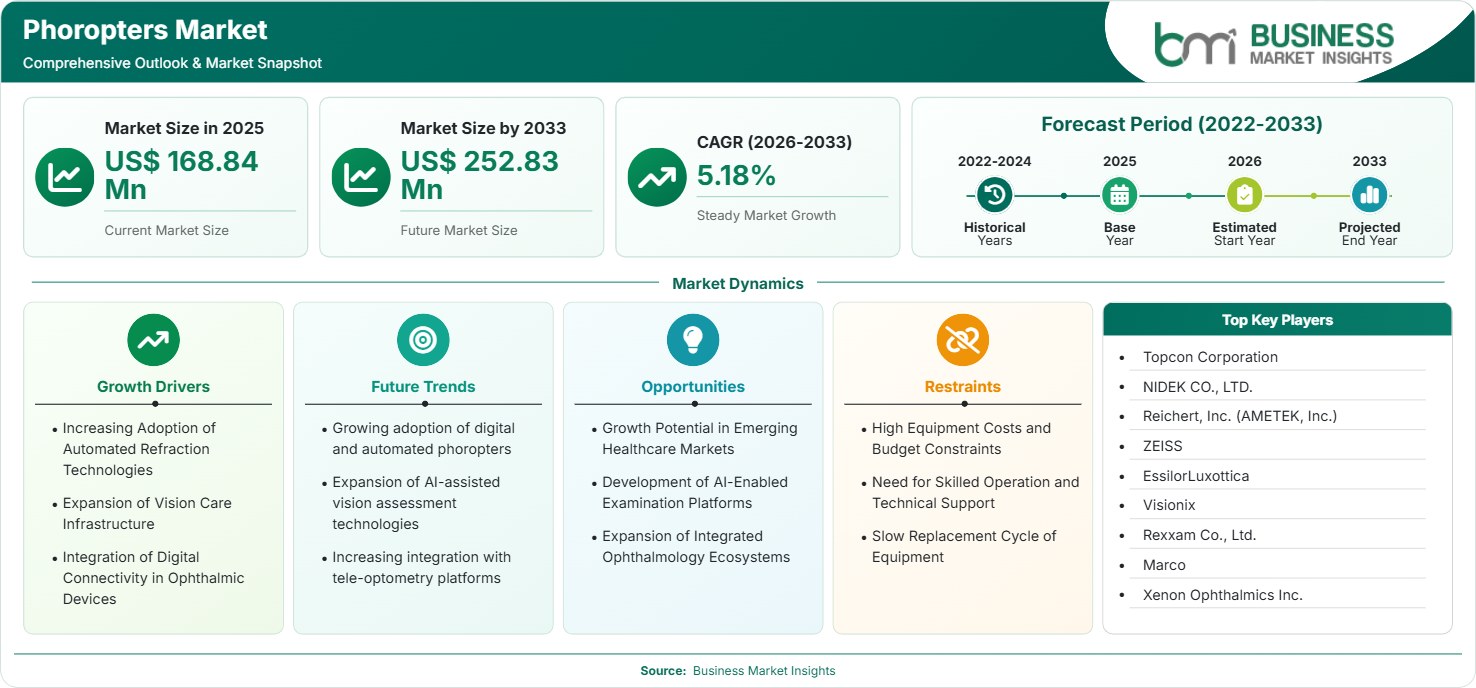
The Phoropters Market size was valued at US$ 168.84 Million in 2025 and is projected to reach US$ 252.83 Million by 2033, growing at a CAGR of 5.18% during 2026–2033 Growing demand for vision correction treatments, rising number of ophthalmic treatments, and replacement of old diagnostic devices are propelling market growth.

Report Coverage
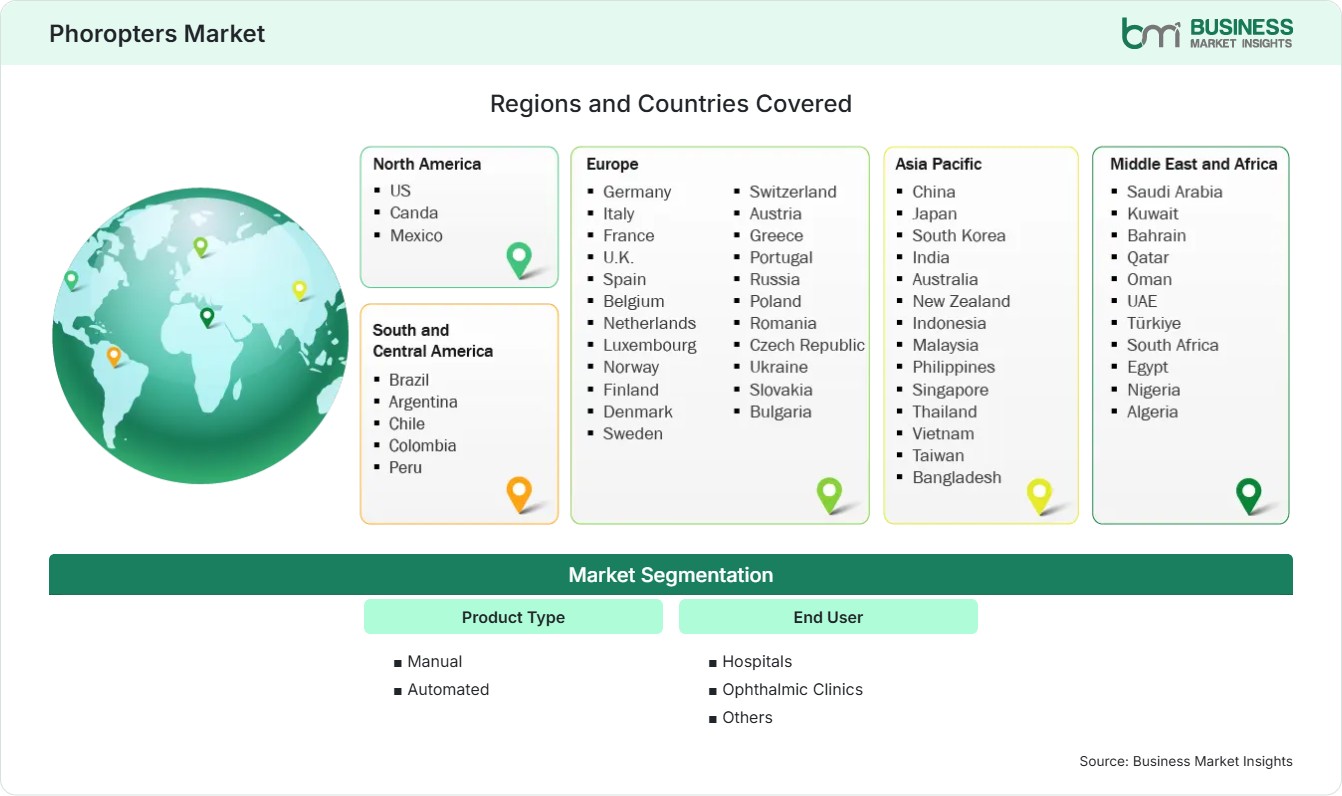
  • Product Type: Manual, Automated
  • End User: Hospitals, Ophthalmic Clinics, Others
US$ 168.84 Mn Market size in 2025
US$ 252.83 Mn Market Size by 2033
5.18% CAGR, 2026 - 2033
2026-2033 Forecast Period

01 AI Overview

Phoropters Market Summary

  • North America Region: North America holds a 35%–38% share in 2025, growing with a CAGR of 5.20%–5.40% influenced by advanced eye care infrastructure, digital refraction adoption, replacement cycles, and expanding optometry services. The U.S. market demonstrates steady adoption of automated refraction technologies, supported by a 5.30% CAGR between 2026 and 2033, driven by clinical modernization and outpatient ophthalmology expansion.
  • Fastest Growing Region: Asia Pacific maintains a 27%–30% share in 2025, expanding with a CAGR of 5.60%–5.90% due to rising vision screening programs, healthcare investments, ophthalmic equipment modernization, and increasing demand from emerging economies seeking efficient diagnostic solutions.
  • Leading Segment: Automated products represent a 55%–58% share in 2025, progressing at a CAGR of 5.70%–5.90% supported by faster examinations, digital workflow integration, enhanced accuracy, and increasing preference among hospitals and ophthalmic clinics adopting technology-enabled diagnostic platforms.
  • High Growth Segment: Ophthalmic clinics account for a 42%–45% share in 2025, advancing with a CAGR of 5.80%–6.00% due to increasing outpatient eye care demand, specialty clinic expansion, personalized vision correction, and investments in compact diagnostic equipment.
  • Key Market Opportunity: Growth opportunities are emerging through connected phoropter systems, artificial intelligence integration, expanding eye care access in developing regions, and partnerships between equipment manufacturers and healthcare providers.
  • Major Market Players: Topcon Corporation, NIDEK CO., LTD., Reichert, Inc. (AMETEK, Inc.), ZEISS, EssilorLuxottica, Visionix, Rexxam Co., Ltd., Marco, and Xenon Ophthalmics Inc.
02 Strategic Insights

Phoropters Market: Strategic Insights

Phoropters Market Strategic Framework
FREE PDF
Request your free sample
Request free sample
03 Stakeholder View

Key Takeaways

  • The supply network is expanding as optical component suppliers, medical device producers, software developers, and distributors collaborate to create a solution for today’s refractive testing environment.
  • Automation is the most promising expansion route due to the growing needs of hospitals and specialized clinics for accelerated diagnostics, consistent measurements, and reduced manual adjustment processes.
  • New innovations aim to develop connected phoropters equipped with touch screens, electronics, and integration with digital eye examination systems.
  • Asia Pacific region provides an attractive market entry opportunity owing to increasing healthcare infrastructure development and growth of the demand in ophthalmology diagnostic equipment in developing countries.
  • Industry consolidation will be facilitated through strategic alliances, technological partnerships, and investments in automation, software integration, and global distribution.
  • Competitive advantage will be based more on services, customization, and integration of diagnostic devices into eye care management system.
04 Geographic Outlook

Phoropters Market Regional Highlights

North America Phoropters Market

North America accounted for a 35%–38% share in 2025 and is projected to expand at a CAGR of 5.20%–5.40% from 2026 to 2033. The region benefits from mature eye care infrastructure, strong reimbursement frameworks, and rapid adoption of automated diagnostic equipment. The Phoropters Market share remains supported by hospitals, optometry chains, and specialty clinics upgrading examination capabilities.

  • The United States remains the dominant contributor due to advanced ophthalmology networks, increasing optometry service demand, and replacement of conventional examination equipment with digital alternatives.
  • Canada supports regional expansion through healthcare modernization initiatives, growing optical service providers, and increasing adoption of advanced diagnostic technologies.
  • Automated refraction platforms are gaining preference as providers seek efficient workflows, improved accuracy, and reduced examination duration.
  • Leading manufacturers benefit from established distribution networks and strong relationships with healthcare institutions across the region.

US Phoropters Market

The U.S. represented a 30%–33% share of the North American market in 2025 and is expected to grow at a CAGR of 5.30%–5.50% during 2026–2033. The country maintains strong demand due to high ophthalmic service utilization, advanced clinical infrastructure, and increasing investments in digital eye examination systems. The Phoropters Market share reflects strong penetration across hospitals and private eye care facilities.

  • Growth is supported by increasing adoption of automated examination technologies in optometry practices seeking operational efficiency and improved patient throughput.
  • Private ophthalmology clinics are investing in upgraded diagnostic equipment to enhance service quality and expand specialty vision care offerings.
  • Healthcare providers increasingly prioritize connected devices capable of integrating with electronic medical record systems.
  • Replacement demand remains consistent as older mechanical systems reach the end of operational life cycles.

Europe Phoropters Market

Europe held a 28%–31% share in 2025 and is anticipated to register a CAGR of 5.00%–5.30% through 2033. The region benefits from established ophthalmic care systems, strong medical device standards, and increasing preference for precision-based diagnostic technologies. Germany, France, and the United Kingdom represent leading markets, while Italy and Spain show increasing adoption of advanced optical equipment. The Phoropters Market growth is supported by technology upgrades across healthcare facilities.

  • Germany leads regional demand through advanced medical device manufacturing capabilities, strong healthcare infrastructure, and high clinical technology adoption.
  • France demonstrates steady expansion through optical care networks and increasing investment in digital ophthalmology solutions.
  • The United Kingdom supports adoption through growing demand for efficient outpatient eye care services and modern diagnostic systems.
  • European regulatory emphasis on device quality encourages manufacturers to introduce reliable and technologically advanced examination platforms.

Asia Pacific Phoropters Market

Asia Pacific represented a 27%–30% share in 2025 and is forecast to grow at a CAGR of 5.60%–5.90% between 2026 and 2033. The region is becoming the fastest-expanding market due to rising healthcare investments, increasing prevalence of refractive disorders, and expanding ophthalmic service availability. China, Japan, India, and South Korea are major contributors, with Japan showing strong technology adoption and India demonstrating increasing healthcare infrastructure development.

  • China benefits from expanding hospitals, rising optical care demand, and government-supported healthcare modernization programs.
  • Japan maintains strong adoption due to domestic manufacturers, advanced medical technology capabilities, and high-quality ophthalmic services.
  • India represents an attractive growth market due to increasing vision screening initiatives and private eye care expansion.
  • South Korea continues adopting advanced diagnostic systems through technologically advanced healthcare facilities and specialized ophthalmology centers.

Regional Trends and Share Analysis

Rest of World Phoropters Market

Rest of World accounted for a 6%–9% share in 2025 and is projected to expand at a CAGR of 4.70%–5.00% during 2026–2033. South and Central America are witnessing gradual adoption through private ophthalmology investments, while Middle East and Africa markets are supported by healthcare infrastructure improvements. The Phoropters Market share remains influenced by expanding access to vision care, medical tourism, and modernization of diagnostic facilities.

South and Central America are experiencing rising demand from urban healthcare centers, optical chains, and specialty clinics. Brazil, Mexico, and Argentina represent important contributors due to improving healthcare access and increasing awareness of refractive correction services. Middle East and Africa markets are developing through investments in hospitals, specialized eye care facilities, and public vision programs.

  • Brazil supports regional demand through expanding private healthcare networks, increasing ophthalmic procedures, and investments in modern diagnostic equipment.
  • Mexico benefits from growing optical retail infrastructure, rising vision screening demand, and increasing adoption of automated examination systems.
  • Middle Eastern countries are upgrading healthcare facilities with advanced ophthalmic technologies to support specialized medical services.
  • African markets show gradual improvement through public-private healthcare partnerships and expanded access to essential eye care services.
Global Market Geography
FREE PDF
Request your free sample
Request free sample
05 Segment Analysis

Phoropters Market Segmentation

Product Type

Product Type segmentation includes Manual and Automated systems, with automated products representing a 55%–58% share in 2025 and expanding at a CAGR of 5.70%–5.90% between 2026–2033. Adoption is influenced by workflow efficiency, digital integration, and increasing preference for precise refractive measurements. The Phoropters Market scope continues expanding as healthcare providers transition from traditional examination methods toward technology-enabled diagnostic solutions.

  • Manual: Manual phoropters remain relevant in cost-sensitive settings due to affordability, operational simplicity, and suitability for basic refractive assessments where advanced automation is not required.
  • Automated: Automated systems gain traction through faster examinations, electronic controls, enhanced repeatability, and integration with digital vision testing platforms across hospitals and ophthalmic clinics.

End User

End User segmentation covers Hospitals, Ophthalmic Clinics, and Others, with ophthalmic clinics representing a 42%–45% share in 2025 and growing at a CAGR of 5.80%–6.00% between 2026–2033. The segment benefits from increasing outpatient eye care demand, specialty clinic expansion, and investments in compact diagnostic equipment. The Phoropters Market trends indicate stronger adoption among specialized providers seeking efficient patient examination workflows.

  • Hospitals: Hospitals adopt advanced phoropter systems to improve ophthalmology department capabilities, support comprehensive eye examinations, and enhance diagnostic accuracy across diverse patient groups.
  • Ophthalmic Clinics: Ophthalmic clinics represent a major adoption area due to rising specialty care demand, personalized vision correction services, and preference for efficient examination technologies.
06 Market Forces

Phoropters Market Dynamics

Key Market Drivers

Increasing Adoption of Automated Refraction Technologies

Automation is one of the main drivers of growth, driven by the demand for faster, more reliable refractive eye testing by healthcare professionals. Automation technologies minimize manual settings, increase examination repeatability, and enable electronic workflows in ophthalmological clinics. The World Health Organization highlights the global significance of addressing visual impairment, as billions of people worldwide are affected. The Phoropters Market trends indicate increasing preference for electronically controlled devices that improve operational efficiency, particularly in high-volume clinics and hospitals. Manufacturers are responding through integrated systems featuring digital interfaces, connectivity capabilities, and enhanced user ergonomics.

Expansion of Vision Care Infrastructure

Growing healthcare infrastructure investments are supporting broader deployment of advanced ophthalmic equipment across developing and developed markets. Rising demand for eye examinations, increasing awareness of refractive disorders, and expansion of specialty clinics are strengthening equipment procurement. The Phoropters Market growth is supported by healthcare providers upgrading examination rooms with reliable diagnostic solutions. Countries investing in healthcare modernization are creating additional demand for optical technologies capable of supporting larger patient volumes. Public and private healthcare partnerships are improving access to vision services, encouraging adoption of advanced refractive examination systems. Manufacturers with regional service networks are benefiting from this infrastructure expansion.

Integration of Digital Connectivity in Ophthalmic Devices

The digital revolution in eye care is driving eye care equipment manufacturers to design diagnostic tools that can connect within the overall workflow. Electronic data transfer, touch screens, and compatibility with digital examination systems are increasing productivity for professionals in this industry. The current market trends are driven by the need for devices that facilitate easy information exchange and are simple to use. Eye care professionals are prioritizing devices that improve examination accuracy and compatibility with current patient management systems. This trend is driving investments in technology that features intelligent interfaces and software-based capabilities.

Key Market Opportunities

Growth Potential in Emerging Healthcare Markets

Developing regions represent important expansion opportunities as governments and private providers increase investments in eye care infrastructure. Rising urbanization, increasing disposable income, and growing awareness of vision correction are creating demand for modern diagnostic equipment. Manufacturers can expand through localized partnerships, affordable automated solutions, and stronger distribution networks. The Phoropters Market Forecasts indicate that emerging economies will contribute increasingly to future demand as healthcare accessibility improves. Countries across Asia Pacific, Latin America, and Africa are prioritizing healthcare modernization, creating opportunities for equipment suppliers. Strategic collaborations with hospitals and optical service providers can accelerate adoption while addressing regional affordability challenges.

Development of AI-Enabled Examination Platforms

AI implementation offers several advantages when it comes to enhancing diagnostic process efficiency, streamlining workflows, and individualized vision test. AI-enabled systems will be helpful to the ophthalmologist in assessing the exam data, refining the process and making decisions. Companies willing to develop intelligent ophthalmic devices have an opportunity to distinguish themselves by their sophisticated features. Growing popularity of digital health makes the environment suitable for developing connected phoropters that offer optical testing together with software support. Possible cooperation between technology firms and medtech companies will also drive innovation.

Expansion of Integrated Ophthalmology Ecosystems

The integration of the phoropter into a broader ecosystem in ophthalmic diagnostics creates opportunities for manufacturers of such devices to offer comprehensive testing solutions rather than stand-alone products. Medical clinics more often seek equipment compatible with autorefractors, imaging systems, and electronic health record systems. It helps to optimize workflows and increase the efficiency of patient management. Manufacturers of compatible platforms can use it to their customers' benefit and develop service-based opportunities. The emergence of healthcare facilities with specialized services further supports this development trend.

Market Restraints and Challenges

High Equipment Costs and Budget Constraints

Factor: The high cost of purchase and maintenance of sophisticated automated phoropters could deter their use in smaller clinics or healthcare organizations with limited funds. Impact: Affordability issues could delay the replacement process and make organizations continue using traditional manual devices. Even though automation offers many benefits, the high initial cost of investment is still a key issue for organizations considering upgrading equipment. To overcome this challenge, manufacturers have come up with affordable ways such as flexible financing, customized products, and extended service plans. However, affordability remains an important factor in purchasing decisions in developing nations.

Need for Skilled Operation and Technical Support

Factor: Proper functioning of diagnostic machines requires trained personnel and reliable technical support systems. Impact: The lack of trained personnel and technical support can pose challenges to the use of the devices in some health care settings. The automated phoropter machines contain electronic and software parts that need proper training and technical support services. Health care facilities can be discouraged from investing in such devices due to uncertainties regarding post-installation support. The manufacturers should ensure that education and technical support services are improved to address these operational issues.

07 Company Analysis

Competitive Landscape

The Phoropters Market analysis indicates that competition is centered on optical precision, automation capabilities, digital integration, global distribution networks, and after-sales service infrastructure. Leading companies are investing in automated refraction platforms, ergonomic designs, software connectivity, and integrated ophthalmic diagnostic ecosystems to strengthen their market positions.

Company Name

Overview

Products and Services relevant to this market

Topcon Corporation

Topcon Corporation is a Japan-based medical technology company specializing in ophthalmic and healthcare solutions with global diagnostic equipment operations.

Provides automated refraction systems, optical diagnostic devices, digital examination technologies, and integrated ophthalmology workflow solutions.

NIDEK CO., LTD.

NIDEK CO., LTD. develops ophthalmic, optometric, and lens processing technologies with strong global presence across eye care markets.

Offers automated refractive measurement systems, vision testing equipment, ophthalmic diagnostic instruments, and clinical workflow technologies.

Reichert, Inc. (AMETEK, Inc.)

Reichert, Inc., part of AMETEK, Inc., focuses on precision ophthalmic instruments used by eye care professionals worldwide.

Provides phoropters, refractive examination equipment, tonometers, diagnostic devices, and advanced vision care instruments.

ZEISS

ZEISS is a Germany-based optical technology leader delivering advanced solutions for ophthalmology, optometry, and medical applications.

Supplies ophthalmic diagnostic systems, refractive technologies, optical instruments, and digital eye care solutions.

EssilorLuxottica

EssilorLuxottica combines optical manufacturing expertise and global vision care capabilities across consumer and professional markets.

Provides vision care technologies, optical solutions, professional equipment, and integrated services supporting eye examination environments.

Visionix

Visionix develops innovative diagnostic and measurement technologies for optometry and ophthalmology professionals globally.

Offers automated refraction systems, wavefront technologies, vision testing devices, and connected eye care solutions.

Rexxam Co., Ltd.

Rexxam Co., Ltd. is a Japanese manufacturer specializing in ophthalmic and optometric equipment for clinical applications.

Produces automated phoropters, refractive examination devices, and advanced optometric instruments for eye care professionals.

Marco

Marco is a U.S.-based ophthalmic equipment provider serving optometrists and ophthalmologists with diagnostic technologies.

Supplies automated and manual phoropters, refraction systems, examination equipment, and practice solutions.

Xenon Ophthalmics Inc.

Xenon Ophthalmics Inc. focuses on ophthalmic technologies designed for professional eye care applications.

Develops ophthalmic examination products and diagnostic solutions supporting refractive assessment and clinical procedures.

10 Trust & Transparency

Research Methodology

The market analysis combines proprietary research with secondary data from government agencies, company disclosures, regulatory filings, industry databases and expert interviews. Market estimates are validated through data triangulation, cross-market benchmarking and analyst review.

View Full Research Methodology

11 Questions Answered

Frequently Asked Questions

What is influencing the future direction of the Phoropters Market Report?

The Report highlights increasing digital transformation, emerging healthcare investments, automation adoption, and the growing importance of integrated diagnostic systems as major influences shaping future industry development.

How are manufacturers differentiating products in competitive Phoropters Market?

Companies are focusing on automation, ergonomic designs, software integration, service networks, and interoperability with broader ophthalmic ecosystems to create differentiated solutions for healthcare providers.

Which healthcare facilities are increasing investments in phoropter technologies?

Hospitals and ophthalmic clinics are major investors, particularly facilities upgrading diagnostic rooms, expanding outpatient services, and adopting technology-driven examination processes to improve operational efficiency.

What role does connectivity play in modern ophthalmic equipment?

Connectivity enables integration between examination devices, patient records, and diagnostic platforms. This improves workflow coordination, supports data management, and helps practitioners deliver more efficient eye care services.

What factors are driving adoption of automated phoropter systems?

Automated systems are gaining acceptance because they reduce examination time, improve measurement consistency, support digital workflows, and allow clinics to manage higher patient volumes with fewer manual adjustments.

Access the Full Phoropters Market Report

Get segment-level forecasts, regional estimates, competitive benchmarking, company profiles and downloadable Excel datasets.

Access the full Phoropters Market Report
350 pages PDF & Excel | 2026-08-12