
Petroleum Coke Market Outlook: Size, Share, Trends, Growth Analysis, Competitive Landscape & Forecast, 2026-2033

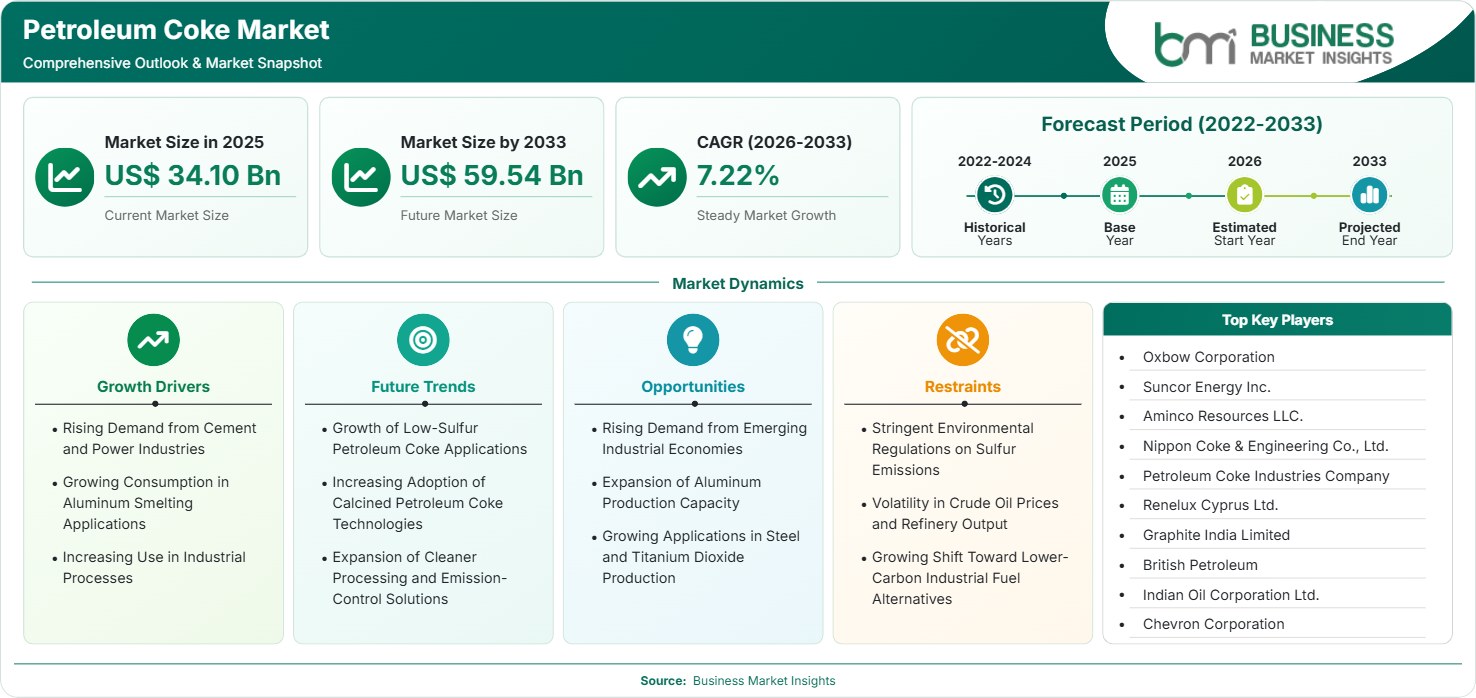
The Petroleum Coke Market size was valued at US$ 34.10 Billion in 2025 and is projected to reach US$ 59.54 Billion by 2033, growing at a CAGR of 7.22% during 2026–2033. Rising demand from aluminum and cement industries, increasing utilization as a cost-effective industrial fuel, expanding refining activities, and growing industrialization across emerging economies are supporting market growth globally.

Report Coverage
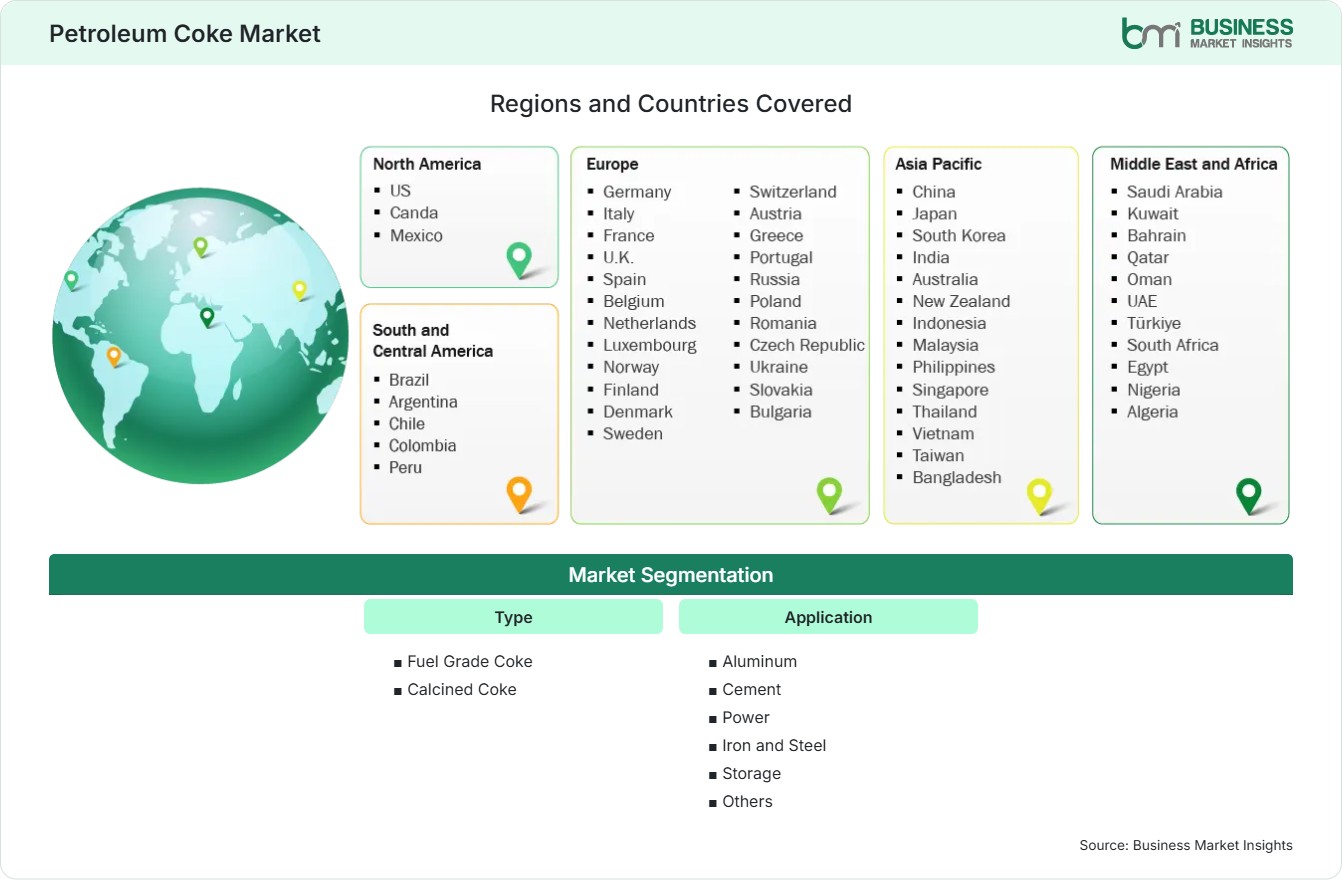
  • Type: Fuel Grade Coke, Calcined Coke
  • Application: Aluminum, Cement, Power, Iron and Steel, Storage, Others
US$ 34.10 Bn Market size in 2025
US$ 59.54 Bn Market Size by 2033
7.22% CAGR, 2026 - 2033
2026-2033 Forecast Period

AI Overview

Petroleum Coke Market Summary

  • North America Region: North America holds a market share of 34%–37% in 2025, growing with a CAGR of 6.8%–7.5% during 2026–2033. Strong refining capacity, established industrial infrastructure, and increasing demand from aluminum and cement sectors continue supporting regional leadership. The U.S. petroleum coke market is expected to register a CAGR of 7.0%–7.7%.
  • Fastest Growing Region: Asia Pacific accounts for 31%–34% share in 2025 and is projected to grow at a CAGR of 7.9%–8.6% through 2033. Expanding industrialization, increasing aluminum production, and growing energy demand continue driving regional growth.
  • Leading Segment: Fuel Grade Coke represents 74%–77% share in 2025 and is expected to grow at a CAGR of 7.0%–7.7% through 2033. Extensive use in cement kilns, industrial boilers, and power generation applications continues supporting segment dominance.
  • High Growth Segment: Aluminum accounts for 29%–32% share in 2025 and is forecast to grow at a CAGR of 7.5%–8.2% during 2026–2033. Rising global aluminum production and growing demand for lightweight materials continue accelerating segment growth.
  • Key Market Opportunity: Expansion of aluminum smelting capacity, increasing industrial fuel demand, and growing utilization of carbon-based industrial materials are creating substantial growth opportunities.
  • Major Market Players: Oxbow Corporation, Suncor Energy Inc., Aminco Resources LLC., Nippon Coke & Engineering Co., Ltd., Petroleum Coke Industries Company, Renelux Cyprus Ltd., Graphite India Limited, British Petroleum, Indian Oil Corporation Ltd., and Chevron Corporation.
Strategic Insights

Petroleum Coke Market: Strategic Insights

Petroleum Coke Market Strategic Framework
FREE PDF
Request your free sample
Request free sample
Stakeholder View

Key Takeaways

  • Petroleum coke remains an important industrial fuel and carbon source across multiple industries.
  • Fuel-grade coke continues dominating the petroleum coke market due to extensive industrial fuel applications.
  • Aluminum production remains the largest application segment for calcined petroleum coke.
  • Refinery expansion continues supporting long-term supply availability.
  • Emerging economies are creating significant demand opportunities through industrial growth.
  • North America remains the leading market due to strong refining and industrial infrastructure.
  • Asia Pacific is projected to witness the fastest growth owing to industrialization and aluminum demand.
  • Carbon-based industrial applications are expected to create significant future opportunities.
Geographic Outlook

Petroleum Coke Market Regional Highlights

North America Petroleum Coke Market

North America accounts for 34%–37% Petroleum Coke Market share in 2025 and is projected to grow at a CAGR of 6.8%–7.5% through 2033. The region benefits from substantial refining capacity, strong industrial demand, advanced manufacturing infrastructure, and growing utilization across aluminum and cement production industries.

  • Refining operators continue generating significant petroleum coke volumes from heavy crude processing.
  • Industrial users increasingly rely on petroleum coke for cost-effective energy generation.
  • Aluminum production continues supporting demand for calcined petroleum coke.
  • Infrastructure investments are strengthening consumption in cement manufacturing.
  • Export opportunities continue benefiting regional producers.
  • Industrial modernization programs remain supportive of market growth.

US Petroleum Coke Market

The United States contributes approximately 88%–92% of North American revenue and is expected to register a CAGR of 7.0%–7.7% through 2033. The country remains the largest market due to large-scale refining operations, industrial demand, and strong export activity.

  • Refinery modernization projects continue supporting production efficiency by improving processing capabilities, operational performance, and overall output levels.
  • Cement and industrial fuel applications remain major demand generators, supported by expanding construction activity and energy-intensive manufacturing operations.
  • Growing carbon material applications continue strengthening market demand as petroleum coke is increasingly utilized across aluminum, metallurgical, and other industrial processes.
  • Export-oriented trade activities remain important for petroleum coke suppliers, enabling producers to access international markets and balance regional supply-demand conditions.
  • Industrial energy consumption continues supporting long-term growth as expanding manufacturing, infrastructure development, and processing activities sustain demand across major end-use sectors.

Europe Petroleum Coke Market

Europe represents 22%–25% of global revenue in 2025 and is anticipated to expand at a CAGR of 7.1%–7.8% through 2033. Industrial manufacturing activities, increasing demand from metallurgical industries, and refinery operations continue supporting regional growth. Germany remains the leading market while Poland demonstrates stronger growth momentum.

  • Germany continues leading regional demand, supported by strong industrial production, metallurgical activities, and established manufacturing infrastructure.
  • Poland is among the fastest-growing markets and is estimated to register a CAGR of 8.0%–8.7% during the forecast period, driven by expanding industrial activity and infrastructure development.
  • Industrial users continue emphasizing fuel efficiency, operational optimization, and cost reduction to manage energy-related expenses.
  • Aluminum and steel industries remain important demand contributors due to their substantial industrial production and energy requirements.
  • Carbon material applications continue expanding across manufacturing sectors, supported by increasing use in industrial and metallurgical processes.
  • Refinery output remains supportive of supply availability, while continued processing activity helps maintain reliable product availability for industrial consumers across the region.

Asia Pacific Petroleum Coke Market

Asia Pacific accounts for 31%–34% of global revenue in 2025 and is expected to achieve the fastest CAGR of 7.9%–8.6% through 2033. Expanding industrialization, increasing aluminum production, and rising infrastructure development continue supporting strong regional growth.

  • China remains the largest regional market, supported by extensive aluminum production, large-scale industrial activities, and strong manufacturing output.
  • India is projected to achieve approximately 8.8%–9.5% CAGR, driven by cement sector growth, refining capacity expansion, infrastructure development, and increasing industrial activity.
  • Growing infrastructure investments continue increasing industrial fuel demand across construction, manufacturing, and related sectors.
  • Cement and metallurgical industries remain major consumers, supported by expanding production capacities and rising industrial output.
  • Refining capacity additions continue supporting supply expansion and strengthening demand from downstream industrial applications.
  • Manufacturing growth continues creating additional opportunities through increasing energy consumption, industrial production, infrastructure development, and investments in new processing facilities across the region.

Rest of World Petroleum Coke Market

Rest of World accounts for 8%–11% of global revenue in 2025 and is projected to expand at a CAGR of 6.2%–6.9% through 2033. Increasing industrial development, refinery investments, and growing energy requirements are supporting market growth across Latin America, the Middle East, and Africa.

  • Brazil continues generating demand through industrial expansion, infrastructure development, and increasing energy requirements across manufacturing sectors.
  • The UAE is witnessing rising refinery and industrial investments, supported by expanding processing capacity and diversification of downstream activities.
  • Saudi Arabia is expected to achieve approximately 7.1%–7.8% CAGR through 2033, driven by downstream expansion, industrial diversification, and investments in energy-related infrastructure.
  • Aluminum production continues supporting demand growth through increasing industrial activity and energy requirements.
  • Industrial fuel consumption remains a key market driver across major applications and manufacturing operations.
  • Refining sector expansion continues creating long-term opportunities by increasing processing capacity, supporting industrial output, and strengthening demand for related energy and fuel product.
Global Market Geography
FREE PDF
Request your free sample
Request free sample
Segment Analysis

Petroleum Coke Market Segmentation

Type

The type segment represents the major categories of petroleum coke utilized across industrial fuel, metallurgical, and manufacturing applications. This segment accounts for approximately 74%–77% share in 2025 and is projected to grow at a CAGR of 7.0%–7.7% through 2033. The expanding Petroleum Coke Market Scope is supported by rising industrial energy demand, increasing aluminum production, and growing utilization of petroleum coke as a cost-effective carbon and fuel source across multiple end-use industries.

  • Fuel Grade Coke: Fuel grade coke dominates the market due to its extensive use in cement kilns, power generation facilities, industrial boilers, and other energy-intensive manufacturing operations.
  • Calcined Coke: Calcined coke continues witnessing strong demand due to its critical role in aluminum smelting, titanium dioxide manufacturing, graphite electrode production, and specialty carbon applications.

Application

The application segment highlights the major industries utilizing petroleum coke for energy generation, metallurgical processing, and carbon-intensive manufacturing activities. This segment accounts for approximately 29%–32% share in 2025 and is expected to register a CAGR of 7.5%–8.2% through 2033. Current Petroleum Coke Market Trends indicate increasing demand from aluminum smelting, cement production, industrial fuels, and metallurgical manufacturing operations.

  • Aluminum: Aluminum remains the leading application segment due to widespread usage of calcined petroleum coke in anode manufacturing for aluminum smelters.
  • Cement: Cement manufacturers extensively utilize petroleum coke as an economical fuel source for kiln operations.
  • Power: Power generation facilities continue using petroleum coke to support energy production requirements in select industrial markets.
  • Iron and Steel: Steel manufacturers utilize petroleum coke in metallurgical applications requiring carbon-rich inputs.
  • Storage: Storage applications are expanding as suppliers and industrial users strengthen supply chain management capabilities.
  • Others: Other applications include chemicals, graphite products, titanium dioxide manufacturing, and industrial processing activities.
Market Forces

Petroleum Coke Market Dynamics

Key Market Drivers

Rising Demand from Cement and Power Industries

The cement and power sectors still contribute to the high utilization of petroleum coke owing to its calorific content and cost-effectiveness relative to some traditional fuels. The cement industry is using more petroleum coke in their kilns in order to increase fuel efficiency and to meet the demands of production on a massive scale. Likewise, certain power plants still make use of petroleum coke in order to meet their energy requirements for industrial areas. The development of infrastructure projects, urbanization, and the industrial construction are increasing the use of cement worldwide.

Growing Consumption in Aluminum Smelting Applications

The manufacturing of aluminum is yet another crucial sector of application for petroleum coke, with the main focus on calcined petroleum coke for anode production. The growing need for lighter materials for transportation, construction, renewable energy, packaging, and consumer goods markets will lead to increased aluminum manufacturing. The use of petroleum coke is very important for these processes because of the characteristics of the material and its processability. The construction of new aluminum plants and expansion projects will add to the demand for petroleum coke.

Increasing Use of Petroleum Coke in Industrial Processes

Industrial manufacturers increasingly utilize petroleum coke as a fuel source and carbon material across a broad range of applications. The product offers favorable energy content, cost advantages, and versatility that make it attractive for energy-intensive industries. Petroleum coke is utilized in cement manufacturing, metallurgical processing, chemicals production, and various industrial heating operations requiring reliable energy sources. Furthermore, expanding industrialization in emerging economies continues increasing demand for efficient production inputs. As industrial output and infrastructure investments rise globally, petroleum coke consumption across manufacturing and processing sectors is expected to remain a significant market growth driver.

Key Market Opportunities

Rising Demand from Emerging Industrial Economies

Emerging economies present substantial opportunities for petroleum coke suppliers due to ongoing industrialization, urban development, and infrastructure expansion. Countries across Asia, Latin America, the Middle East, and Africa are witnessing increasing investments in manufacturing facilities, cement production plants, power generation infrastructure, and metallurgical industries. These developments are creating significant demand for cost-effective energy sources and industrial raw materials. Petroleum coke's affordability and widespread industrial applicability position it favorably in these high-growth regions. Continued economic development and industrial expansion are expected to create attractive long-term growth opportunities for market participants.

Expansion of Aluminum Production Capacity

Growing global aluminum demand is encouraging investments in smelting facilities and production capacity expansion projects worldwide. Aluminum producers require consistent supplies of high-quality calcined petroleum coke for anode manufacturing and operational efficiency. Increasing utilization of aluminum in electric vehicles, renewable energy infrastructure, consumer products, aerospace applications, and construction materials is supporting long-term production growth. New production facilities and modernization initiatives are expected to strengthen petroleum coke demand further. As manufacturers continue expanding aluminum output to meet evolving market requirements, suppliers are likely to benefit from increasing consumption levels.

Growing Applications in Steel and Titanium Dioxide Production

Petroleum coke is increasingly finding applications beyond traditional fuel markets, particularly in steel manufacturing and titanium dioxide production. These industries require carbon-rich materials capable of supporting efficient industrial processing and product quality enhancement. Rising investments in advanced manufacturing and specialty industrial products are expanding the scope of petroleum coke utilization. In addition, technological developments are encouraging broader industrial adoption across value-added applications. Long-term Petroleum Coke Market Forecast projections remain positive as demand from steel production, specialty chemicals, and titanium dioxide manufacturing continues expanding across global industrial markets.

Market Restraints and Challenges

Stringent Environmental Regulations on Sulfur Emissions

Factor: Petroleum coke often contains sulfur and other compounds that contribute to industrial emissions during combustion. Governments and environmental agencies are implementing increasingly stringent regulations aimed at reducing sulfur emissions, improving air quality, and supporting sustainability objectives.

Impact: Regulatory compliance requirements can increase operational costs, necessitate investments in emissions control technologies, and limit petroleum coke usage in certain markets. Companies may also face greater pressure to adopt cleaner alternatives or invest in environmental mitigation measures.

Volatility in Crude Oil Prices and Refinery Output

Factor: Petroleum coke production is closely linked to crude oil refining activity, making supply availability and pricing sensitive to fluctuations in crude oil markets, refinery utilization rates, and downstream energy sector dynamics.

Impact: Market volatility can affect supply consistency, procurement planning, and profitability for both producers and end users. Uncertain refinery output levels and changing crude oil economics may influence long-term investment decisions and create challenges for market participants across the value chain.

Company Analysis

Competitive Landscape

The Petroleum Coke Market Analysis is characterized by competition among refinery operators, petroleum coke producers, commodity traders, carbon material suppliers, and industrial fuel providers. Market participants are focusing on supply chain optimization, calcined petroleum coke production expansion, industrial fuel applications, and strategic partnerships with aluminum and cement manufacturers to strengthen their market positions. Rising demand from aluminum smelting, cement manufacturing, and industrial processing sectors continues driving investments across the petroleum coke value chain. Companies are also emphasizing operational efficiency, logistics capabilities, and specialty carbon product development to meet evolving industrial requirements and expand market presence globally.

Company Name

Overview

Products and Services relevant to this market

Oxbow Corporation

Global energy and commodity supplier specializing in petroleum coke trading and distribution.

Fuel-grade petroleum coke, calcined petroleum coke, commodity trading, and logistics services.

Suncor Energy Inc.

Integrated energy company with refining and petroleum product operations.

Petroleum coke production, refinery products, industrial fuels, and energy solutions.

Aminco Resources LLC.

Commodity trading and industrial raw material supplier.

Petroleum coke distribution, industrial fuel solutions, and commodity sourcing services.

Nippon Coke & Engineering Co., Ltd.

Industrial materials and coke manufacturing company.

Calcined coke, carbon materials, industrial fuels, and engineering services.

Petroleum Coke Industries Company (Kuwait)

Producer of calcined petroleum coke for industrial applications.

Calcined petroleum coke, carbon products, and aluminum industry materials.

Renelux Cyprus Ltd.

International trading company focused on energy and industrial commodities.

Petroleum coke supply, commodity trading, and industrial raw material solutions.

Graphite India Limited

Carbon products manufacturer serving metallurgical and industrial sectors.

Calcined petroleum coke, graphite electrodes, carbon products, and industrial materials.

British Petroleum (BP)

Global energy company with refining and downstream operations.

Petroleum products, refinery byproducts, petroleum coke, and industrial fuel solutions.

Indian Oil Corporation Ltd.

Integrated energy company with extensive refining operations.

Petroleum coke, refinery products, industrial fuels, and energy distribution services.

Chevron Corporation

Global energy company with refining and petrochemical operations.

Petroleum coke production, refinery products, industrial fuel solutions, and energy products.

Trust & Transparency

Research Methodology

The market analysis combines proprietary research with secondary data from government agencies, company disclosures, regulatory filings, industry databases and expert interviews. Market estimates are validated through data triangulation, cross-market benchmarking and analyst review.

View Full Research Methodology

Questions Answered

Frequently Asked Questions

How is aluminum production influencing the market?

Rising aluminum production is significantly increasing demand for calcined petroleum coke, which is required for manufacturing carbon anodes used in aluminum smelting processes worldwide.

What does this Petroleum Coke Market Report cover?

This report covers type analysis, application assessment, regional trends, competitive landscape analysis, market drivers, opportunities, restraints, challenges, and future growth prospects through 2033.

Why is Aluminum the leading application segment?

Aluminum leads the market because calcined petroleum coke is a critical raw material used in anode production for aluminum smelting operations, making it essential to the aluminum value chain.

Which type segment dominates the market?

Fuel Grade Coke dominates the market due to its extensive utilization as a cost-effective fuel source across cement manufacturing, power generation, and industrial processing applications.

What is driving growth in the Petroleum Coke market?

Rising demand from cement and power industries, growing consumption in aluminum smelting applications, increasing use of petroleum coke in industrial processes, and expanding industrialization across emerging economies are major factors driving market growth.

Access the Full Petroleum Coke Market Report

Get segment-level forecasts, regional estimates, competitive benchmarking, company profiles and downloadable Excel datasets.

Access the full Petroleum Coke Market Report
350 pages PDF & Excel | 2026-08-20
Similar Research

Related Market Reports