Market Summary
Executive Summary and Global Market Analysis
Patient lifting equipment comprises mechanical and powered mobility assistance systems designed to safely transfer, reposition, and support individuals with limited physical movement. These solutions reduce caregiver strain while improving patient handling practices across healthcare, residential care, and home-based treatment environments.
Healthcare providers are increasingly emphasizing workplace safety, injury prevention, and patient comfort during mobility-related procedures. Rising attention toward safe patient handling programs has encouraged healthcare facilities to modernize transfer equipment and replace manual lifting practices with specialized support systems. The industry also benefits from broader efforts to improve operational efficiency and quality-of-care standards.
Market demand spans multiple application environments, reflecting differing patient mobility requirements and care delivery models. Hospitals represent a significant utilization area due to frequent patient transfers and intensive care needs. Long-term care facilities, home health care settings, and hospice environments continue integrating lifting technologies that enhance caregiver productivity and patient dignity throughout daily care routines.
Technological development is shaping product capabilities through ergonomic designs, battery-powered mobility systems, smart control interfaces, and enhanced safety mechanisms. Manufacturers are introducing equipment with improved maneuverability, higher weight accommodation, and streamlined operation. These advancements support wider deployment across facilities seeking reliable mobility assistance solutions for diverse patient populations.
The competitive environment is characterized by product differentiation, regulatory compliance, and user-focused innovation. Market participants concentrate on improving equipment functionality, durability, and ease of use while addressing evolving healthcare requirements. Continuous refinement of lifting systems reflects the industry's commitment to safety, efficiency, and adaptable patient care support.
Segment Analysis
Patient Lifting Equipment Market Segmentation
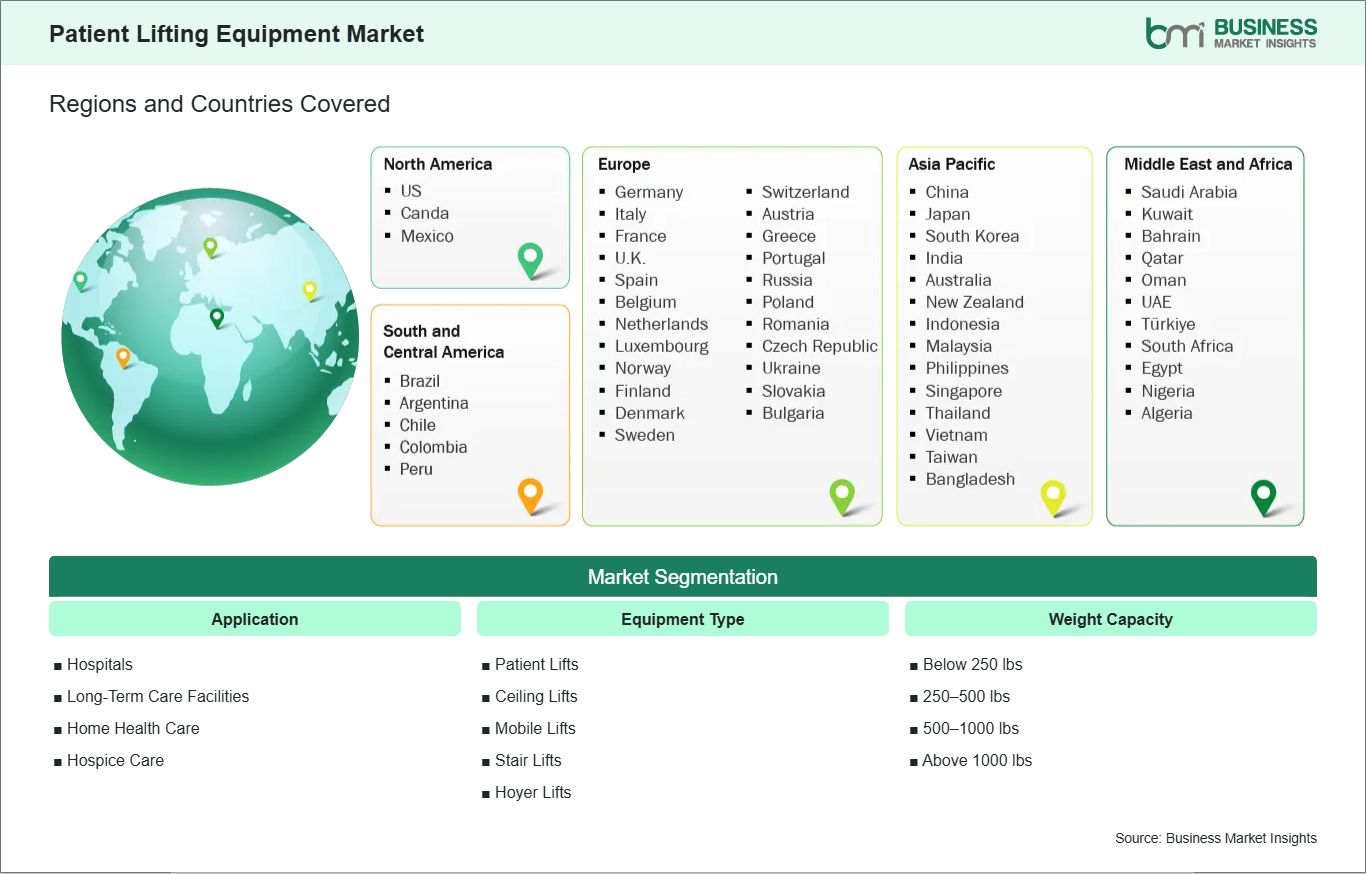
The patient lifting equipment market is segmented based on application, equipment type, and weight capacity, reflecting its critical role in enhancing caregiver safety and patient mobility.
By Application
Hospitals: Account for extensive transfer activities and mobility assistance procedures.
Long-Term Care Facilities: Prioritize resident safety during routine repositioning tasks.
Home Health Care: Supports independent care delivery within residential environments.
Hospice Care: Facilitates comfortable movement for patients requiring supportive assistance.
By Equipment Type
Patient Lifts: Provide versatile transfer support across multiple care settings.
Ceiling Lifts: Maximize space efficiency while reducing caregiver exertion.
Mobile Lifts: Enable flexible movement between rooms and treatment areas.
Stair Lifts: Assist mobility across multi-level residential environments.
Hoyer Lifts: Remain widely recognized for dependable patient transfer applications.
By Weight Capacity
Below 250 lbs: Addresses standard mobility assistance requirements.
250–500 lbs: Accommodates broader patient handling needs.
500–1000 lbs: Supports bariatric care environments effectively.
Above 1000 lbs: Serves specialized heavy-capacity transfer applications.
Market Forces
Patient Lifting Equipment Market Drivers and Opportunities
Expansion of Safe Patient Handling Initiatives
Healthcare organizations continue implementing structured patient handling programs aimed at reducing caregiver injuries and improving transfer safety. Manual lifting practices present operational challenges and physical strain for healthcare personnel. As institutions seek safer alternatives, patient lifting equipment has become increasingly integrated into routine mobility procedures across hospitals, care facilities, and home healthcare environments.
The impact extends beyond workforce protection by supporting consistent care quality and operational efficiency. Healthcare administrators recognize the value of standardized transfer systems that minimize injury-related disruptions while enhancing patient comfort. These considerations reinforce procurement activities and strengthen the relevance of lifting technologies across diverse healthcare delivery settings
Innovation in Intelligent and Ergonomic Mobility Assistance Systems
Product development increasingly focuses on intelligent mobility solutions that improve usability and safety. Advanced control systems, powered lifting mechanisms, ergonomic structures, and integrated monitoring features are enhancing equipment performance. These innovations support caregivers in managing transfers more effectively while delivering improved patient experiences across clinical and residential environments.
Future opportunities are associated with expanding deployment in home-based care and specialized mobility programs. Equipment manufacturers continue developing adaptable solutions suitable for varying patient conditions and facility requirements. As healthcare delivery models evolve toward personalized care approaches, technologically enhanced lifting systems may create new avenues for market expansion and operational improvement.
Size and Share Analysis
Patient Lifting Equipment Market Size and Share Analysis
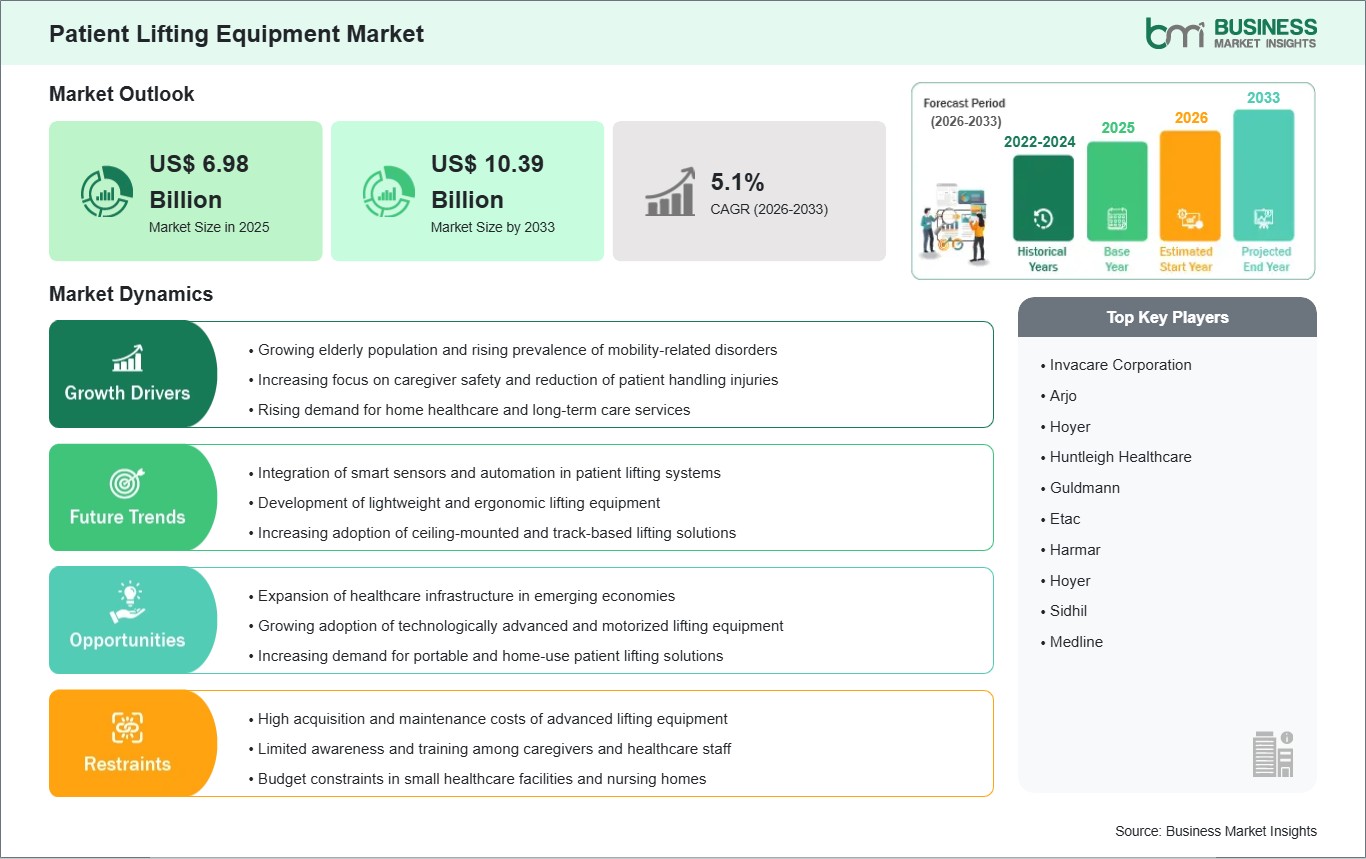
The patient lifting equipment market was valued at USD 6.98 Billion in 2025 and is projected to reach USD 10.39 Billion by 2033, registering a CAGR of 5.1% during 2026 - 2033. The market trajectory reflects sustained investment in patient mobility support technologies and continuous emphasis on caregiver safety across healthcare systems.
Among equipment categories, patient lifts maintain a leading position due to their broad applicability across healthcare environments. Ceiling lift systems also hold a significant presence where facilities seek permanent mobility infrastructure capable of supporting efficient patient transfers.
Hospitals represent the dominant application segment owing to frequent mobility assistance requirements and structured patient handling protocols. Long-term care facilities and home health care settings also contribute meaningfully as providers focus on enhancing care quality and operational effectiveness.
Report Coverage
Patient Lifting Equipment Market Report Coverage and Deliverables
The "Patient Lifting Equipment Market Size and Forecast (2022:2033)" report provides a detailed analysis of the market covering below areas:
- Market size and forecast at global, regional, and country levels for all market segments covered under the scope
- Market trends, as well as drivers, restraints, and opportunities
- Market analysis covering key trends, global and regional framework, major players, regulations, and recent developments
- Industry landscape and competition analysis covering market concentration, heat map analysis, prominent players, and recent developments for the market
- Detailed company profiles, including SWOT analysis
Geographic Insights
Patient Lifting Equipment Market Geographic Insights
The Patient Lifting Equipment market shows diverse regional adoption patterns influenced by healthcare infrastructure maturity, workforce safety priorities, patient care standards, and long-term care service expansion. Across global healthcare systems, providers increasingly incorporate mobility assistance technologies to improve transfer safety and optimize caregiver workflows. This broader shift supports steady utilization across institutional and residential care environments.
North America maintains a prominent position due to established healthcare networks and widespread implementation of safe patient handling practices. Healthcare facilities regularly invest in mobility support equipment to improve staff safety and patient outcomes. The region also benefits from strong awareness regarding workplace injury prevention and advanced healthcare technology integration.
Asia Pacific presents significant opportunities as healthcare modernization initiatives continue across major economies. Expanding hospital capacity, evolving eldercare services, and improving healthcare accessibility contribute to equipment deployment. Healthcare providers are increasingly evaluating mobility assistance technologies that align with patient-centered care models and operational efficiency objectives.
Europe demonstrates sustained utilization supported by structured healthcare systems and strong emphasis on quality-of-care standards. Meanwhile, emerging markets across the Middle East, Africa, and South and Central America are progressively enhancing healthcare infrastructure and care delivery capabilities. These developments encourage broader incorporation of patient lifting solutions tailored to regional healthcare requirements and facility modernization efforts
Industry Activity
Recent Developments
The patient lifting equipment market is evaluated by gathering qualitative and quantitative data post primary and secondary research, which includes important corporate publications, association data, and databases. Recent developments and news in the market include:
- March 2026, Embecta announced an agreement to acquire Owen Mumford. While the acquisition focuses on medical devices and drug-delivery technologies, it reflects the broader consolidation trend across the patient handling and healthcare equipment industry.
- February 2026, Lifeward announced the acquisition of AI-enabled upper-body exoskeleton technology from Skelable. The move highlights increasing convergence between rehabilitation robotics, mobility assistance, and patient handling solutions.
Trust & Transparency
Research Methodology
The market analysis combines proprietary research with secondary data from government agencies, company disclosures, regulatory filings, industry databases and expert interviews. Market estimates are validated through data triangulation, cross-market benchmarking and analyst
review.
View Full Research Methodology
Key Sources Referred:
World Bank – Global Trade IndicatorsWorld Trade Organization (WTO)(International Monetary Fund )IMFInternational Trade Administration (ITA)Company websiteCompany annual reportsCompany investor presentations