Market Summary
Executive Summary and Global Market Analysis
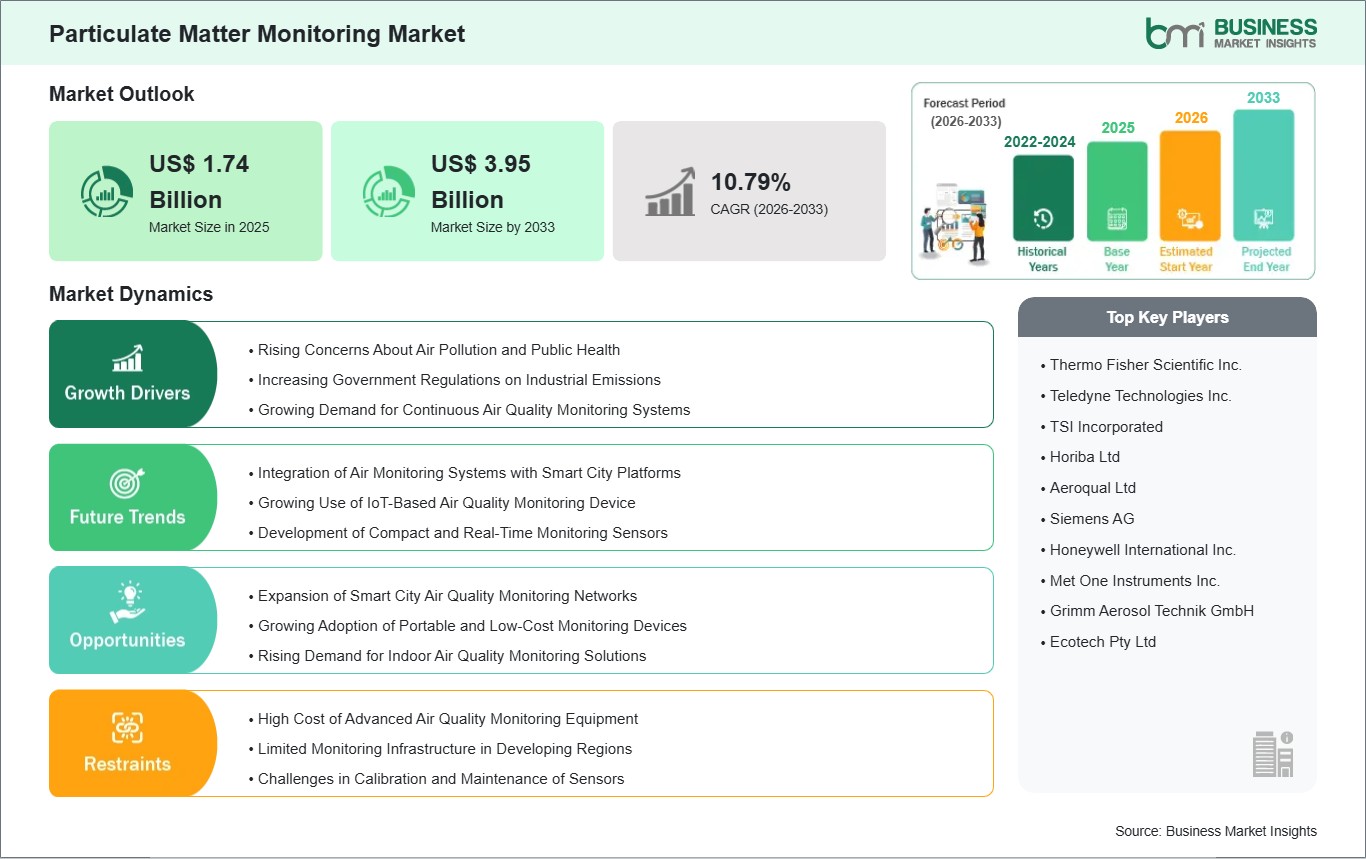
The market for particulate matter monitoring is growing as governments, industries, and environmental groups step up efforts to improve air quality and protect public health. These systems measure airborne particles that affect human health and the environment and are used across industrial sites, city monitoring networks, and research programs to track pollution and meet regulatory standards. Rising urbanization, industrial activity, and transportation emissions are increasing concerns about air pollution, driving broader adoption of monitoring technologies.
Growing concern about environmental health and tougher regulations are driving market growth. Governments are rolling out air quality monitoring programs to track pollution and shape policies that cut emissions. Industries are installing monitoring systems to measure particulate output and meet compliance requirements. Advances in technology, like connected sensors and digital monitoring platforms, are making these systems more efficient. As cities and businesses emphasize sustainable development and environmental protection, demand for particulate matter monitoring systems is rising across many applications.
Segment Analysis
Particulate Matter Monitoring Market Segmentation
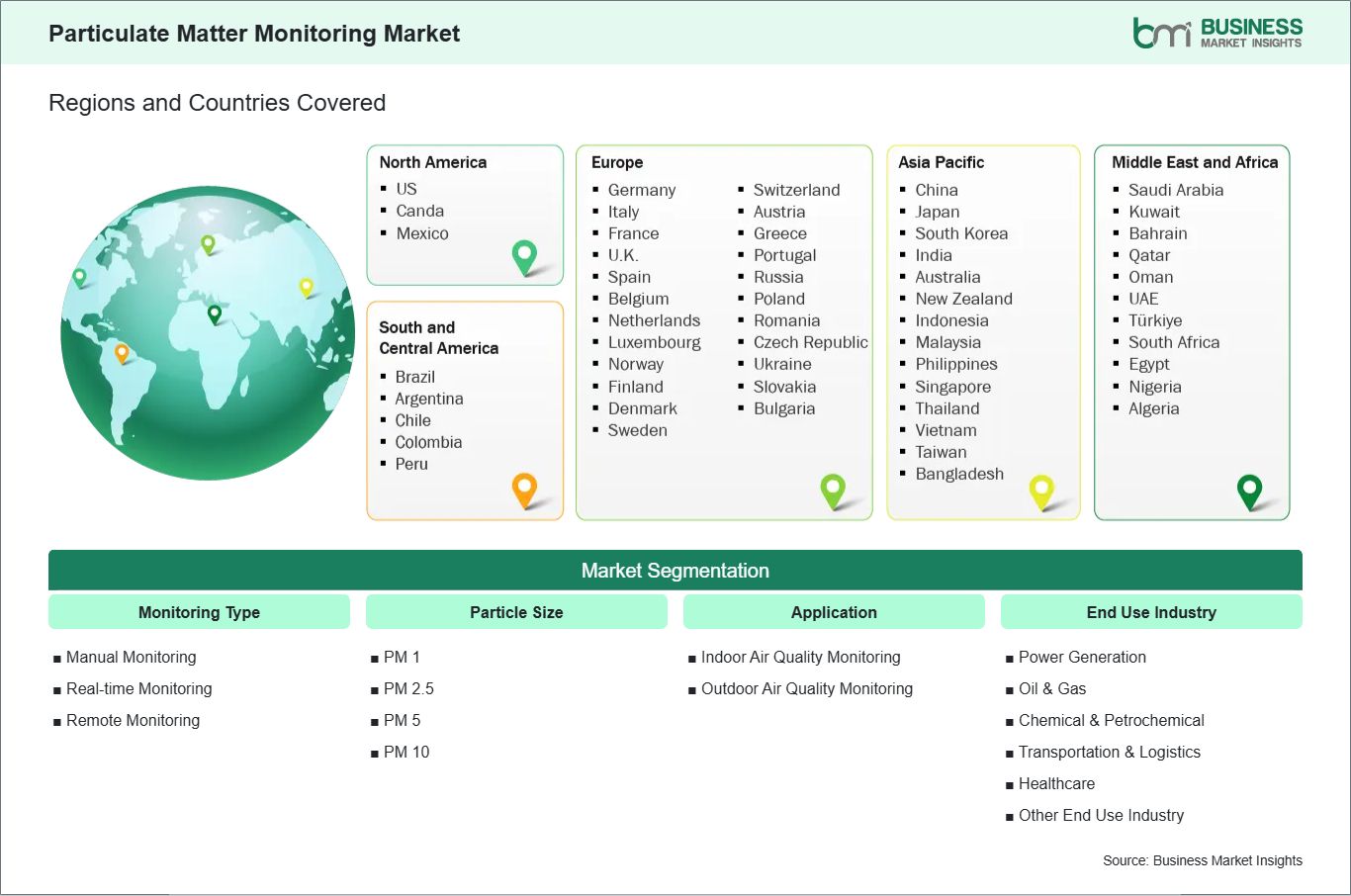
Key segments that contributed to the derivation of the particulate matter monitoring market analysis are monitoring type, particle size, application, end use industry.
- By monitoring type, the particulate matter monitoring market is segmented into manual monitoring, real-time monitoring, and remote monitoring. The real-time monitoring segment dominated the market in 2025.
- By particle size, the market is classified into PM 1, PM 2.5, PM 5, and PM 10. The PM 2.5 segment dominated the market in 2025.
- By application, the market is segmented into indoor air quality monitoring and outdoor air quality monitoring. The outdoor air quality monitoring segment dominated the market in 2025.
- By end use industry, the market is segmented into power generation, oil & gas, chemical & petrochemical, transportation & logistics, healthcare, and other end use industries. The power generation segment dominated the market in 2025.
Market Forces
Particulate Matter Monitoring Market Drivers and Opportunities
Rising Concerns About Air Pollution and Public Health
Growing worries about air pollution and its effects on public health are driving demand in the particulate matter monitoring market. Governments, environmental agencies, and health organizations are focusing more on tracking air quality to understand pollution levels and lower health risks. Fine particulate matter can penetrate the respiratory system and cause serious health problems. That’s why there’s increasing need for monitoring systems that can accurately measure and track particulate pollution in cities and industrial areas.
Cities and industrial regions are experiencing higher pollution levels due to transportation activities, manufacturing operations, and energy production. Authorities are implementing monitoring networks to measure particulate levels and take corrective actions when pollution increases. Industries are also required to monitor emissions from their facilities to comply with environmental standards and reduce harmful pollutants released into the atmosphere.
In addition, public awareness regarding air quality and health is increasing. Communities, research institutions, and environmental organizations are using monitoring systems to study pollution trends and support environmental protection programs. As the need for reliable pollution data grows, the demand for particulate matter monitoring systems continues to expand across urban, industrial, and environmental applications.
Expansion of Smart City Air Quality Monitoring Networks
The expansion of smart city air quality monitoring networks is creating strong opportunities for the particulate matter monitoring market. Cities around the world are adopting smart technologies to improve environmental management and public health. Air quality monitoring systems are becoming an important part of these smart city initiatives because they help track pollution levels and support better urban planning.
Smart monitoring networks use connected sensors placed across different parts of a city to collect real-time air quality data. These systems allow authorities to monitor pollution patterns, identify high-risk areas, and implement policies that reduce emissions. Integration with digital platforms also enables data sharing with citizens, researchers, and environmental agencies, improving transparency and awareness.
In addition, smart city programs encourage the use of advanced monitoring technologies such as connected sensors, remote monitoring platforms, and data analytics tools. These technologies improve the efficiency of environmental monitoring while reducing operational challenges. As governments continue investing in smart city infrastructure and sustainable urban development, the adoption of particulate matter monitoring systems is expected to grow significantly in the coming years.
Size and Share Analysis
Particulate Matter Monitoring Market Size and Share Analysis
The global particulate matter monitoring market is experiencing steady growth, with market size and share analysis reflecting evolving treatment preferences and competitive dynamics among key players. The report evaluates important subsegments categorized within monitoring type, particle size, application, end use industry, highlighting their respective contributions to overall market performance.
By monitoring type, the real-time monitoring subsegment dominated the market in 2025, due to the growing need for continuous air quality tracking, faster detection of pollution levels, and improved environmental management in urban and industrial environments.
By particle size, the PM 2.5 subsegment dominated the market in 2025, because fine particulate matter poses serious health risks and is widely regulated by environmental agencies, driving demand for monitoring solutions that track and manage these harmful particles.
By application, the outdoor air quality monitoring subsegment dominated the market in 2025, driven by increasing urban pollution levels, regulatory requirements, and government programs aimed at monitoring and improving environmental air quality.
By end use industry, the power generation subsegment dominated the market in 2025, due to strict emission regulations and the need to continuously monitor particulate emissions from power plants to ensure environmental compliance.
Report Coverage
Particulate Matter Monitoring Market Report Coverage and Deliverables
The "Particulate Matter Monitoring Market Size and Forecast (2022 - 2033)" report provides a detailed analysis of the market covering below areas:
- Particulate Matter Monitoring market size and forecast at the regional and country levels for segments covered under the scope
- Particulate Matter Monitoring market trends, as well as drivers, restraints, and opportunities
- Particulate Matter Monitoring market analysis covering key trends, regional framework, major players, regulations, and recent developments
- Industry landscape and competition analysis covering market concentration, heat map analysis, prominent players, and recent developments for the Particulate Matter Monitoring market
- Detailed company profiles, including SWOT analysis
Geographic Insights
Particulate Matter Monitoring Market Geographic Insights
The geographical scope of the particulate matter monitoring market report is divided into: North America, Asia Pacific, Europe, Middle East & Africa, and South & Central America. North America held the largest share in 2025.
North America dominates the particulate matter monitoring market due to strong environmental regulations and advanced monitoring infrastructure. Governments and environmental agencies in the region have implemented strict air quality standards that require continuous monitoring of particulate emissions from industrial facilities and urban environments. These regulations encourage industries and municipalities to adopt advanced monitoring technologies that can provide reliable air quality data. he region also benefits from strong technological development and active research in environmental monitoring systems.
Cities across North America are implementing air quality monitoring networks to track pollution levels and support public health programs. These systems are often integrated with digital platforms that allow real-time data analysis and reporting. In addition, industries such as power generation, transportation, and manufacturing are investing in monitoring systems to ensure environmental compliance and improve operational sustainability. Continuous investment in environmental research, smart city programs, and advanced monitoring technologies further strengthens the market in North America. As awareness of air quality and health impacts continues to grow, the region is expected to maintain its leadership in the global particulate matter monitoring market.
Industry Activity
Recent Developments
The particulate matter monitoring market is evaluated by gathering qualitative and quantitative data post primary and secondary research, which includes important corporate publications, association data, and databases. A few of the key developments in the Particulate Matter Monitoring market are:
- In July 2024, Thermo Fisher Scientific Inc. announced that it launched the Thermo Scientific 5014iQ Beta Attenuation Monitor and the 5030iQ SHARP Monitor, advanced particulate matter monitoring systems designed to meet stricter regulatory air-quality requirements and provide accurate measurement of PM2.5 and PM10 levels.
- In April 2025, ENVEA announced that it launched a next-generation Optical Aerosol Spectrometer for real-time particulate matter monitoring, delivering high-precision measurements of airborne particles across a wide range of environmental conditions.
Trust & Transparency
Research Methodology
The market analysis combines proprietary research with secondary data from government agencies, company disclosures, regulatory filings, industry databases and expert interviews. Market estimates are validated through data triangulation, cross-market benchmarking and analyst
review.
View Full Research Methodology
Key Sources Referred:
International Electrotechnical Commission Institute of Electrical and Electronics Engineers International Organization for Standardization Bureau of Indian Standards Central Electricity Authority Ministry of Power Indian Electrical and Electronics Manufacturers' Association European Committee for Electrotechnical Standardization VDE Association for Electrical Electronic & Information Technologies Company Websites Company Annual Reports Company Investor Presentations