Parabens Market Outlook: Size, Share, Trends, Growth Analysis, Competitive Landscape & Forecast, 2026-2033

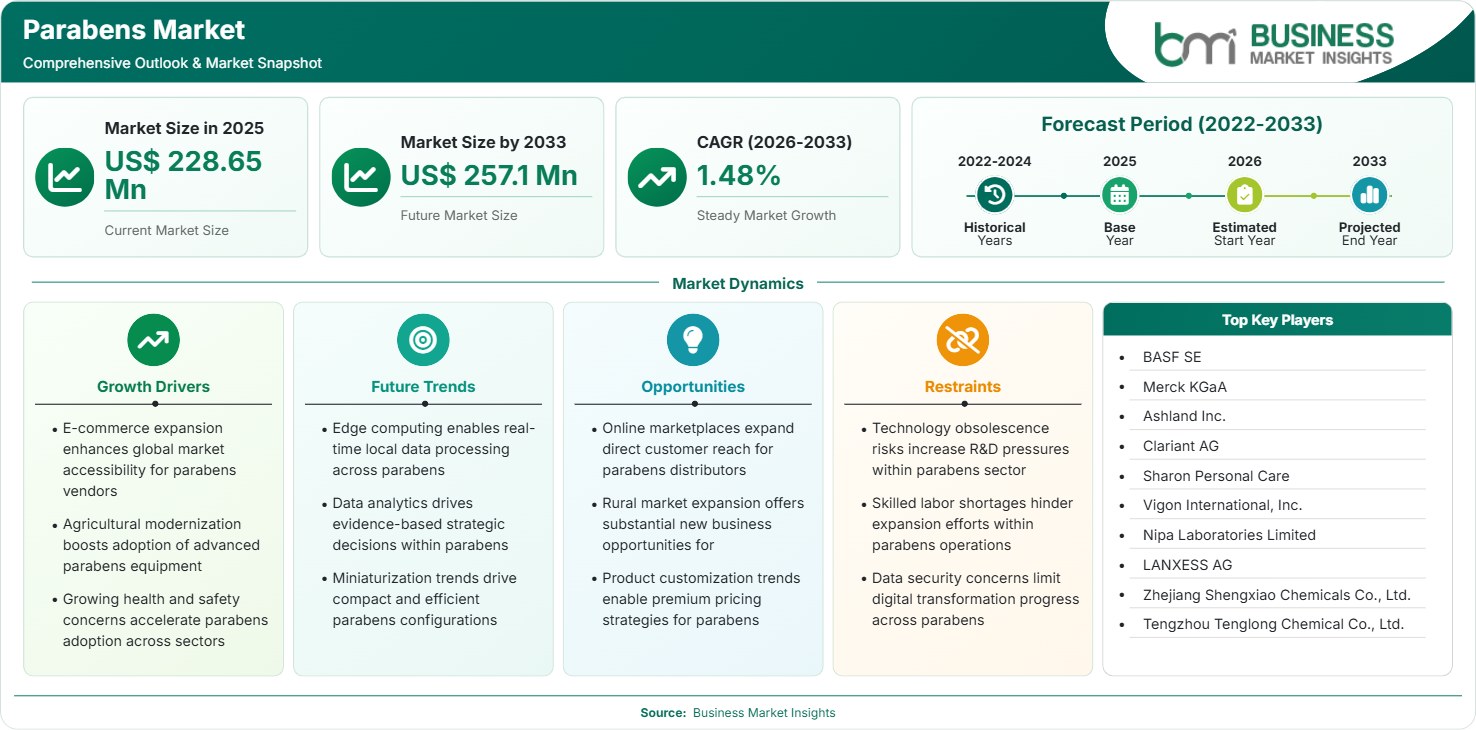
The Parabens Market size was valued at US$ 228.65 Million in 2025 and is projected to reach US$ 257.1 Million by 2033, growing at a CAGR of 1.48% during 2026–2033. Key drivers include preservative demand in cosmetics and pharmaceuticals, shelf-life enhancement requirements, formulation stability needs, emerging market consumption, and cost-effective antimicrobial protection opportunities.

Report Coverage
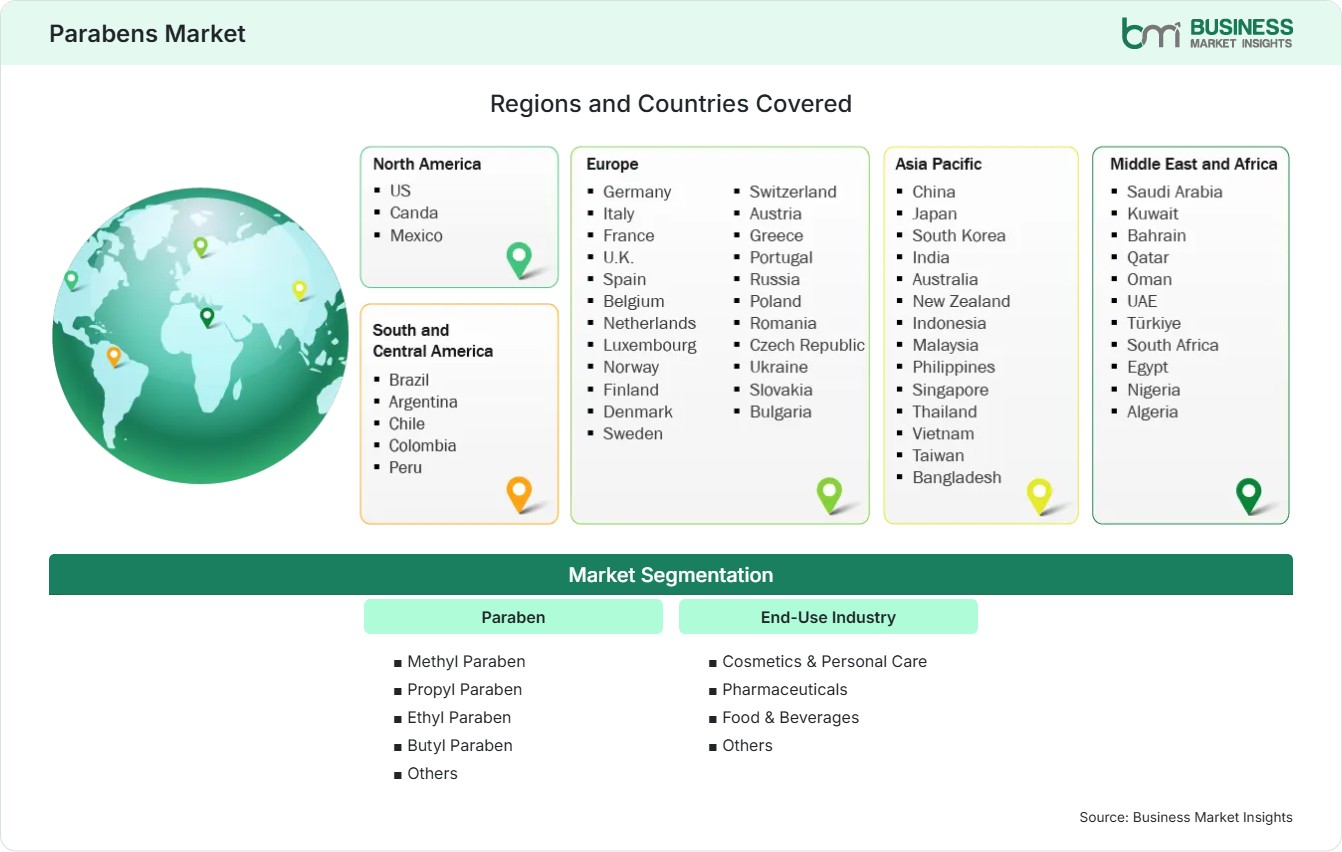
  • Paraben: Methyl Paraben, Propyl Paraben, Ethyl Paraben, Butyl Paraben, Others
  • End-Use Industry: Cosmetics & Personal Care, Pharmaceuticals, Food & Beverages, Others
US$ 228.65 Mn Market size in 2025
US$ 257.1 Mn Market Size by 2033
1.48% CAGR, 2026 - 2033
2026-2033 Forecast Period

AI Overview

Parabens Market Summary

  • North America Region: North America holds a market share of 28%–31% in 2025 and is expected to grow at a CAGR of 1.0%–1.4% during 2026–2033. Demand is supported by pharmaceutical manufacturing, personal care product consumption, formulation stability requirements, established regulatory frameworks, and premium product preservation needs. The U.S. accounts for 78%–82% of regional demand and is expected to grow at a CAGR of 1.1%–1.5%.
  • Fastest Growing Region: Asia Pacific accounts for 34%–38% share in 2025 and is projected to grow at a CAGR of 2.1%–2.6% through 2033. Expanding cosmetics manufacturing, pharmaceutical production, urban consumer spending, and rising personal care consumption support demand.
  • Leading Segment: Methyl Paraben represents a 38%–42% share in 2025 and is anticipated to grow at a CAGR of 1.3%–1.7%. Broad compatibility, cost efficiency, antimicrobial effectiveness, and extensive use in cosmetic formulations sustain leadership.
  • High Growth Segment: Pharmaceuticals account for a 22%–26% share in 2025 and are forecast to grow at a CAGR of 2.0%–2.5%. Drug stability requirements, liquid formulations, topical preparations, and expanding healthcare access support growth.
  • Key Market Opportunity: Development of advanced preservative blends that balance efficacy, regulatory compliance, and formulation compatibility creates opportunities for manufacturers serving premium personal care and pharmaceutical customers globally.
  • Major Market Players: BASF SE, Merck KGaA, Ashland Inc., Clariant AG, Sharon Personal Care, Vigon International, Inc., Nipa Laboratories Limited, LANXESS AG, Zhejiang Shengxiao Chemicals Co., Ltd., and Tengzhou Tenglong Chemical Co., Ltd.
Strategic Insights

Parabens Market: Strategic Insights

Parabens Market Strategic Framework
FREE PDF
Request your free sample
Request free sample
Stakeholder View

Key Takeaways

  • Supply chains depend heavily on specialty chemical producers, formulators, distributors, and consumer goods manufacturers.
  • Pharmaceutical applications present stronger long-term opportunities than mature cosmetic segments in multiple regions.
  • Research increasingly focuses on optimized preservative combinations and improved formulation compatibility.
  • Asia Pacific offers attractive investment potential due to manufacturing expansion and consumer product demand.
  • Strategic partnerships between specialty ingredient suppliers and cosmetic formulators continue increasing.
  • Regulatory compliance capabilities are becoming critical competitive differentiators across global markets.
Geographic Outlook

Parabens Market Regional Highlights

North America Parabens Market

North America holds 28%–31% of global demand in 2025 and is projected to expand at a CAGR of 1.0%–1.4% through 2033. Strong pharmaceutical manufacturing capabilities and high personal care product consumption support regional demand. The Parabens Market share remains supported by established product formulations and quality-focused production requirements. Regulatory oversight encourages manufacturers to maintain high product standards and transparency.

  • Pharmaceutical production continues supporting preservative demand across topical and liquid formulations.
  • Premium personal care brands emphasize stability and extended shelf life.
  • Regulatory compliance remains a significant market influence.
  • Research activities focus on safety validation and product optimization.
  • Established supply networks strengthen ingredient availability.

US Parabens Market

The U.S. accounts for 78%–82% of regional consumption and is forecast to grow at a CAGR of 1.1%–1.5% through 2033. Pharmaceutical applications and premium cosmetics remain major consumption areas.

  • Advanced formulation development supports preservative demand.
  • Healthcare manufacturing growth strengthens pharmaceutical consumption.
  • Consumer awareness increases scrutiny of ingredient transparency.
  • Large contract manufacturers remain key buyers.

Europe Parabens Market

Europe accounts for 24%–27% market share in 2025, with a CAGR of 0.8%–1.2%. Germany dominates the regional demand, while there is steady growth in Eastern Europe. Regulations play an important role in product selection and formulation.

  • Germany remains the largest regional consumer.
  • Personal care innovation drives specialty preservative requirements.
  • Regulatory compliance shapes purchasing decisions.
  • Pharmaceutical manufacturing supports stable demand.
  • Sustainability discussions continue influencing product development.

Asia Pacific Parabens Market

Asia Pacific accounts for 34%–38% market share in 2025 and is expected to expand at 2.1%–2.6% CAGR through 2033. China leads demand while India exhibits rapid consumption growth. The region benefits from growing cosmetics production and pharmaceutical manufacturing activity.

  • Expanding beauty and personal care sectors support growth.
  • Pharmaceutical manufacturing investments increase ingredient demand.
  • Export-focused production strengthens consumption patterns.
  • Urbanization encourages higher personal care spending.
  • Contract manufacturing organizations expand purchasing activity.

Rest of World Parabens Market

Rest of World contributes 10%–13% share and is projected to grow at 1.5%–1.9% CAGR. Latin America and the Middle East continue to support stable demand through healthcare and cosmetics sectors.

  • Brazil remains an important Latin American consumer.
  • GCC countries support pharmaceutical industry expansion.
  • Growing retail channels increase product availability.
  • Healthcare development supports formulation demand.
  • Personal care manufacturing contributes incremental growth.
Global Market Geography
FREE PDF
Request your free sample
Request free sample
Segment Analysis

Parabens Market Segmentation

Paraben

This segment represents 51%–55% market activity and is expected to grow at 1.2%–1.8% CAGR. The market scope continues to be shaped by efficacy, formulation compatibility, regulatory acceptance, and cost-performance considerations across multiple end-use industries.

  • Methyl Paraben: Most widely utilized due to strong antimicrobial properties, formulation compatibility, and broad application across cosmetics and pharmaceutical products.
  • Propyl Paraben: Frequently combined with other preservatives to enhance performance and product protection.
  • Ethyl Paraben: Utilized in selected formulations requiring effective microbial control and stability.
  • Butyl Paraben: Applied where enhanced preservation characteristics are required in specialized products.

End-Use Industry

This segment holds a market share of 45%–49%, and is expected to register a CAGR of 1.4%–1.9%. Parabens Market trends reflect growing demand from regulated industries, where there is a requirement for integrity, safety, and performance.

  • Cosmetics & Personal Care: Remains the largest application area due to broad product usage and preservation requirements.
  • Pharmaceuticals: Supports increasing demand through topical medicines, syrups, and healthcare formulations.
  • Food & Beverages: Limited but relevant applications continue in approved preservation environments.
Market Forces

Parabens Market Dynamics

Key Market Drivers

Demand for Product Shelf-Life Enhancement

Parabens remain useful preservatives due to their effectiveness and cost-effectiveness, allowing producers to extend product shelf life and protect products from microbial activity. It is the antimicrobial nature of parabens that makes them useful in cosmetics, pharmaceuticals, skincare products, and even certain household products. With more products being transported through complex logistics systems, it becomes increasingly important for producers to have an efficient preservation system, as it helps maintain product quality during transport.

Growth of Pharmaceutical Manufacturing

The continued expansion of pharmaceutical manufacturing in both developed and emerging economies is driving sustained demand for preservative ingredients across a wide range of formulations. The use of parabens and other preservatives is common in syrups, topical medicines, creams, gels, lotions, and liquid drugs to prevent microbial contamination and product instability during storage. Increased demand for health care, higher production of medicines, and greater quality-assurance demands have made the need for preservatives more significant. Moreover, product safety and efficacy regulations push pharmaceutical companies to use preservation technologies.

Formulation Efficiency and Cost Advantages

Parabens remain widely used in the production of cosmetics, personal care products, pharmaceuticals, and consumer goods owing to their high cost-effectiveness. Parabens offer broad-spectrum protection against bacteria, yeasts, and fungi and can be used in small amounts without compromising product quality while keeping formulation costs low. Furthermore, parabens offer stability, compatibility with a wide variety of ingredients, and an easy-to-incorporate system. The long history of use, safety data, and supply chain of parabens have made it easier for manufacturers to offer good preservation performance even with stiff competition from other preservatives.

Key Market Opportunities

Advanced Preservative Blends Development

Manufacturers are increasingly focusing on developing high-quality preservative blends composed of parabens and other preservatives to create synergistic systems that exhibit enhanced efficacy and performance. Blends are instrumental in ensuring that various products have improved microbial protection, stability, and compatibility among a host of cosmetics, personal care, pharmaceutical, and household items. Due to changing consumer preferences for balanced and optimized formulas, manufacturers are focusing on developing advanced preservative systems that are efficient while using low levels of preservatives. There are parabens market forecasts for advanced parabens blends that satisfy consumer needs and meet product technical requirements necessary for product safety and quality.

Expansion in Emerging Healthcare Markets

The fast development of healthcare infrastructure and pharmaceutical consumption in emerging economies offers considerable opportunities for the preservatives market. The increasing availability of healthcare facilities, government investment in healthcare infrastructure, and high demand for pharmaceuticals are driving growth in pharmaceutical production volumes in Asia, Latin America, the Middle East, and Africa. Preservatives continue to play an important role in maintaining the safety, stability, and shelf-life of pharmaceutical products such as syrups, creams, gels, and liquid medicines. Besides, the rise in local drug and CDMO production contributes to demand for preservatives, driven by increased production capacity and the variety of products requiring proper preservation systems.

Premium Formulation Services

Technical consulting, formulation testing, and customized preservative solutions are emerging as important value-added services offered by specialty ingredient suppliers. In addition to supplying preservative components, companies are also assisting their customers with optimizing formulations, conducting stability studies, performing microbial efficacy testing, and ensuring regulatory compliance. Such assistance can help manufacturers accelerate formulation development, optimize formulation performance, and comply with regional regulations. As formulations become more complex and customer requirements change, there arises a need for expertise. This can be an opportunity for suppliers to strengthen customer relationships and earn additional revenue from their high-end formulation services.

Market Restraints and Challenges

Consumer Perception Concerns and Product Reformulation

Factor: Increasing consumer awareness of food ingredient labels and concerns regarding the potential health implications of synthetic preservatives are influencing purchasing decisions across multiple product categories. As demand grows for clean-label and naturally preserved products, manufacturers are facing heightened pressure to align formulations with evolving consumer preferences. Impact: This trend is prompting manufacturers to reformulate existing products by reducing or replacing conventional preservative ingredients with alternative solutions that meet consumer expectations while maintaining product safety and shelf life. The reformulation process often requires extensive research, product testing, regulatory assessments, and supply chain adjustments, resulting in increased development costs and longer product commercialization timelines.

Regulatory Restrictions and Market Limitation

Factor: Preservative regulations vary significantly across countries and regions, with differing approval processes, usage limits, labeling requirements, and safety standards. These regulatory inconsistencies create compliance challenges for ingredient suppliers and manufacturers operating in multiple markets. Impact: The lack of harmonized regulations increases administrative and operational burdens, requiring companies to maintain extensive documentation, conduct additional compliance evaluations, and adapt product formulations for specific jurisdictions. As a result, ingredient suppliers may face delays in market entry, restricted access to certain regions, and higher regulatory compliance costs, limiting overall market expansion opportunities.

Company Analysis

Competitive Landscape

Parabens Market analysis reflects competition among specialty chemical manufacturers focused on quality assurance, regulatory compliance, technical support, and customized preservative solutions.

Company Name

Overview

Products and Services relevant to this market

BASF SE

Global specialty chemicals company serving personal care and pharmaceutical industries.

Preservatives, formulation ingredients, specialty chemicals.

Merck KGaA

Science and technology company serving pharmaceutical and life science markets.

High-purity preservatives and formulation ingredients.

Ashland Inc.

Specialty additives supplier with broad formulation expertise.

Preservation systems and personal care ingredients.

Clariant AG

Global specialty chemicals producer focused on performance ingredients.

Cosmetic ingredients and preservative solutions.

Sharon Personal Care

Specialist provider of preservation technologies.

Parabens and preservation blends.

Vigon International, Inc.

Ingredient distributor serving personal care markets.

Preservative ingredients and formulation support.

Nipa Laboratories Limited

Established preservative manufacturer.

Paraben-based preservatives and specialty blends.

LANXESS AG

Specialty chemicals company with diversified portfolio.

Industrial and formulation chemicals.

Zhejiang Shengxiao Chemicals Co., Ltd.

Chemical manufacturer supplying preservative ingredients.

Methyl, propyl, and related parabens.

Tengzhou Tenglong Chemical Co., Ltd.

Producer of specialty preservative chemicals.

Paraben ingredients and formulation additives.

Trust & Transparency

Research Methodology

The market analysis combines proprietary research with secondary data from government agencies, company disclosures, regulatory filings, industry databases and expert interviews. Market estimates are validated through data triangulation, cross-market benchmarking and analyst review.

View Full Research Methodology

Questions Answered

Frequently Asked Questions

What does a Parabens Market Report generally include?

A Market Report typically evaluates market size, regional demand, regulatory developments, segment performance, competitive landscape, industry trends, growth drivers, and future opportunities.

What are the main challenges facing manufacturers?

Consumer perception concerns, evolving regulations, reformulation requirements, and competition from alternative preservation technologies remain key challenges.

What makes methyl paraben the leading product type?

Its effectiveness, compatibility with multiple formulations, economic efficiency, and broad antimicrobial performance help maintain widespread commercial use.

Why is Asia Pacific the fastest-growing region?

Expanding cosmetics manufacturing, pharmaceutical production growth, rising disposable incomes, and increasing personal care consumption support regional demand growth.

What is the largest application area for parabens?

Cosmetics and personal care remain the largest application segment because preservation is critical for creams, lotions, shampoos, makeup products, and skincare formulations.

Access the Full Parabens Market Report

Get segment-level forecasts, regional estimates, competitive benchmarking, company profiles and downloadable Excel datasets.

Access the full Parabens Market Report
350 pages PDF & Excel | 2026-08-31
Similar Research

Related Market Reports