Palladium Market Regional Highlights
North America Palladium Market
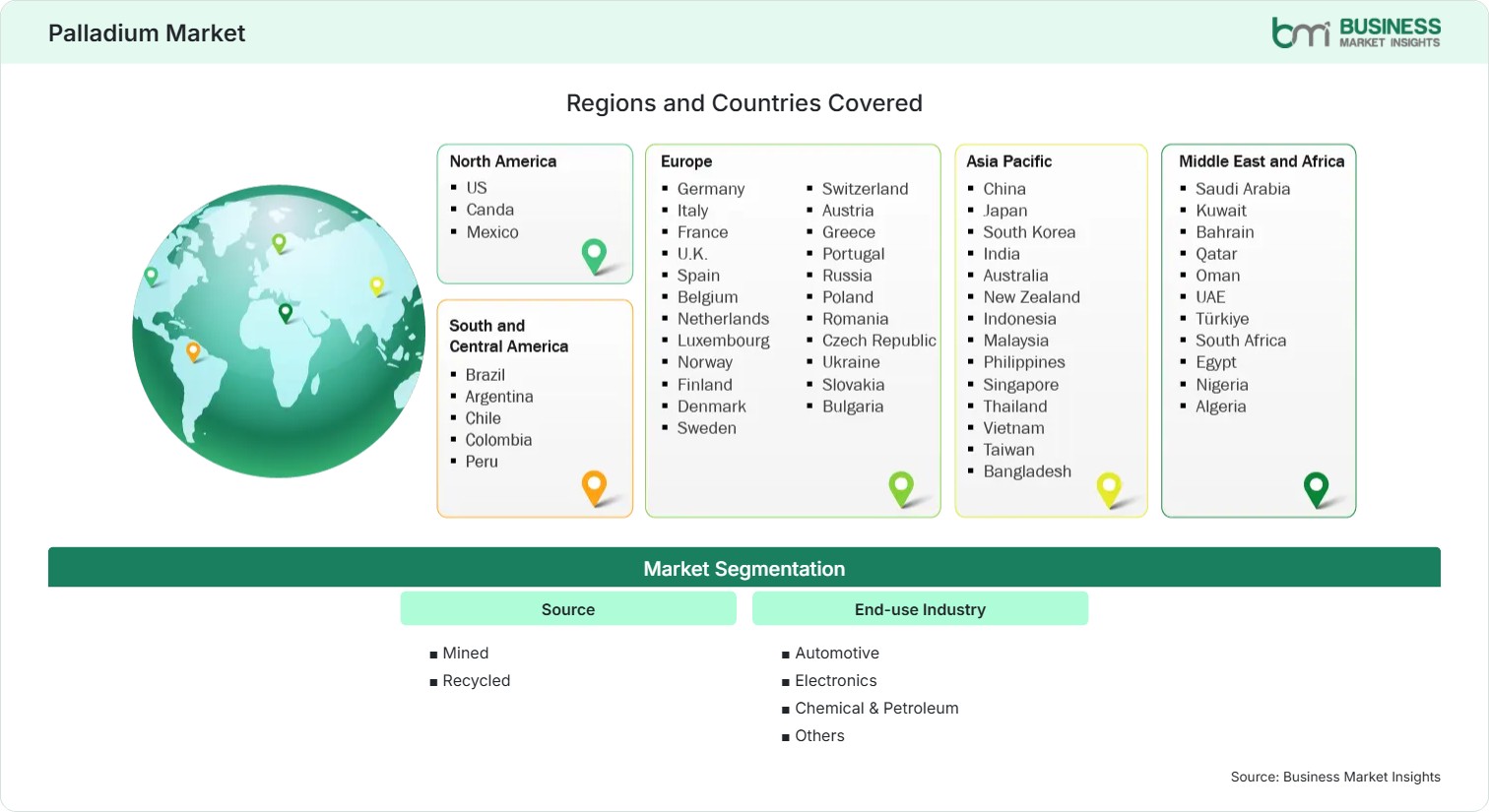
North America accounts for market share of 20%–24% in 2025 and records a CAGR of 2.4%–3.1% during 2026–2033. The region benefits from established automotive manufacturing, catalyst recycling, electronics demand, and critical-mineral supply-chain initiatives. US demand dominates regional consumption, while Canada contributes through PGM resources and processing linkages.
- Automotive catalyst replacement remains a core demand source, with tightening emission requirements supporting palladium use despite gradual electrification of passenger vehicle fleets.
- Domestic recycling infrastructure strengthens supply resilience, reducing dependence on imported refined material and improving recovery economics from spent catalytic converters.
- Critical-mineral policies encourage diversified sourcing, domestic processing, and recycling investments, creating opportunities for integrated producers and specialized secondary-material processors.
US Palladium Market
The US represents share of 15%–19% in 2025 and US palladium market forecast to grow by CAGR of 2.5%–3.2% through 2033. Domestic mine production declined sharply in 2025, while apparent consumption reached 130,000 kilograms. Recycling therefore remains strategically important for reducing import exposure.
- US palladium demand is supported by gasoline and hybrid vehicle catalyst requirements, while battery electric vehicle adoption gradually limits long-term automotive consumption growth.
- Secondary recovery provides a major supply opportunity, with approximately 50,000 kilograms recovered from automobile catalytic converters in 2025.
- Supply diversification is increasingly important because 2025 net import reliance reached 57%, exposing consumers to international trade and geopolitical disruptions.
Europe Palladium Market
Europe represents a Palladium Market share of 22%–26% in 2025 and records a CAGR of 2.1%–2.8% through 2033. Germany, Italy, and France remain leading industrial markets, while Poland and Spain offer comparatively stronger growth potential. Stringent vehicle-emission regulations, established catalyst manufacturing, and sophisticated metal recycling support regional demand.
- Germany remains a leading demand center because of its automotive manufacturing base, catalyst supply chain, and extensive industrial processing capabilities.
- France and Italy benefit from automotive and chemical industries, while catalyst recycling supports material recovery and circular supply models.
- Poland is positioned for comparatively faster growth at a CAGR of 3.4%–4.1%, supported by expanding automotive manufacturing and industrial investment.
- Spain offers a CAGR of 3.1%–3.8%, supported by vehicle production, component manufacturing, and recycling activity.
Asia Pacific Palladium Market
Asia Pacific commands a Palladium Market share of 39%–43% in 2025 and achieves a CAGR of 3.8%–4.6% through 2033. China, Japan, and South Korea lead regional demand, while India and Southeast Asia represent higher-growth opportunities. Automotive production, electronics manufacturing, chemical processing, and expanding recycling networks support consumption.
- China remains the leading regional consumption center because automotive manufacturing, electronics, chemical production, and refining create diversified palladium demand.
- Japan and South Korea maintain strong positions through advanced automotive, electronics, catalyst, and precision-manufacturing ecosystems.
- India is projected to record a CAGR of 5.0%–5.8%, supported by vehicle production, industrialization, chemical processing, and emerging recycling capacity.
- Southeast Asia offers a CAGR of 4.5%–5.3%, driven by automotive manufacturing relocation, electronics investment, and industrial supply-chain diversification.
Rest of World Palladium Market
South and Central America represent an estimated 7%–10% regional share in 2025, with a CAGR of 2.7%–3.5%, supported by automotive demand, mining investment, and industrial applications. Brazil remains the leading market, while Mexico benefits from automotive manufacturing and exports. The Middle East and Africa account for approximately 8%–11% share in 2025 and register a CAGR of 2.9%–3.7%. South Africa remains central to PGM supply, while Saudi Arabia and the UAE provide emerging industrial opportunities through chemical, refining, and technology investments.
- Brazil leads regional demand, while Mexico provides comparatively strong growth through automotive production and integration into North American manufacturing networks.
- South Africa remains strategically important for mined PGM supply, supporting the broader global ecosystem despite production-cost and operational pressures.
- Saudi Arabia offers a CAGR of 3.8%–4.6%, supported by industrial diversification, refining investments, and chemical-sector development.
- The UAE benefits from a CAGR of 3.5%–4.3%, driven by advanced industrial processing, trading infrastructure, and downstream precious-metals activity.