
Orthopedic Power Tools Market Outlook: Size, Share, Trends, Growth Analysis, Competitive Landscape & Forecast, 2026–2033

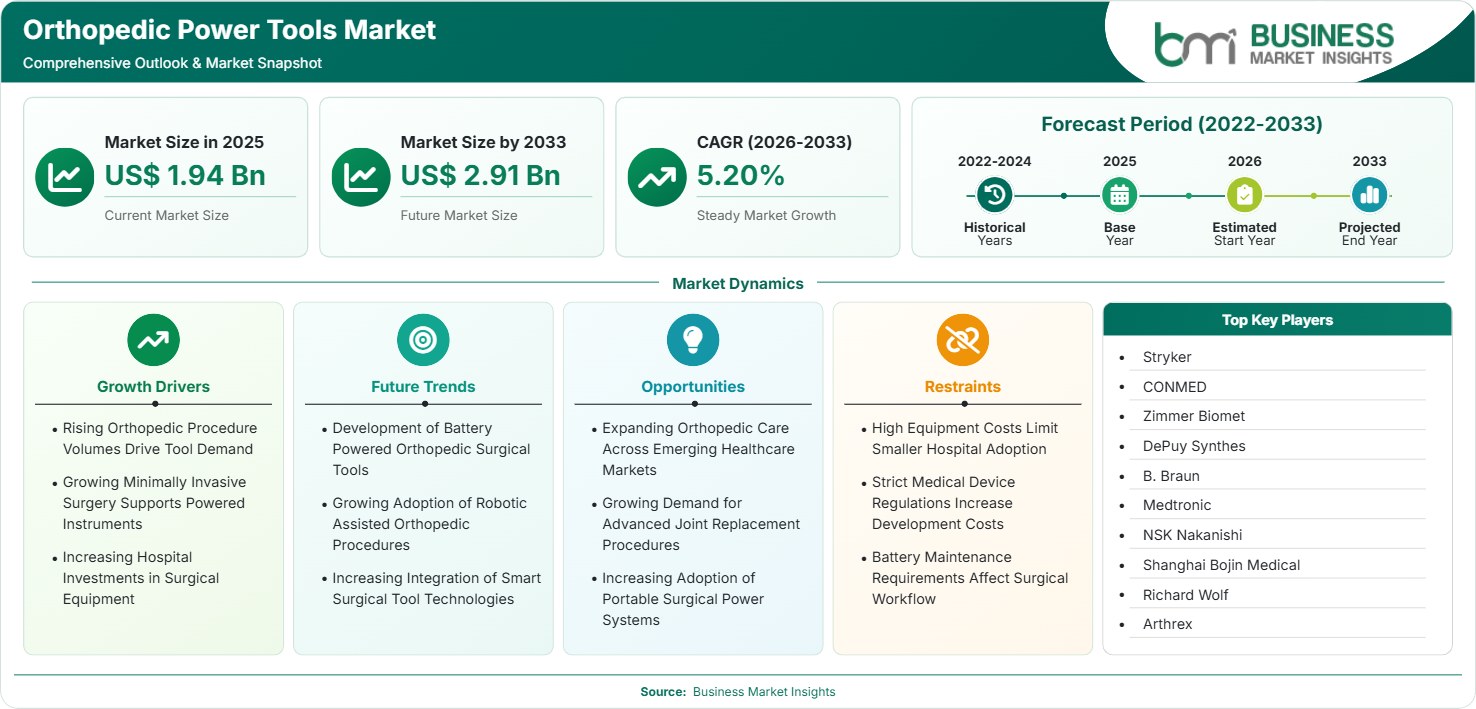
The Orthopedic Power Tools Market size was valued at US$ 1.94 billion in 2025 and is projected to reach US$ 2.91 billion by 2033, growing at a CAGR of 5.20% during 2026–2033, driven by orthopedic procedure volumes, minimally invasive surgery, hospital equipment investment, joint replacement demand, and portable surgical systems.

Report Coverage
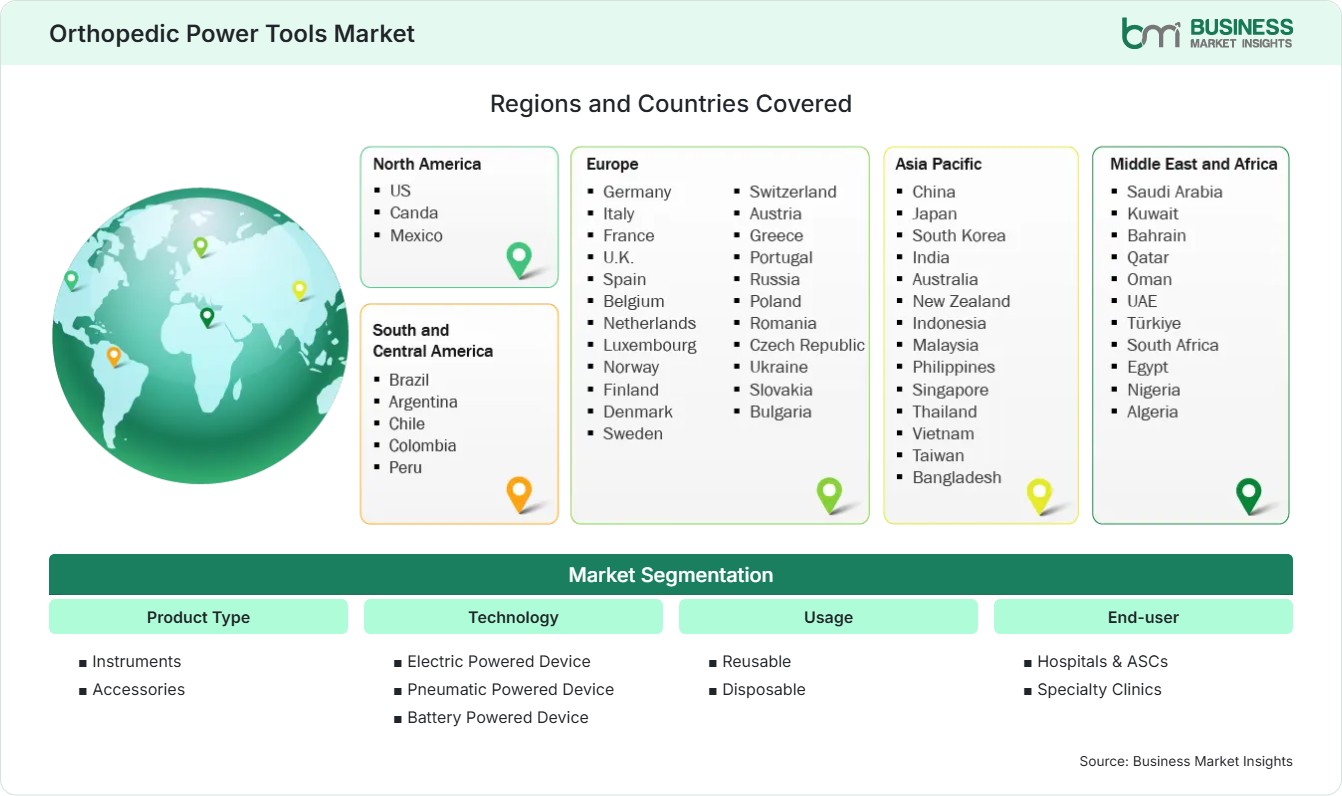
  • Product Type: Instruments , Accessories
  • Technology: Electric Powered Device, Pneumatic Powered Device, Battery Powered Device
  • Usage: Reusable, Disposable
  • End-user: Hospitals & ASCs, Specialty Clinics
US$ 1.94 Bn Market size in 2025
US$ 2.91 Bn Market Size by 2033
5.20% CAGR, 2026 - 2033
2026-2033 Forecast Period

AI Overview

Orthopedic Power Tools Market Summary

  • North America: North America holds 34%-37% share in 2025 and grows at a CAGR of 4.8%-5.4%, supported by orthopedic surgery demand, established hospital infrastructure, advanced surgical centers, replacement purchasing, and adoption of battery-powered instruments. The U.S. represents 82%-86% of regional demand, supported by mature orthopedic care, ambulatory surgery, advanced joint procedures, and continued investment in surgical equipment.
  • Fastest Growing Region: Asia Pacific holds 24%-27% share in 2025 and expands at a CAGR of 6.1%-6.8%, supported by improving healthcare infrastructure, expanding orthopedic care, rising surgical capacity, medical tourism, and increasing adoption of modern powered surgical equipment.
  • Leading Segment: Instruments holds 67%-71% Orthopedic Power Tools Market share in 2025 and grows at a CAGR of 5.0%-5.5%, supported by recurring demand for surgical drills, saws, reamers, cutting systems, trauma procedures, joint reconstruction, and other bone-preparation applications.
  • High Growth Segment: Battery Powered Device holds 29%-33% share in 2025 and grows at a CAGR of 6.2%-6.9%, driven by cordless operating-room workflows, portability, ergonomic benefits, simplified setup, and increasing demand for flexible surgical systems.
  • Key Market Opportunity: Emerging orthopedic care, advanced joint replacement, portable surgical systems, and expanding ambulatory procedures create opportunities for compact, ergonomic, efficient, and versatile powered surgical platforms.
  • Major Market Players: Stryker, CONMED, Zimmer Biomet, DePuy Synthes, B. Braun, Medtronic, NSK Nakanishi, Shanghai Bojin Medical, Richard Wolf, Arthrex.
Strategic Insights

Orthopedic Power Tools Market: Strategic Insights

Orthopedic Power Tools Market Strategic Framework
FREE PDF
Request your free sample
Request free sample
Stakeholder View

Key Takeaways

  • The value chain increasingly connects surgical-device manufacturers, accessory suppliers, distributors, hospitals, ambulatory surgery centers, specialty clinics, sterilization teams, and surgeons around complete instrument ecosystems.
  • Battery-powered platforms provide an attractive growth opportunity because cordless operation improves mobility, reduces cable dependence, and supports flexible operating-room configurations across multiple orthopedic procedures.
  • Product innovation is concentrating on ergonomic handpieces, modular attachments, improved battery performance, lightweight construction, precision cutting, reduced vibration, and compatibility with increasingly specialized surgical workflows.
  • Asia Pacific offers a compelling investment case as healthcare infrastructure expands and orthopedic procedures become more accessible across major urban centers and emerging medical markets.
  • Procurement decisions are increasingly influenced by lifecycle economics, sterilization requirements, accessory availability, service support, equipment uptime, and compatibility with existing operating-room infrastructure.
  • Competitive differentiation increasingly depends on procedural versatility, surgeon ergonomics, reliability, battery management, accessory breadth, service capabilities, and the ability to support both conventional and minimally invasive orthopedic workflows.
Geographic Outlook

Orthopedic Power Tools Market Regional Highlights

North America Orthopedic Power Tools Market

North America represents 34%-37% share in 2025 and is projected to grow at a CAGR of 4.8%-5.4% through 2033. Mature orthopedic infrastructure, surgical capacity, replacement demand, and advanced procedures support regional adoption.

  • Hospitals increasingly evaluate powered instruments through ergonomic performance, operating-room efficiency, sterilization compatibility, maintenance requirements, and equipment standardization across orthopedic departments.
  • Ambulatory surgery centers provide opportunities for compact and portable systems because smaller procedural environments prioritize efficient setup, mobility, simplified workflows, and equipment versatility.
  • Joint reconstruction remains an important application area, supported by demand for precise bone preparation and reliable powered cutting, drilling, and reaming capabilities.
  • Replacement purchasing supports recurring demand as hospitals modernize aging equipment, improve battery platforms, and standardize surgical power systems across facilities.

US Orthopedic Power Tools Market

The U.S. represents 82%-86% of North American demand in 2025 and grows at a CAGR of 4.7%-5.3%. Mature orthopedic care, ambulatory surgery, and equipment modernization sustain demand.

  • Hospitals and ASCs increasingly prioritize cordless and modular systems that simplify operating-room preparation while providing surgeons with flexible instrument configurations.
  • Advanced joint replacement procedures support demand for precise drilling, sawing, reaming, and bone-preparation tools designed for demanding surgical workflows.
  • Specialty orthopedic centers provide additional opportunities for compact systems optimized for high procedure utilization, quick setup, and surgeon ergonomics.

Europe Orthopedic Power Tools Market

Europe represents 27%-30% Orthopedic Power Tools Market share in 2025 and grows at a CAGR of 4.9%-5.6%. Germany leads regional demand, while the United Kingdom, France, Italy, and Spain provide expanding opportunities.

  • Germany benefits from established medical-device manufacturing, advanced hospital infrastructure, orthopedic specialization, and demand for technically sophisticated surgical instrumentation.
  • The United Kingdom provides opportunities through orthopedic service expansion, ambulatory procedures, hospital modernization, and increasing attention to operating-room efficiency.
  • France and Italy offer demand across joint reconstruction, trauma surgery, specialty clinics, and hospital replacement programs requiring reliable powered instruments.
  • Spain benefits from expanding orthopedic services and medical tourism, supporting demand for modern surgical equipment across public and private healthcare facilities.

Asia Pacific Orthopedic Power Tools Market

Asia Pacific represents 24%-27% share in 2025 and expands at a CAGR of 6.1%-6.8%, making it the fastest-growing region. China, Japan, India, and South Korea lead regional opportunities.

  • China benefits from expanding hospital capacity, domestic medical-device production, orthopedic service development, and increasing access to advanced surgical technologies.
  • Japan provides a mature orthopedic-care environment with demand for precise, ergonomic, reliable instruments across joint reconstruction, trauma, and specialty procedures.
  • India is expanding orthopedic capacity through private hospitals, specialty clinics, medical tourism, and increasing availability of advanced surgical technologies.
  • South Korea offers opportunities through advanced healthcare infrastructure, medical tourism, specialty hospitals, and adoption of modern surgical instrumentation.

Rest of World Orthopedic Power Tools Market

Rest of World represents 12%-15% share in 2025 and grows at a CAGR of 4.4%-5.1%. Latin America provides leading opportunities, while Middle Eastern and African markets develop from smaller installed bases.

Middle Eastern markets are investing in advanced hospitals and specialist care, while selected African Orthopedic Power Tools Markets are expanding surgical capacity. Gulf countries offer the strongest near-term opportunities for sophisticated orthopedic equipment and private healthcare investment.

  • Brazil provides opportunities across private hospitals, specialty clinics, trauma care, and joint reconstruction as access to advanced orthopedic procedures expands.
  • Mexico benefits from medical tourism, private healthcare investment, and growing orthopedic specialization, supporting demand for modern surgical power systems.
  • Gulf markets are developing advanced surgical centers that require reliable, ergonomic, and technologically sophisticated orthopedic instrumentation.
  • South Africa provides a comparatively developed healthcare base and longer-term opportunities through hospital modernization and specialist orthopedic services.
Global Market Geography
FREE PDF
Request your free sample
Request free sample
Segment Analysis

Orthopedic Power Tools Market Segmentation

Product Type

Instruments represent 67%-71% share in 2025 and grow at 5.0%-5.5% CAGR through 2033, supported by recurring surgical requirements for drilling, sawing, and bone preparation. Accessories generate recurring replacement demand through blades, burs, attachments, and related components. The Orthopedic Power Tools Market scope therefore extends beyond capital equipment into procedure-specific consumables and reusable attachments.

  • Instruments (Surgical Drills, Saws, and Others): Instruments support bone cutting, drilling, reaming, and preparation across trauma, joint reconstruction, spine, sports medicine, and other orthopedic procedures.
  • Accessories: Accessories support instrument versatility and recurring procedural requirements through blades, burs, attachments, couplings, and specialized components tailored to different surgical techniques.

Technology

Electric Powered Device represents 42%-46% share in 2025 and grows at 4.8%-5.4% CAGR through 2033, supported by consistent power delivery and broad operating-room compatibility. Battery-powered systems provide the fastest growth as cordless workflows gain acceptance. Pneumatic systems remain relevant where existing infrastructure and surgeon familiarity support continued use across specialized procedures.

  • Electric Powered Device: Electric systems provide consistent power and controlled operation, supporting drilling, sawing, reaming, and other procedures where dependable performance is essential.
  • Pneumatic Powered Device: Pneumatic systems remain relevant in facilities with established compressed-air infrastructure, offering dependable operation across selected orthopedic and trauma procedures.
  • Battery Powered Device: Battery systems provide cordless mobility, simplified setup, ergonomic flexibility, and greater operating-room freedom, supporting growing adoption across trauma and reconstructive surgery.

Usage

Reusable devices represent 78%-82% share in 2025 and grow at 4.7%-5.3% CAGR through 2033, reflecting established hospital sterilization infrastructure and lifecycle economics. Disposable systems provide opportunities where infection-control priorities, rapid turnover, and simplified processing are important. Procurement increasingly weighs acquisition cost against sterilization, maintenance, utilization, and replacement requirements.

  • Reusable: Reusable systems support repeated procedures and can provide favorable lifecycle economics where hospitals maintain established sterilization, maintenance, and instrument-processing capabilities.
  • Disposable: Disposable systems reduce reprocessing requirements and can support selected procedures where convenience, infection-control considerations, rapid turnover, and simplified workflow justify higher per-procedure costs.

End-user

Hospitals & ASCs represent 82%-86% share in 2025 and grow at 5.1%-5.7% CAGR through 2033, supported by high procedure volumes and broad equipment requirements. Specialty Clinics provide targeted opportunities as orthopedic care becomes more distributed. Purchasing decisions increasingly emphasize utilization, procedural breadth, service support, sterilization capabilities, and compatibility with existing surgical infrastructure.

  • Hospitals & ASCs: Hospitals and ASCs require versatile powered systems across trauma, reconstruction, sports medicine, and joint procedures, with strong emphasis on reliability and workflow efficiency.
  • Specialty Clinics: Specialty clinics increasingly adopt compact and procedure-focused systems as orthopedic services become more specialized and outpatient care expands.
Market Forces

Orthopedic Power Tools Market Dynamics

Key Market Drivers

Rising Orthopedic Procedure Volumes Drive Tool Demand

The Orthopedic Power Tools Market growth will be driven by consistent requirements for surgical procedures related to cutting, drilling, reaming, fixing, and joint reconstruction. The worldwide burden of musculoskeletal diseases will create a need for orthopedic surgery, whereas population aging will drive the requirement for surgical procedures related to degenerative joint diseases and movement disabilities. The use of powered devices becomes essential for a number of surgeries due to the ability of such devices to perform controlled cutting and drilling tasks, which become impossible to complete manually. Hospitals will need reliable tools capable of performing a high volume of procedures without frequent downtime. Manufacturers are developing modular handpieces, ergonomic solutions, battery-operated devices, and accessories for specific surgical procedures.

Growing Minimally Invasive Surgery Supports Powered Instruments

The Orthopedic Power Tools Market trends, such as minimally invasive orthopedic surgeries, are leading to an increased demand for small-sized, accurate, and ergonomically efficient instruments. In some cases, small incisions will lead to the need for precision-controlled drilling, cutting, and preparation of bone through special instruments and attachments. In this case, surgeons prefer systems with precision power drive without excessive hand fatigue and multiple changes of instruments. Thus, manufacturers of such instruments have been working on producing smaller handpieces, modular attachments, small-size batteries, special burrs, and cutting devices specifically designed for particular operations. This type of technology could be applied to trauma, extremity, sports medicine, and select reconstruction surgery.

Increasing Hospital Investments in Surgical Equipment

Hospitals are buying surgical equipment in order to increase efficiency in the OR, update old facilities, and expand the range of specialized services. Power-assisted orthopedic systems could be strategically significant in cases where the volume of procedures is sufficient to consider equipment standardization and surgeons need high consistency of their operation in several ORs. Increasingly, hospitals look not only at the cost of purchase but also at maintenance, sterilization, availability of accessories, battery life, reaction time, and usage forecast. Modular systems could add extra value through the capability of supporting several types of attachments and procedures within one system. Hospitals with tight budgets could focus on those systems that can cover a wide range of procedures and provide good service coverage.

Key Market Opportunities

Expanding Orthopedic Care Across Emerging Healthcare Markets

The Orthopedic Power Tools Market Forecast is based on the growing availability of orthopedic care in new healthcare markets. The building of new hospitals, specialized clinics, private healthcare networks, and medical tourism centers is increasing the demand for modern surgical instruments. These could be greenfield situations where purchasing departments are building their orthopedic operating rooms without many restrictions from legacy equipment. Manufacturers will be able to penetrate such markets through modular solutions, training, distribution, financing, and servicing. Mobile equipment will be especially appealing if operating rooms are multi-specialty or when healthcare organizations require mobility of the equipment from one facility to another.

Growing Demand for Advanced Joint Replacement Procedures

Joint replacement is a valuable opportunity since the complex process demands reliable drill, cut, ream, and bone preparation functions. The growing trend towards implant position, surgery accuracy, and process consistency makes the hospitals look into the capabilities of the power tool, along with other orthopedic devices. Suppliers could distinguish themselves by providing specialized tips, precise power delivery systems, ergonomic handpieces, and systems that work in various procedures. Another potential opportunity is the accessories segment, since procedure-specific blades, burs, and reamers create recurring demand once the equipment is installed at the hospital. High-volume joint procedure hospitals might prefer standardized platforms that make instruments simpler to use and easy to train the hospital staff.

Increasing Adoption of Portable Surgical Power Systems

Portable power surgical systems present a chance for increasing flexibility of the operating room especially in ambulatory care units, specialty clinics, trauma centers, and in cases where there are multiple procedural areas within a facility. The battery-operated devices eliminate the need for cables or compressed air lines and enable easier positioning of equipment around the surgery area. Current battery technologies can also be used to develop a platform that allows for module attachments, whereby a single instrument would serve for multiple purposes. Suppliers may enhance adoption through increased battery life, sterility, battery charging, ergonomics, and system diagnostic capabilities. Portable systems have more appeal in cases where quick setup and mobility of equipment play a critical role in efficiency.

Market Restraints and Challenges

High Equipment Costs Limit Smaller Hospital Adoption

Factor: The implementation of more sophisticated powered surgical devices will involve considerable expenditure on handpieces, consoles, batteries, chargers, attachments, accessories, sterilization systems, and service agreements. Impact: Increased expenses involved in acquiring and maintaining the system may slow down the process of adoption by small hospitals or specialty hospitals having limited capital budgets. This cost concern may become more prominent for institutions that require purchasing several systems in order to serve different medical departments or operating rooms. Manufacturers can minimize this obstacle with the help of modular systems, upgradable components, leasing, service agreements, and standardized accessories. Nevertheless, hospitals should determine their usage frequency and procedure volume prior to investing their capital.

Strict Medical Device Regulations Increase Development Costs

Factor: Orthopedic surgical power systems should meet medical device requirements regarding electrical safety, electromagnetic compatibility, biocompatibility (where appropriate), sterilization, performance, labeling, and quality management system control. Impact: Regulatory validation adds to the time and cost associated with testing and documentation, among other factors. For systems that run on batteries, battery safety and electromagnetic compatibility issues may have to be considered in addition to those listed above. There will also be different sets of requirements across different jurisdictions, which adds to the burden of those hoping to commercialize in an international environment. This barrier can be reduced by manufacturers who have a well-established regulatory program using common platforms and common validation processes.

Company Analysis

Competitive Landscape

The Orthopedic Power Tools Market analysis centers on diversified medical-device companies, orthopedic specialists, surgical-instrument manufacturers, and technology providers. Competition is increasingly based on precision, ergonomics, battery performance, accessory breadth, reliability, service support, and procedural versatility. Suppliers with established hospital relationships and broad orthopedic portfolios can strengthen adoption through integrated equipment ecosystems.

Company Name

Overview

Products and Services relevant to this market

Stryker

Major medical technology company with a broad portfolio spanning orthopedics, surgical equipment, and powered instrumentation.

Orthopedic drills, saws, cordless systems, consoles, cutting accessories, attachments, and surgical power platforms.

CONMED

Medical technology company providing surgical equipment and orthopedic power systems for diverse operating-room applications.

Powered instruments, large- and small-bone systems, cordless tools, saws, drills, attachments, and accessories.

Zimmer Biomet

Orthopedic technology company with extensive joint reconstruction, trauma, and surgical instrumentation capabilities.

Orthopedic power systems, drills, saws, attachments, batteries, cutting accessories, and procedural instruments.

DePuy Synthes

Orthopedic technology business providing surgical systems for trauma, joint reconstruction, spine, and related procedures.

Electric and battery-powered tools, drills, saws, reamers, attachments, blades, and modular power systems.

B. Braun

Healthcare technology company providing surgical instruments and systems across multiple medical specialties.

Surgical power systems, drills, saws, accessories, handpieces, and orthopedic instrumentation solutions.

Medtronic

Global medical technology company with surgical technologies and instruments serving multiple clinical applications.

Surgical power equipment, drills, cutting systems, handpieces, accessories, and procedure-focused technologies.

NSK Nakanishi

Precision equipment manufacturer specializing in high-speed surgical and dental instruments.

Surgical motors, high-speed drills, handpieces, cutting instruments, and precision orthopedic power technologies.

Shanghai Bojin Medical

Medical-device manufacturer focused on orthopedic and surgical equipment for healthcare providers.

Orthopedic power tools, surgical drills, saws, handpieces, accessories, and related surgical systems.

Richard Wolf

Medical technology company providing surgical instruments and systems across minimally invasive specialties.

Surgical power systems, drills, handpieces, instruments, accessories, and minimally invasive surgical technologies.

Arthrex

Orthopedic technology company specializing in sports medicine, arthroscopy, and surgical products.

Surgical drills, shavers, power systems, handpieces, cutting accessories, and orthopedic procedural equipment.

Trust & Transparency

Research Methodology

The market analysis combines proprietary research with secondary data from government agencies, company disclosures, regulatory filings, industry databases and expert interviews. Market estimates are validated through data triangulation, cross-market benchmarking and analyst review.

View Full Research Methodology

Questions Answered

Frequently Asked Questions

What does the Orthopedic Power Tools Market report indicate about future competition?

The report indicates that competition will focus on ergonomic design, battery performance, precision, procedural versatility, accessory compatibility, reliability, service support, and lifecycle economics. Suppliers offering complete powered ecosystems can strengthen relationships with hospitals, ASCs, specialty clinics, and orthopedic surgeons.

Why are emerging healthcare markets creating opportunities for orthopedic power tools?

Healthcare infrastructure expansion is increasing access to orthopedic surgery, while private hospitals and specialty clinics are developing new surgical capabilities. Greenfield facilities can adopt modern powered systems without extensive legacy constraints, creating opportunities for modular, affordable, and serviceable equipment platforms.

How are battery-powered technologies influencing orthopedic power tool adoption?

Battery-powered systems improve mobility by eliminating dependence on cords or compressed-air connections. They can simplify operating-room setup, provide greater instrument positioning flexibility, and support procedures in ambulatory and specialty settings where portability and workflow efficiency are important.

Which applications present the strongest opportunity in the market?

Joint reconstruction, trauma surgery, sports medicine, extremity procedures, and minimally invasive orthopedic interventions provide strong opportunities. High-volume facilities can particularly benefit from versatile systems capable of supporting multiple surgical workflows while maintaining consistent performance and efficient instrument handling.

What factors are improving Orthopedic Power Tools Market return on investment?

Higher orthopedic procedure volumes, increasing joint replacement demand, minimally invasive surgery, hospital modernization, and growing use of ambulatory surgical centers are improving investment potential. Modular platforms can also improve utilization by supporting multiple procedures through interchangeable attachments and accessories.

Access the Full Orthopedic Power Tools Market Report

Get segment-level forecasts, regional estimates, competitive benchmarking, company profiles and downloadable Excel datasets.

Access the full Orthopedic Power Tools Market Report
350 pages PDF & Excel | 2026-08-19
Similar Research

Related Market Reports