Key Market Drivers
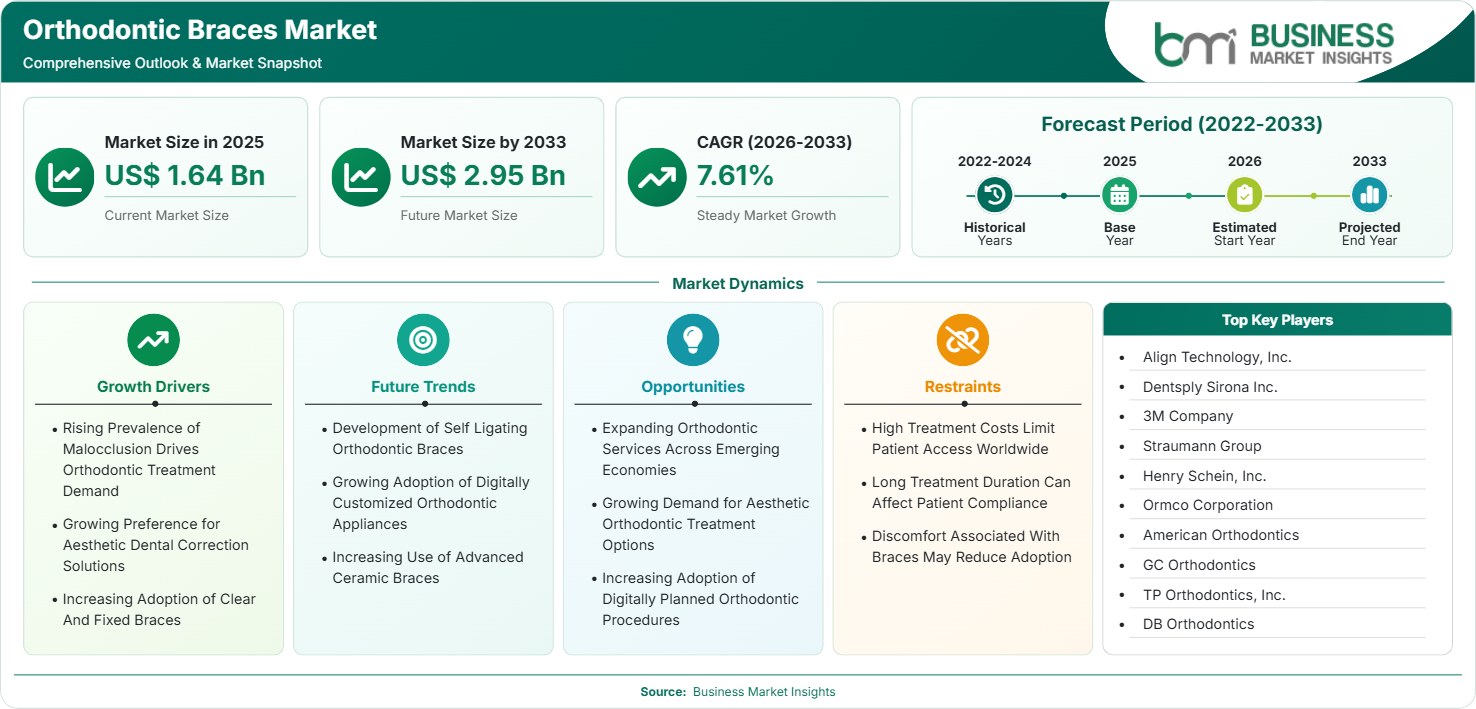
Rising Prevalence of Malocclusion Drives Orthodontic Treatment Demand
Malocclusion remains a widespread dental condition across children, adolescents, and adults, creating a persistent clinical need for orthodontic correction. Greater screening, improved dental awareness, and broader recognition of functional and aesthetic consequences are expanding the addressable treatment population. The Orthodontic Braces Market growth is supported by increasing referrals from general dentists and greater willingness among adults to seek corrective treatment. Product demand also benefits from improved access to specialist care and more standardized treatment pathways. Manufacturers are responding with appliance configurations suitable for different malocclusion severities, patient ages, and clinical preferences. This broad patient base reduces reliance on a single demographic and supports continued demand for fixed orthodontic systems across developed and emerging dental markets.
Growing Preference for Aesthetic Dental Correction Solutions
Aesthetic expectations are reshaping fixed orthodontic appliance selection as patients increasingly consider visibility, comfort, and appearance alongside clinical effectiveness. Ceramic brackets, lingual systems, smaller-profile designs, and coordinated treatment workflows allow providers to offer differentiated options for image-conscious patients. The Orthodontic Braces Market trends increasingly reflect adult treatment demand, where appearance can strongly influence appliance acceptance. Manufacturers are therefore refining bracket profiles, materials, finishes, and packaging to improve patient experience without compromising treatment mechanics. Premium positioning also creates opportunities for practices to segment services according to aesthetic preferences and affordability. As orthodontic treatment becomes more common beyond adolescence, aesthetic considerations are likely to remain important in product development and practice-level purchasing decisions.
Increasing Adoption of Clear and Fixed Braces
The patients, as well as orthodontists, take into account the use of clear and fixed systems depending on the complexity of the case, goals of the treatment, aesthetics, and clinical control. Fixed braces continue to be essential for achieving full correction, while clear methods increase the range of options available for consumers and also motivate manufacturers to provide additional appliance systems. The use of digital diagnostics has allowed for enhancing the process of treatment planning, since it gives an opportunity for clinicians to assess the appliance systems prior to treatment. For manufacturers, it is useful to design fixed appliances, which can easily be incorporated into the digital workflow and thus make it easier to document the case and plan the treatment. It therefore becomes essential for the competitive landscape to evolve from traditional performance of brackets to treatment ecosystems. Product manufacturers, who make their products compatible with different appliances, can meet the wider requirements of patients and also be able to adapt to changing trends.
Key Market Opportunities
Expanding Orthodontic Services Across Emerging Economies
Emerging economies provide room for orthodontic penetration as urbanization, private dental investment, specialist availability, and awareness of dental aesthetics improve. India, Southeast Asia, Latin America, and selected Middle Eastern markets offer particularly relevant expansion pathways because orthodontic services remain unevenly distributed. Manufacturers can strengthen access through distributor development, clinician education, localized product portfolios, and pricing structures suited to different practice economics. The Orthodontic Braces Market forecast increasingly depends on how effectively suppliers convert growing awareness into affordable treatment capacity. Partnerships with dental groups and training institutions can also accelerate adoption by improving practitioner familiarity with advanced appliance systems. Companies able to combine reliable products with education and service support can establish stronger positions in developing orthodontic ecosystems.
Growing Demand for Aesthetic Orthodontic Treatment Options
There is an opportunity for product differentiation within aesthetic orthodontics, as there is a demand for the correction of malocclusions without using highly visible appliances. There is an opportunity for manufacturers to use products such as ceramic and lingual appliances in order to have high-end positioning due to patient demands regarding their appearance, and fixed braces may be made more comfortable and less visually intrusive through improvements in design. There is the opportunity for the manufacturer to gain added value from customization of the appliance, miniaturization, better finish, and packaging of the appliance according to the needs of the patient. There are also chances of developing tiered treatment plans according to clinical needs and aesthetic desires. It provides more commercial possibilities than simply competing on the basis of conventional stainless-steel appliances. With more and more adults visiting for orthodontic treatments, there is likely to be increased demand for less visible appliances as long as clinicians are able to convey clinical acceptability and other details about appliances.
Increasing Adoption of Digitally Planned Orthodontic Procedures
The use of digital treatment planning allows for the possibility of bringing together imaging, diagnosis, appliance selection, manufacturing, tracking, and patient interaction in one unified process flow. Digital models and 3D planning can help increase case visualization and ensure more consistent documentation of the treatment process. Practices can also leverage digital methods to engage their patients through better presentation of the goals and tooth movements. Integration of appliances with planning systems can help enhance the relevance of workflow and build relationships with orthodontic practices. Digital compatibility becomes especially useful for group practices requiring standardization at several locations. Hence, the Orthodontic Braces Market scope is becoming less centered around hardware and more about technologies.
Market Restraints and Challenges
High Treatment Costs Limit Patient Access Worldwide
Factor: Orthodontic treatment may entail appliance costs, diagnostic tests, professional costs, follow-ups, retainers, and auxiliary services, all of which result in high costs. Impact: affordability issues could cause delays in treatment, reduced treatment uptake among low-income families, and encourage patients to opt for cheaper appliances. Affordability becomes very important in the context where orthodontic treatment is highly dependent on private payment. Manufacturers are compelled to ensure that their products are high-quality, even when offering prices that would permit practices to offer their services to many patients. Installment schemes, differential appliance schemes, and group buying are some of the ways practices can deal with affordability issues. Efficient suppliers will enable cost savings on unnecessary costs while retaining appliance effectiveness. Expansion of cheap alternatives for fixed braces is still necessary to improve penetration in price-sensitive environments.
Long Treatment Duration Can Affect Patient Compliance
Factor: Orthodontic treatment can require sustained patient participation, regular appointments, oral hygiene, dietary discipline, and adherence to clinical instructions over an extended period. Impact: treatment fatigue, missed appointments, appliance breakage, or inadequate cooperation can disrupt planned workflows and affect treatment efficiency. Patient adherence research indicates that compliance is influenced by multiple clinical and behavioral factors rather than a single determinant. Manufacturers can respond by improving appliance comfort, durability, handling, and design simplicity. Digital monitoring and patient communication tools can further support appointment management and reinforce treatment instructions. Shorter treatment pathways where clinically appropriate may also strengthen satisfaction. The commercial implication is clear: products that support predictable treatment mechanics and a better patient experience can provide greater value to both orthodontists and patients.