
Microcatheter Market Outlook: Size, Share, Trends, Growth Analysis, Competitive Landscape & Forecast, 2026–2033

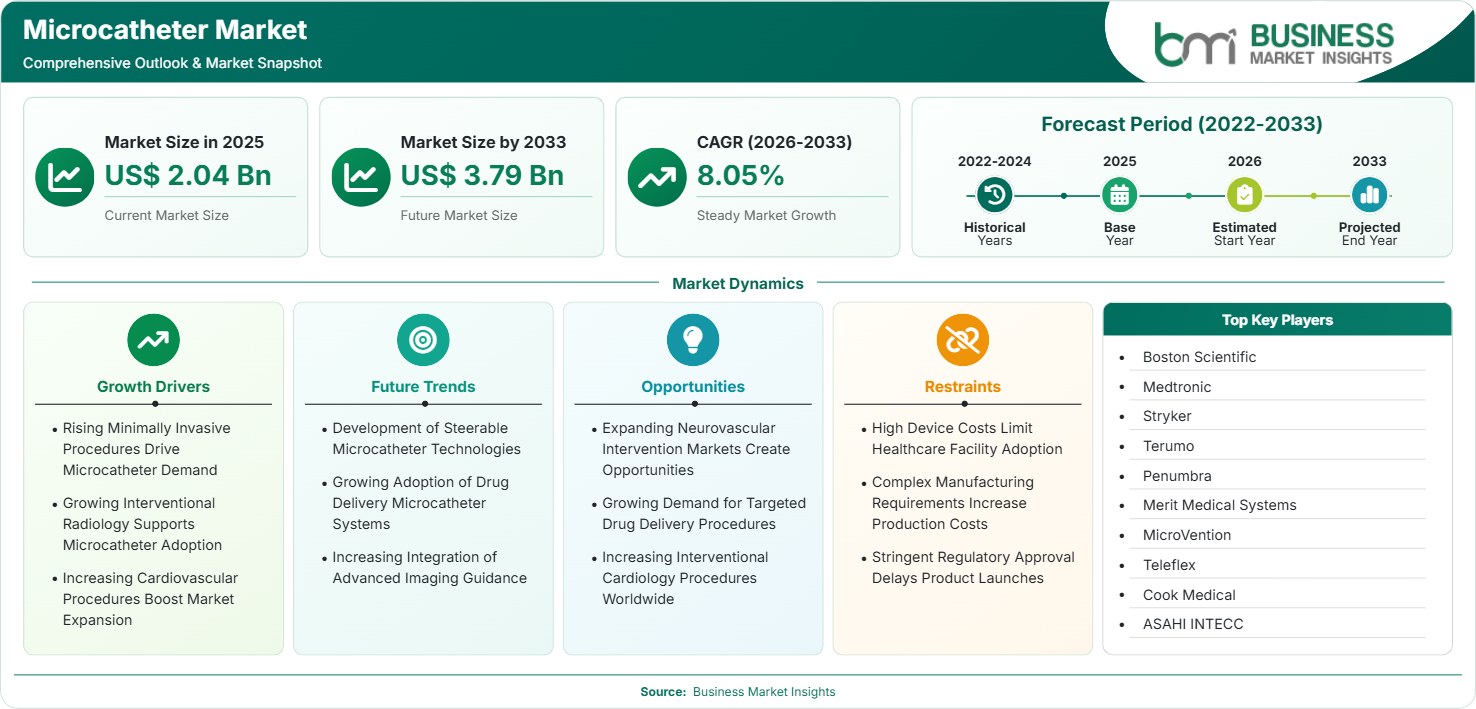
The Microcatheter Market size was valued at US$ 2.04 billion in 2025 and is projected to reach US$ 3.79 billion by 2033, growing at a CAGR of 8.05% during 2026–2033, supported by minimally invasive procedures, neurovascular interventions, targeted therapies, device miniaturization, and advanced catheter navigation.

Report Coverage
  • Product: Delivery Microcatheters, Aspiration Microcatheters, Steerable Microcatheters, Others
  • Design: Single Lumen, Dual & Multi-Lumen
  • Application: Cardiovascular Disorders, Neurovascular Disorders, Oncology, Urological Disorders, Others
  • End User: Hospitals & ASCs, Specialty Clinics, Others
US$ 2.04 Bn Market size in 2025
US$ 3.79 Bn Market Size by 2033
8.05% CAGR, 2026 - 2033
2026-2033 Forecast Period

AI Overview

Microcatheter Market Summary

  • North America Region: North America holds a 34%–38% share in 2025 and is projected to grow at a 7.2%–8.0% CAGR through 2033, supported by advanced interventional care, specialized hospitals, reimbursement access, physician expertise, and sophisticated catheter technologies.
  • Fastest Growing Region: Asia Pacific holds a 24%–28% share in 2025 and is projected to grow at a 9.0%–10.2% CAGR through 2033, supported by expanding healthcare infrastructure, increasing interventional procedures, improving specialist access, and rising adoption of minimally invasive therapies.
  • Leading Segment: Delivery Microcatheters hold a 42%–46% Microcatheter Market share in 2025 and are projected to grow at a 7.5%–8.4% CAGR through 2033, supported by broad procedural utility, precise device delivery, embolization applications, and increasing neurovascular intervention volumes.
  • High Growth Segment: Steerable Microcatheters hold a 16%–20% share in 2025 and are projected to grow at a 9.5%–10.8% CAGR through 2033, supported by distal navigation, complex anatomy, improved control, and expanding advanced endovascular procedures.
  • Key Market Opportunity: Growing demand for targeted intervention, complex vascular navigation, neurovascular treatment, oncology procedures, and minimally invasive drug delivery creates opportunities for differentiated catheter designs and specialized procedural platforms.
  • Major Market Players: Boston Scientific Corporation; Medtronic plc; Stryker Corporation; Terumo Corporation; Penumbra, Inc.; Merit Medical Systems, Inc.; MicroVention, Inc.; Teleflex Incorporated; Cook Medical LLC; ASAHI INTECC CO., LTD.
Strategic Insights

Microcatheter Market: Strategic Insights

Microcatheter Market Strategic Framework
FREE PDF
Request your free sample
Request free sample
Stakeholder View

Key Takeaways

  • The value chain increasingly rewards suppliers that combine polymer engineering, precision extrusion, distal-tip design, coating technologies, and dependable manufacturing quality.
  • Procedure-specific products provide the strongest commercial upside where complex anatomy requires controlled navigation, selective delivery, or improved physician handling.
  • Product innovation is shifting toward lower-profile designs, enhanced steerability, improved lubricity, and catheter configurations tailored to specialized interventions.
  • Asia Pacific provides an attractive expansion case as healthcare infrastructure, specialist capabilities, and minimally invasive treatment availability broaden across developing markets.
  • Strategic partnerships can strengthen access to hospitals, specialty clinics, distributors, and procedure-focused physician networks while accelerating adoption of differentiated catheter technologies.
  • Suppliers should balance established delivery applications with emerging opportunities in targeted therapies, neurovascular intervention, aspiration, and advanced image-guided procedures.
Geographic Outlook

Microcatheter Market Regional Highlights

North America Microcatheter Market

North America holds a 34%–38% share in 2025 and is projected to grow at a 7.2%–8.0% CAGR through 2033. Demand is supported by established interventional infrastructure, specialist expertise, advanced hospitals, and broad adoption of minimally invasive procedures.

  • The United States remains the principal regional demand center, supported by sophisticated neurovascular and cardiovascular intervention capabilities and broad availability of specialized procedural equipment.
  • Canada provides steady demand through expanding interventional care, specialized hospitals, physician training, and improving access to minimally invasive vascular procedures.
  • Premium catheter designs benefit from physician preference for improved distal navigation, controlled delivery, lower profiles, and compatibility with complex vascular anatomy.
  • Mature distribution networks favor suppliers with broad product portfolios, procedural training capabilities, reliable inventory, and strong relationships with healthcare institutions.

US Microcatheter Market

The U.S. represents approximately 78%–82% of North American demand in 2025 and is projected to grow at a 7.4%–8.2% CAGR through 2033. Demand benefits from advanced intervention centers, specialist expertise, and established reimbursement pathways.

  • Neurovascular procedures remain important because microcatheters enable controlled access and delivery within challenging cerebral vascular anatomy during specialized interventions.
  • Cardiovascular and peripheral procedures create additional demand through targeted delivery, selective access, embolization, and image-guided therapeutic techniques.
  • Specialty hospitals and ambulatory intervention centers increasingly favor products that combine navigational control, procedural reliability, and compatibility with advanced delivery systems.

Europe Microcatheter Market

Europe holds a 25%–29% share in 2025 and is projected to grow at a 6.8%–7.7% CAGR through 2033. Germany, France, the United Kingdom, Italy, and Spain remain major Microcatheter Markets, while Poland offers stronger expansion potential.

  • Germany benefits from advanced hospital infrastructure, specialist interventional capabilities, medical-device manufacturing expertise, and established demand for sophisticated vascular technologies.
  • France, Italy, Spain, and the United Kingdom maintain replacement and procedural demand through developed healthcare systems and established minimally invasive treatment pathways.
  • Poland and selected Central European markets offer higher growth potential as specialist care expands and hospitals increasingly adopt advanced interventional equipment.
  • European procurement increasingly emphasizes clinical performance, reliability, procedural efficiency, and regulatory compliance, favoring suppliers with strong technical documentation and quality systems.

Asia Pacific Microcatheter Market

Asia Pacific holds a 24%–28% share in 2025 and is projected to grow at a 9.0%–10.2% CAGR through 2033. China, Japan, India, South Korea, and Australia represent important demand centers, with India and China offering strong expansion potential.

  • China combines expanding healthcare infrastructure with growing interventional capabilities, creating opportunities for delivery, aspiration, and specialized neurovascular catheter technologies.
  • India offers substantial upside as tertiary hospitals expand minimally invasive services and specialist training improves access to advanced vascular interventions.
  • Japan maintains sophisticated demand supported by established medical infrastructure, advanced clinical expertise, and physician preference for high-performance interventional devices.
  • South Korea and Australia provide attractive opportunities through specialist healthcare systems, increasing procedure sophistication, and adoption of advanced image-guided interventions.

Rest of World Microcatheter Market

Rest of World represents approximately 9%–13% of global Microcatheter Market demand in 2025 and is projected to grow at a 6.2%–8.0% CAGR through 2033. Latin America benefits from improving specialist access, while Middle East and Africa demand develops around advanced hospital infrastructure.

Brazil and Mexico lead Latin American demand, supported by expanding private healthcare capacity and greater availability of minimally invasive procedures. Saudi Arabia, the UAE, and South Africa provide attractive opportunities as specialist centers broaden advanced intervention capabilities.

  • Brazil and Mexico offer expanding procedural opportunities through larger healthcare networks, specialist hospitals, and increasing adoption of image-guided vascular intervention.
  • Argentina, Colombia, and Chile provide additional potential as specialist treatment availability improves and hospitals modernize interventional equipment.
  • Saudi Arabia and the UAE support premium demand through advanced medical centers, specialized physicians, and investment in sophisticated healthcare infrastructure.
  • South Africa remains an important regional market as specialist hospitals and interventional services develop across major metropolitan healthcare centers.
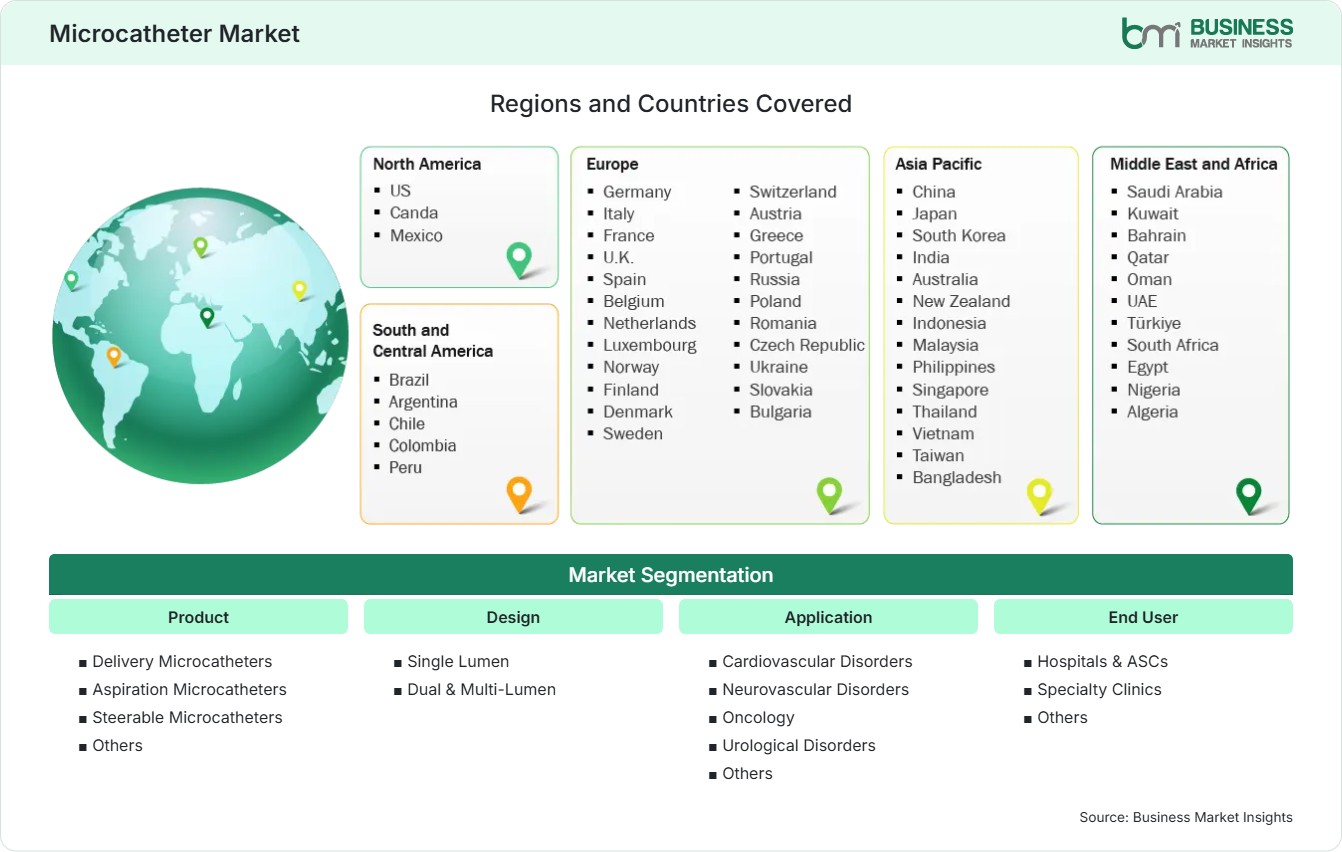
Global Market Geography
FREE PDF
Request your free sample
Request free sample
Segment Analysis

Microcatheter Market Segmentation

Product

Delivery Microcatheters hold a 42%–46% share in 2025 and are projected to grow at a 7.5%–8.4% CAGR through 2033. Broad procedural utility, precise delivery, and compatibility with embolic and interventional devices support their leading position.

  • Delivery Microcatheters: Designed for controlled delivery of therapeutic or interventional devices, these products benefit from neurovascular, cardiovascular, oncology, and peripheral procedure applications.
  • Aspiration Microcatheters: Aspiration-focused designs support clot and material removal procedures, with demand influenced by stroke intervention, vascular access, and advances in aspiration-based techniques.
  • Steerable Microcatheters: Steerable systems improve distal navigation and physician control, supporting complex vascular anatomy where conventional catheter manipulation presents procedural limitations.
  • Others: Specialized configurations address niche diagnostic, therapeutic, and delivery requirements, with adoption shaped by procedure-specific clinical needs and evolving intervention techniques.

Design

Dual & Multi-Lumen designs provide differentiated procedural functionality and are projected to gain adoption as physicians seek simultaneous delivery, aspiration, or fluid-management capabilities in complex interventions. Single-lumen products remain broadly utilized across established applications.

  • Single Lumen: Single-lumen designs offer straightforward construction, broad procedural compatibility, and established physician familiarity across routine diagnostic and therapeutic interventions.
  • Dual & Multi-Lumen: Multi-lumen configurations enable greater procedural flexibility by supporting separate functions, improving workflow efficiency and expanding capabilities in complex intervention settings.

Application

Neurovascular Disorders represent a leading application area because microcatheters provide controlled access to small, tortuous vessels during specialized interventions. Growing procedure complexity supports continued demand across cardiovascular, oncology, and urological applications.

  • Cardiovascular Disorders: Cardiovascular procedures use microcatheters for selective access, diagnostic delivery, embolization, and targeted intervention across challenging vascular pathways.
  • Neurovascular Disorders: Neurovascular procedures require precise distal navigation for embolization, therapeutic delivery, and device placement within intricate cerebral vascular structures.
  • Oncology: Interventional oncology uses microcatheters for selective delivery and embolization, supporting targeted treatment strategies that reduce exposure to surrounding healthy tissue.
  • Urological Disorders: Urological interventions utilize specialized catheter systems for selective vascular access and targeted treatment within anatomically demanding procedural environments.

End User

Hospitals & ASCs remain the leading end-user group because complex interventions require advanced imaging, trained specialists, procedural infrastructure, and comprehensive device availability. Specialty clinics provide additional demand as outpatient intervention capabilities expand.

  • Hospitals & ASCs: Hospitals and ambulatory centers support the broadest procedural range, including neurovascular, cardiovascular, oncology, and other image-guided minimally invasive interventions.
  • Specialty Clinics: Specialty clinics increasingly adopt focused catheter technologies where procedural specialization, physician expertise, and targeted treatment capabilities support efficient patient management.
  • Others: Other healthcare settings contribute niche demand through diagnostic, specialty, and procedural applications requiring selective vascular access and specialized catheter configurations.
Market Forces

Microcatheter Market Dynamics

Key Market Drivers

Rising Minimally Invasive Procedures Expand Catheter Adoption

Increasing demand for less-invasive approaches is leading to an increasing demand for instruments that can navigate through small and intricate blood vessels. Microcatheters give the doctors controlled access, along with the ability to selectively deliver agents like embolics or interventional instruments. This fits well within the approaches that are based on minimizing tissue trauma and increasing the accuracy of intervention. In this way, the future prospects of Microcatheter Market growth will be associated with more usage of image-guided interventions in various medical specialties. Innovations in microcatheters include improvements in terms of their flexibility, torque transfer, distal softness, lubricity, and interaction with other devices.

Expanding Interventional Radiology Strengthens Specialized Catheter Demand

Interventional Radiology has made advancements through the use of catheterization in vascular disease, oncology, peripheral intervention, and targeted therapy. As such, there has been an increased need for devices that provide selective access to vessels and control of treatment delivery. Manufacturers of catheters have focused on lowering their profiles, improving coating efficacy, radiopacity, and handling. There has also been an increased need for standardized platforms for procedures that allow for various interventions but maintain reliability. Suppliers who integrate engineering know-how and application development in their work have a competitive advantage in this trend. It benefits those who cater to both existing interventions and new targeted therapies.

Increasing Cardiovascular Procedures Support Advanced Catheter Development

There will still be a need for catheters, which facilitate selective delivery, diagnostics, treatments, and embolizations, because of the ongoing cardiovascular interventions. The increasingly complex anatomical structures and increasingly specialized procedures necessitate the use of reliable microcatheters with easily managed distal behavior. Changes are being made to the shaft, coating, tip, and lumens to improve their navigability and delivery. Another Microcatheter Market trend involves the demand from physicians for products that simplify procedures, yet they can work with the already existing guidewires and interventions.

Key Market Opportunities

Expanding Neurovascular Intervention Creates New Revenue Pools

Neurovascular interventional therapy presents a compelling opportunity due to the need for accurate navigation within very small and extremely tortuous vessels. Product differentiation can be achieved based on advancements in distal catheter maneuverability, radiopacity, and delivery system performance. Need for customized systems also makes partnerships between suppliers and doctors during the development phase and the procedure assessment process more necessary. The Microcatheter Market forecasts will benefit from potential use within aneurysm therapy, embolization, and stroke therapy, among others. Those suppliers who come up with catheter designs capable of integrating with emerging interventional technologies stand to benefit from increased recurring demand.

Growing Demand for Targeted Drug Delivery Procedures

Targeted drug delivery provides an opportunity to develop catheters that will be able to selectively access the diseased area, avoiding exposure in other areas. There are possibilities to develop catheters for oncotherapeutic procedures, among others, with the ability to provide vascular access and selective infusion. Developers can look into smaller profiles, flow control, increased compatibility with the drug, and distal positioning of the device. The opportunity does not only come from the conventional embolization approach, but also due to the possibility of personalization of therapy. Companies capable of material engineering and clinical development can create differentiated devices for special procedures.

Increasing Interventional Cardiology Procedures Worldwide

Growing interventional cardiology gives rise to business opportunities for catheter makers that have the ability to cater to specialized procedures and more complicated vascular access needs. There could be an emphasis on product development that revolves around tractability, torque performance, tip flex, and compatibility with guidewires and treatment devices. Healthcare markets in development also give more opportunities as training and infrastructure become better for specialists. Catheter makers can enhance their penetration in the market by way of training physicians, regional marketing, and product offerings for specific procedures. Business opportunity is especially important when there are hospitals that want to enhance their intervention capacities and look for equipment that will help with multiple treatment purposes.

Market Restraints and Challenges

High Device Costs Limit Healthcare Facility Adoption

Factor: High-quality microcatheters involve special materials, intricate extrusion, coating, radiopacity elements, sophisticated tips, and rigorous quality control measures. Impact: Increased expenses on manufacturing and procurement may limit usage by healthcare facilities operating within tight healthcare budget constraints. The issue is especially important for developing countries, where expensive interventional technologies have to compete with cheaper methods of treatment. Producers may cope with the problem by implementing automation in the manufacturing process, using better materials, introducing modularity, and localizing their production facilities. Premium technologies should prove their benefits in the procedure to justify higher expenses on equipment purchase.

Complex Manufacturing Requirements Increase Production Costs

Factor: Microcatheters need very strict control of their size, mechanical properties, bonding, coating types, and sterilization procedures since small deviations in their manufacturing can influence their performance during procedures. Impact: A complicated manufacturing process raises the demands on the quality control, engineering, validations, and manufacturing time. This is even more challenging when catheters have a complex design and use several materials or have an intricate distal end. Manufacturers can protect themselves from such factors by using advanced process controls, standardizing their manufacturing equipment, implementing automatic inspections, and qualifying suppliers. Still, consistency is required to be maintained among high-performance catheter lines.

Company Analysis

Competitive Landscape

The competitive environment combines diversified medical-device companies, interventional specialists, catheter manufacturers, and specialty healthcare suppliers. Microcatheter Market analysis indicates that differentiation centers on navigation, profile, delivery control, materials, procedural compatibility, manufacturing precision, and physician acceptance.

Company Name

Overview

Products and Services relevant to this market

Boston Scientific Corporation

Diversified medical-device company with extensive interventional cardiovascular and peripheral vascular capabilities.

Microcatheters, delivery systems, interventional devices, vascular accessories, and procedure-specific catheter technologies.

Medtronic plc

Global healthcare technology company with broad cardiovascular, neurovascular, and minimally invasive intervention expertise.

Neurovascular microcatheters, delivery systems, embolization platforms, and catheter-based interventional solutions.

Stryker Corporation

Medical technology company with strong neurovascular capabilities and specialized interventional product portfolios.

Neurovascular microcatheters, aspiration systems, delivery devices, and complementary intervention technologies.

Terumo Corporation

Japanese healthcare technology company with extensive vascular intervention and catheter-development capabilities.

Microcatheters, guidewires, delivery systems, embolization products, and vascular intervention devices.

Penumbra, Inc.

Interventional company focused strongly on neurovascular and thrombectomy-related treatment technologies.

Aspiration microcatheters, access systems, neurovascular intervention products, and catheter-based treatment platforms.

Merit Medical Systems, Inc.

Medical-device manufacturer specializing in disposable products for interventional and diagnostic procedures.

Microcatheters, infusion systems, vascular access products, and procedure-specific interventional devices.

MicroVention, Inc.

Specialized neurovascular company developing devices for complex cerebral vascular interventions.

Neurovascular microcatheters, delivery systems, embolization products, and intervention accessories.

Teleflex Incorporated

Diversified medical-device supplier with established catheter and vascular access expertise.

Catheter-based intervention products, vascular access systems, specialty devices, and procedural accessories.

Cook Medical LLC

Medical-device company serving interventional radiology, vascular, urology, and other specialty procedures.

Microcatheters, vascular catheters, delivery systems, diagnostic products, and minimally invasive procedure solutions.

ASAHI INTECC CO., LTD.

Japanese manufacturer specializing in guidewires, catheters, and precision components for complex intervention.

Microcatheters, guidewires, vascular access products, and specialized interventional catheter technologies.

Trust & Transparency

Research Methodology

The market analysis combines proprietary research with secondary data from government agencies, company disclosures, regulatory filings, industry databases and expert interviews. Market estimates are validated through data triangulation, cross-market benchmarking and analyst review.

View Full Research Methodology

Questions Answered

Frequently Asked Questions

What does the Microcatheter Market report indicate about future competition?

The report indicates that competition will increasingly focus on navigation performance, miniaturization, coating technology, procedural compatibility, manufacturing consistency, and application-specific innovation. Suppliers combining engineering capabilities with physician-centered development and strong distribution should strengthen their competitive positioning.

Why are targeted therapies creating new opportunities for microcatheter suppliers?

Targeted therapies require controlled access and selective delivery to specific anatomical regions. Microcatheters can support localized infusion and embolization strategies, making them valuable for oncology and other specialized interventions where treatment precision is increasingly important.

How are advanced catheter technologies influencing adoption?

Improved steerability, lower profiles, enhanced lubricity, distal flexibility, and better delivery control are increasing the usefulness of microcatheters in complex procedures. These technologies help physicians address difficult vascular anatomy while improving procedural control and compatibility with interventional devices.

Which applications present the strongest opportunity in the market?

Neurovascular intervention, cardiovascular procedures, oncology, and targeted drug delivery provide attractive opportunities. Neurovascular applications particularly benefit from advanced navigation requirements, while oncology offers potential through selective therapeutic delivery and embolization procedures.

What factors are improving Microcatheter Market return on investment?

Growing minimally invasive intervention, expanding neurovascular procedures, targeted therapies, and demand for precise vascular access are improving investment potential. Suppliers can enhance returns through differentiated catheter designs, manufacturing efficiency, broader procedural applications, and stronger hospital and specialist-clinic distribution.

Access the Full Microcatheter Market Report

Get segment-level forecasts, regional estimates, competitive benchmarking, company profiles and downloadable Excel datasets.

Access the full Microcatheter Market Report
350 pages PDF & Excel | 2026-08-19
Similar Research

Related Market Reports