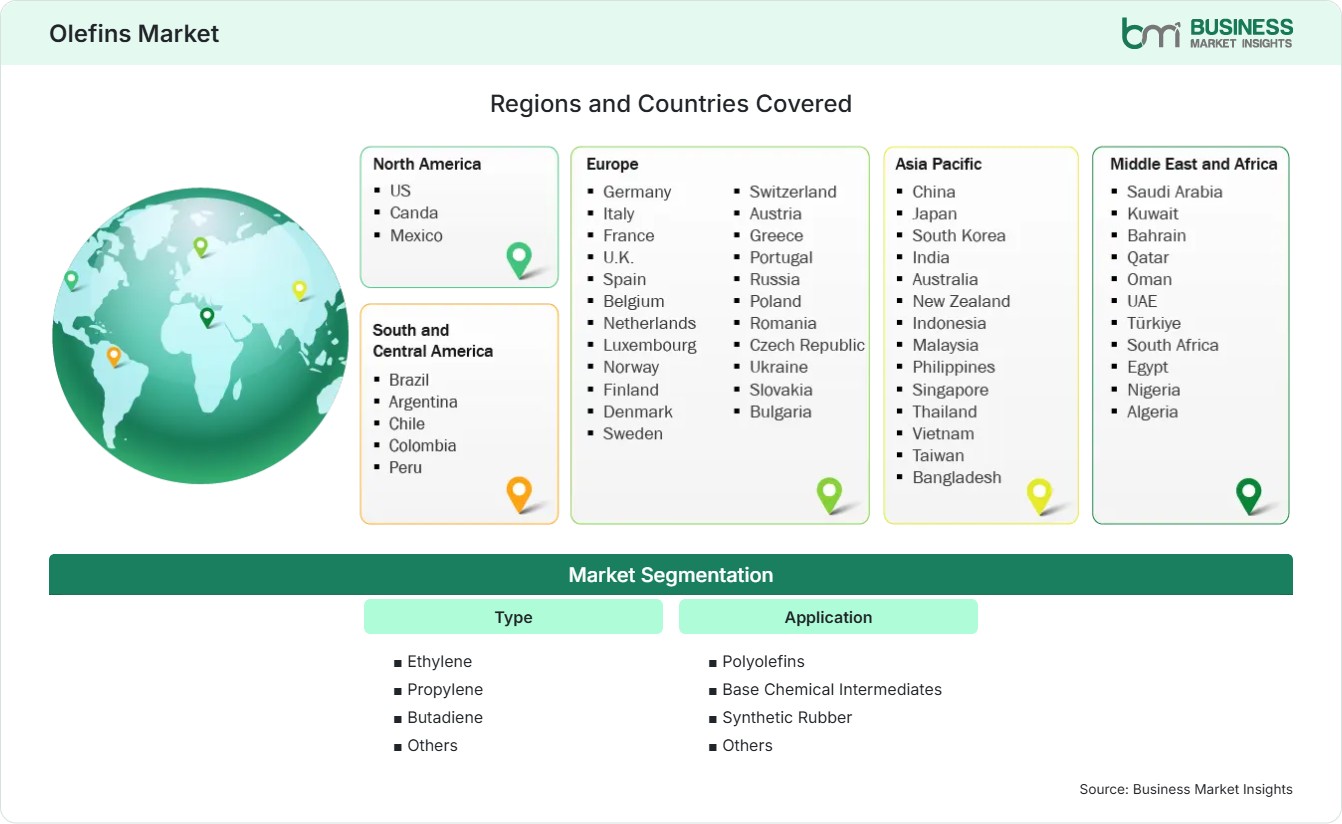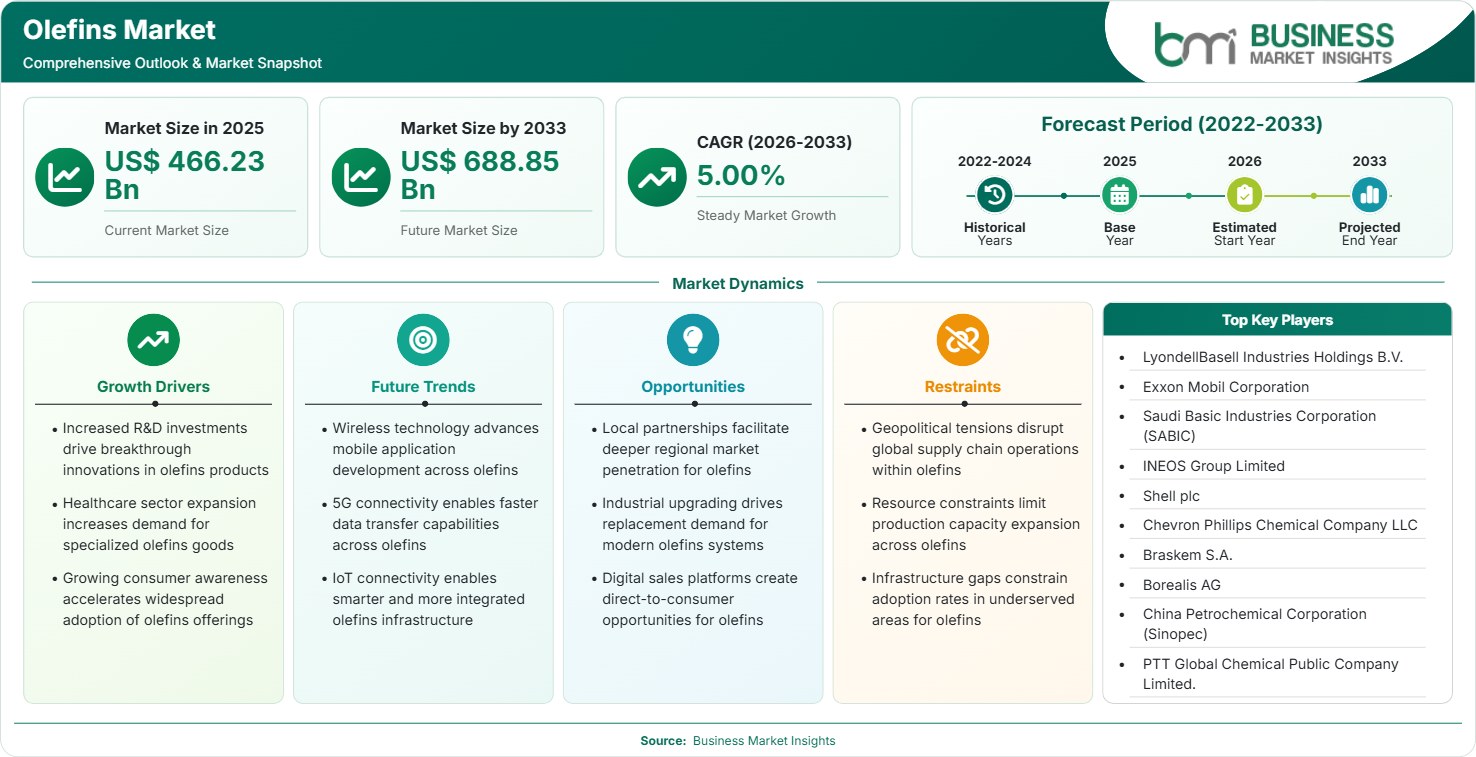
Olefins Market Regional Highlights
North America Olefins Market
North America accounts for 23%–26% of global demand during 2025, supported by abundant shale-derived ethane, integrated petrochemical infrastructure, and competitive production economics. Regional manufacturers continue expanding export capacity while investing in low-carbon production technologies. The region is projected to register a 4.4%–4.8% CAGR through 2033. The Olefins Market share remains supported by advanced logistics, mature downstream polymer industries, and sustained investments in digital manufacturing optimization and circular feedstock development.
- Shale gas availability continues reducing feedstock costs for major producers, encouraging long-term investments in world-scale ethylene crackers, downstream polymer facilities, export terminals, and integrated chemical manufacturing ecosystems serving domestic and international customers.
- Growing adoption of advanced catalyst technologies, predictive maintenance systems, and energy-efficient cracking furnaces improves production efficiency while supporting decarbonization objectives across integrated petrochemical complexes throughout the region.
- Packaging, automotive, healthcare, and industrial manufacturing sectors remain primary consumption centers, encouraging producers to diversify specialty chemical portfolios while expanding sustainable polymer production capabilities.
- Increasing investments in chemical recycling facilities and circular polymer initiatives strengthen long-term competitiveness as regulatory frameworks encourage lower-emission manufacturing and improved resource utilization across North American operations.
US Olefins Market
The United States contributes 72%–76% of North American Olefins Market production capacity and is anticipated to expand at a 4.5%–4.9% CAGR through 2033. Competitive shale gas resources, world-scale petrochemical infrastructure, strong export networks, and continuous investment in integrated production facilities reinforce the country's leadership. Advanced manufacturing technologies and expanding downstream chemical industries continue strengthening global competitiveness while supporting domestic industrial growth.
- Gulf Coast petrochemical investments continue expanding integrated production capacity through refinery modernization, advanced cracking facilities, and downstream polymer manufacturing supporting domestic and international demand.
- Chemical recycling initiatives, lower-carbon process technologies, and renewable energy integration increasingly influence investment strategies among leading petrochemical manufacturers across major production clusters.
- Stable natural gas availability improves feedstock flexibility while enabling manufacturers to optimize operating costs, production reliability, and export competitiveness within global petrochemical supply chains.
- Growing specialty chemical production and innovation partnerships between industrial manufacturers and technology providers accelerate commercialization of advanced materials for automotive, healthcare, electronics, and infrastructure applications.
Europe Olefins Market
Europe represents 18%–21% of global Olefins Market consumption in 2025 while progressing at a 4.0%–4.4% CAGR through 2033. Sustainability regulations, circular economy initiatives, and investments in low-emission production technologies continue transforming regional manufacturing strategies. Germany leads regional production, while the Netherlands maintains strong export infrastructure. Belgium and Poland demonstrate comparatively stronger expansion with projected CAGRs ranging between 4.5%–5.0% due to modernization investments.
- European producers increasingly prioritize renewable feedstocks, electrified cracking technologies, and chemical recycling to comply with climate objectives while maintaining industrial competitiveness.
- Strategic collaborations among refiners, polymer manufacturers, and technology developers accelerate commercialization of sustainable petrochemical production and circular material solutions.
- Automotive lightweighting, medical packaging, renewable energy equipment, and infrastructure modernization continue supporting stable downstream consumption despite energy price volatility.
- Continued investment in carbon capture technologies and digital plant optimization strengthens operational efficiency while reducing lifecycle emissions across major petrochemical manufacturing facilities.
Asia Pacific Olefins Market
Asia Pacific commands 45%–48% of global Olefins Market demand during 2025 and records the fastest expansion with a 5.8%–6.3% CAGR through 2033. China remains the largest production and consumption center, while India exhibits the strongest growth trajectory at approximately 6.4%–6.8% CAGR supported by manufacturing expansion, infrastructure investment, and increasing domestic polymer demand across multiple industrial sectors.
- Integrated refinery-to-chemical developments across China, India, South Korea, and Southeast Asia significantly expand regional production capacity and strengthen supply chain integration.
- Rising packaging demand, infrastructure development, automotive manufacturing, and consumer goods production continue driving sustained downstream chemical consumption throughout rapidly industrializing economies.
- Government-supported industrial development programs encourage domestic petrochemical investments while improving export competitiveness and reducing import dependence across strategic manufacturing sectors.
- Foreign direct investment, technology transfer partnerships, and advanced process automation accelerate modernization of regional petrochemical facilities supporting long-term production efficiency.
- Expanding renewable energy infrastructure, electric vehicle manufacturing, and electronics production generate additional demand for advanced polymer materials and specialty chemical intermediates.
Rest of World Olefins Market
The Rest of World region accounts for 9%–12% of global Olefins Market demand and is projected to expand at a 5.0%–5.5% CAGR through 2033. The Middle East remains a major export-oriented production hub because of competitive hydrocarbon resources and integrated petrochemical investments.
South and Central America continue benefiting from expanding downstream manufacturing, while selected African economies gradually increase petrochemical investments supporting domestic industrialization and regional supply diversification.
- Saudi Arabia and the United Arab Emirates continue strengthening export-oriented petrochemical production through integrated refining investments and advanced manufacturing technologies supporting global supply chains.
- Brazil remains South America's leading manufacturing center, while Mexico expands downstream chemical investments supporting packaging, automotive, and industrial applications across regional markets.
- Infrastructure development and industrial diversification initiatives across Africa gradually increase domestic petrochemical consumption while encouraging strategic investments in production capacity.
- Export-oriented petrochemical complexes, logistics modernization, and cross-border industrial partnerships continue improving regional competitiveness and strengthening participation within international chemical value chains.