
Offshore Drilling Market Outlook: Size, Share, Trends, Growth Analysis, Competitive Landscape & Forecast, 2026-2033

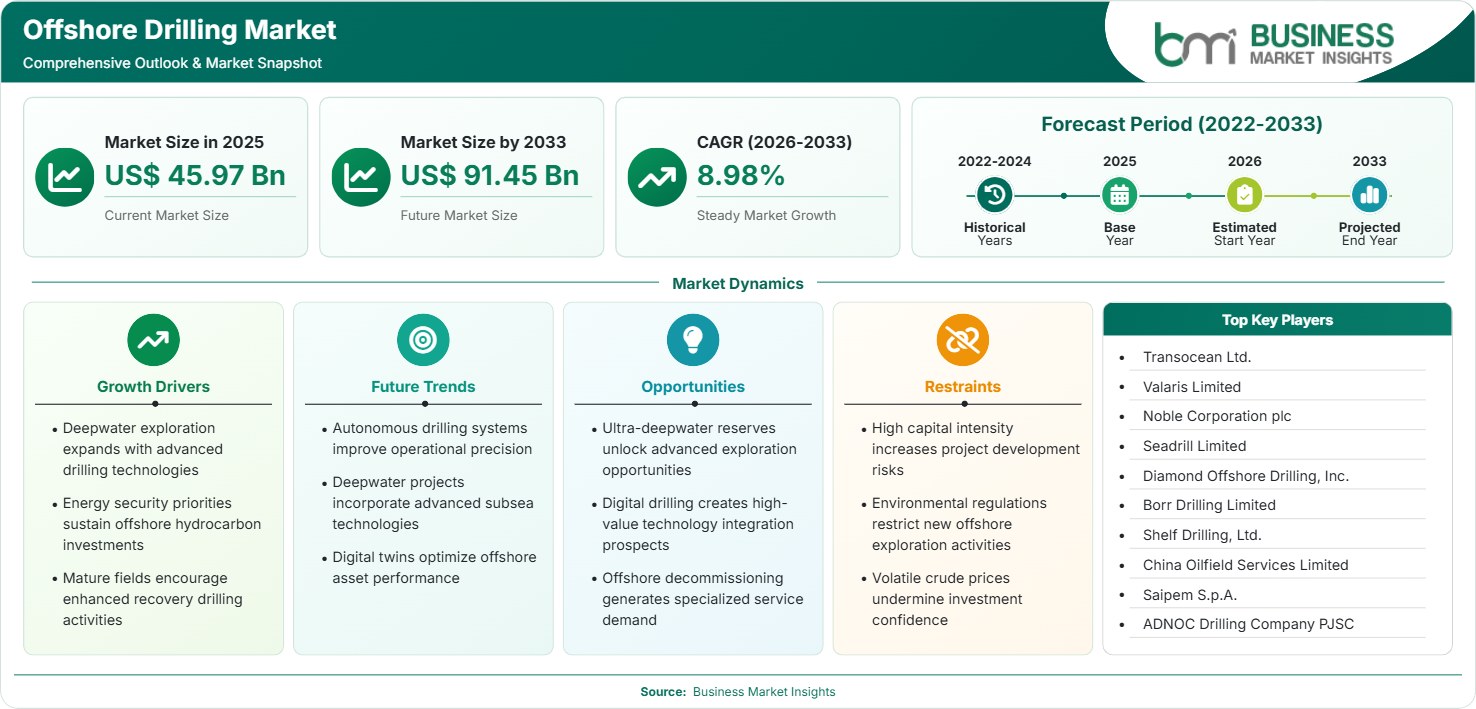
The Offshore Drilling Market size was valued at US$ 45.97 Billion in 2025 and is projected to reach US$ 91.45 Billion by 2033, growing at a CAGR of 8.98% during 2026–2033. Rising deepwater exploration investments, expanding offshore oil discoveries, digital drilling optimization, and increasing national energy security initiatives are driving demand while ultra-deepwater developments create substantial opportunities.

Report Coverage
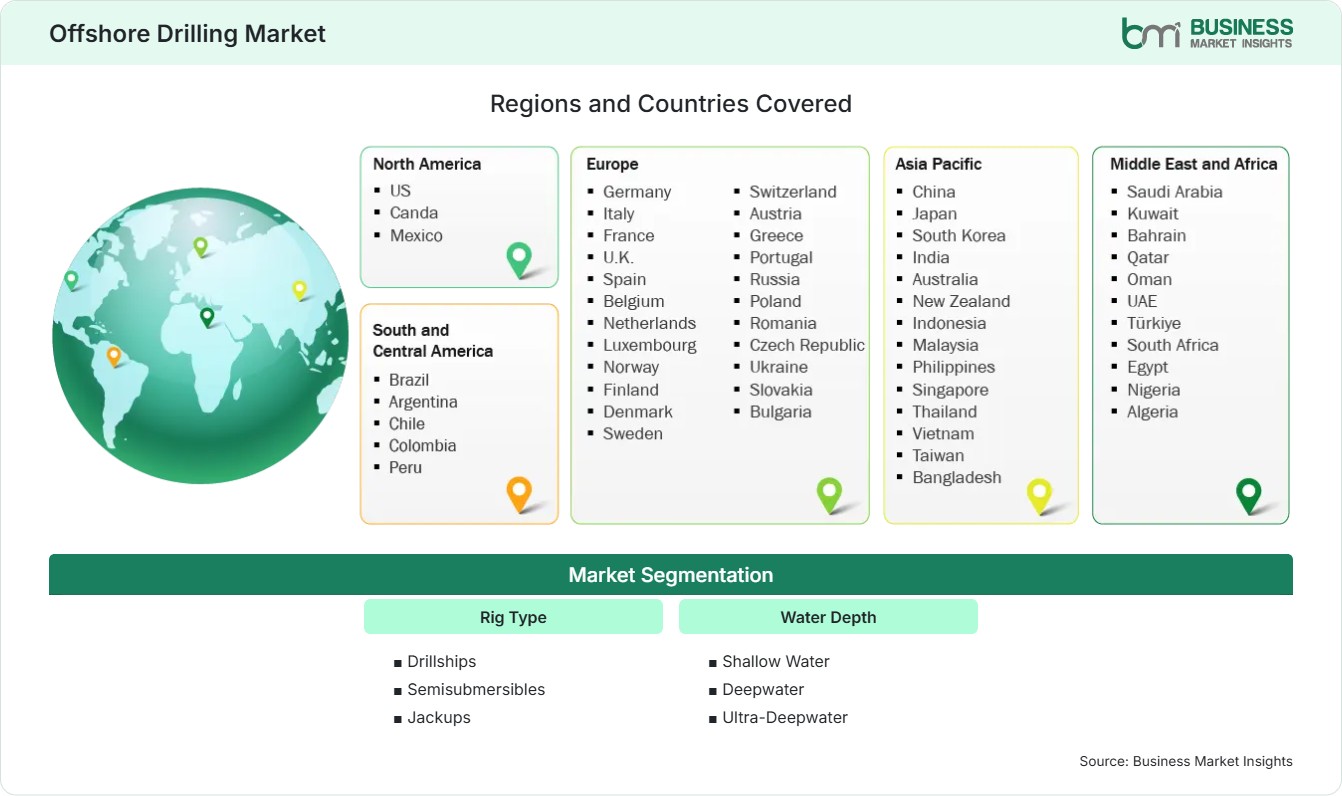
  • Rig Type: Drillships, Semisubmersibles, Jackups
  • Water Depth: Shallow Water, Deepwater, Ultra-Deepwater
US$ 45.97 Bn Market size in 2025
US$ 91.45 Bn Market Size by 2033
8.98% CAGR, 2026 - 2033
2026-2033 Forecast Period

AI Overview

Offshore Drilling Market Summary

  • North America Region: North America holds a market share of 34%–37% in 2025 and is projected to grow at a CAGR of 8.4%–8.8% during 2026–2033. Growth is supported by developments in the Gulf of Mexico, advanced drilling fleets, higher exploration budgets, improvements in operator efficiency, enhanced digital drilling systems, stronger energy security priorities, long-term contracts, and deepwater project sanctions globally. The US market benefits from sustained Gulf of Mexico investment, premium drillship utilization, and an estimated CAGR of 8.5%–8.9%.
  • Fastest Growing Region: Asia Pacific accounts for 22%–25% share in 2025 and expands at 10.2%–10.7% CAGR during 2026–2033. Offshore licensing rounds, energy consumption growth, natural gas development, regional energy independence initiatives, rig modernization, and rising investments in frontier basins are accelerating project activity.
  • Leading Segment: Drillships represent 42%–45% share in 2025 and advance at 9.4%–9.9% CAGR. Demand is driven by ultra-deepwater capability, operational mobility, high-pressure reservoir access, automated drilling technologies, improved efficiency, premium day rates, expanding exploration programs, and increasing offshore discovery investments.
  • High Growth Segment: Ultra-Deepwater holds 23%–26% share in 2025 and records 10.8%–11.3% CAGR. Large reserve discoveries, improving project economics, technological advancement, long-term production visibility, enhanced recovery potential, operator confidence, offshore infrastructure expansion, and strategic resource development support growth.
  • Key Market Opportunity: Expansion of offshore natural gas and deepwater projects across emerging regions creates opportunities for contractors, technology providers, subsea specialists, and high-specification rig operators seeking long-duration contracts and premium margins.
  • Major Market Players: Transocean Ltd., Valaris Limited, Noble Corporation plc, Seadrill Limited, Diamond Offshore Drilling, Inc., Borr Drilling Limited, Shelf Drilling, Ltd., China Oilfield Services Limited, Saipem S.p.A., and ADNOC Drilling Company PJSC.
Strategic Insights

Offshore Drilling Market: Strategic Insights

Offshore Drilling Market Strategic Framework
FREE PDF
Request your free sample
Request free sample
Stakeholder View

Key Takeaways

  • The value chain is increasingly centered around integrated drilling services, subsea engineering, digital monitoring platforms, and long-term rig contracting models that improve operational efficiency.
  • The greatest potential for increased revenue comes from ultra-deepwater developments and the use of advanced drillships, since these options benefit from high daily rates and provide access to major offshore discoveries.
  • For fleet operators and service providers, automation, remote operations, predictive maintenance, and AI-assisted drilling optimization are becoming key factors in setting them apart.
  • The investment prospects in Guyana, Brazil, and some Southeast Asian markets are very attractive due to active exploration programs and favorable regulatory frameworks.
  • Consolidation in the industry is still taking place through acquisitions and fleet optimization strategies, which in turn lead to stronger balance sheets and higher utilization rates.
  • Offshore natural gas projects are becoming a key element in countries' efforts to diversify their energy sources and adopt lower-emission fuels.
Geographic Outlook

Offshore Drilling Market Regional Highlights

North America Offshore Drilling Market

North America accounts for 34%–37% share in 2025 and is projected to expand at 8.4%–8.8% CAGR through 2033. The region benefits from sustained approvals for Gulf of Mexico projects, high-specification rig demand, and extensive offshore infrastructure. Strong operator spending by oil majors and independent producers supports contract awards and fleet utilization. The Offshore Drilling Market share remains concentrated in deepwater developments, where operators prioritize long-life reserves and production stability. Technological innovation and favorable economic conditions continue to support regional competitiveness.

  • Digital drilling platforms improve well performance, reduce downtime, and increase operational efficiency in complex offshore developments.
  • The deepwater Gulf projects are creating demand for premium drillships and semisubmersibles with enhanced technical capabilities.
  • Initiatives aimed at achieving national energy security promote further investments in offshore exploration and production.
  • Integrated service contracts help strengthen the relationships among operators, contractors, and subsea technology providers.

US Offshore Drilling Market

The United States represents approximately 72%–76% of the North American share and grows at 8.5%–8.9% CAGR during 2026–2033. Gulf of Mexico exploration remains a central demand source for advanced drilling fleets. Operators focus on high-return deepwater assets and lower-carbon intensity production. Investment in digital drilling systems and reservoir characterization supports improved project economics. Strong offshore infrastructure and experienced service ecosystems strengthen the country's competitive position.

  • The main operators focus on offshore assets that have a long lifespan since they offer steady production volumes and good returns.
  • The level of visibility regarding the contracts has been improved because of the multiyear drilling programmes and the expansion of the development pipelines.
  • In high-end offshore operations drillships which are advanced are favoured because of their operational flexibility and technical performance.
  • Improving the supply chain has the effect of enhancing the way in which projects are carried out and aids in the management of offshore assets.

Europe Offshore Drilling Market

Europe holds 20%–23% Offshore Drilling Market share in 2025 and is expected to grow at 7.8%–8.3% CAGR. The North Sea remains the primary activity center, supported by redevelopment projects and gas-focused investments. Norway leads regional revenue generation, while the UK demonstrates notable activity in offshore developments. Operators increasingly deploy advanced semisubmersibles and digital monitoring technologies. Regulatory emphasis on operational efficiency and emissions management promotes fleet modernization while sustaining offshore investment attractiveness.

  • Norway remains the leading market due to its high level of offshore spending and advanced field development.
  • The UK is seeing strong activity in the form of redevelopment and incremental production programmes.
  • The strategic importance of rigs used in harsh environments is due to the operating conditions in the North Sea.
  • The development of offshore gas fields helps reinforce pipelines and increase long-term demand for drilling.

Asia Pacific Offshore Drilling Market

Asia Pacific captures 22%–25% share in 2025 and registers the fastest growth at 10.2%–10.7% CAGR. Expanding energy consumption, offshore gas development, and national energy security priorities support exploration activity. Countries including China, India, Malaysia, and Indonesia are advancing offshore investments. Regional governments promote licensing opportunities and strategic energy initiatives. The market share in the Asia Pacific continues to expand as operators address growing energy requirements through offshore resource development.

  • China remains the largest contributor in the region due to its wide-ranging offshore exploration programs.
  • India is a country experiencing high growth, together with a growing number of offshore development projects and exploration licences.
  • The higher demand for natural gas encourages investment in offshore wells and in production infrastructure.
  • The modernization of regional fleets improves both operational capability and project efficiency.
  • The exploration in the frontier basin offers opportunities for international contractors and service providers.

Rest of World Offshore Drilling Market

The rest of the world represents 19%–22% share in 2025 and advances at 9.1%–9.6% CAGR through 2033. South & Central America benefit from major offshore discoveries, particularly in Brazil and Guyana. Middle East & Africa markets continue expanding through offshore gas and oil developments. Government-backed energy strategies, reserve replacement objectives, and foreign investment participation reinforce activity across both subregions and support long-term drilling demand.

  • Brazil remains the leading regional market driven by presalt developments and deepwater investments.
  • Because of ongoing offshore discoveries and development programs, Guyana is experiencing some of the fastest rates of growth.
  • West Africa attracts investment through offshore exploration and projects aimed at expanding the fields.
  • The need for drilling services is continuously driven by offshore gas projects in the Middle East.
  • Licensing rounds prompt global operators to seek out frontier opportunities.
Global Market Geography
FREE PDF
Request your free sample
Request free sample
Segment Analysis

Offshore Drilling Market Segmentation

Rig Type

Rig Type accounts for a critical component of the market structure. Drillships remained the leading category, with a 42%–45% share in 2025, and are projected to grow at a 9.4%–9.9% CAGR. The Offshore Drilling Market scope within this segment continues to expand due to deepwater project economics, mobility advantages, technological sophistication, and the increasing exploration of complex offshore reservoirs that require advanced drilling solutions.

  • Drillships: Preferred for ultra-deepwater environments because of dynamic positioning capability, operational flexibility, and suitability for complex exploration campaigns across major offshore basins.
  • Semisubmersibles: Widely deployed in harsh environments and deepwater locations where stability, safety, and efficient performance support demanding drilling operations.
  • Jackups: Strong demand persists in shallow-water developments, particularly among national oil companies seeking cost-effective production and exploration activities.

Water Depth

Water depth classification significantly influences project economics and equipment requirements. Shallow water remains the largest category, with a 48%–51% share in 2025, while ultra-deepwater is the fastest-growing category, with a 10.8%–11.3% CAGR. Offshore Drilling Market trends indicate increasing operator focus on deeper reservoirs due to large resource potential and improved project viability.

  • Shallow Water: Mature infrastructure, lower development costs, and shorter project cycles sustain activity across established offshore producing regions.
  • Deepwater: Strong investment interest arises from substantial reserve potential, improving drilling technologies, and favorable production economics.
  • Ultra-Deepwater: Growing discoveries, demand from premium contractors, and advanced drilling capabilities support rapid expansion in frontier offshore regions.
Market Forces

Offshore Drilling Market Dynamics

Key Market Drivers

Rising Deepwater and Ultra-Deepwater Exploration Activity

Global energy companies continue to target large offshore reserves in deepwater and ultra-deepwater environments. Discoveries in Brazil, Guyana, the Gulf of Mexico, and West Africa are encouraging capital allocation toward offshore developments. Advanced drillships and semisubmersibles improve technical feasibility while higher recovery rates strengthen project economics. Increasing reserve replacement requirements among operators further stimulates exploration expenditure. Growing offshore production contributes to supply diversification and energy security objectives. As accessible onshore reserves mature, offshore basins provide strategic long-term opportunities. These factors collectively enhance contractor utilization rates, support premium day rates, and contribute directly to sustained Offshore Drilling Market expansion.

Technological Advancements in Drilling Operations

Automation, together with real-time analytics, predictive maintenance, and digital twin technologies, is transforming offshore operations. To reduce nonproductive time and boost well performance, operators are making greater use of intelligent drilling systems. Better data integration enables quicker operational decisions, and automated processes improve safety and efficiency. Today's rigs are equipped with energy-efficient systems and advanced monitoring features, which help to increase their competitiveness. Since they have higher specifications, these assets enjoy greater demand due to the reliability of their products. The incorporation of digital technologies results in lower lifecycle costs and greater reliability in the execution of projects. Ongoing innovation in drilling equipment, subsea systems, and operational management promotes wider adoption and leads to longer-term increases in industry productivity.

Growing Energy Security and Offshore Resource Development

Many governments place a high priority on developing domestic resources to improve energy security and reduce supply risks. Offshore oil and gas projects have great potential for production and help support a country's energy strategies. To attract international operators, licensing rounds, investment incentives, and exploration partnerships are provided. The national oil companies are speeding up their offshore programs to secure long-term production capacity. The demand for natural gas is rising, which in turn increases the attractiveness of offshore investment. The combination of sound policy support and favorable reservoir economics strengthens the decision to proceed with projects. The rise in drilling operations in turn boosts demand for equipment, increases fleet usage, and leads to higher revenue for contractors.

Key Market Opportunities

Expansion of Offshore Natural Gas Projects

Natural gas is assuming a larger role in energy transition strategies, creating opportunities across offshore resource development. Developing economies are investing in gas infrastructure to meet industrial and electricity demand. Offshore gas discoveries support long-term production growth and export potential through LNG facilities. Contractors capable of operating advanced rigs are positioned to benefit from increasing project activity. Offshore Drilling Market Forecasts remain supported by growing natural gas investments across Asia Pacific, Africa, and the Middle East. Integrated development models that combine exploration, drilling, production, and export infrastructure offer attractive returns for investors and service providers.

Growth of Frontier Offshore Basins

Because of their good geological potential and the fact that their reserves are still largely untapped, newly emerging offshore regions continue to attract exploration spending. To encourage investment, countries in Africa, South America, and Southeast Asia are broadening the scope of their licensing opportunities. Since frontier projects usually require high-specification rigs capable of operating in complex conditions, this has created opportunities for more advanced contractors. When discoveries are made, they can set up development programs that last for several years, thus keeping drilling demand high. Governments are increasingly providing support for exploration by introducing regulatory changes and offering investment incentives. Since operators are looking to increase their reserves beyond those in mature basins, frontier exploration is expected to stay an important source of long-term opportunity.

Industry Consolidation and Fleet Modernization

Consolidation allows companies to boost the quality of their fleets, strengthen their negotiating position, and make better use of their assets. Modern fleets equipped with advanced technologies achieve greater productivity and better operational reliability. Mergers and acquisitions help improve a company's competitive position while reducing operational redundancies. Improved balance sheets enable contractors to take on large-scale projects and make strategic investments. Moreover, fleet modernization helps meet changing environmental and operational standards. Companies that are able to combine their top-quality assets, digital capabilities, and service expertise are likely to win higher-value contracts and increase their profitability during the forecast period.

Market Restraints and Challenges

Oil Price Volatility and Project Deferrals

Oil prices continuing to fluctuate present a major problem for offshore developments since the economics of such projects are based on long-term forecasts of commodity prices. If prices go down, operators often review their plans for capital expenditure and delay exploration activities. As a result, there is less demand for rigs, utilization rates fall, and contractors suffer pressure on their profits. Because offshore projects usually involve a large initial outlay and take a long time to develop, they are more sensitive to market uncertainty. Moreover, unstable pricing conditions can also affect the availability of financing and dampen investment confidence. Even though big offshore discoveries are still appealing, price instability continues to affect project approval cycles and overall market visibility.

High Capital Intensity and Investment Barriers

Because offshore drilling projects entail high costs across exploration, drilling, subsea infrastructure, production systems, and logistics, the impact of this high level of capital investment is especially evident in frontier and ultra-deepwater development,s where risks are greater. Minor operators might encounter financial obstacles, as a result of which they are unable to take part in major offshore projects. Furthermore, cost overruns, equipment shortages, and schedule delays can all affect the economic viability of the projects. The need to comply with regulations and the duty to meet environmental requirements lead to extra expenses. Since these difficulties can hinder decision-making even when there is promising reserve potential, they present barriers to wider industry expansion and to greater levels of investment participation.

Company Analysis

Competitive Landscape

The competitive environment is characterized by fleet modernization, long-term contract acquisition, and operational efficiency initiatives. Current Offshore Drilling Market analysis indicates increasing emphasis on advanced drillships, digital capabilities, and strategic consolidation.

Company Name

Overview

Products and Services relevant to this market

Transocean Ltd.

Leading offshore drilling contractor with extensive deepwater and ultra-deepwater fleet presence globally.

Drillships, semisubmersibles, offshore drilling services, project execution support.

Valaris Limited

Major offshore operator serving global energy companies across multiple offshore basins.

Jackups, drillships, semisubmersibles, offshore contract drilling solutions.

Noble Corporation plc

Established contractor with diversified offshore fleet and global operating footprint.

Offshore drilling rigs, well construction support, drilling operations.

Seadrill Limited

Focuses on modern, high-specification offshore drilling assets and services.

Deepwater drilling, drillships, semisubmersible rig services.

Diamond Offshore Drilling, Inc.

Specialized offshore drilling company with deepwater expertise.

Offshore rig operations, deepwater drilling services, fleet management.

Borr Drilling Limited

Significant jackup-focused contractor serving shallow-water developments globally.

Premium jackup rigs, offshore drilling services, project support.

Shelf Drilling, Ltd.

Provider focused primarily on shallow-water drilling markets.

Jackup rig services, field development drilling operations.

China Oilfield Services Limited

Integrated oilfield services company with offshore drilling capabilities.

Offshore rigs, integrated drilling services, engineering solutions.

Saipem S.p.A.

Global energy services provider participating across offshore developments.

Drilling services, engineering, procurement, offshore project execution.

ADNOC Drilling Company PJSC

Leading drilling company supporting offshore and onshore energy projects.

Offshore drilling rigs, integrated drilling and well services.

Trust & Transparency

Research Methodology

The market analysis combines proprietary research with secondary data from government agencies, company disclosures, regulatory filings, industry databases and expert interviews. Market estimates are validated through data triangulation, cross-market benchmarking and analyst review.

View Full Research Methodology

Questions Answered

Frequently Asked Questions

What does an Offshore Drilling Market Report typically evaluate?

An Offshore Drilling Market Report generally assesses market size, competitive positioning, regional dynamics, technology developments, regulatory influences, segment performance, investment trends, and future growth opportunities.

How does technology influence industry performance?

Automation, predictive maintenance, real-time analytics, and digital drilling systems improve efficiency, reduce downtime, enhance safety, and optimize well performance across offshore projects.

Which regions offer the strongest future opportunities?

Asia Pacific, South America, and parts of Africa offer attractive opportunities due to licensing activity, offshore discoveries, national energy strategies, and expanding exploration investments.

What makes drillships the leading rig type?

Drillships provide operational mobility, dynamic positioning capability, and access to ultra-deepwater reservoirs, making them highly suitable for complex offshore exploration and development projects.

What factors are accelerating offshore drilling demand?

Rising deepwater discoveries, energy security initiatives, improved project economics, digital drilling technologies, and growing offshore natural gas investments are the key demand drivers across major producing regions.

Access the Full Offshore Drilling Market Report

Get segment-level forecasts, regional estimates, competitive benchmarking, company profiles and downloadable Excel datasets.

Access the full Offshore Drilling Market Report
350 pages PDF & Excel | 2026-09-17
Similar Research

Related Market Reports