
Drilling Fluid Market Outlook: Size, Share, Trends, Growth Analysis, Competitive Landscape & Forecast, 2026-2033

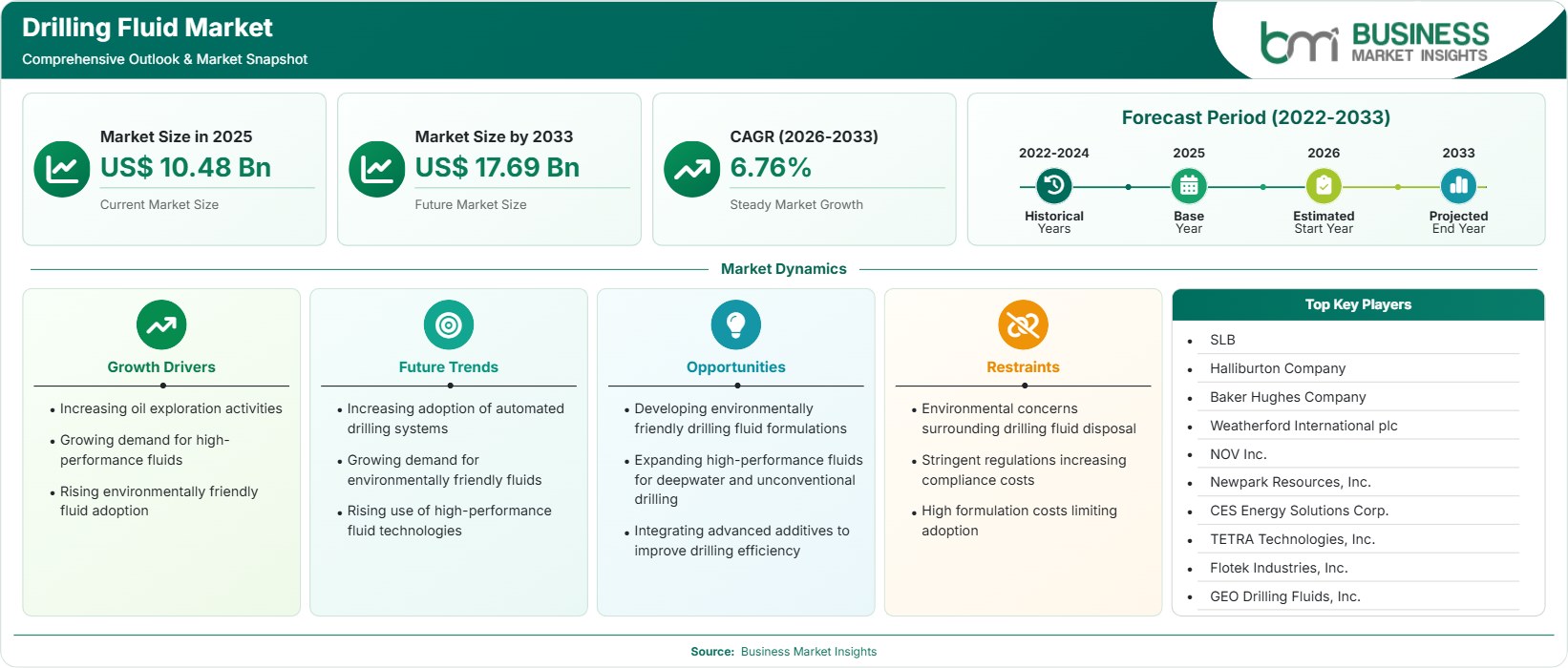
The Drilling Fluid Market size was valued at US$ 10.48 Billion in 2025 and is projected to reach US$ 17.69 Billion by 2033, growing at a CAGR of 6.76% during 2026–2033. Rising oil and gas exploration activities, increasing demand for high-performance drilling systems, and greater adoption of environmentally responsible fluid technologies are supporting industry expansion. Key opportunities include deepwater drilling growth, unconventional resource development, and advanced fluid-additive innovations.

Report Coverage
  • Type: Water-based, Oil-based, Synthetic-based, Others
  • Application: Onshore, Offshore
US$ 10.48 Bn Market size in 2025
US$ 17.69 Bn Market Size by 2033
6.76% CAGR, 2026 - 2033
2026-2033 Forecast Period

01 AI Overview

Drilling Fluid Market Summary

  • North America Region: North America holds a 33%–36% share in 2025 and is projected to grow at a CAGR of 6.3%–6.8% during 2026–2033. Strong shale activity, offshore investments, drilling optimization technologies, and growing environmentally compliant fluid demand continue supporting regional development. The U.S. remains the dominant market, advancing at a CAGR of 6.4%–6.9%.
  • Fastest Growing Region: Middle East & Africa holds a 17%–20% share in 2025 and is expected to register a CAGR of 7.5%–8.1% during 2026–2033. Expanding upstream investments, enhanced recovery projects, offshore developments, and national energy strategies are creating substantial opportunities.
  • Leading Segment: Water-based fluids account for 45%–49% share in 2025 and are projected to grow at a CAGR of 6.4%–6.9% during 2026–2033. Cost efficiency, regulatory acceptance, lower environmental impact, and broad application suitability continue supporting adoption.
  • High Growth Segment: Offshore applications represent 30%–34% share in 2025 and are projected to grow at a CAGR of 7.4%–7.9% during 2026–2033. Deepwater projects, complex reservoir exploration, and increasing energy demand are accelerating deployment.
  • Key Market Opportunity: Development of sustainable drilling fluid formulations combined with advanced additive technologies is creating new value opportunities across deepwater, high-pressure, and unconventional drilling environments.
  • Major Market Players: SLB, Halliburton Company, Baker Hughes Company, Weatherford International plc, NOV Inc., Newpark Resources, Inc., CES Energy Solutions Corp., TETRA Technologies, Inc., Flotek Industries, Inc., GEO Drilling Fluids, Inc.
02 Strategic Insights

Drilling Fluid Market: Strategic Insights

Drilling Fluid Market Strategic Framework
FREE PDF
Request your free sample
Request free sample
03 Stakeholder View

Key Takeaways

  • Supply chain resilience and specialty chemical availability have become critical competitive factors across drilling-fluid manufacturing and distribution networks.
  • Offshore drilling applications offer the strongest long-term revenue potential due to increasing deepwater and ultra-deepwater investments.
  • Development of low-toxicity and biodegradable fluid systems is emerging as a key technology focus area.
  • The Middle East presents a compelling investment destination due to extensive upstream expansion projects and national production targets.
  • Strategic partnerships between fluid suppliers and oilfield service providers are strengthening market consolidation trends.
04 Geographic Outlook

Drilling Fluid Market Regional Highlights

North America Drilling Fluid Market

North America accounted for 33%–36% share in 2025 and is projected to grow at a CAGR of 6.3%–6.8% during 2026–2033. The region remains the largest Drilling Fluid Market share due to extensive unconventional drilling activities, strong oilfield service infrastructure, and continuous investments in advanced drilling technologies. Rising well complexity, increasing lateral lengths, and growing use of high-performance drilling systems continue to create demand for advanced fluid formulations. Environmental compliance requirements and drilling optimization initiatives are further encouraging the adoption of specialized drilling fluid solutions across upstream operations.

  • The Permian Basin continues to drive fluid consumption through sustained drilling activity, increasing horizontal well development, and investments in productivity enhancement programs across major shale formations.
  • Operators are increasingly utilizing advanced drilling fluid chemistries that improve wellbore stability, reduce formation damage, and enhance drilling efficiency in challenging geological environments.
  • Growing adoption of real-time drilling analytics is supporting the use of customized fluid systems designed to improve operational performance and lower overall drilling costs.
  • Environmental considerations are accelerating demand for fluid recycling technologies and formulations with improved environmental profiles across drilling and completion operations.
  • Canada continues to contribute significantly through natural gas exploration and oil sands development projects requiring specialized drilling fluid systems for demanding operating conditions.

US Drilling Fluid Market

The United States represented 74%–78% of North American demand in 2025 and is expected to register a CAGR of 6.4%–6.9% during 2026–2033. Strong shale exploration activity, growing investments in unconventional hydrocarbon production, and increasing deployment of horizontal drilling techniques continue to strengthen fluid demand. Operators are focusing on technologies that minimize non-productive time while maximizing drilling efficiency and reservoir performance in Drilling Fluid Market.

  • The Permian Basin remains the dominant consumption hub due to large-scale drilling programs and continuous expansion of unconventional oil and gas production activities.
  • Increased development of extended-reach wells is supporting demand for drilling fluids capable of delivering enhanced lubrication and superior thermal stability.
  • Oilfield operators continue investing in premium fluid solutions that improve cuttings transport, pressure management, and drilling performance in complex formations.
  • Digital drilling technologies are improving fluid optimization by enabling real-time monitoring and better decision-making during drilling operations.

Europe Drilling Fluid Market

Europe held 18%–21% share in 2025 and is anticipated to expand at a CAGR of 5.8%–6.3% during 2026–2033. Offshore exploration activity in the North Sea remains the primary source of demand, while increasingly stringent environmental regulations continue to influence product selection and fluid management practices in Drilling Fluid Market. Operators are focusing on sustainable drilling practices and enhanced operational performance.

  • Norway represents the leading country market owing to significant offshore development activity and continued investments in upstream energy projects.
  • The United Kingdom continues to generate demand through mature field redevelopment programs, offshore drilling operations, and enhanced recovery initiatives.
  • Environmental regulations are encouraging the adoption of biodegradable and low-toxicity drilling fluid products throughout offshore operations.
  • Advanced waste-management and fluid-recovery technologies are gaining traction as operators seek improved compliance with environmental standards.
  • Denmark and the Netherlands are emerging as higher-growth opportunities, supported by offshore exploration activities and increased investment in energy security initiatives.

Asia Pacific Drilling Fluid Market

Asia Pacific accounted for 24%–27% Drilling Fluid Market share in 2025 and is projected to grow at a CAGR of 6.9%–7.4% during 2026–2033. Increasing energy demand, expanding offshore developments, and rising investments in domestic hydrocarbon production continue to support market growth. National efforts to improve energy security are encouraging exploration and production activities across several countries, creating strong demand for drilling fluid technologies.

  • China remains the largest regional market due to significant investments in conventional and unconventional oil and gas exploration activities.
  • India is among the fastest-growing markets, supported by upstream investment programs and government initiatives aimed at increasing domestic production capacity.
  • Australia continues to create demand through offshore gas developments and deepwater exploration projects requiring premium fluid systems.
  • Indonesia and Malaysia are expanding offshore drilling operations, generating opportunities for advanced drilling fluids capable of operating under complex geological conditions.
  • High-performance water-based and synthetic-based fluids are gaining popularity due to growing requirements for environmental compliance and drilling efficiency.

Rest of World Drilling Fluid Market

The Rest of World region accounted for 17%–20% share in 2025 and is forecast to advance at a CAGR of 7.5%–8.1% during 2026–2033, making it the fastest-growing regional segment. Expanding upstream investments across the Middle East, Africa, and Latin America continue to create substantial opportunities for drilling fluid suppliers. National oil companies are increasing exploration and production activities to strengthen energy output and export capabilities in Drilling Fluid Market forecasts.

  • Saudi Arabia remains the region's largest market, supported by extensive drilling programs, production capacity expansion plans, and long-term hydrocarbon development strategies.
  • The United Arab Emirates is emerging as a high-growth market due to offshore developments and investments in technologically advanced drilling operations.
  • Brazil continues to drive demand through pre-salt and deepwater exploration activities requiring high-performance drilling fluid formulations.
  • Several African countries are increasing exploration spending, generating opportunities for fluid suppliers across both offshore and onshore projects.
  • Enhanced recovery programs and development of technically complex reservoirs are supporting demand for premium drilling fluid solutions throughout the region.
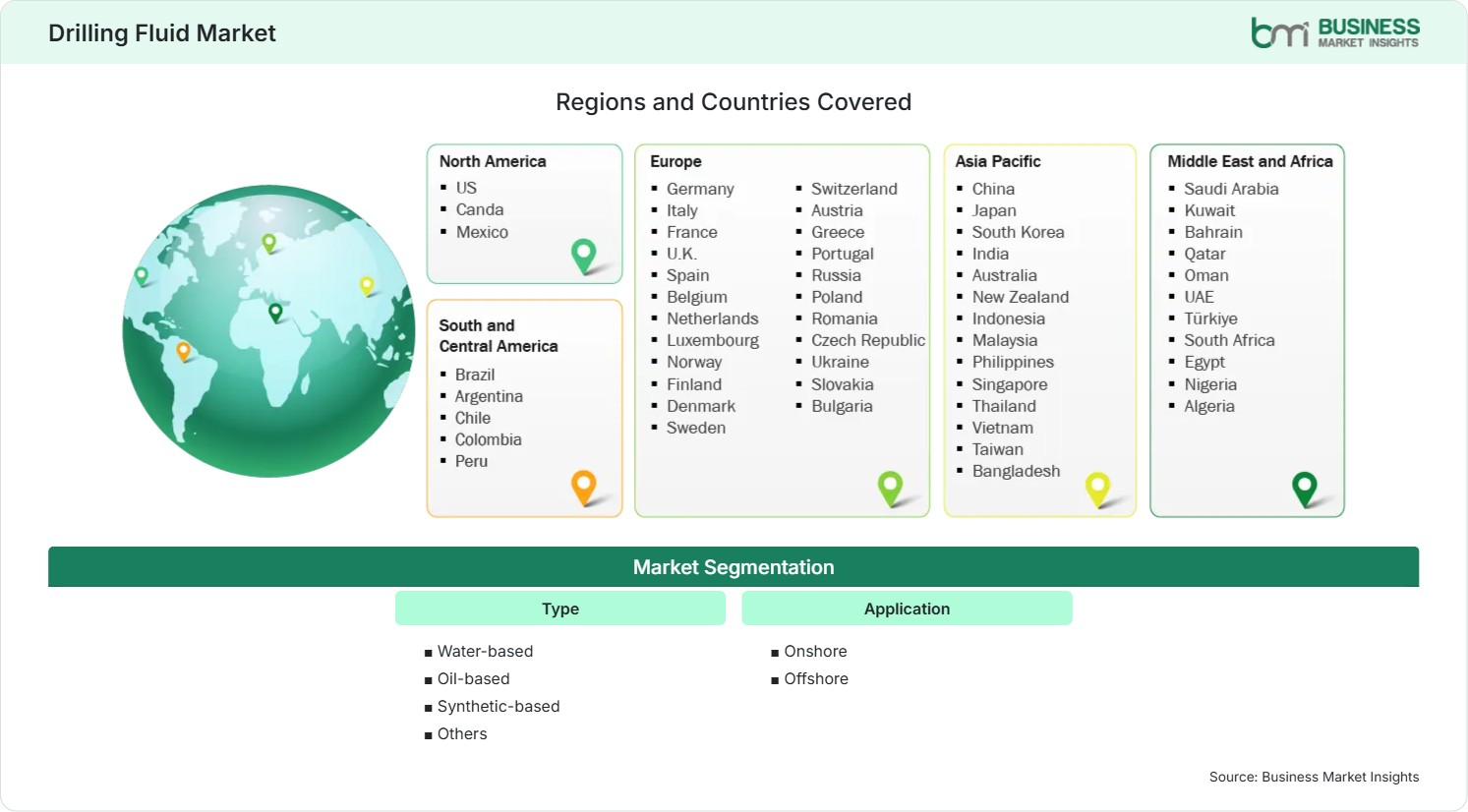
Global Market Geography
FREE PDF
Request your free sample
Request free sample
05 Segment Analysis

Drilling Fluid Market Segmentation

Type

The Type segment constitutes the foundation of product demand across drilling operations. Water-based fluids remain the leading category, accounting for 45%–49% share in 2025 and projected to grow at a CAGR of 6.4%–6.9% during 2026–2033. The segment benefits from operational versatility, cost-effectiveness, and increasing environmental acceptance. As drilling activities become more complex, operators are selecting fluid systems based on formation characteristics, regulatory requirements, thermal stability needs, and drilling performance objectives. The Drilling Fluid Market scope continues expanding through technological innovation across all fluid categories.

  • Water-based: Widely preferred across conventional and unconventional drilling projects due to lower costs, environmental compatibility, effective cuttings transport capabilities, and continuous improvements in fluid chemistry enhancing overall drilling performance.
  • Oil-based: Extensively utilized in complex drilling environments requiring superior lubrication, shale inhibition, thermal stability, and wellbore integrity, particularly in challenging formations with high pressure and temperature conditions.
  • Synthetic-based: Increasing adoption in offshore and environmentally sensitive regions due to excellent drilling performance, lower toxicity profiles, strong lubrication properties, and improved environmental compliance compared with conventional alternatives.

Application

Application demand is primarily driven by onshore drilling activities, which account for 66%–70% share in 2025 and are expected to maintain strong growth throughout the forecast period. However, offshore drilling represents the fastest-growing application segment, advancing at a CAGR of 7.4%–7.9% during 2026–2033. The Drilling Fluid Market trends indicate increasing deployment of advanced fluid systems capable of addressing deepwater challenges, extended-reach wells, and unconventional resource development requirements. Growing investments in exploration and production continue supporting both application categories.

  • Onshore: Dominates demand due to extensive shale exploration, conventional oilfield development, lower operational costs, and increasing deployment of horizontal drilling technologies across major producing regions globally.
  • Offshore: Experiencing rapid growth as deepwater and ultra-deepwater exploration projects increase demand for high-performance drilling fluids capable of delivering operational efficiency under complex geological conditions.
06 Market Forces

Drilling Fluid Market Dynamics

Key Market Drivers

Increasing Oil Exploration Activities

Rising global energy consumption and the need to maintain hydrocarbon production levels are encouraging national oil companies and private operators to expand exploration and drilling programs. Increased investment in conventional, deepwater, and unconventional reservoirs is directly supporting demand for drilling fluids that improve borehole stability, cooling, lubrication, and cuttings transport. Operators are increasingly focusing on maximizing drilling efficiency and reducing non-productive time, creating demand for technically advanced fluid systems. Growing exploration activities across North America, the Middle East, Latin America, and Asia Pacific continue to support fluid consumption. As producers seek to access more complex reserves, drilling fluids are becoming increasingly important for ensuring operational reliability, reservoir protection, and cost-effective well construction throughout the drilling lifecycle.

Growing Demand for High-Performance Fluids

Increased drilling environments have created a need for advanced drilling fluid systems that can withstand high pressure and high temperature. Drilling operations today include extended horizontal wells, deep wells and difficult geology which needs better drilling fluid properties. Improved rheological properties, filtration, stability of the well bore and increased lubrication is being sought using better formulations. These formulations help minimize equipment wear, prevent stuck-pipe problems, and improve the drilling process. Increased drilling rates and reduced operational risks have made advanced drilling fluids more attractive and valuable for both onshore and offshore projects.

Rising Environmentally Friendly Fluid Adoption

Environmental sustainability has become a major concern for exploration and production firms, leading to the development of environmentally friendly drilling fluid technologies. There has been an increasing demand for products that are non-toxic, biodegradable, and environmentally friendly. This has been seen mostly in offshore and environmentally fragile areas, where discharge rules help determine the type of product selected. Firms have introduced new technologies focused on ensuring the product performs well in drilling operations while remaining environmentally friendly. Water-based and synthetic-based technologies have become more popular because they support operational needs and environmental sustainability.

Key Market Opportunities

Developing Environmentally Friendly Drilling Fluid Formulations

The transition toward sustainable drilling operations presents significant opportunities for fluid manufacturers. Exploration companies increasingly seek products that comply with environmental regulations while maintaining high levels of operational performance. This trend is creating demand for biodegradable additives, renewable raw-material technologies, and low-toxicity fluid systems. Suppliers capable of delivering environmentally responsible solutions can strengthen their competitive position and expand market access. Growing offshore developments and operations in environmentally regulated regions provide additional opportunities for innovation. As sustainability becomes an important purchasing criterion, manufacturers are expected to increase research and development spending to create products that balance performance, regulatory compliance, and environmental stewardship throughout drilling operations.

Expanding High-Performance Fluids for Deepwater and Unconventional Drilling

The expansion in deepwater exploration and production of unconventional resources is creating significant demand for high-end drilling fluids. Complex reservoirs necessitate advanced drilling fluids that can withstand high temperatures and pressures, handle complex operations, and ensure efficient drilling. Deepwater exploration requires advanced drilling fluids to ensure that wellbores remain stable and to reduce operational risks. Increased exploration efforts in offshore basins, shale formations, and complex reservoirs are creating prospects for premium drilling fluid companies. Those drilling fluid companies that offer high-end thermal stability, lubricating features, and filtration control are set to capitalize on the growing demand.

Integrating Advanced Additives to Improve Drilling Efficiency

Continuous advancements in drilling chemistry are creating opportunities for suppliers to enhance overall well performance. New additive technologies can improve cuttings transport, reduce torque and drag, optimize pressure control, and enhance wellbore stability. Operators are becoming aware of the commercial importance of drilling fluids that are unlikely to cause drilling complications, thereby reducing non-productive time. There is an increased need for customized products as drilling projects become more complex. Additionally, additives can enhance the longevity of fluid systems and their performance across varied geological formations. This presents an opportunity for companies to brand their products and develop good client relationships.

Market Restraints and Challenges

Environmental Concerns Surrounding Drilling Fluid Disposal

Factor: the generation of drilling waste, contaminated cuttings, and spent fluid systems requires careful treatment and disposal procedures to meet environmental requirements. Impact: operators often face increased operational costs, additional waste-management investments, and longer project timelines due to disposal obligations. Regulations governing waste discharge continue becoming more stringent across several jurisdictions, increasing compliance complexity. Companies are required to invest in fluid recovery systems, recycling technologies, and environmentally acceptable formulations to mitigate risks. While sustainable products help reduce environmental impact, disposal-related challenges continue influencing project economics and operational decision-making throughout the drilling industry.

Stringent Regulations Increasing Compliance Costs

Factor: governments and environmental agencies are implementing stricter standards related to chemical composition, toxicity profiles, transportation procedures, and waste management practices. Impact: compliance increases product development costs, testing requirements, certification expenses, and operational complexity. Manufacturers must continuously update product formulations to align with changing regulations while maintaining performance standards demanded by end users. Smaller suppliers may face additional barriers due to limited resources available for research, certification, and compliance activities. As regulatory oversight expands globally, companies are expected to allocate greater resources toward quality assurance, environmental monitoring, and compliance management programs.

07 Company Analysis

Competitive Landscape

The Drilling Fluid Market analysis reflects a competitive environment characterized by global oilfield service providers, specialty chemical manufacturers, and drilling-fluid specialists focused on enhancing drilling efficiency, wellbore stability, environmental compliance, and operational performance. Market participants are increasingly investing in sustainable fluid technologies, advanced additives, digital monitoring capabilities, and customized solutions for deepwater and unconventional drilling applications.

Company Name

Overview

Products and Services Relevant to the Market

SLB

Global oilfield technology leader providing integrated drilling solutions across conventional, offshore, and unconventional operations worldwide.

Water-based fluids, synthetic-based fluids, drilling optimization services, fluid engineering, and well construction solutions.

Halliburton Company

Major energy services provider offering comprehensive drilling and completion technologies for complex upstream projects.

Baroid drilling fluids, fluid additives, waste management solutions, drilling optimization technologies, and engineering services.

Baker Hughes Company

International energy technology company serving onshore and offshore drilling operations across multiple regions.

Specialty drilling fluids, fluid performance technologies, drilling chemicals, reservoir protection solutions, and consulting services.

Weatherford International plc

Oilfield services company specializing in well construction, drilling optimization, and production enhancement solutions.

Drilling fluid systems, engineered additives, wellbore stabilization products, and fluid management services.

NOV Inc.

Leading provider of equipment, technologies, and services supporting upstream drilling activities globally.

Drilling fluid processing equipment, solids control technologies, fluid handling systems, and drilling support services.

Newpark Resources, Inc.

Specialized provider of environmentally focused drilling and completion fluid solutions.

Water-based systems, specialty additives, fluid engineering services, and waste-management technologies.

CES Energy Solutions Corp.

Supplier of advanced consumable chemical solutions for oilfield applications across North America.

Drilling fluids, completion chemicals, production chemicals, and customized fluid formulations.

TETRA Technologies, Inc.

Energy services company focused on completion fluids, water management, and specialty chemistry products.

Drilling fluid additives, calcium chloride products, water treatment solutions, and engineered chemical technologies.

Flotek Industries, Inc.

Chemistry-focused technology company supporting upstream drilling and production performance improvement.

Specialty drilling additives, fluid chemistry solutions, data-driven performance technologies, and reservoir enhancement services.

GEO Drilling Fluids, Inc.

Independent drilling fluid company serving operators across diverse onshore and offshore environments.

Customized drilling fluids, fluid engineering services, solids-control support, and drilling performance optimization services.

10 Trust & Transparency

Research Methodology

The market analysis combines proprietary research with secondary data from government agencies, company disclosures, regulatory filings, industry databases and expert interviews. Market estimates are validated through data triangulation, cross-market benchmarking and analyst review.

View Full Research Methodology

11 Questions Answered

Frequently Asked Questions

What challenges affect drilling fluid suppliers?

Major challenges include environmental concerns associated with fluid disposal, increasingly stringent regulatory requirements, fluctuating raw-material costs, and the need to develop advanced products that balance performance, sustainability, and compliance objectives.

Which region leads the global Drilling Fluid Market?

North America remains the leading regional market due to extensive shale development, a mature oilfield services ecosystem, advanced drilling technologies, and sustained exploration and production investments.

Why is offshore drilling considered a high-growth application?

Offshore projects increasingly involve deepwater and ultra-deepwater reservoirs that require specialized drilling fluid systems capable of operating under extreme temperature and pressure conditions while maintaining drilling safety and efficiency.

Which type segment dominates the Drilling Fluid Market report?

Water-based drilling fluids represent the largest segment because of their lower environmental impact, cost-effectiveness, regulatory acceptance, and suitability across a broad range of drilling applications.

What factors are driving demand for drilling fluids?

Growth is primarily supported by increased oil and gas exploration activity, expanding offshore developments, rising unconventional resource extraction, and the growing need for high-performance fluid systems capable of improving drilling efficiency and wellbore stability.

Access the Full Drilling Fluid Market Report

Get segment-level forecasts, regional estimates, competitive benchmarking, company profiles and downloadable Excel datasets.

Access the full Drilling Fluid Market Report
350 pages PDF & Excel | 2026-08-24