Market Summary
Executive Summary and Global Market Analysis
Polycrystalline diamond compact drill bits represent rotary cutting tools engineered with synthetic diamond cutters bonded onto tungsten carbide substrates for subsurface drilling operations. These tools are designed to enhance penetration efficiency in hard rock formations while maintaining structural stability under high-pressure drilling environments across energy and resource extraction activities.
Adoption patterns are closely linked to sustained drilling activity across hydrocarbon exploration and underground resource development. Operators prioritize drilling efficiency, reduced tool replacement cycles, and improved rate of penetration when selecting advanced cutting solutions. Demand is further shaped by deeper well architectures and more complex geological formations requiring durable and thermally stable drilling components.
Application diversity significantly defines market structure, with oil and gas drilling forming the dominant utilization base. Mining operations contribute steady demand due to continuous ore extraction requirements, while geothermal and water well drilling segments reflect expanding non-conventional usage. Infrastructure drilling introduces additional consumption linked to tunneling and foundation development activities.
Engineering advancements in cutter geometry, thermal resistance, and hydraulic optimization are reshaping product capabilities. Manufacturers are focusing on wear-resistant matrix compositions and enhanced chip evacuation designs to improve operational lifespan. These improvements support more efficient drilling cycles in both conventional and high-hardness formation environments.
Competitive dynamics reflect strong emphasis on performance differentiation and field reliability. Suppliers invest in application-specific bit designs tailored to formation characteristics and drilling depth requirements. Continuous innovation in material science and cutter integration techniques reinforces product positioning within increasingly demanding drilling operations worldwide.
Segment Analysis
PDC Drill Bit Market Segmentation
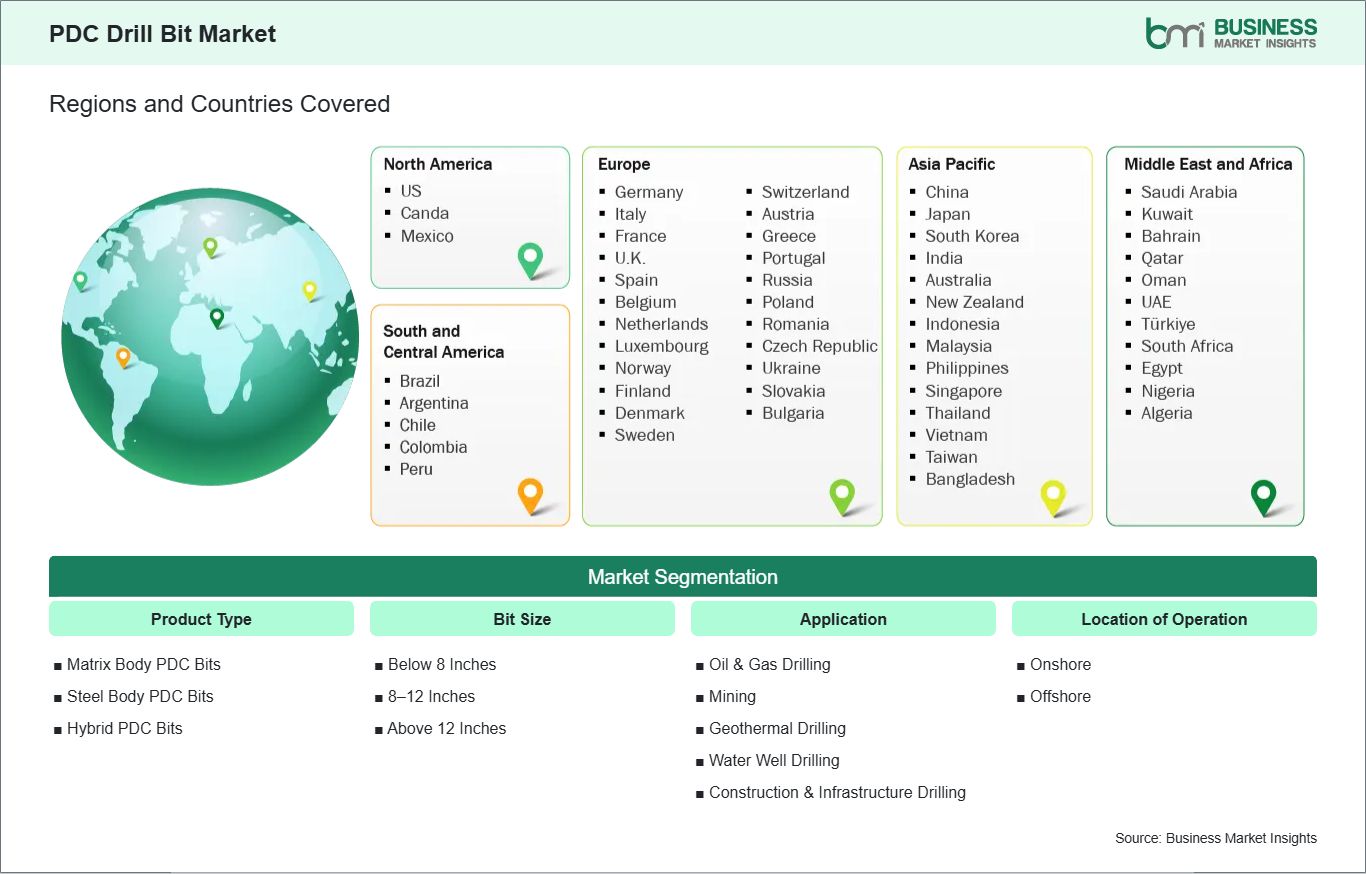
The PDC drill bit market is segmented based on product type, bit size, application, and location of operation, reflecting its critical role in modern oil, gas, mining, and geothermal exploration drilling operations.
By Product Type
- Matrix Body PDC Bits: Optimized for abrasive and hard rock formations.
- Steel Body PDC Bits: Deliver improved impact resistance in varied drilling conditions.
- Hybrid PDC Bits: Combine durability and cutting efficiency for mixed formations.
By Bit Size
- Below 8 Inches: Used in precision drilling and directional applications.
- 8–12 Inches: Supports standard oilfield drilling operations.
- Above 12 Inches: Applied in large-diameter borehole construction projects.
By Application
- Oil & Gas Drilling: Primary utilization across exploration and production wells.
- Mining: Supports continuous ore extraction and deep drilling activities.
- Geothermal Drilling: Enables high-temperature subsurface energy access.
- Water Well Drilling: Facilitates groundwater extraction projects.
- Construction & Infrastructure Drilling: Used in tunneling and foundation works.
By Location of Operation
- Onshore: Widely deployed across land-based drilling sites.
- Offshore: Utilized in deepwater and subsea exploration environments
Market Forces
PDC Drill Bit Market Drivers and Opportunities
Expansion of Deep and Complex Well Drilling Activities
Growing drilling depth requirements in hydrocarbon exploration have intensified reliance on high-performance cutting tools. Operators face increased formation hardness, pressure variability, and thermal stress conditions during extended well construction. These operational complexities necessitate drill bits capable of maintaining structural integrity and cutting efficiency across prolonged drilling cycles.
This shift has reinforced adoption of PDC drill bits with advanced cutter configurations and optimized hydraulic designs. The need for improved penetration rates and reduced non-productive time has influenced procurement decisions across upstream operations. As drilling projects extend into deeper reservoirs, equipment durability and performance consistency remain central considerations for operational planning.
Advancements in Cutter Technology and Formation-Specific Designs
Innovation in cutter materials and bit architecture is enabling improved adaptability across heterogeneous formations. Enhanced synthetic diamond structures and refined blade geometries support better wear resistance and thermal stability. These developments allow operators to address drilling challenges in abrasive, interbedded, and high-compression rock environments more effectively.
Future opportunities are emerging from formation-specific bit customization and digital drilling optimization tools. Integration of performance monitoring with bit design selection is improving operational precision and efficiency. As drilling environments become more technically demanding, tailored PDC solutions are expected to expand across energy, mining, and geothermal applications.
Size and Share Analysis
PDC Drill Bit Market Size and Share Analysis
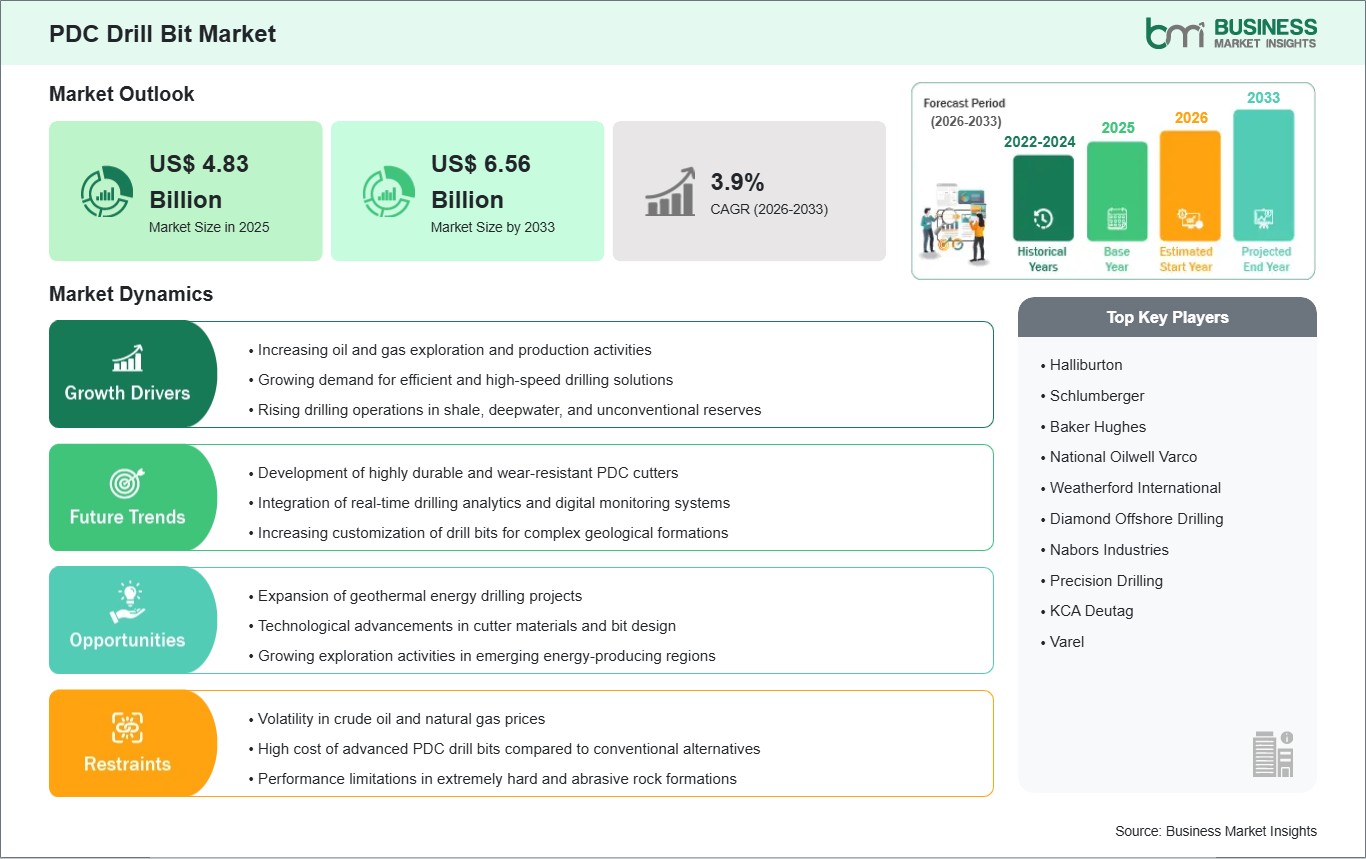
The PDC drill bit market was valued at USD 4.83 Billion in 2025 and is projected to reach USD 6.56 Billion by 2033, registering a CAGR of 3.9% during 2026 - 2033. Market expansion reflects steady drilling activity across energy and mineral extraction sectors alongside gradual adoption of high-efficiency cutting technologies.
Among product categories, matrix body configurations maintain strong positioning due to their suitability for abrasive and hard formations. Steel body variants retain relevance in applications requiring higher impact resistance and operational flexibility across variable drilling conditions.
Oil and gas drilling remains the leading application segment, supported by continuous upstream exploration and production activities. Mining operations and geothermal drilling contribute additional demand as resource extraction expands into deeper and more complex geological environments.
Report Coverage
PDC Drill Bit Market Report Coverage and Deliverables
The "PDC Drill Bit Market Size and Forecast (2022:2033)" report provides a detailed analysis of the market covering below areas:
- Market size and forecast at global, regional, and country levels for all market segments covered under the scope
- Market trends, as well as drivers, restraints, and opportunities
- Market analysis covering key trends, global and regional framework, major players, regulations, and recent developments
- Industry landscape and competition analysis covering market concentration, heat map analysis, prominent players, and recent developments for the market
- Detailed company profiles, including SWOT analysis
Geographic Insights
PDC Drill Bit Market Geographic Insights
The PDC Drill Bit market shows diverse regional adoption patterns influenced by drilling intensity, energy exploration strategies, mineral extraction activity, and infrastructure development requirements. Across global drilling operations, demand patterns vary based on formation complexity and depth-driven engineering needs. Equipment selection practices increasingly prioritize durability and efficiency across both conventional and unconventional drilling environments.
North America demonstrates strong utilization supported by extensive shale development and advanced drilling infrastructure. Operators in the region focus on optimizing well productivity through high-performance drilling tools designed for complex geological formations. Continuous technological refinement across upstream operations further strengthens equipment deployment consistency.
Asia Pacific reflects growing drilling activity driven by expanding energy demand and mining operations. Infrastructure development and geothermal exploration also contribute to broader adoption across regional markets. Equipment requirements are increasingly aligned with deeper drilling targets and heterogeneous formation conditions.
Europe maintains steady utilization across energy transition projects and geothermal expansion initiatives. Emerging regions across the Middle East, Africa, and South America continue to develop drilling capacity supported by resource exploration activities. These regions present evolving demand landscapes shaped by operational depth requirements and geological variability.
Industry Activity
Recent Developments
The PDC drill bit market is evaluated by gathering qualitative and quantitative data post primary and secondary research, which includes important corporate publications, association data, and databases. Recent developments and news in the market include:
- May 2026, Several North American drill bit manufacturers accelerated the transition toward steel-body PDC drill bits as tungsten prices surged due to supply constraints and trade restrictions. The move is expected to reduce manufacturing costs while maintaining drilling performance in many shale and conventional drilling applications.
- April 2026, Halliburton acquired Sekal AS to enhance its drilling automation capabilities. The acquisition combines Halliburton's drilling technologies with Sekal's automation platform, helping operators optimize drilling performance and reduce well construction costs, which directly supports PDC bit efficiency and utilizatio.
Trust & Transparency
Research Methodology
The market analysis combines proprietary research with secondary data from government agencies, company disclosures, regulatory filings, industry databases and expert interviews. Market estimates are validated through data triangulation, cross-market benchmarking and analyst
review.
View Full Research Methodology
Key Sources Referred:
World Bank – Global Trade Indicators World Trade Organization (WTO) (International Monetary Fund )IMF International Trade Administration (ITA) Company website Company annual reports Company investor presentations