
Nylon Market Outlook: Size, Share, Trends, Growth Analysis, Competitive Landscape & Forecast, 2026-2033

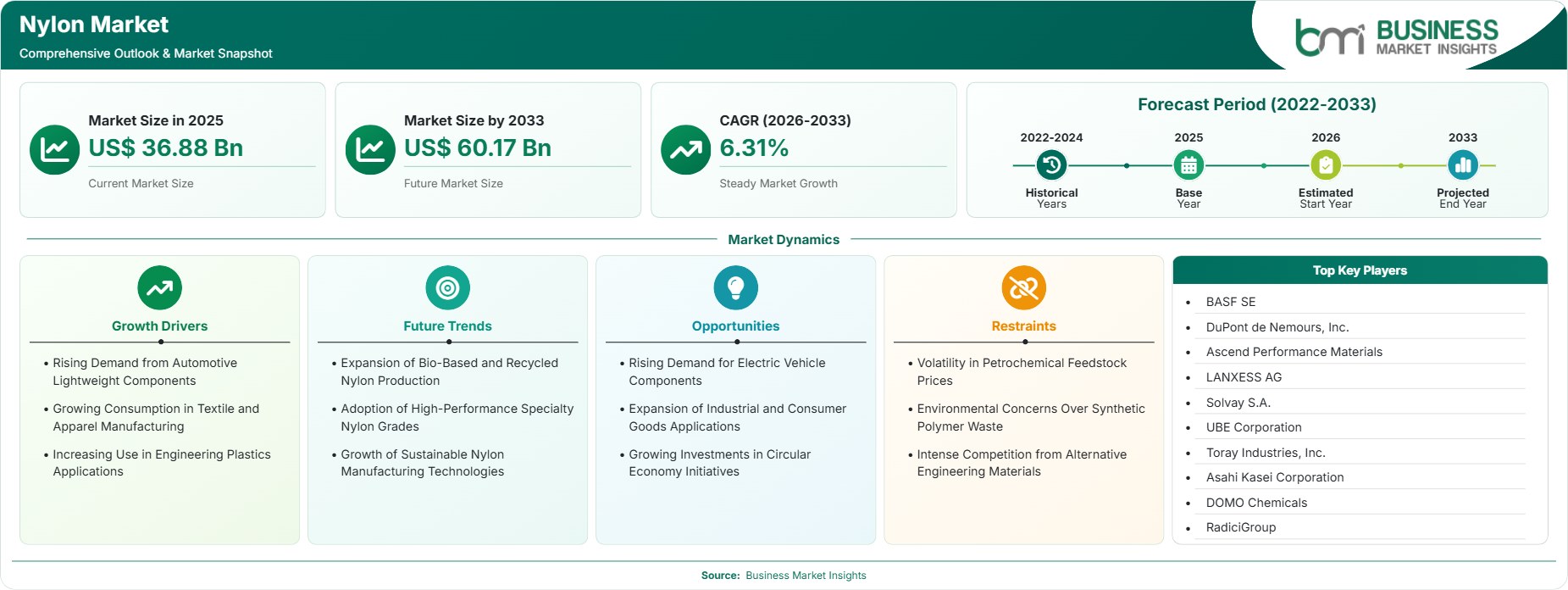
The Nylon Market size was valued at US$ 36.88 Billion in 2025 and is projected to reach US$ 60.17 Billion by 2033, growing at a CAGR of 6.31% during 2026–2033. Rising demand for lightweight engineering plastics, increasing automotive production, growing adoption across electrical and electronics applications, and expanding industrial manufacturing activities are supporting market growth globally.

Report Coverage
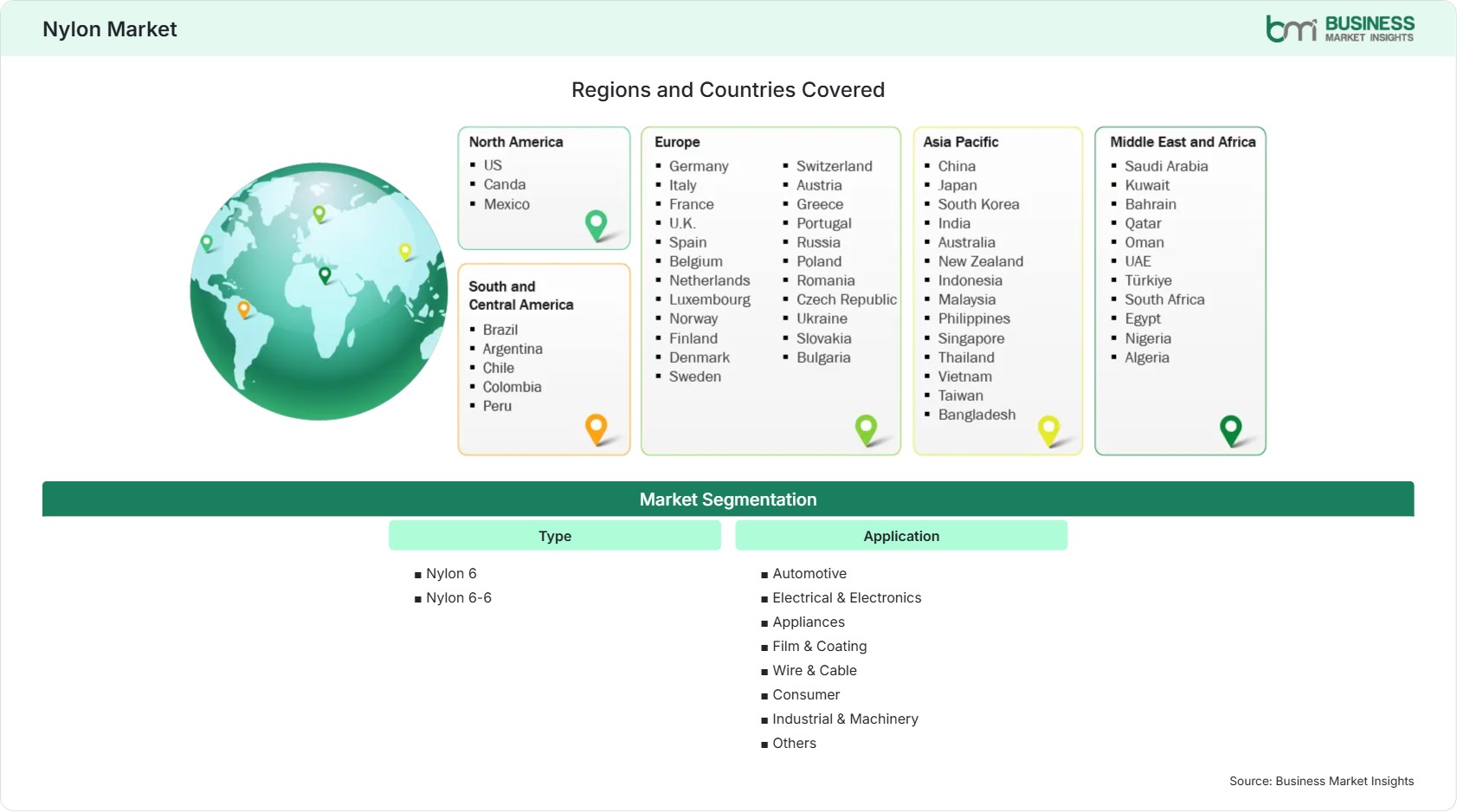
  • Type: Nylon 6, Nylon 6-6
  • Application: Automotive, Electrical & Electronics, Appliances, Film & Coating, Wire & Cable, Consumer, Industrial & Machinery, Others
US$ 36.88 Bn Market size in 2025
US$ 60.17 Bn Market Size by 2033
6.31% CAGR, 2026 - 2033
2026-2033 Forecast Period

AI Overview

Nylon Market Summary

  • North America Region: North America holds a nylon market share of 34%–37% in 2025, growing with a CAGR of 5.8%–6.5% during 2026–2033. Strong demand from automotive, industrial machinery, and electrical applications continues supporting regional leadership. The U.S. market is expected to register a CAGR of 6.0%–6.7%.
  • Fastest Growing Region: Asia Pacific accounts for 31%–34% share in 2025 and is projected to grow at a CAGR of 6.8%–7.5% through 2033. Expanding manufacturing activities, increasing automotive production, and rising electronics demand continue driving regional growth.
  • Leading Segment: Nylon 6 represents 56%–59% share in 2025 and is expected to grow at a CAGR of 6.2%–6.9% through 2033. Its cost-effectiveness, versatility, and broad industrial applicability continue supporting segment dominance.
  • High Growth Segment: Automotive accounts for 28%–31% share in 2025 and is forecast to grow at a CAGR of 6.7%–7.4% during 2026–2033. Rising demand for lightweight materials and fuel-efficient vehicle components continues accelerating segment growth.
  • Key Market Opportunity: Expansion of electric vehicle manufacturing, industrial automation, and high-performance engineering plastic applications is creating significant growth opportunities.
  • Major Market Players: BASF SE, Lanxess, Huntsman International LLC, AdvanSix, Ube Industries Ltd., Domo Chemicals, TORAY INDUSTRIES, INC., Ashley Polymers, Inc., Ascend Performance Materials, and TOYOBO CO., LTD.
Strategic Insights

Nylon Market: Strategic Insights

Nylon Market Strategic Framework
FREE PDF
Request your free sample
Request free sample
Stakeholder View

Key Takeaways

  • Nylon remains a critical engineering plastic used across automotive, industrial, electrical, and consumer applications.
  • Nylon 6 continues dominating the nylon market due to its versatility, cost-effectiveness, and broad applicability.
  • Automotive remains the largest application segment as manufacturers prioritize lightweight vehicle components.
  • Engineering plastics are increasingly replacing metal components across multiple industries.
  • Electrical and electronics applications continue generating significant demand for high-performance nylon products.
  • North America remains the leading market due to strong industrial and automotive manufacturing activities.
  • Asia Pacific is projected to witness the fastest growth owing to expanding manufacturing and automotive production.
  • Electric vehicles and industrial automation are expected to create substantial future growth opportunities.
Geographic Outlook

Nylon Market Regional Highlights

North America Nylon Market

North America accounts for 34%–37% Nylon Market share in 2025 and is projected to grow at a CAGR of 5.8%–6.5% through 2033. Strong automotive production, expanding industrial manufacturing, and increasing demand for engineering plastics continue supporting regional leadership. The region also benefits from advanced polymer processing capabilities and growing adoption of lightweight materials.

  • Automotive manufacturers are increasingly utilizing nylon components to reduce vehicle weight, improve fuel efficiency, and support evolving performance requirements.
  • Industrial equipment producers continue adopting nylon materials for mechanical components requiring durability, wear resistance, and long operational lifecycles.
  • Growing investments in electric vehicle manufacturing are creating additional demand for high-performance nylon products and specialty engineering plastics.
  • Electrical and electronics manufacturers are increasingly utilizing nylon materials because of their insulation properties and mechanical strength.
  • Product innovation initiatives continue encouraging development of advanced nylon grades designed for specialized industrial and transportation applications.
  • Sustainability initiatives are supporting research into recyclable and bio-based nylon materials for long-term environmental performance improvements.

US Nylon Market

The United States contributes approximately 85%–89% of North American revenue and is expected to register a CAGR of 6.0%–6.7% through 2033. Strong industrial activity, substantial automotive production, and growing adoption of engineering plastics continue supporting market leadership.

  • Automotive suppliers continue adopting advanced nylon materials to improve component performance and reduce overall vehicle weight.
  • Industrial automation investments are increasing utilization of durable polymer components across manufacturing environments.
  • Demand for electrical and electronic equipment continues supporting consumption of high-performance nylon grades.
  • Advanced manufacturing technologies are encouraging broader implementation of engineered polymer solutions.
  • Growing electric vehicle production remains a major contributor to nylon demand across transportation applications.

Europe Nylon Market

Europe represents 24%–27% of global revenue in 2025 and is anticipated to expand at a CAGR of 6.0%–6.7% through 2033. Strong automotive manufacturing capabilities, increasing sustainability initiatives, and demand for advanced engineering materials continue supporting regional growth. Germany remains the leading market while Poland demonstrates stronger growth momentum.

  • Germany continues leading regional demand through its extensive automotive manufacturing sector and advanced industrial production capabilities.
  • Poland is among the fastest-growing markets and is estimated to register a CAGR of 6.9%–7.6% during the forecast period due to expanding manufacturing investments.
  • Automotive manufacturers are increasingly utilizing nylon materials to support lightweighting strategies and regulatory efficiency requirements.
  • Growing demand for advanced electrical equipment continues supporting nylon consumption across industrial and commercial applications.
  • Sustainability objectives are encouraging development of recyclable and environmentally responsible nylon solutions.
  • Industrial modernization initiatives continue creating new application opportunities for engineered polymer materials.

Asia Pacific Nylon Market

Asia Pacific accounts for 31%–34% of global revenue in 2025 and is expected to achieve the fastest CAGR of 6.8%–7.5% through 2033. Expanding manufacturing activities, increasing automotive production, and rising electronics demand continue supporting strong regional growth. Rapid industrialization and infrastructure development are further strengthening market opportunities.

  • China remains the largest regional market due to its extensive manufacturing base, automotive production capacity, and growing engineering plastics demand.
  • India is projected to achieve approximately 7.4%–8.1% CAGR, supported by industrial expansion, automotive production growth, and increasing infrastructure investments.
  • Electrical and electronics manufacturers continue expanding production capacity, creating sustained demand for nylon materials.
  • Growing electric vehicle manufacturing activities are accelerating adoption of lightweight engineering plastics across transportation applications.
  • Industrial equipment manufacturers are increasingly utilizing nylon components for performance-critical applications.
  • Government support for manufacturing development and industrial modernization continues supporting long-term market expansion.

Rest of World Nylon Market

Rest of World accounts for 8%–11% of global revenue in 2025 and is projected to expand at a CAGR of 5.9%–6.6% through 2033. Expanding industrialization, increasing automotive activities, and growing infrastructure investments continue supporting market growth across emerging economies.

  • Brazil continues generating demand through industrial manufacturing expansion and increasing automotive component production.
  • The UAE is witnessing growing adoption of engineering plastics across construction, industrial, and infrastructure applications.
  • Saudi Arabia is expected to achieve approximately 6.6%–7.3% CAGR through 2033, supported by industrial diversification and manufacturing investments.
  • Rising demand for durable industrial materials continues driving nylon consumption across multiple sectors.
  • Infrastructure modernization programs are creating additional opportunities for engineering plastics adoption.
  • Manufacturing sector investments continue supporting long-term growth in regional nylon consumption.
Global Market Geography
FREE PDF
Request your free sample
Request free sample
Segment Analysis

Nylon Market Segmentation

Type

The type segment forms the foundation of the nylon industry, with different nylon grades offering distinct performance characteristics for industrial, automotive, textile, and consumer applications. The segment accounts for approximately 56%–59% share in 2025 and is projected to grow at a CAGR of 6.2%–6.9% through 2033. The expanding Nylon Market scope is supported by increasing demand for engineering plastics, growing replacement of metal components, and rising consumption across automotive and industrial sectors.

  • Nylon 6: Nylon 6 represents the dominant segment due to its excellent toughness, chemical resistance, ease of processing, and cost-effectiveness. The material is extensively utilized in automotive parts, industrial machinery, textiles, packaging films, and electrical components.
  • Nylon 6,6: Nylon 6,6 continues witnessing strong demand owing to its superior mechanical strength, thermal stability, wear resistance, and durability. It is widely used in high-performance automotive, industrial, and electrical applications where enhanced performance characteristics are required.

Application

Application diversity remains a major growth driver for the nylon industry as manufacturers increasingly utilize engineering plastics to improve product performance, reduce weight, and optimize manufacturing efficiency. This segment accounts for approximately 28%–31% share in 2025 and is expected to register a CAGR of 6.7%–7.4% through 2033. Current Nylon Market trends indicate increasing utilization of nylon materials across transportation, consumer goods, industrial equipment, and electrical systems.

  • Automotive: Automotive remains the largest application segment due to increasing adoption of lightweight nylon components in engine systems, under-the-hood applications, structural parts, and electric vehicle components.
  • Electrical & Electronics: The electrical and electronics sector increasingly relies on nylon materials for connectors, switches, housings, circuit protection devices, and insulation applications.
  • Appliances: Nylon continues witnessing strong demand across household and commercial appliances due to its durability, heat resistance, and mechanical performance.
  • Film & Coating: Nylon films are utilized in packaging, industrial protection, and specialty coating applications because of their strength, flexibility, and barrier properties.
  • Wire & Cable: Wire and cable manufacturers use nylon materials to enhance insulation performance, mechanical protection, and product durability.
  • Consumer: Consumer goods applications include sporting equipment, luggage, furniture components, and numerous molded plastic products.
  • Industrial & Machinery: Industrial equipment manufacturers increasingly utilize nylon for gears, bearings, rollers, bushings, and wear-resistant mechanical components.
  • Others: Additional applications include construction materials, medical devices, agricultural equipment, and specialty engineering products.
Market Forces

Nylon Market Dynamics

Key Market Drivers

Rising Demand from Automotive Lightweight Components

Automobile manufacturers have continued looking for lightweight materials that can reduce car weight and enhance fuel economy without affecting its performance and safety. Nylon has been found to be an ideal engineering plastic because it has all these properties at the same time. This plastic is increasingly being used in place of metal in different areas such as engines, air intake manifolds, cooling systems, and structurally. On the other hand, increased production of electric vehicles has offered new possibilities for nylon parts that enhance efficiency and increase mileage. Therefore, there is an expectation that the demand for nylon will keep increasing due to vehicle lightweighting.

Growing Consumption in Textile and Apparel Manufacturing

Nylon continues to be one of the leading materials used by the textile and apparel industry owing to its strength, elasticity, wear resistance, and light weight. Nylon fibers have been extensively used in sporting goods, stockings, outdoor clothes, technical textiles, and industrial textiles. Growing demand for durable and technical clothing products will continue driving material consumption. In addition, growing awareness about functional and advanced textile technology will drive the use of nylon fibers in a variety of end-use segments. Expansion of textile manufacturing operations worldwide will further fuel market growth.

Increasing Use in Engineering Plastics Applications

Engineering Plastics are being used to replace conventional materials like metals in several industrial processes because of the benefits offered by them in terms of weight, corrosion resistance, and ease of processing. Nylon products are known for their superior mechanical properties and are widely employed in machinery, consumer appliances, electrical devices, and the transportation industry. The use of nylon-based products by manufacturers to enhance the performance of the products while reducing the complexities of manufacturing is continuing.

Key Market Opportunities

Rising Demand for Electric Vehicle Components

The rapid growth of electric vehicle (EV) manufacturing is creating significant opportunities for the nylon market. As automakers focus on producing lighter, more energy-efficient vehicles, the demand for high-performance engineering plastics such as nylon continues to increase. Nylon offers excellent mechanical strength, heat resistance, electrical insulation, and chemical durability, making it suitable for battery housings, charging systems, electrical connectors, cooling circuits, cable protection, and under-the-hood components. These properties help improve vehicle performance, enhance battery efficiency, and reduce overall vehicle weight. In addition, increasing government incentives, stricter emission regulations, and growing consumer adoption of EVs are driving production worldwide. To meet evolving industry requirements, manufacturers are investing in advanced nylon formulations with enhanced flame retardancy, thermal stability, and durability, positioning nylon as a critical material in the future of electric mobility.

Expansion of Industrial and Consumer Goods Applications

The increasing usage of nylon in industrial machinery and consumer goods is generating new prospects for the manufacturer. The blend of properties like high strength, wear resistance, flexibility, and light weight of nylon makes it suitable for numerous applications. The industries are making good use of nylon in machinery parts, gears, bearings, conveyors, power tools, and automation equipment for improving efficiency and reducing maintenance costs. In the consumer goods industry, nylon is extensively used in furniture, household appliances, sports equipment, luggage, kitchenware, and electronics due to its high durability, aesthetic appearance, and processability. Innovations in product design along with the development in nylon formulation are helping the manufacturer to substitute other heavy and costly material with nylon.

Growing Investments in Circular Economy Initiatives

Sustainability has become a major priority across the plastics and materials industry. Manufacturers are investing in advanced recycling technologies, recycled nylon production, and circular economy strategies to address environmental concerns and improve resource efficiency. Demand for sustainable engineering materials continues increasing among automotive, consumer goods, and industrial manufacturers. Long-term Nylon Market Forecasts remain favorable as investments in recycled and bio-based nylon solutions continue expanding globally.

Market Restraints and Challenges

Volatility in Petrochemical Feedstock Prices

Factor: Nylon production relies heavily on petrochemical feedstocks derived from crude oil and natural gas value chains. Fluctuations in raw material costs, energy prices, supply chain disruptions, and geopolitical developments can significantly affect manufacturing economics. Variability in feedstock pricing often creates uncertainty for both producers and downstream users.

Impact: Raw material price volatility can reduce profit margins, complicate procurement planning, and influence pricing strategies throughout the nylon value chain. Manufacturers may face challenges in maintaining stable costs while remaining competitive in global markets.

Environmental Concerns Over Synthetic Polymer Waste

Factor: Growing environmental awareness has increased scrutiny of synthetic polymers and plastic waste generation. Concerns regarding end-of-life disposal, recycling challenges, and environmental impacts are encouraging governments and industry stakeholders to promote more sustainable material solutions. Regulatory requirements related to waste reduction and circular economy initiatives are also becoming more stringent.

Impact: Environmental concerns may increase compliance costs, encourage material substitution in certain applications, and require significant investments in sustainable manufacturing and recycling technologies. Companies are increasingly focusing on recycled and eco-friendly nylon solutions to address evolving regulatory and consumer expectations.

Company Analysis

Competitive Landscape

The Nylon Market analysis is characterized by competition among global chemical manufacturers, engineering plastics producers, specialty polymer suppliers, and advanced materials companies. Market participants are focusing on high-performance nylon grades, lightweight material solutions, recycled nylon innovations, specialty compounds, and sustainable polymer technologies to strengthen their market positions. Growing demand from automotive, electrical & electronics, industrial machinery, and consumer goods industries continues driving product development and capacity expansion. Companies are investing in advanced polymer processing technologies, circular economy initiatives, and specialty nylon formulations to address evolving industry requirements.

Company Name

Overview

Products and Services relevant to this market

BASF SE

Global chemical company serving automotive, industrial, consumer, and electronics sectors.

Nylon resins, engineering plastics, polyamide compounds, specialty polymers, and lightweight material solutions.

Lanxess

Specialty chemicals company focused on engineering materials and performance polymers.

Nylon compounds, high-performance plastics, automotive materials, industrial polymers, and specialty engineering solutions.

Huntsman International LLC

Chemical manufacturer serving industrial and consumer markets worldwide.

Polyamide materials, polymer solutions, engineering plastics, specialty chemicals, and industrial materials.

AdvanSix

Integrated chemicals and materials company specializing in nylon production.

Nylon 6 resins, engineered plastics, polymer materials, industrial compounds, and specialty chemical solutions.

Ube Industries Ltd.

Japanese manufacturer serving chemicals, advanced materials, and industrial markets.

Nylon resins, engineering plastics, polyamide compounds, specialty materials, and industrial polymer products.

Domo Chemicals

Engineering materials company specializing in polyamide and performance materials.

Nylon 6 and Nylon 6,6 materials, engineering plastics, sustainable polyamide solutions, and industrial compounds.

TORAY INDUSTRIES, INC.

Advanced materials company serving automotive, industrial, electronics, and consumer sectors.

Nylon resins, engineering plastics, fibers, specialty compounds, and high-performance materials.

Ashley Polymers, Inc.

Polymer solutions provider serving industrial and manufacturing applications.

Nylon compounds, engineered thermoplastics, custom polymer blends, and specialty material solutions.

Ascend Performance Materials

Materials company focused on high-performance engineered polymers.

Nylon 6,6 resins, engineered materials, automotive compounds, industrial plastics, and specialty polymer solutions.

TOYOBO CO., LTD.

Materials and chemicals company serving industrial, packaging, and consumer markets.

Nylon materials, engineering plastics, industrial fibers, polymer compounds, and specialty material technologies.

Trust & Transparency

Research Methodology

The market analysis combines proprietary research with secondary data from government agencies, company disclosures, regulatory filings, industry databases and expert interviews. Market estimates are validated through data triangulation, cross-market benchmarking and analyst review.

View Full Research Methodology

Questions Answered

Frequently Asked Questions

How is nylon supporting vehicle lightweighting initiatives?

Nylon helps replace metal components in automotive systems, reducing overall vehicle weight while maintaining strength, durability, heat resistance, and design flexibility, thereby improving performance and efficiency.

What does this Nylon Market Report cover?

This report covers type analysis, application assessment, regional trends, competitive landscape evaluation, market drivers, opportunities, restraints, challenges, and future growth prospects through 2033.

Why is Automotive the largest application segment?

The automotive segment leads the market because manufacturers increasingly utilize nylon components to reduce vehicle weight, improve fuel efficiency, enhance durability, and support electric vehicle development.

Which type segment dominates the market?

Nylon 6 dominates the market due to its cost-effectiveness, strong mechanical properties, ease of processing, and extensive adoption across automotive, textile, packaging, and industrial applications.

What is driving growth in the Nylon market?

Rising demand from automotive lightweight components, growing consumption in textile and apparel manufacturing, increasing use in engineering plastics applications, and expanding industrial manufacturing activities are key factors driving market growth.

Access the Full Nylon Market Report

Get segment-level forecasts, regional estimates, competitive benchmarking, company profiles and downloadable Excel datasets.

Access the full Nylon Market Report
350 pages PDF & Excel | 2026-08-31