
Nurse Call Systems Market Outlook: Size, Share, Trends, Growth Analysis, Competitive Landscape & Forecast, 2026-2033

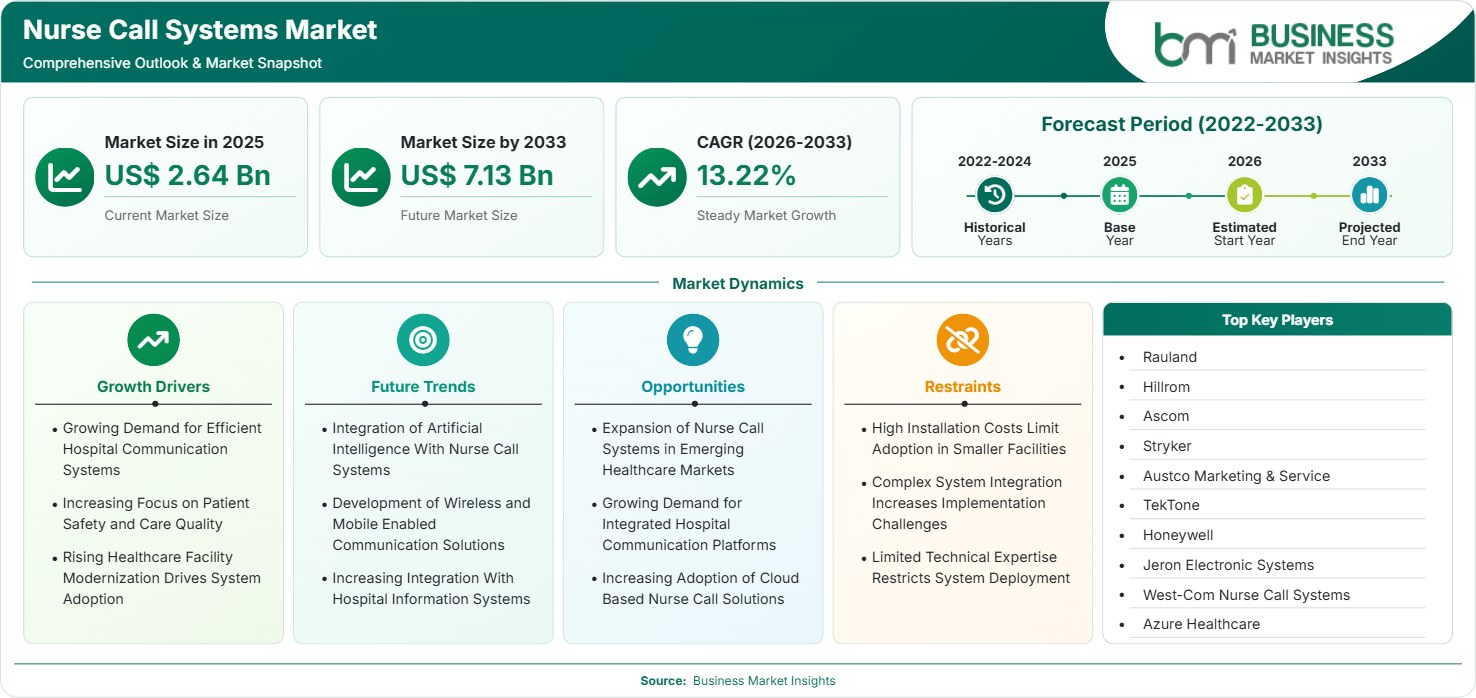
The Nurse Call Systems Market size was valued at US$ 2.64 billion in 2025 and is projected to reach US$ 7.13 billion by 2033, growing at a CAGR of 13.22% during 2026–2033, driven by hospital modernization, patient safety priorities, integrated communications, cloud adoption, and expanding healthcare infrastructure.

Report Coverage
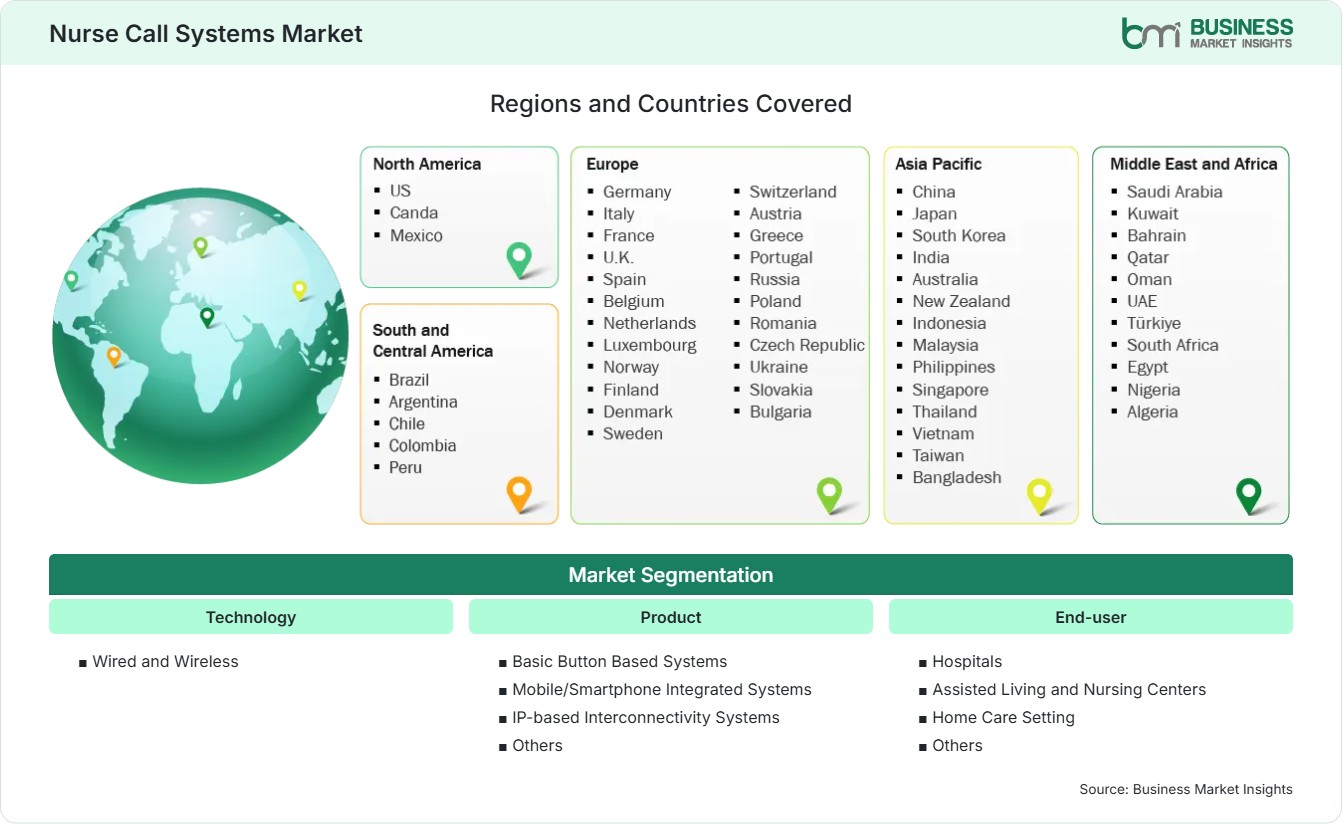
  • Technology: Wired, Wireless
  • Product: Basic Button Based Systems, Mobile/Smartphone Integrated Systems, IP-based Interconnectivity Systems, Others
  • End-user: Hospitals, Assisted Living and Nursing Centers, Home Care Setting, Others
US$ 2.64 Bn Market size in 2025
US$ 7.13 Bn Market Size by 2033
13.22% CAGR, 2026 - 2033
2026-2033 Forecast Period

AI Overview

Nurse Call Systems Market Summary

  • North America Region: North America held an estimated 38%–42% share in 2025 and is projected to grow at a 12.6%–13.0% CAGR, supported by hospital modernization, replacement of legacy communication systems, patient safety initiatives, and integration with clinical workflows. The U.S. market is projected to grow at a 12.7%–13.1% CAGR, supported by technology upgrades and healthcare facility investments.
  • Fastest Growing Region: Asia Pacific held an estimated 20%–24% share in 2025 and is projected to expand at a 15.1%–15.5% CAGR, driven by hospital construction, healthcare digitization, rising patient volumes, smart infrastructure investments, and growing adoption of wireless communication technologies.
  • Leading Segment: Wired technology represented an estimated 55%–59% share in 2025 and is projected to grow at a 11.8%–12.2% CAGR, supported by established hospital infrastructure, reliability requirements, and integration with existing communication networks.
  • High Growth Segment: Mobile/Smartphone Integrated Systems represented an estimated 18%–22% share in 2025 and are projected to grow at a 16.2%–16.6% CAGR, supported by mobility, faster staff response, smartphone adoption, and integration with digital workflows.
  • Key Market Opportunity: Cloud-connected communication platforms can unify nurse calls, mobile alerts, workflow automation, and analytics, enabling healthcare providers to improve responsiveness while reducing dependence on fragmented legacy systems.
  • Major Market Players: Rauland, Hillrom, Ascom, Stryker, Austco Marketing & Service, TekTone, Honeywell, Jeron Electronic Systems, West-Com Nurse Call Systems, Azure Healthcare.
Strategic Insights

Nurse Call Systems Market: Strategic Insights

Nurse Call Systems Market Strategic Framework
FREE PDF
Request your free sample
Request free sample
Stakeholder View

Key Takeaways

  • The Nurse Call Systems Market ecosystem increasingly connects nurse call hardware with wireless networks, mobile devices, IP infrastructure, software platforms, patient monitoring systems, and hospital communication tools, making interoperability a critical competitive factor.
  • Mobile and smartphone-integrated solutions offer strong upside because they allow caregivers to receive alerts away from centralized stations and improve response coordination across large facilities.
  • Cloud connectivity, analytics, artificial intelligence-enabled prioritization, and workflow automation are shifting product development toward software-enabled communication platforms rather than standalone alert systems.
  • Asia Pacific provides an attractive investment opportunity as healthcare infrastructure expands, new hospitals are constructed, and providers increasingly adopt digital communication technologies.
  • Strategic partnerships and acquisitions involving healthcare technology providers, communication specialists, and infrastructure companies can accelerate integrated platform development and expand distribution capabilities.
  • Smaller healthcare facilities represent an underserved opportunity for modular systems that reduce installation complexity and allow organizations to scale capabilities as budgets and operational requirements evolve.
Geographic Outlook

Nurse Call Systems Market Regional Highlights

North America Nurse Call Systems Market

North America held an estimated 38%–42% share in 2025, with the Nurse Call Systems Market share supported by advanced healthcare infrastructure, established technology providers, high digital adoption, and ongoing hospital modernization. The region is projected to grow at a 12.6%–13.0% CAGR through 2033.

  • Hospitals are replacing legacy systems with IP-based and mobile-enabled platforms that support faster communication, centralized monitoring, and integration with broader clinical technology environments.
  • Patient safety initiatives are encouraging healthcare providers to improve alert routing and response coordination, increasing demand for systems capable of prioritizing and escalating calls.
  • Integration with smartphones and mobile devices is gaining traction because caregivers can receive notifications while moving between patient rooms and clinical departments.
  • Healthcare technology suppliers are increasingly emphasizing interoperability, allowing communication platforms to connect with patient monitoring, workflow management, and facility infrastructure systems.

US Nurse Call Systems Market

The U.S. represented an estimated 34%–38% share in 2025 and is projected to grow at a 12.7%–13.1% CAGR through 2033. Demand is supported by hospital modernization, patient safety requirements, technology replacement cycles, and the growing need for integrated communication. Large healthcare networks are increasingly investing in platforms that connect nurse calls with mobile devices and broader digital hospital infrastructure.

  • Hospitals are upgrading legacy infrastructure to support IP connectivity, mobile communication, and integration with clinical workflows across increasingly complex healthcare environments.
  • Smartphone-enabled alerts can help improve staff mobility and reduce dependence on fixed communication stations, particularly across large hospitals and multi-building healthcare campuses.
  • Demand for interoperability is increasing as providers seek to connect nurse call systems with patient monitoring, electronic records, real-time location technologies, and clinical communication platforms.
  • Healthcare organizations increasingly evaluate solutions according to response times, workflow efficiency, cybersecurity, scalability, and total ownership costs rather than hardware functionality alone.

Europe Nurse Call Systems Market

Europe held an estimated 25%–29% share in 2025 and is projected to grow at a 12.0%–12.4% CAGR through 2033. Germany, the UK, France, and Italy represent leading Nurse Call Systems Markets supported by established healthcare infrastructure and digital transformation. Germany is projected to grow at a 12.2%–12.6% CAGR, while the UK and France benefit from modernization of hospitals, care facilities, and connected communication infrastructure.

  • Germany benefits from sophisticated healthcare infrastructure and strong demand for reliable communication technologies across hospitals, rehabilitation facilities, and long-term care environments.
  • The UK offers opportunities as healthcare providers focus on digital transformation, operational efficiency, and improved communication between patients and clinical staff.
  • France is supported by healthcare modernization initiatives and increasing interest in connected infrastructure that can improve patient safety and staff coordination.
  • Italy provides opportunities through hospital technology upgrades and increasing demand for communication systems capable of supporting aging healthcare infrastructure.

Asia Pacific Nurse Call Systems Market

Asia Pacific represented an estimated 20%–24% share in 2025 and is projected to grow at a 15.1%–15.5% CAGR through 2033. China, Japan, South Korea, and India lead regional opportunities, with India projected to grow at a 15.5%–15.9% CAGR. Hospital construction, healthcare digitization, rising patient volumes, and increasing technology investment are supporting adoption across major markets.

  • China offers significant potential as hospital infrastructure expands and healthcare providers invest in digital communication platforms capable of supporting large patient populations.
  • Japan benefits from advanced healthcare infrastructure and growing demand for communication technologies that support hospitals and long-term care facilities.
  • South Korea's sophisticated digital ecosystem creates opportunities for integrated platforms combining mobile communication, IP connectivity, and smart healthcare infrastructure.
  • India represents a high-growth opportunity as new hospitals and private healthcare facilities invest in modern communication systems rather than relying solely on legacy infrastructure.

Rest of World Nurse Call Systems Market

South and Central America accounted for an estimated 7%–9% share in 2025 and are projected to grow at a 11.2%–11.6% CAGR through 2033. Brazil and Mexico lead regional opportunities. The Middle East and Africa represented an estimated 5%–7% share and are projected to grow at a 10.8%–11.2% CAGR, supported by hospital construction and healthcare infrastructure modernization.

  • Brazil offers opportunities as private hospitals and healthcare networks upgrade communication infrastructure and seek technologies supporting improved patient service and operational coordination.
  • Mexico is benefiting from healthcare infrastructure investment and increasing adoption of digital technologies designed to improve communication across hospitals and care facilities.
  • Saudi Arabia's healthcare transformation programs support opportunities for modern communication infrastructure as new hospitals and upgraded facilities incorporate connected digital technologies.
  • The UAE provides potential through private healthcare investment, hospital development, and demand for sophisticated technologies supporting high-quality patient care and operational efficiency.
Global Market Geography
FREE PDF
Request your free sample
Request free sample
Segment Analysis

Nurse Call Systems Market Segmentation

Technology

Technology is led by Wired systems, which represented an estimated 55%–59% share in 2025 and are projected to grow at a 11.8%–12.2% CAGR between 2026–2033. Wired platforms remain important in established facilities because of reliability, infrastructure integration, and predictable performance. Wireless systems offer strong growth potential as healthcare providers seek flexible deployments and reduced installation complexity.

  • Wired: Wired infrastructure remains widely used in established hospitals, providing reliable communication and supporting integration with existing clinical and building systems.
  • Wireless: Wireless technologies enable flexible deployment, easier expansion, and mobility, making them attractive for renovated facilities, temporary care environments, and modern healthcare campuses.

Product

Product demand is led by Basic Button Based Systems, representing an estimated 32%–36% share in 2025 and projected to grow at a 10.8%–11.2% CAGR through 2033. However, mobile and IP-enabled solutions are gaining momentum as healthcare organizations prioritize integrated communication. Product evolution increasingly emphasizes interoperability, mobility, centralized management, and intelligent alert handling.

  • Basic Button Based Systems: Simple call buttons remain essential for fundamental patient-staff communication, particularly in facilities prioritizing affordability, reliability, and straightforward deployment.
  • Mobile/Smartphone Integrated Systems: Mobile integration enables staff to receive and manage alerts remotely, improving mobility, response coordination, and communication across large healthcare environments.
  • IP-based Interconnectivity Systems: IP platforms support scalable communication and integration with hospital networks, enabling centralized management and connections with digital healthcare technologies.
  • Others: Additional solutions address specialized communication requirements and facility-specific workflows, supporting customized deployments across hospitals, long-term care, and other healthcare environments.

End-user

End-user demand is led by Hospitals, representing an estimated 62%–66% share in 2025 and projected to grow at a 12.8%–13.2% CAGR through 2033. Hospitals require a comprehensive communication infrastructure to coordinate staff responses and support patient safety. Assisted living centers, nursing facilities, and home care settings provide additional opportunities as healthcare delivery becomes increasingly decentralized.

  • Hospitals: Hospitals remain the largest users because they require comprehensive communication systems across patient rooms, nursing stations, emergency areas, and specialized clinical departments.
  • Assisted Living and Nursing Centers: Long-term care facilities increasingly adopt communication systems to support resident safety, staff coordination, and rapid response across distributed care environments.
  • Home Care Setting: Home-based healthcare creates opportunities for simplified communication technologies that connect patients with caregivers and enable timely assistance outside institutional facilities.
  • Others: Other healthcare environments, including rehabilitation and specialty facilities, provide demand for scalable systems tailored to specific patient communication and operational requirements.
Market Forces

Nurse Call Systems Market Dynamics

Key Market Drivers

Growing Demand for Efficient Hospital Communication Systems

In today’s healthcare facilities, it is increasingly necessary to have communication systems in place that help coordinate staff efforts and minimize the time required to respond to patient inquiries. Traditional call systems can pose challenges in managing communication, especially in large hospitals with multiple departments and many patients. The Nurse Call Systems Market growth is fueled by the demand for a centralized system, which helps in routing calls in an efficient manner. An IP-enabled system, along with the mobile integration feature, can be very useful as it enables communication to happen irrespective of the nursing station.

Increasing Focus on Patient Safety and Care Quality

Safety continues to be a priority in health care institutions, placing greater emphasis on communication solutions that enable fast, reliable responses. Modern tools have features such as routing calls to the right person, prioritizing urgent calls, and escalating in case of delays. All these features can be used by healthcare institutions to make improvements in workflow management and accountability. The Nurse Call Systems Market trends are influenced by the integration of these systems with mobile devices and clinical communication tools, which allow messages to be received from anywhere.

Rising Healthcare Facility Modernization Drives System Adoption

The modernization of health care infrastructure is driving organizations to move away from outdated technology and towards scalable digital technology solutions. New facilities are being built with IP networking, wireless, mobile, and management capabilities within their infrastructure architecture. The modernization process has created the chance for integration of nurse call solutions into patient monitoring as well as other hospital communication technologies. Organizations will be able to enhance functionality while minimizing reliance on standalone hardware components. In building smarter infrastructure in health care facilities, communication systems are increasingly being viewed as part of an overall digital environment.

Key Market Opportunities

Expansion of Nurse Call Systems in Emerging Healthcare Markets

Opportunities exist in the expanding healthcare market for the Nurse Call Systems market, driven by the expansion of existing hospitals and the construction of new facilities with modern infrastructure. These new constructions can deploy digital and wireless systems without having any limitations that come along with outdated technology, thus providing the opportunity to deploy scalable platforms from the get-go. This can prove beneficial for vendors, as they will be able to develop cost-effective systems, create partnerships in the locality, and even install them and train personnel to operate them.

Growing Demand for Integrated Hospital Communication Platforms

Healthcare professionals now seek communication solutions that integrate nurse call systems with mobile phones, monitoring systems, and other IT systems. Integration helps eliminate fragmented information and enables healthcare professionals to manage multiple alerts through a unified interface. Vendors offering open architecture and interoperability will have an edge as hospital networks will consolidate their technology vendors. An integrated platform solution may be used to collect operational information to support workforce management and optimize workflows. The business case is not only about nurse call systems but about unified clinical communications systems.

Increasing Adoption of Cloud Based Nurse Call Solutions

There exist opportunities in cloud solutions to help healthcare organizations become more efficient in managing their systems, scale, and limit their reliance on in-house infrastructure. There may be centralized updating and monitoring of the system that could help reduce maintenance in multi-site health care institutions. There may also be possibilities of analyzing the performance of systems through cloud solutions and identifying response problems. Subscription models could be employed to lower technology access hurdles for certain organizations, thereby providing revenue streams for vendors. But issues such as cybersecurity, data governance, network reliability, and compliance should be taken seriously.

Market Restraints and Challenges

High Installation Costs Limit Adoption in Smaller Facilities

Factor: Comprehensive communication deployments can require significant spending on hardware, cabling, networking, software, installation, integration, and staff training.

Impact: The high cost of installation may discourage smaller hospitals, nursing homes, and care centers from upgrading their existing systems. Limited budgets may force organizations to delay upgrades or go for less sophisticated products. There are several ways that vendors can employ to overcome this obstacle. One way is to provide affordable options with the ability to upgrade in the future.

Complex System Integration Increases Implementation Challenges

Factor: Integrating nurse call platforms with existing hospital networks, patient monitoring systems, mobile devices, electronic records, and other communication technologies can involve substantial technical complexity.

Impact: Integration difficulties could delay deployment, increase implementation costs, and pose interoperability risks. Extensive testing is required by healthcare providers before implementing a new system due to the potential impact on the safety of patients resulting from communication failures. Vendor organizations having open interfaces, standardization, experience in implementation, and technical support could mitigate these problems. Integration success will be increasingly dependent on infrastructure evaluation.

Company Analysis

Competitive Landscape

The competitive environment includes specialized nurse call manufacturers, diversified healthcare technology companies, communication technology providers, and infrastructure specialists. The Nurse Call Systems Market analysis indicates that competitive differentiation increasingly depends on interoperability, mobile integration, cloud capabilities, cybersecurity, installation expertise, and the ability to support diverse healthcare facilities.

Company Name

Overview

Products and Services relevant to this market

Rauland

Healthcare communication technology provider focused on clinical communication and patient response solutions.

Nurse call systems, clinical communication platforms, mobile workflows, and integrated healthcare communication technologies.

Hillrom

Healthcare technology company known for connected care solutions and hospital infrastructure technologies.

Nurse call platforms, patient communication technologies, connected care solutions, and hospital workflow integration.

Ascom

Global communication technology company specializing in healthcare workflow and critical communication solutions.

Nurse call systems, mobile devices, workflow software, alarm management, and clinical communication platforms.

Stryker

Diversified medical technology company providing solutions across hospital care and patient safety environments.

Patient communication technologies, clinical workflow solutions, hospital infrastructure, and connected healthcare systems.

Austco Marketing & Service

Specialist provider of nurse call and healthcare communication solutions serving diverse care environments.

Nurse call systems, emergency call solutions, wireless communication, and healthcare workflow technologies.

TekTone

Healthcare communication technology company focused on nurse call and emergency communication systems.

Nurse call platforms, wireless systems, emergency communication, and healthcare facility alert solutions.

Honeywell

Diversified technology company offering connected building and healthcare infrastructure solutions.

Healthcare communication technologies, building integration, safety systems, and connected facility solutions.

Jeron Electronic Systems

Specialist manufacturer focused on nurse call and healthcare communication technology.

Nurse call systems, emergency call platforms, wireless communication, and patient-staff alert technologies.

West-Com Nurse Call Systems

Healthcare communication provider focused on customizable nurse call and staff response solutions.

Nurse call systems, wireless solutions, patient communication, and healthcare facility alert management.

Azure Healthcare

Healthcare communication technology provider serving hospitals and care facilities with integrated solutions.

Nurse call systems, patient communication, emergency call technologies, and integrated healthcare communication platforms.

Industry Activity

Recent Developments

April 2026

Stryker continued expanding its connected healthcare technology portfolio, supporting hospitals seeking integrated solutions for patient care and operational workflows.

February 2026

Honeywell continued developing connected building and healthcare infrastructure technologies supporting digital transformation and smarter facility management.

November 2025

Rauland continued advancing healthcare communication solutions focused on clinical workflows, patient safety, and coordinated staff response.

Jun, 2026: Ascom continued advancing connected healthcare communication capabilities designed to support mobile workflows, clinical alert management, and integrated care environments.

Trust & Transparency

Research Methodology

The market analysis combines proprietary research with secondary data from government agencies, company disclosures, regulatory filings, industry databases and expert interviews. Market estimates are validated through data triangulation, cross-market benchmarking and analyst review.

View Full Research Methodology

Questions Answered

Frequently Asked Questions

What does the Nurse Call Systems Market forecast indicate about future development?

The market forecast indicates increasing movement toward integrated communication ecosystems connecting nurse calls with mobile devices, clinical workflows, patient monitoring, analytics, and cloud-based infrastructure.

What limits adoption among smaller healthcare facilities?

High installation and integration costs can create barriers for smaller facilities. Modular architectures, wireless deployment, phased implementation, and flexible financing can help address these challenges.

Why are cloud-based systems gaining attention?

Cloud-based platforms can simplify software management, support centralized monitoring, improve scalability across healthcare networks, and reduce dependence on extensive on-site infrastructure.

Which technology segment has the strongest growth potential?

Mobile and smartphone-integrated systems have strong potential because they allow staff to receive alerts remotely, support mobility, and improve response coordination across large healthcare facilities.

What is driving demand for modern nurse call systems?

The Nurse Call Systems Market report identifies hospital modernization, patient safety priorities, healthcare digitization, mobile communication adoption, and the need to connect patient alerts with broader clinical workflows as key demand factors.

Access the Full Nurse Call Systems Market Report

Get segment-level forecasts, regional estimates, competitive benchmarking, company profiles and downloadable Excel datasets.

Access the full Nurse Call Systems Market Report
350 pages PDF & Excel | 2026-08-07
Similar Research

Related Market Reports