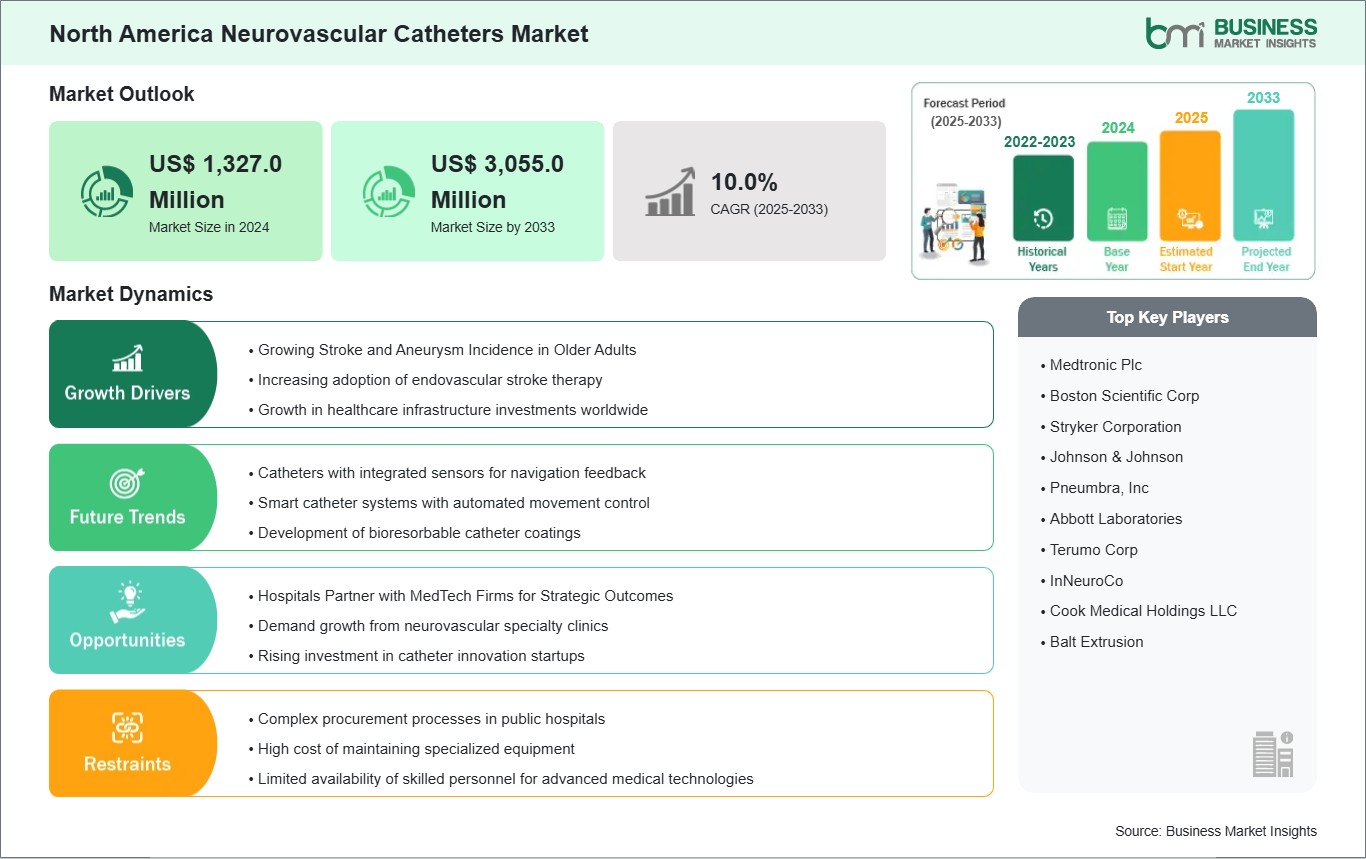
The North America Neurovascular Catheters market size is expected to reach US$ 3,055.0 million by 2033 from US$ 1,327.0 million in 2024. The market is estimated to record a CAGR of 10.0% from 2025 to 2033.
North America, particularly the US, dominates the global neurovascular devices market due to its advanced healthcare infrastructure, strong reimbursement systems, and high procedural volumes for minimally invasive interventions such as mechanical thrombectomy and endovascular embolization.
Stroke remains one of the leading causes of morbidity and mortality in the region, with ischemic strokes accounting for the majority of cases. Neurovascular catheters — including aspiration, access, and guide catheters — are essential in mechanically retrieving occlusive clots and facilitating precise device delivery during coil embolization procedures. Emerging technologies such as steerable microcatheters and enhanced aspiration platforms are gaining clinical traction, supported by rapid regulatory approvals and clinician adoption.
Hospitals and clinics remain the primary end users due to high procedural throughput and availability of comprehensive stroke centers. Diagnostic imaging centers with interventional suites contribute meaningfully as access to high‑resolution imaging supports early detection and intervention. Competitive dynamics include global leaders such as Medtronic, Stryker, Johnson & Johnson (Cerenovus), and Penumbra, alongside emerging innovators contributing to portfolio diversification and enhanced clinical outcomes. Continued investments in stroke care pathways, rising procedural volumes, and expansion of catheter technologies position North America as a growth region for neurovascular catheter adoption through 2033.

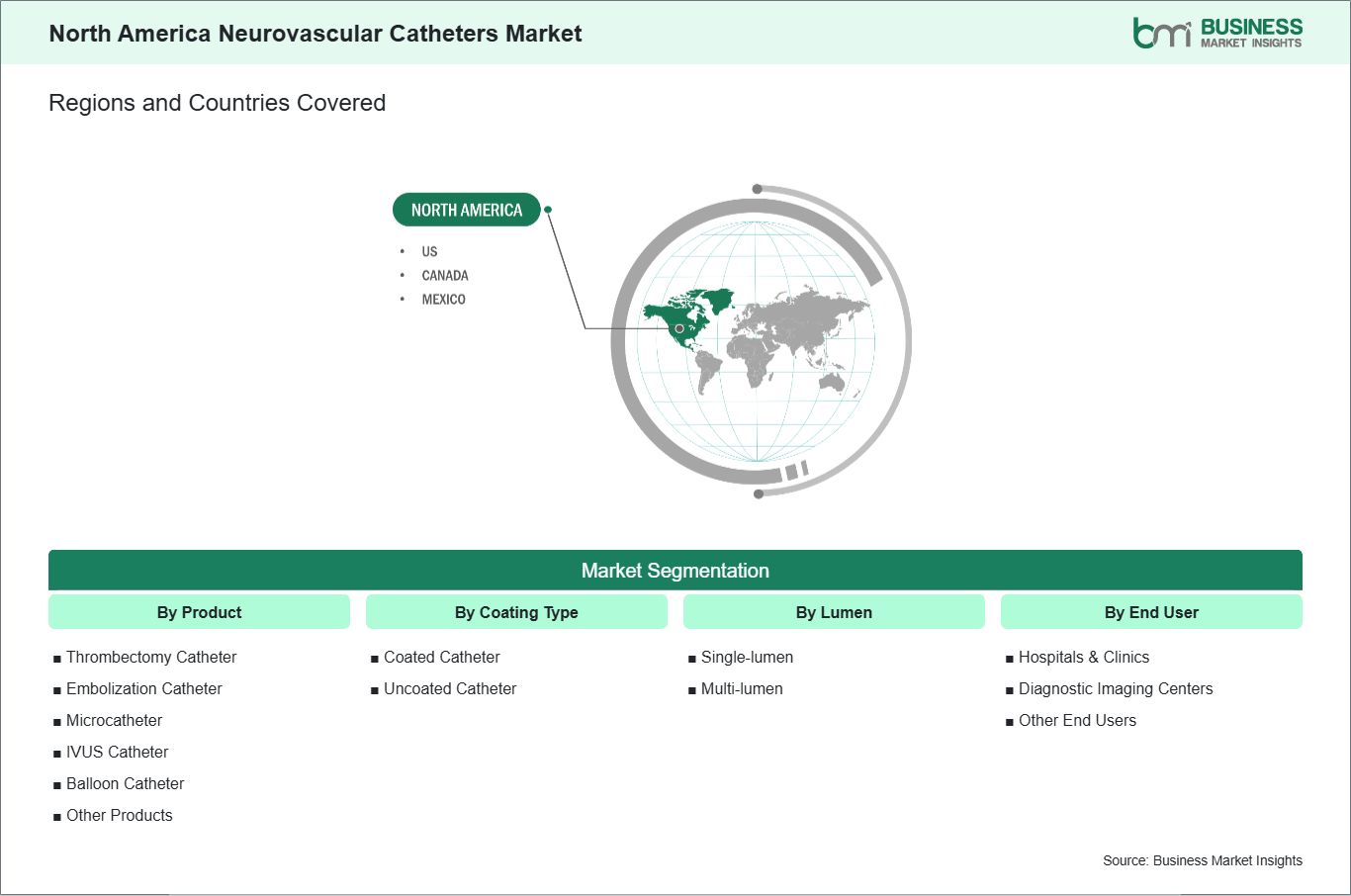
Key segments that contributed to the derivation of the North America Neurovascular Catheters market analysis are product, coating type, lumen, and end user.
Stroke continues to be a leading cause of death and long‑term disability in the US and Canada, and ischemic stroke — which accounts for most cases — increasingly relies on mechanical thrombectomy as a standard care intervention. Neurovascular catheters are fundamental to these procedures, allowing physicians to navigate complex cerebral vasculature, retrieve clots, and restore blood flow, which is crucial for improved functional recovery and reduced neurological damage.
Cerebral aneurysms and other neurovascular abnormalities are being detected more frequently because of broader access to advanced imaging technologies such as high‑resolution CT and MR angiography in major medical centers. This prevalence has increased procedural volumes for endovascular aneurysm treatments, including coil embolization and flow diversion techniques that rely on microcatheters and embolization catheters for precise device delivery.
Healthcare systems in North America emphasize minimally invasive treatments, backed by robust reimbursement frameworks and strong clinician training programs, which facilitate broader adoption of advanced catheter systems. Proactive public health initiatives to promote rapid stroke intervention protocols augment procedural demand. The rising disease burden, improved diagnostic access, and clinical emphasis on rapid interventional care drive sustained demand for neurovascular catheters across healthcare facilities.
Hospitals partner with device manufacturers to secure access to advanced catheter technologies, clinical training, and procedural support, enhancing clinical outcomes and facilitating adoption of next‑generation products. Such collaborations include long‑term supply contracts, co‑development initiatives, and integrated clinical education programs that align device innovation with real‑world clinical needs.
For MedTech firms, collaboration with neuro interventional centers provides critical insights into procedural challenges and clinician preferences. This feedback enables companies to design catheters with improved trackability, stability, and precision — features essential for navigating complex cerebral vessels and improving procedural success rates. Hospitals benefit from early access to new catheter platforms, structured training pathways, and dedicated procedural support that enhances physician proficiency and patient care quality.
Clinical research partnerships generate real‑world evidence that supports regulatory approvals, guideline integration, and broader reimbursement coverage. Participating hospitals emerge as reference centers that drive wider adoption of advanced catheter technologies across regional healthcare networks. Commercially, collaborations with major health systems and integrated delivery networks provide stable revenue streams and enhanced presence for MedTech companies.
As healthcare delivery in North America continues to prioritize minimally invasive care and value‑based outcomes, strategic engagements between manufacturers and clinical institutions will be pivotal in accelerating catheter adoption and sustaining market growth.

The North America neurovascular catheters market demonstrates steady growth, with size and share analysis highlighting evolving trends and competitive dynamics among key players. The report further examines subsegments categorized within product, coating type, lumen, and end user, offering insights into their contribution to overall market performance.
By product, the thrombectomy catheter subsegment dominated the market in 2024, driven by the widespread adoption in mechanical thrombectomy for ischemic stroke.
Per coating type, the coated catheters subsegment dominated the market in 2024, driven by infection control priorities in tertiary centers.
Based on lumen, multi-lumen subsegment dominated the market in 2024, driven by its flexibility in delivering multiple therapies simultaneously.
By end user, the hospitals and clinics subsegment dominated the market in 2024, driven by high procedural volumes and established stroke care programs.
| Report Attribute | Details |
|---|---|
| Market size in 2024 | US$ 1,327.0 Million |
| Market Size by 2033 | US$ 3,055.0 Million |
| CAGR (2025 - 2033) | 10.0% |
| Historical Data | 2022-2023 |
| Forecast period | 2025-2033 |
| Segments Covered | By Product
|
| Regions and Countries Covered | North America
|
| Market leaders and key company profiles |
|
The "North America Neurovascular Catheters Market Size and Forecast (2025–2033)" report provides a detailed analysis of the market covering below areas:
The geographical scope of the North America Neurovascular Catheters market report is divided into: the US, Canada, and Mexico. The US held the largest share in 2024.
The US leads global adoption of advanced neurovascular procedures, supported by well‑established tertiary care hospitals, comprehensive stroke centers, and robust reimbursement systems. Medical centers across states such as California, Texas, New York, and Massachusetts showcase high procedural volumes for mechanical thrombectomy and aneurysm embolization, driving catheter demand.
Canada’s market growth is underpinned by investments in imaging technology and regional stroke networks, improving access to catheter‑based interventions in urban and tertiary hospitals. Both countries benefit from a strong regulatory environment that supports prompt FDA and Health Canada clearances, facilitating early access to catheter technologies.
Hospitals and clinics remain the dominant end users due to higher procedural volumes and concentrated neuro interventional expertise. Diagnostic imaging centers with interventional suites are integrating catheter‑based procedures to enhance service offerings, particularly in urban centers with high patient throughput. Collaborative programs between academic research institutions and MedTech firms strengthen adoption patterns by advancing clinical evidence and operator training in neurovascular interventions.

The North America Neurovascular Catheters market is evaluated by gathering qualitative and quantitative data post primary and secondary research, which includes important corporate publications, association data, and databases. A few of the key developments in the North America neurovascular catheters market are:
The North America Neurovascular Catheters Market is valued at US$ 1,327.0 Million in 2024, it is projected to reach US$ 3,055.0 Million by 2033.
As per our report North America Neurovascular Catheters Market, the market size is valued at US$ 1,327.0 Million in 2024, projecting it to reach US$ 3,055.0 Million by 2033. This translates to a CAGR of approximately 10.0% during the forecast period.
The North America Neurovascular Catheters Market report typically cover these key segments-
The historic period, base year, and forecast period can vary slightly depending on the specific market research report. However, for the North America Neurovascular Catheters Market report:
The North America Neurovascular Catheters Market is populated by several key players, each contributing to its growth and innovation. Some of the major players include:
The North America Neurovascular Catheters Market report is valuable for diverse stakeholders, including:
Essentially, anyone involved in or considering involvement in the North America Neurovascular Catheters Market value chain can benefit from the information contained in a comprehensive market report.
Please tell us your area of interest
(Market Segments/ Regions and Countries/ Companies)