Market Summary
Executive Summary and Market Analysis
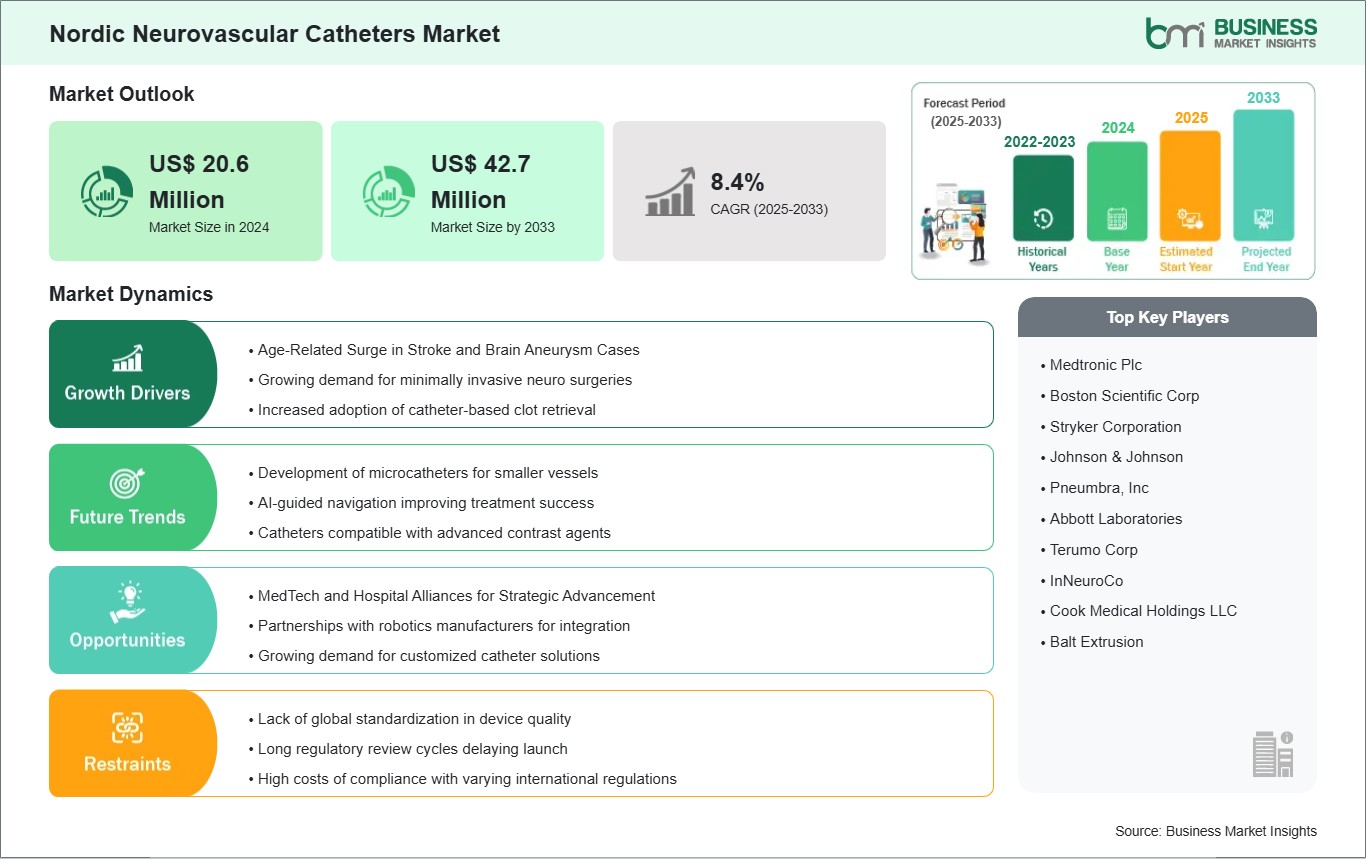
Sweden, Norway, Denmark, and Finland exhibit strong healthcare infrastructure, extensive diagnostic imaging coverage, and established referral networks for acute stroke care, which facilitate rapid adoption of neurovascular technologies.
Stroke is a leading cause of morbidity and mortality across the Nordics, and mechanical thrombectomy has become a standard of care for eligible patients with large vessel occlusions. This procedural increase drives demand for thrombectomy and aspiration catheters capable of navigating complex cerebral vasculature. Early detection of cerebral aneurysms through advanced imaging has increased the volume of coil embolization and flow diversion procedures, elevating demand for specialized microcatheters.
Hospitals and dedicated neuro interventional centers represent the largest end user segment, bolstered by state‑of‑the‑art angiography suites in major university hospitals (e.g., Karolinska, Rigshospitalet, Oslo University Hospital, Helsinki University Hospital). Coated catheters are gaining traction due to infection control priorities. Multi‑lumen designs support simultaneous therapies in emergency and intensive care settings. Competitive dynamics in the region include global MedTech leaders (such as Terumo, Medtronic, Stryker, and Penumbra) collaborating with distributors and clinical networks to expand procedural training and device access. The market reflects a mature healthcare environment with increasing procedural volumes, strong reimbursement support, and growing clinician familiarity with advanced neurovascular catheter systems — positioning the region for stable growth.
Segment Analysis
Nordic Neurovascular Catheters Market Segmentation
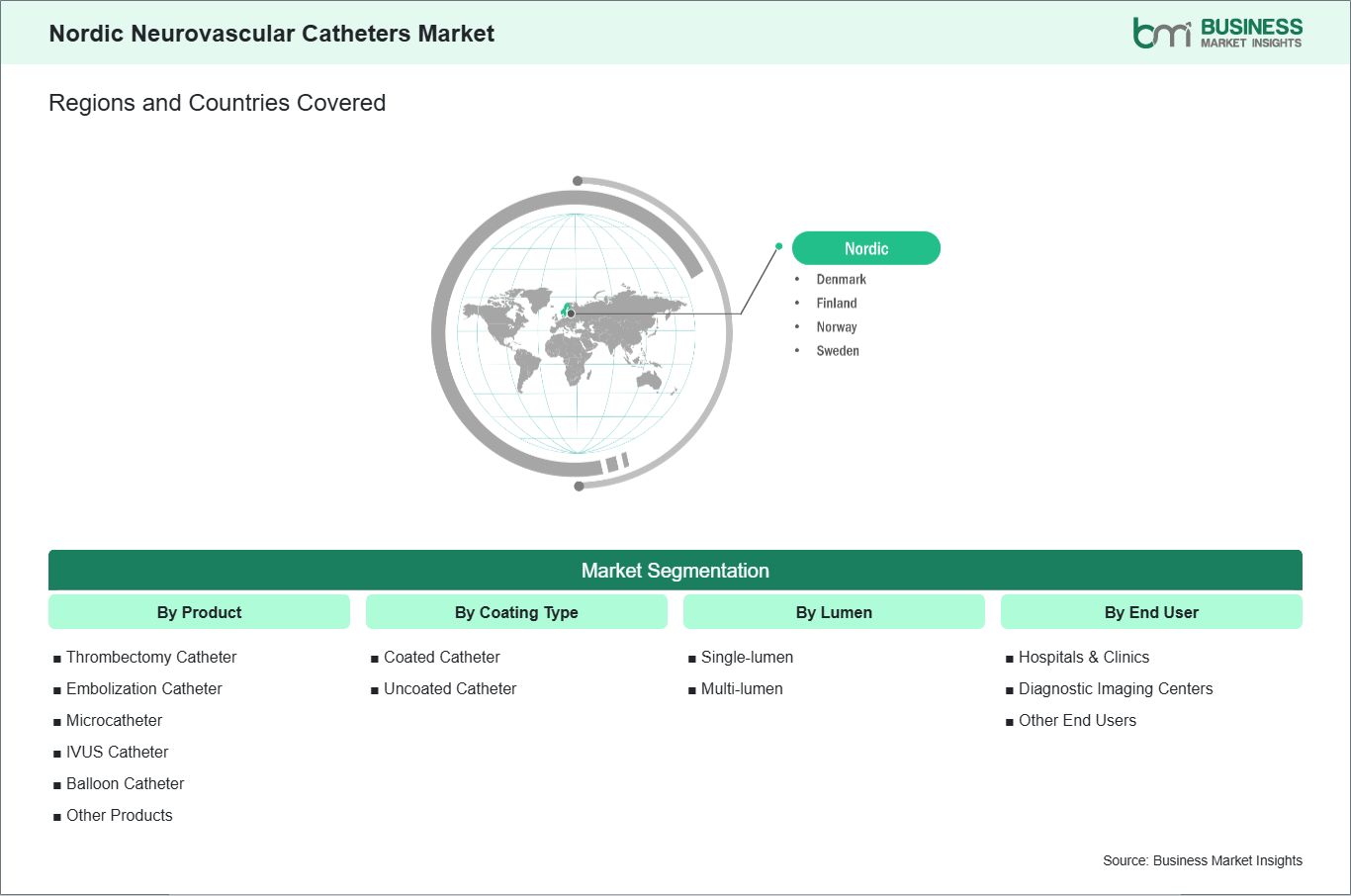
Key segments that contributed to the derivation of the Nordic Neurovascular Catheters market analysis are product, coating type, lumen, and end user.
- By product, the neurovascular catheters market is segmented into thrombectomy catheter, embolization catheter, microcatheter, IVUS catheter, balloon catheter, and others. The thrombectomy catheter segment dominated the market in 2024.
- Per coating type, the neurovascular catheters market is bifurcated into coated catheters, uncoated catheters. The coated catheters segment dominated the market in 2024.
- Based on lumen, the market is divided into single-lumen and multi-lumen. The multi-lumen segment dominated the market in 2024.
- By end user, the market is segmented into hospitals and clinics, diagnostic imaging Centers, and others. The hospitals and clinics segment dominated the market in 2024.
Market Forces
Nordic Neurovascular Catheters Market Drivers and Opportunities
Age-Related Surge in Stroke and Brain Aneurysm Cases
Stroke remains one of the leading causes of death and long‑term disability in Europe, with ischemic strokes accounting for the majority of cases. Neurovascular catheter‑based mechanical thrombectomy has gained clinical acceptance as a standard of care for large vessel occlusion strokes, enabling rapid recanalization and improved functional outcomes. High levels of diagnostic imaging accessibility mean more patients are identified early and referred for thrombectomy, boosting utilization of aspiration and delivery catheters.
Cerebral aneurysms are detected through routine use of CT angiography (CTA) and magnetic resonance angiography (MRA) in tertiary hospitals. Endovascular aneurysm treatments such as coil embolization and flow diversion rely on microcatheters and embolization catheter systems for precise device delivery. These procedures are performed in comprehensive stroke and neurovascular centers located in capital cities, where neurointerventional expertise and hybrid angiography suites are available. The aging demographics in the region — combined with high rates of vascular risk factors such as hypertension and atrial fibrillation — contribute to growing procedural volumes. The increasing burden of neurovascular diseases, enhanced imaging capabilities, and broader procedural eligibility criteria are driving sustained demand for neurovascular catheters in healthcare systems, supporting market growth.
MedTech and Hospital Alliances for Strategic Advancement
Nordic hospital systems and academic centers are increasingly partnering with global medical device manufacturers to gain access to advanced catheter technologies, clinical education, and procedural support tailored to regional clinical workflows. These collaborations help accelerate the adoption of novel devices while enhancing procedural outcomes.
Long‑term supply agreements and clinical research partnerships enable MedTech firms to engage with interventional neurologists and radiologists to better understand procedural challenges unique to Nordic patient populations. Insights from these collaborations support the refinement of device design — for example, improving catheter trackability, flexibility, and precision in navigating tortuous cerebral anatomy — increasing clinical adoption. Hospitals benefit from early access to next‑generation technologies, structured training programs, and on‑site support during complex procedures.
Joint clinical studies conducted with academic hospitals generate real‑world evidence that can support regulatory submissions and inclusion in clinical guidelines. Hospitals participating in such trials become reference centers, promoting wider acceptance of advanced neurovascular catheter systems within regional healthcare networks. Additionally, educational collaborations and simulation training enhance physician proficiency in catheter‑based stroke and aneurysm interventions, increasing procedural volumes.
From a commercial perspective, partnerships with national hospital networks and stroke care initiatives provide MedTech firms with market penetration and stable revenue streams. In a region emphasizing quality of care and minimally invasive interventions, strategic collaborations between device manufacturers and hospitals will remain pivotal in expanding access to neurovascular catheter technologies and sustaining long-term market growth.
Size and Share Analysis
Nordic Neurovascular Catheters Market Size and Share Analysis
The Nordic neurovascular catheters market demonstrates steady growth, with size and share analysis highlighting evolving trends and competitive dynamics among key players. The report further examines subsegments categorized within product, coating type, lumen, and end user, offering insights into their contribution to overall market performance.
By product, the thrombectomy catheter subsegment dominated the market in 2024, driven by the widespread use in routine IV therapy and emergency care across hospitals and clinics.
Based on coating type, the coated catheters subsegment dominated the market in 2024, driven by infection prevention initiatives and demand for biocompatible devices in Nordic healthcare systems.
Per lumen, multi-lumen subsegment dominated the market in 2024, driven by the efficiency needs in administering multiple therapies simultaneously in critical care settings.
By end user, hospitals and clinics subsegment dominated the market in 2024, driven by government investment in healthcare infrastructure and expansion of private medical facilities across the Nordic.
Report Coverage
Nordic Neurovascular Catheters Market Report Coverage and Deliverables
The "Nordic Neurovascular Catheters Market Size and Forecast (2025–2033)" report provides a detailed analysis of the market covering below areas:
- Nordic Neurovascular Catheters market size and forecast at regional and country levels for all the key market segments covered under the scope
- Nordic Neurovascular Catheters market trends, as well as market dynamics such as drivers, restraints, and key opportunities
- Nordic Neurovascular Catheters market analysis covering key market trends, regional framework, major players, regulations, and recent market developments
- Industry landscape and competition analysis covering market concentration, heat map analysis, prominent players, and recent developments for the Nordic Neurovascular Catheters market
- Detailed company profiles, including SWOT analysis
Geographic Insights
Nordic Neurovascular Catheters Market Geographic Insights
The geographical scope of the Nordic Neurovascular Catheters market report is divided into: Sweden, Denmark, Norway, and Finland. Sweden held the largest share in 2024.
The Nordic neurovascular catheters market comprises Sweden, Norway, Denmark, Finland, and Iceland. Sweden is the largest market in the region, benefiting from strong healthcare investment, a high density of certified stroke centers, and widespread adoption of advanced interventional workflows in major hospitals such as Karolinska University Hospital. Norway demonstrates growth through comprehensive stroke care programs, with Medtronic, Stryker, and other device players represented in major tertiary centers.
Denmark continues to expand neurovascular capabilities, especially in Copenhagen and Aarhus, where high procedural volumes for mechanical thrombectomy and coil embolization support catheter adoption. Finland emphasizes integrated stroke networks and advanced imaging access, particularly in Helsinki and Tampere, where neurovascular procedures are performed. Iceland is a smaller market but shows rising procedural adoption in its main tertiary hospital, with catheter workflows embedded into acute care pathways.
Hospitals and specialized neuro interventional centers dominate device adoption due to centralized procedural capabilities, strong reimbursement support, and clinician expertise. Regional collaborations with global MedTech firms help facilitate training, evidence generation, and structured product rollouts, fostering market growth across healthcare systems.
Industry Activity
Recent Developments
The Nordic Neurovascular Catheters market is evaluated by gathering qualitative and quantitative data post primary and secondary research, which includes important corporate publications, association data, and databases. A few of the key developments in the Nordic neurovascular catheters market are:
- In January 2026, Boston Scientific Corporation revealed a definitive deal to acquire Penumbra, Inc. for approximately US$ 14.5 billion, expanding its neurovascular portfolio — including thrombectomy and aspiration catheters — that are used extensively in Nordic hospitals for stroke and neurovascular procedures.
- In June 2024, Penumbra, Inc. announced the commercial launch of its BMX81 and BMX96 neurovascular access catheter systems in Europe, enhancing neurovascular procedural options for stroke care and aneurysm management. These devices, compatible with a range of access techniques, support catheter‑based interventions offered in Nordic hospitals and comprehensive stroke centers.
Trust & Transparency
Research Methodology
The market analysis combines proprietary research with secondary data from government agencies, company disclosures, regulatory filings, industry databases and expert interviews. Market estimates are validated through data triangulation, cross-market benchmarking and analyst
review.
View Full Research Methodology
Key Sources Referred:
World Health Organization (WHO) World Heart Federation (WHF) Organisation for Economic Cooperation and Development (OECD) The World Bank Group Worldometer The Lancet International Bar Association International Trade Administration