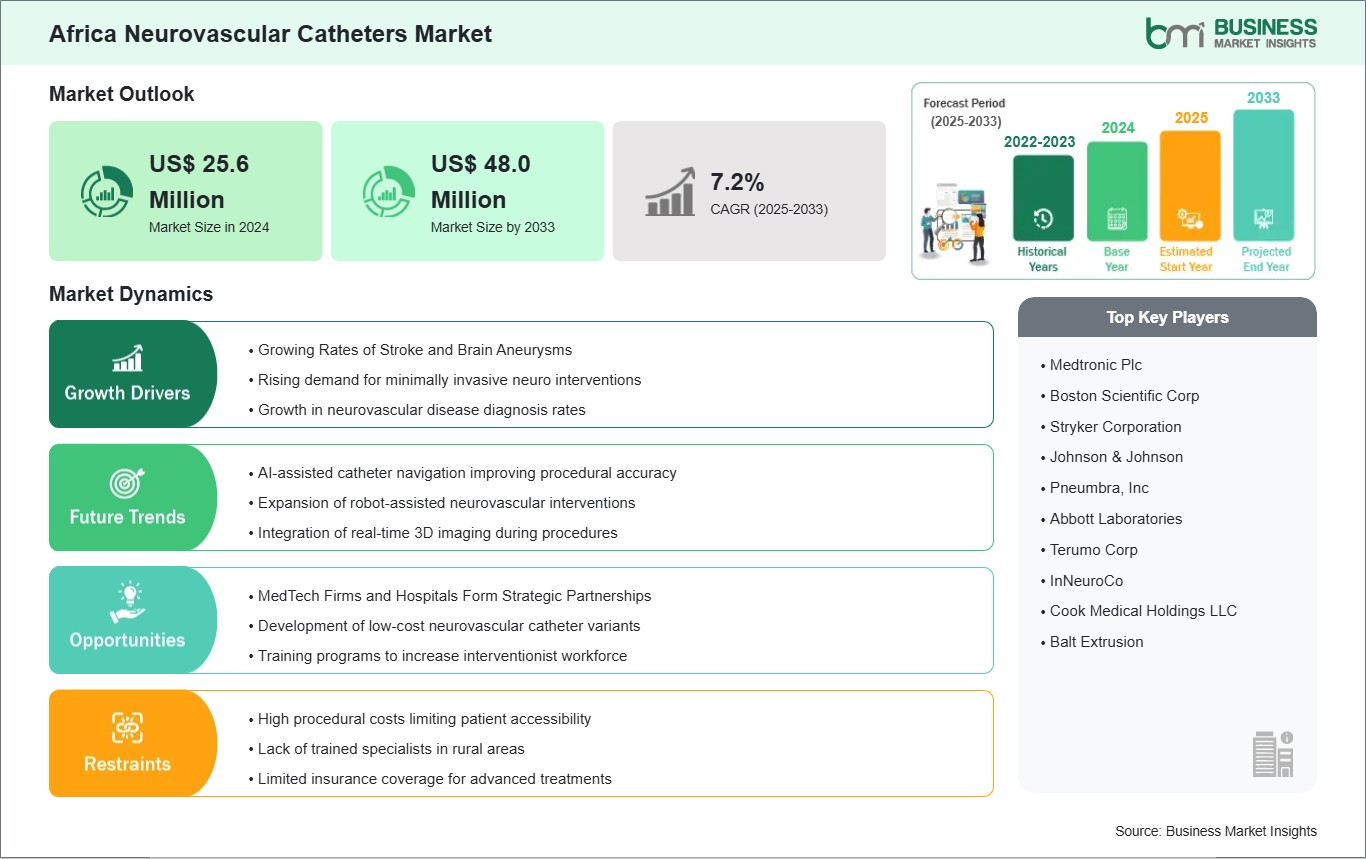
The Africa Neurovascular Catheters market size is expected to reach US$ 48.0 million by 2033 from US$ 25.6 million in 2024. The market is estimated to record a CAGR of 7.2% from 2025 to 2033.
The neurovascular catheters market in Africa is experiencing significant growth driven by the rising incidence of stroke and cerebral aneurysms, especially in aging populations, the expansion of mechanical thrombectomy procedures using aspiration and guide catheters, and the growing availability of neuro-interventional facilities in Tier 2/3 cities globally. The market is characterized by a blend of rapid healthcare modernization, rising patient volumes, and evolving clinical practices. Peripheral intravenous catheters dominate usage due to their role in routine fluid administration, emergency care, and widespread availability across public and private hospitals. Coated catheters are gaining traction as infection prevention becomes a priority, particularly in tertiary centers where nosocomial infections remain a challenge. Multi‑lumen catheters, though more specialized, are adopted in intensive care units to streamline therapy delivery for critically ill patients. Hospitals and clinics represent the largest end user segment, supported by government initiatives to expand healthcare infrastructure and private sector investment in modern facilities.
Competitive dynamics reveal a mix of multinational corporations such as B. Braun, Teleflex, and BD, alongside regional distributors who play a critical role in ensuring product accessibility in fragmented markets. The analysis highlights that adoption patterns vary significantly: urban centers in South Africa and Nigeria show strong uptake of advanced coated catheters, while rural regions rely on peripheral devices due to cost and training limitations. Overall, the market reflects a balance of affordability, innovation, and infrastructure development, positioning Africa as a region of incremental but strategic growth for intravenous catheter manufacturers.

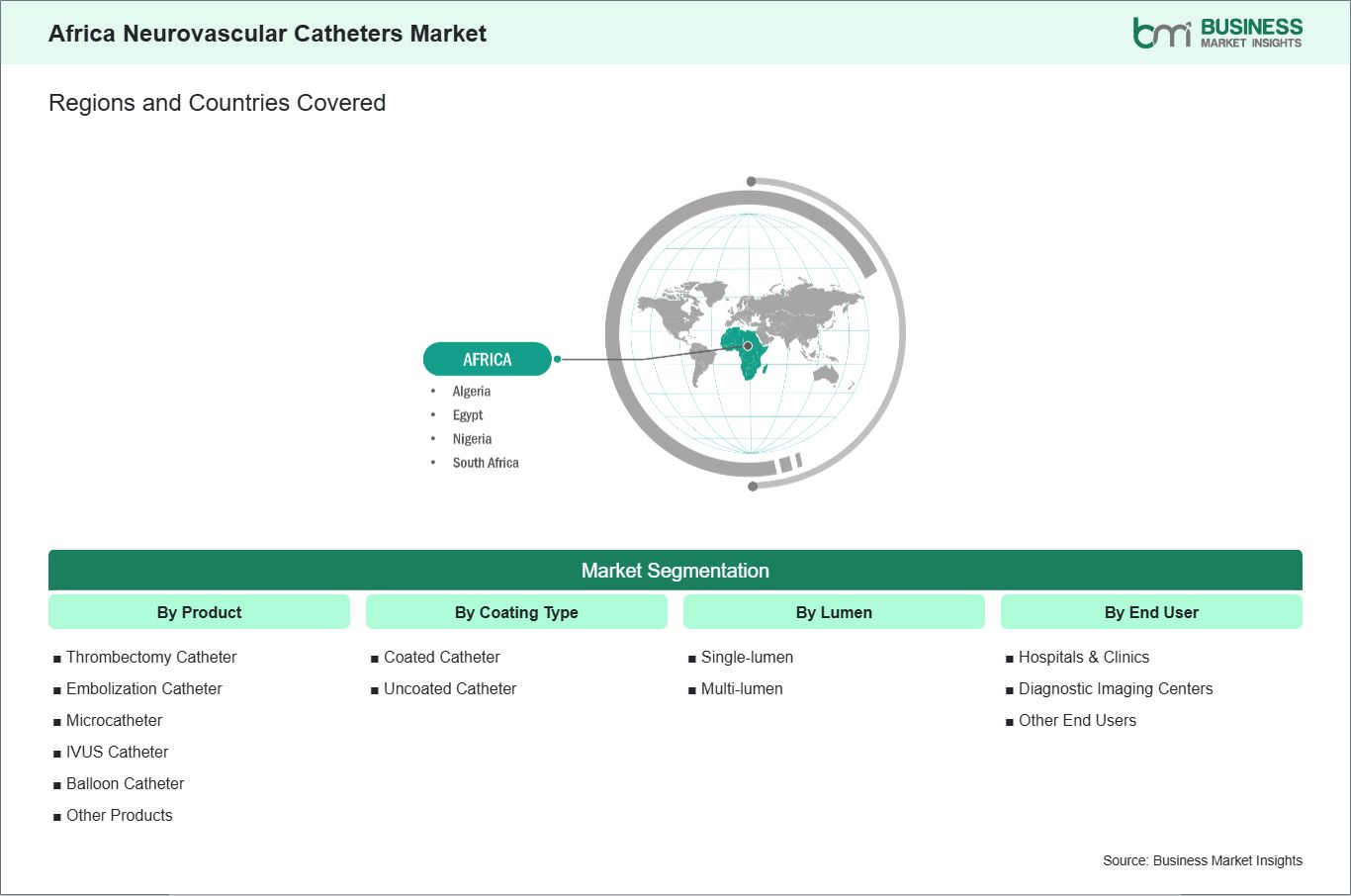
Key segments that contributed to the derivation of the Africa Neurovascular Catheters market analysis are product, coating type, lumen, and end user.
Stroke remains one of the leading causes of death and long-term disability worldwide, with incidence rates steadily increasing due to demographic aging and the growing prevalence of vascular risk factors such as hypertension, diabetes, obesity, and atrial fibrillation. Stroke risk increases with age, roughly doubling with each decade after 55 years, resulting in an expanding patient population requiring neurovascular diagnosis and intervention. Ischemic stroke, which accounts for the majority of cases, relies on catheter-based mechanical thrombectomy as a standard of care for large vessel occlusions.
Neurovascular catheters play a critical role in navigating complex cerebral vasculature to enable rapid clot retrieval, restore blood flow, and minimize neurological damage. As clinical guidelines expand treatment time windows and procedural volumes increase, demand for advanced aspiration and delivery catheters continues to rise. In parallel, the prevalence of cerebral aneurysms increases with age due to degenerative changes in blood vessel walls.
Improved access to diagnostic imaging has led to higher detection rates of both ruptured and unruptured aneurysms, prompting early interventional management. Minimally invasive endovascular procedures such as coil embolization and flow diversion depend on specialized microcatheters for precise device delivery and vessel access. The growing burden of neurovascular diseases, combined with aging populations and increased adoption of minimally invasive therapies, is driving sustained demand for neurovascular catheters across hospitals and specialized stroke centers worldwide.
As neurovascular procedures become complex and technology-driven, hospitals seek partnerships with MedTech firms to access advanced catheter solutions, clinical expertise, and procedural support. These collaborations enable faster adoption of neurovascular catheters while improving procedural efficiency and patient outcomes. Through long-term supply agreements and co-development partnerships, MedTech companies gain direct insight into real-world clinical needs, allowing them to design catheters with enhanced trackability, flexibility, and precision for complex cerebral anatomy. Hospitals benefit from customized device solutions, early access to next-generation technologies, and training programs for interventional neurologists and neurosurgeons. This collaborative innovation shortens product development cycles and increases the clinical relevance of newly launched catheters.
Clinical research collaborations generate real-world evidence that supports regulatory approvals, guideline inclusion, and broader reimbursement coverage. Hospitals participating in clinical trials become early adopters and reference centers, driving wider acceptance of neurovascular catheter systems across regional healthcare networks. Additionally, joint training initiatives and simulation programs improve physician proficiency in catheter-based stroke and aneurysm interventions, leading to higher procedural volumes.
From a commercial perspective, partnerships with large hospital systems and comprehensive stroke centers provide MedTech firms with stable revenue streams and expanded market penetration. As healthcare systems prioritize value-based care and minimally invasive treatments, strategic collaborations will play a pivotal role in expanding access to neurovascular catheter technologies and sustaining market growth.

The Africa neurovascular catheters market demonstrates steady growth, with size and share analysis highlighting evolving trends and competitive dynamics among key players. The report further examines subsegments categorized within product, coating type, lumen, and end user, offering insights into their contribution to overall market performance.
By product, the thrombectomy catheter subsegment dominated the market in 2024, driven by the widespread use in routine IV therapy and emergency care across hospitals and clinics.
Based on coating type, the coated catheters subsegment dominated the market in 2024, driven by infection prevention initiatives and demand for biocompatible devices in African healthcare systems.
Per lumen, the multi-lumen subsegment dominated the market in 2024, driven by the efficiency needs in administering multiple therapies simultaneously in critical care settings.
By end user, the hospitals and clinics subsegment dominated the market in 2024, driven by government investment in healthcare infrastructure and the expansion of private medical facilities across Africa.
| Report Attribute | Details |
|---|---|
| Market size in 2024 | US$ 25.6 Million |
| Market Size by 2033 | US$ 48.0 Million |
| CAGR (2025 - 2033) | 7.2% |
| Historical Data | 2022-2023 |
| Forecast period | 2025-2033 |
| Segments Covered | By Product
|
| Regions and Countries Covered | Africa
|
| Market leaders and key company profiles |
|
The "Africa Neurovascular Catheters Market Size and Forecast (2025–2033)" report provides a detailed analysis of the market covering below areas:
The geographical scope of the Africa Neurovascular Catheters market report is divided into: Egypt, South Africa, Nigeria, and Algeria. Egypt held the largest share in 2024.
Country‑level dynamics in Africa reveal diverse adoption patterns shaped by healthcare infrastructure, government priorities, and private sector participation. Egypt leads the region, supported by advanced hospitals and strong private healthcare investment, driving demand for coated and multi‑lumen catheters in intensive care units. Nigeria represents a high‑potential market, where affordability and distribution efficiency are critical success factors, as intravenous therapy is used in urban and rural hospitals. South Africa emphasizes modernization, with government programs expanding catheterization labs and infection‑control initiatives, boosting demand for coated catheters.
Smaller markets are witnessing incremental growth, driven by government investment in tertiary hospitals and training programs for clinicians. Across these countries, hospitals and clinics remain the dominant end users, but private diagnostic centers are investing in intravenous catheter technologies to expand service offerings. The diversity of country insights underscores the need for differentiated strategies: premium positioning in South Africa and Egypt, affordability in Nigeria, and partnership‑driven expansion in emerging economies. Africa’s country‑level dynamics highlight a patchwork of opportunities where localized approaches, strong distribution networks, and education initiatives are essential for sustained success.

The Africa Neurovascular Catheters market is evaluated by gathering qualitative and quantitative data post primary and secondary research, which includes important corporate publications, association data, and databases. A few of the key developments in the Africa neurovascular catheters market are:
The Africa Neurovascular Catheters Market is valued at US$ 25.6 Million in 2024, it is projected to reach US$ 48.0 Million by 2033.
As per our report Africa Neurovascular Catheters Market, the market size is valued at US$ 25.6 Million in 2024, projecting it to reach US$ 48.0 Million by 2033. This translates to a CAGR of approximately 7.2% during the forecast period.
The Africa Neurovascular Catheters Market report typically cover these key segments-
The historic period, base year, and forecast period can vary slightly depending on the specific market research report. However, for the Africa Neurovascular Catheters Market report:
The Africa Neurovascular Catheters Market is populated by several key players, each contributing to its growth and innovation. Some of the major players include:
The Africa Neurovascular Catheters Market report is valuable for diverse stakeholders, including:
Essentially, anyone involved in or considering involvement in the Africa Neurovascular Catheters Market value chain can benefit from the information contained in a comprehensive market report.
Please tell us your area of interest
(Market Segments/ Regions and Countries/ Companies)