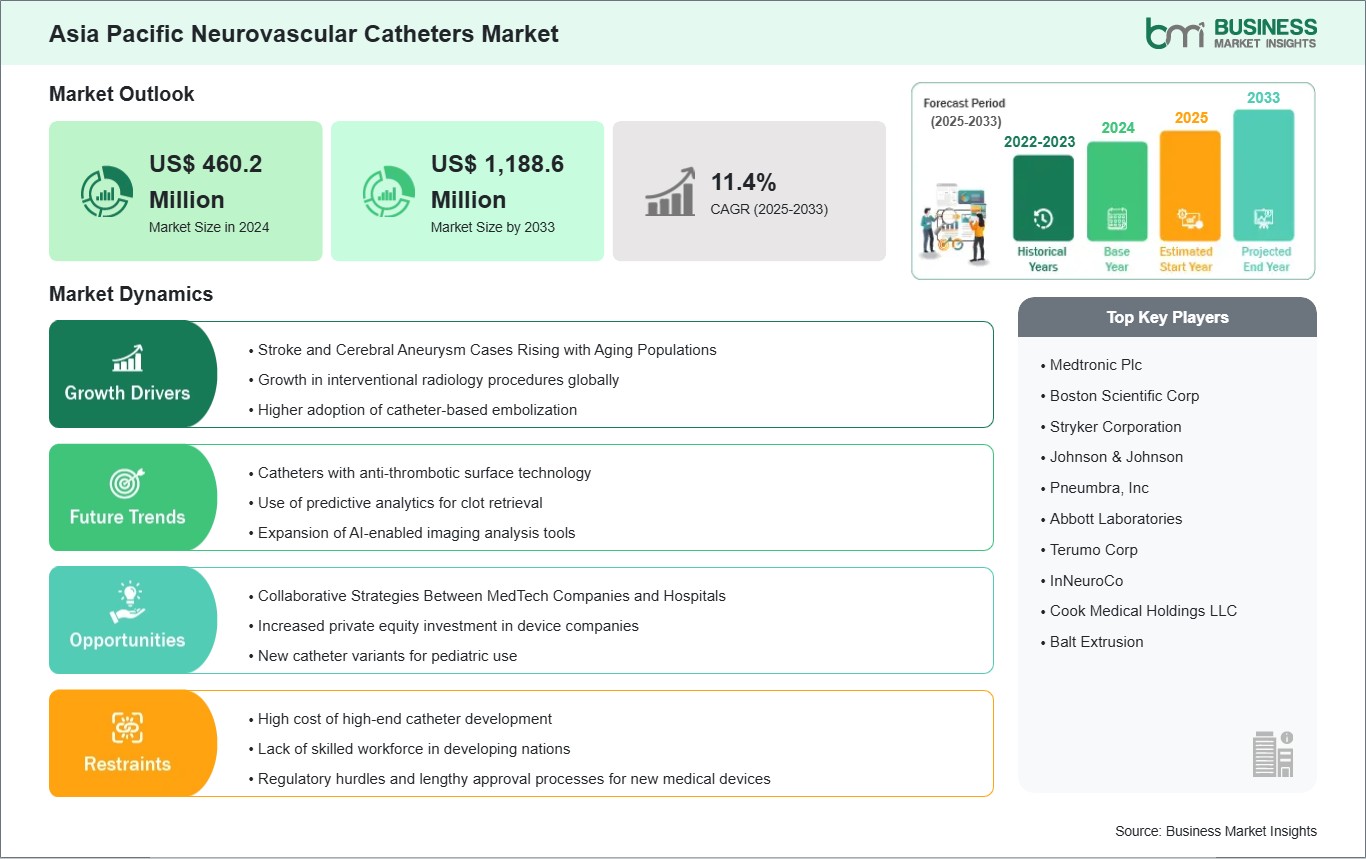
The Asia Pacific Neurovascular Catheters market size is expected to reach US$ 1,188.6 million by 2033 from US$ 460.2 million in 2024. The market is estimated to record a CAGR of 11.4% from 2025 to 2033.
The region accounts for a substantial proportion of global stroke and cerebral aneurysm cases, particularly in populous countries such as China and India. Governments are prioritizing stroke management through national healthcare reforms, expansion of comprehensive stroke centers, and increased reimbursement coverage for endovascular procedures, which directly supports demand for neurovascular catheters.
Advanced healthcare systems in Japan, South Korea, Australia, and Singapore drive innovation-led adoption of high-performance thrombectomy and microcatheters. Emerging markets such as India, Indonesia, Vietnam, and the Philippines are witnessing rising procedural volumes due to improved access to diagnostic imaging and growing awareness of early stroke intervention. Hospitals and clinics dominate end user demand as they remain the primary settings for emergency stroke care and aneurysm treatment.
Technological advancements such as hydrophilic coatings, enhanced catheter trackability, and improved aspiration efficiency are accelerating replacement demand and product upgrades across the region. Competitive dynamics include strong participation from multinational MedTech firms alongside regional distributors that enable last-mile access in fragmented healthcare systems. Asia Pacific represents an important growth region where rising patient volumes, improving infrastructure, and evolving clinical standards drive expansion of the neurovascular catheters market.

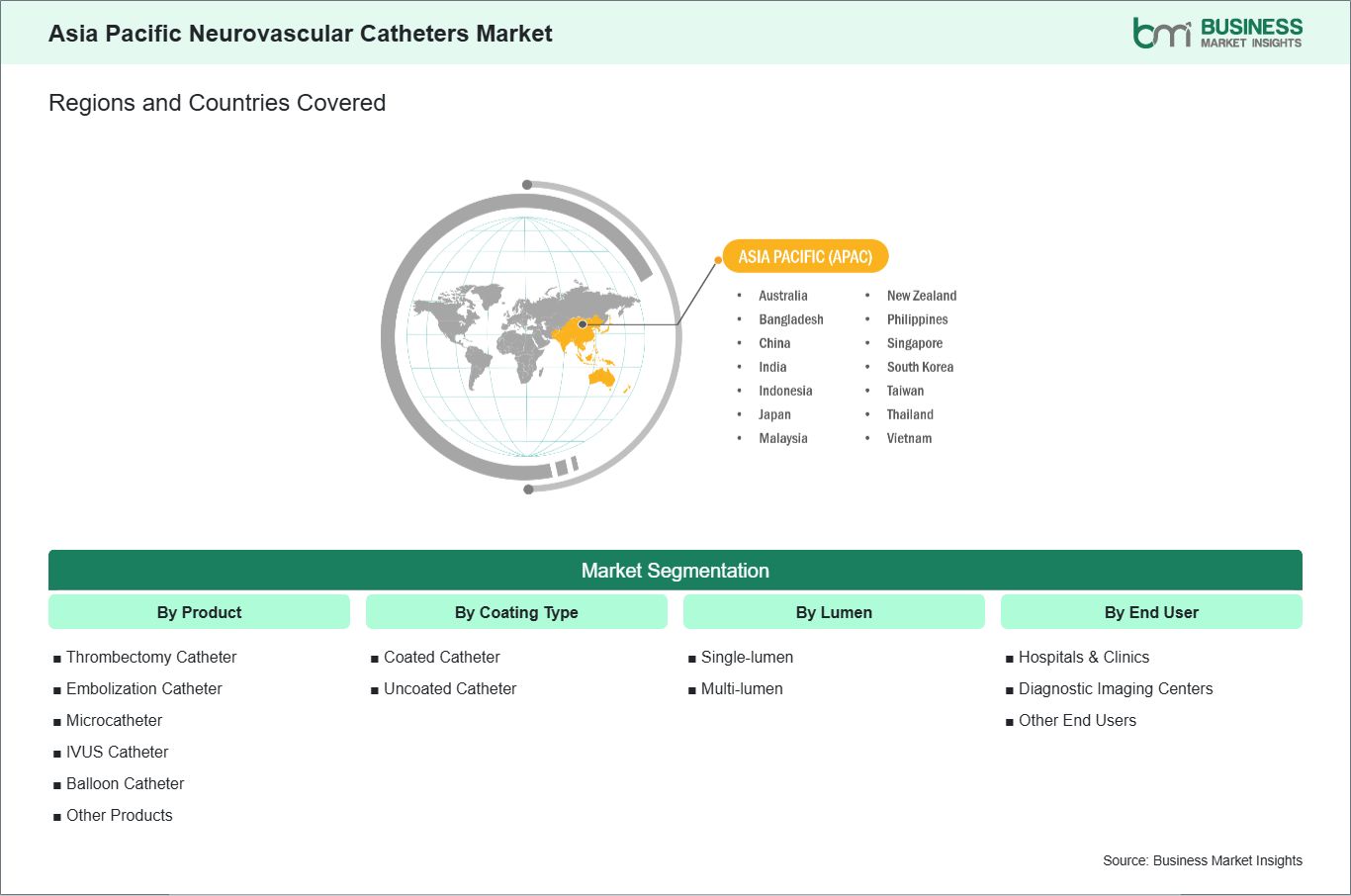
Key segments that contributed to the derivation of the Asia Pacific Neurovascular Catheters market analysis are product, coating type, lumen, and end user.
Rapid population aging in China, Japan, South Korea, and Australia has increased the prevalence of ischemic stroke and cerebral aneurysms. Additionally, rising lifestyle-related risk factors—including hypertension, diabetes, obesity, smoking, and sedentary behavior—are accelerating stroke incidence across developed and emerging economies.
Ischemic stroke accounts for the majority of cases in the region, and catheter-based mechanical thrombectomy has become the standard of care for large-vessel occlusions in advanced healthcare systems. As treatment guidelines expand therapeutic windows and procedural eligibility, hospitals are performing higher volumes of thrombectomy procedures, boosting demand for aspiration, guide, and microcatheters. Improved access to CT and MRI imaging has enhanced early detection of unruptured cerebral aneurysms, increasing the utilization of embolization and flow-diversion procedures that rely on specialized neurovascular catheters.
In emerging Asia Pacific markets, expanding public awareness campaigns and emergency stroke referral networks are improving patient presentation timelines, supporting procedural growth. Aging demographics, growing disease prevalence, and rising interventional procedure volumes are driving demand for neurovascular catheters across hospitals and specialized stroke centers.
As neuro-interventional procedures become more complex and outcome-driven, hospitals increasingly seek partnerships with MedTech firms to access advanced catheter technologies, procedural expertise, and clinical training support. These collaborations facilitate faster adoption of next-generation thrombectomy and microcatheters while improving procedural efficiency and patient outcomes.
In Asia Pacific, partnerships involve long-term supply agreements, joint training initiatives, and co-development programs tailored to regional clinical needs. MedTech companies benefit from real-world procedural insights that inform catheter design improvements, such as enhanced flexibility, trackability, and compatibility with diverse vascular anatomies. Hospitals gain access to customized device solutions, early-stage innovations, and structured physician education programs that help build neuro-interventional expertise, particularly in emerging markets.
Clinical research collaborations generate Asia-specific evidence supporting regulatory approvals, reimbursement inclusion, and broader guideline adoption. Hospitals participating in clinical studies evolve into regional reference centers, influencing technology uptake across healthcare networks. From a commercial standpoint, partnerships with large hospital groups and government-backed stroke programs provide MedTech firms with stable revenue streams and scalable market penetration. As Asia Pacific healthcare systems emphasize minimally invasive treatment pathways and value-based outcomes, collaborative models will remain central to expanding neurovascular catheter adoption.

The Asia Pacific neurovascular catheters market demonstrates steady growth, with size and share analysis highlighting evolving trends and competitive dynamics among key players. The report further examines subsegments categorized within product, coating type, lumen, and end user, offering insights into their contribution to overall market performance
By product, the thrombectomy catheter subsegment dominated the market in 2024, driven by the increased mechanical thrombectomy adoption.
Based on coating type, the coated catheters subsegment dominated the market in 2024, driven by infection-control and biocompatibility needs.
Based on lumen, the multi-lumen subsegment dominated the market in 2024, driven by the efficiency needs in administering multiple therapies simultaneously in critical care settings.
By end user, the hospitals and clinics subsegment dominated the market in 2024, driven by government investment in healthcare infrastructure and the expansion of private medical facilities across the region.
| Report Attribute | Details |
|---|---|
| Market size in 2024 | US$ 460.2 Million |
| Market Size by 2033 | US$ 1,188.6 Million |
| CAGR (2025 - 2033) | 11.4% |
| Historical Data | 2022-2023 |
| Forecast period | 2025-2033 |
| Segments Covered | By Product
|
| Regions and Countries Covered | Asia-Pacific
|
| Market leaders and key company profiles |
|
The "Asia Pacific Neurovascular Catheters Market Size and Forecast (2025–2033)" report provides a detailed analysis of the market covering below areas:
The geographical scope of the Asia Pacific Neurovascular Catheters market report is divided into: China, India, Japan, Australia, Bangladesh, Indonesia, Malaysia, New Zealand, Philippines, Singapore, South Korea, Taiwan, Thailand, and Vietnam. China held the largest share in 2024.
China is the largest market for neurovascular catheters in Asia Pacific, driven by its vast population, rapidly aging demographics, and aggressive expansion of stroke care infrastructure. Government initiatives supporting nationwide stroke center certification and emergency care networks have increased mechanical thrombectomy and aneurysm intervention volumes. Rising healthcare expenditure and local manufacturing capabilities support market leadership.
Japan and South Korea represent mature markets characterized by advanced neuro-interventional expertise, high procedural standards, and early adoption of innovative catheter technologies. Japan’s aging population continues to drive sustained demand for stroke and aneurysm management solutions. India is an emerging market, supported by expanding tertiary hospitals, improved diagnostic access, and increasing awareness of endovascular stroke treatment. Southeast Asian countries, including Indonesia, Vietnam, Thailand, and Malaysia, are experiencing gradual growth as healthcare modernization spreads beyond urban centers. Across the region, hospitals and clinics remain dominant end users, with diagnostic imaging and specialty centers adopting neurovascular procedures.

The Asia Pacific Neurovascular Catheters market is evaluated by gathering qualitative and quantitative data post primary and secondary research, which includes important corporate publications, association data, and databases. A few of the key developments in the Asia Pacific neurovascular catheters market are:
The Asia Pacific Neurovascular Catheters Market is valued at US$ 460.2 Million in 2024, it is projected to reach US$ 1,188.6 Million by 2033.
As per our report Asia Pacific Neurovascular Catheters Market, the market size is valued at US$ 460.2 Million in 2024, projecting it to reach US$ 1,188.6 Million by 2033. This translates to a CAGR of approximately 11.4% during the forecast period.
The Asia Pacific Neurovascular Catheters Market report typically cover these key segments-
The historic period, base year, and forecast period can vary slightly depending on the specific market research report. However, for the Asia Pacific Neurovascular Catheters Market report:
The Asia Pacific Neurovascular Catheters Market is populated by several key players, each contributing to its growth and innovation. Some of the major players include:
The Asia Pacific Neurovascular Catheters Market report is valuable for diverse stakeholders, including:
Essentially, anyone involved in or considering involvement in the Asia Pacific Neurovascular Catheters Market value chain can benefit from the information contained in a comprehensive market report.
Please tell us your area of interest
(Market Segments/ Regions and Countries/ Companies)