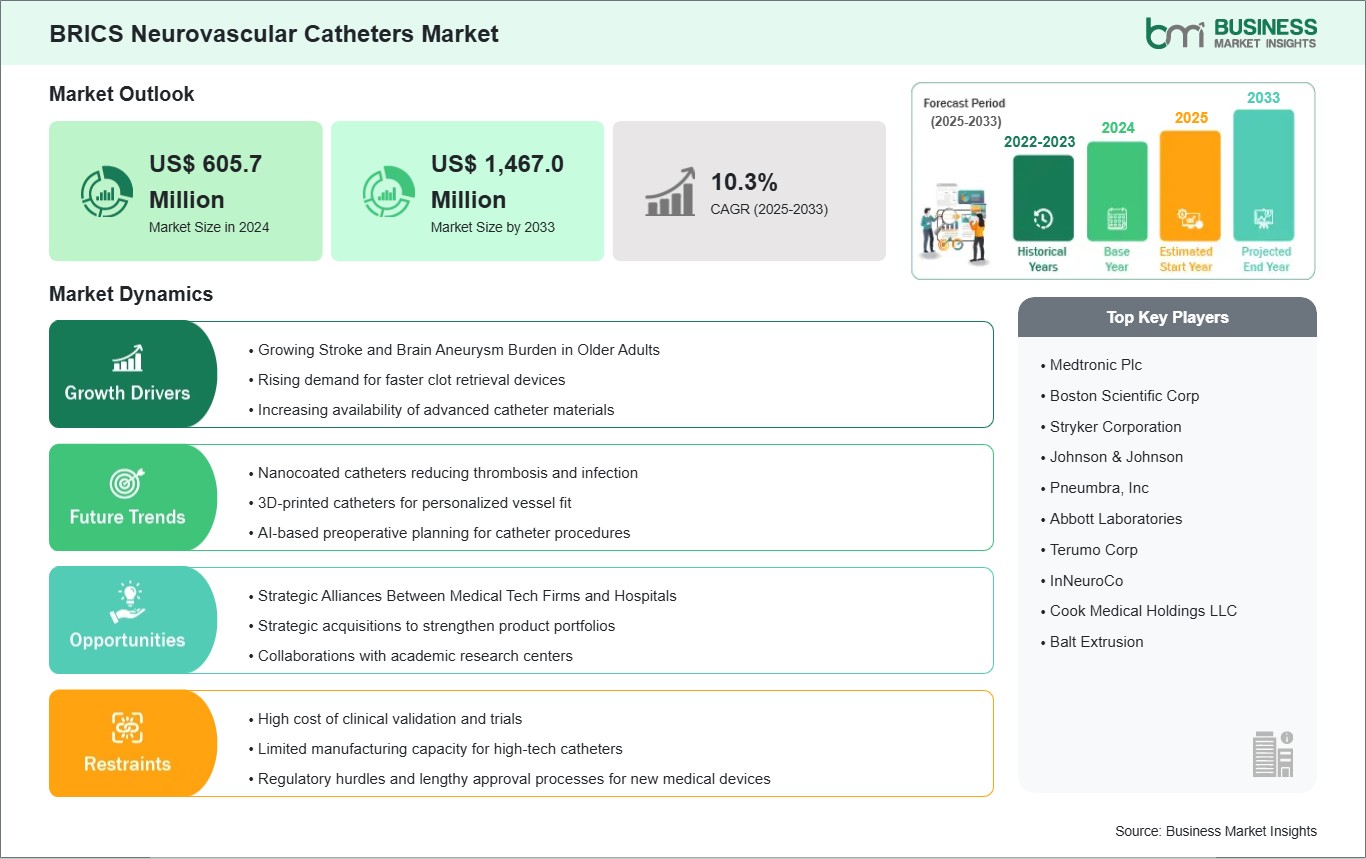
The BRICS Neurovascular Catheters market size is expected to reach US$ 1,467.0 million by 2033 from US$ 605.7 million in 2024. The market is estimated to record a CAGR of 10.3% from 2025 to 2033.
Stroke and cerebral aneurysms are significant health challenges in BRICS nations, with China being the largest country market and a high volume of neurovascular thrombectomy procedures recorded in recent years. Population aging, lifestyle‑related risk factors, and uneven access to advanced stroke care have accelerated demand for minimally invasive catheter‑based interventions. Hospitals across cities in Brazil, India, and China are investing in thrombectomy and aneurysm treatment programs, driving procurement of aspiration, microcatheters, and coil delivery systems.
Healthcare investments and public health initiatives have expanded stroke care networks, particularly in urban centers, increasing procedural volumes for mechanical thrombectomy and embolization. Coated catheters are gaining preference for infection prevention in tertiary hospitals, while multi‑lumen catheters support complex critical‑care protocols. Cost sensitivity in India and South Africa encourages the adoption of scalable solutions, while China and Brazil emphasize technology innovation and clinical excellence.
Competitive dynamics include multinational manufacturers partnering with regional distributors and local manufacturers to improve accessibility and cost effectiveness. The convergence of rising disease incidence, expanding surgical capabilities, and strategic collaborations between MedTech firms and hospital systems positions the BRICS neurovascular catheters market for sustained growth.

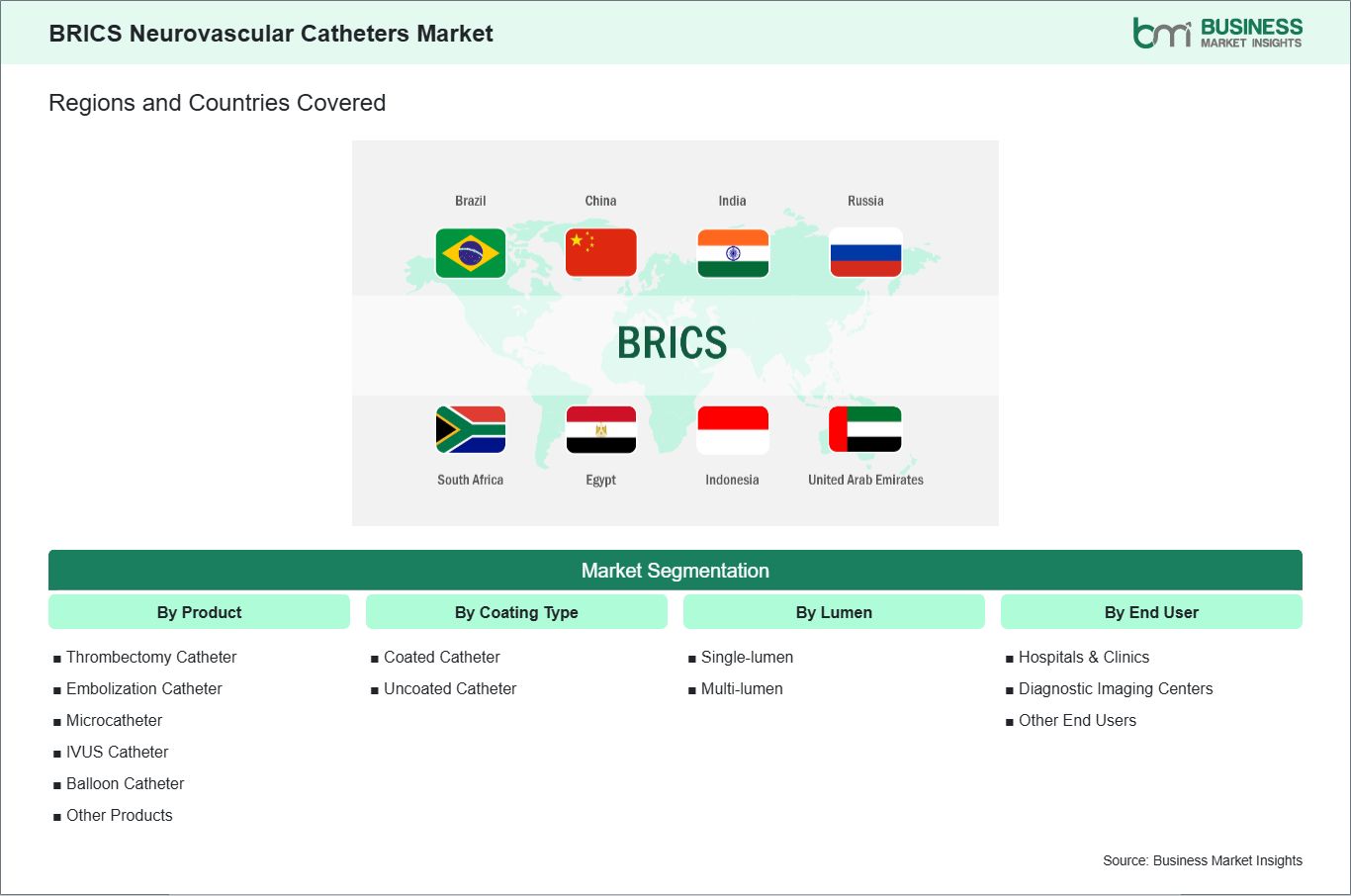
Key segments that contributed to the derivation of the BRICS Neurovascular Catheters market analysis are product, coating type, lumen, and end user.
Stroke is a leading cause of death and disability worldwide — with ischemic strokes comprising a majority — and is prevalent in BRICS countries due to demographic aging, rising prevalence of hypertension, diabetes, and lifestyle risk factors. China, India, and Brazil contribute a significant share of global stroke cases with large patient volumes presenting for emergency neurovascular interventions. Neurovascular catheters are essential in mechanical thrombectomy procedures to navigate tortuous cerebral vessels, retrieve clots, and restore blood flow, improving chances of recovery when administered rapidly.
Cerebral aneurysms, often asymptomatic until rupture, are more frequently identified due to improved access to diagnostic imaging, especially in urban centers. Endovascular treatments such as coil embolization and flow diversion demand microcatheter systems for precise device delivery. Hospitals in China and India are making strategic investments in tertiary care facilities to provide these minimally invasive treatments. The rising procedural volumes for both stroke and aneurysm management have elevated demand for specialized catheters with enhanced flexibility, trackability, and biocompatibility.
With expanding awareness campaigns, government healthcare spending, and increasing access to emergency neurology services, BRICS countries are witnessing consistent procedural growth. These factors drive sustained demand for neurovascular catheters across hospitals, clinics, and specialized neuro interventional centers throughout the region.
As neurovascular interventions become more complex and demand rises, hospitals in BRICS nations are seeking partnerships with device manufacturers to access advanced catheter technologies, specialized clinical training, and procedural support. These collaborations include long‑term supply agreements, co‑development initiatives, and integrated service models that tailor device portfolios to regional clinical needs.
For MedTech firms, engagement with leading hospitals and stroke centers in China, Brazil, and India provides insights into clinician preferences, procedural challenges, and opportunities for product innovation. This feedback loop enables the design of catheters with improved navigation, reduced friction, and compatibility with varied anatomical profiles prevalent across diverse patient populations. Hospitals benefit from early access to new catheter solutions, structured training programs for neuro interventional specialists, and on‑site procedural support.
Clinical research partnerships generate region‑specific evidence that bolsters regulatory approvals and inclusion in treatment guidelines, which are critical in markets with diverse reimbursement policies. Hospitals participating in collaborative studies become reference centers, catalyzing broader adoption of advanced catheter technologies within their healthcare networks. Commercially, collaborations with large hospital groups and government health systems provide MedTech firms with predictable procurement channels and deeper market penetration.
In emerging BRICS markets — particularly India and South Africa — where cost sensitivity and infrastructure variability exist, collaborations help address local training needs and device support requirements. As healthcare systems emphasize value‑based outcomes and minimally invasive care, these strategic partnerships will be central to expanding access to neurovascular catheter technologies and sustaining regional growth.

The BRICS neurovascular catheters market demonstrates steady growth, with size and share analysis highlighting evolving trends and competitive dynamics among key players. The report further examines subsegments categorized within product, coating type, lumen, and end user, offering insights into their contribution to overall market performance.
By product, the thrombectomy catheter subsegment dominated the market in 2024, driven by the extensive use in acute ischemic stroke protocols across hospital environments.
Per coating type, the coated catheters subsegment dominated the market in 2024, driven by infection control and biocompatibility needs.
Based on lumen, the multi-lumen subsegment dominated the market in 2024, driven by the preference in critical care units that require simultaneous therapies.
By end user, the hospitals and clinics subsegment dominated the market in 2024, driven by increased procedural capacity and stroke care expansion.
| Report Attribute | Details |
|---|---|
| Market size in 2024 | US$ 605.7 Million |
| Market Size by 2033 | US$ 1,467.0 Million |
| CAGR (2025 - 2033) | 10.3% |
| Historical Data | 2022-2023 |
| Forecast period | 2025-2033 |
| Segments Covered | By Product
|
| Regions and Countries Covered | BRICS
|
| Market leaders and key company profiles |
|
The "BRICS Neurovascular Catheters Market Size and Forecast (2025–2033)" report provides a detailed analysis of the market covering below areas:
The geographical scope of the BRICS Neurovascular Catheters market report is divided into: Russia, Brazil, South Africa, India, the UAE, and China. China held the largest share in 2024.
China is the largest market, supported by extensive investment in healthcare infrastructure, rapid expansion of hospital networks, and a high volume of neurovascular procedures, especially mechanical thrombectomy. The country’s emphasis on domestic medical device innovation and localized manufacturing strengthens accessibility of advanced catheter technologies.
India represents a high‑volume, price‑sensitive market with growing demand for specialized neurovascular catheters. Expanding tertiary care facilities, increasing stroke awareness, and government efforts to improve emergency neurology services are boosting adoption across major cities. Brazil combines public and private healthcare systems, with increasing regulatory changes encouraging foreign MedTech partnerships and catheter technology uptake in urban centers. Russia is modernizing its hospital infrastructure and integrating high‑technology diagnostics that support complex neurovascular procedures in leading facilities. South Africa shows growing procedural volumes driven by rising neurological disease prevalence and expanding capabilities in tertiary hospitals. Across the region, hospitals and clinics dominate end user adoption due to higher procedural volumes and better access to imaging and interventional suites. Market growth is influenced by regional disparities in infrastructure, reimbursement policies, and economic factors, but shared drivers such as aging populations and rising stroke incidence create opportunities for neurovascular catheter adoption.

The BRICS Neurovascular Catheters market is evaluated by gathering qualitative and quantitative data post primary and secondary research, which includes important corporate publications, association data, and databases. A few of the key developments in the BRICS neurovascular catheters market are:
The BRICS Neurovascular Catheters Market is valued at US$ 605.7 Million in 2024, it is projected to reach US$ 1,467.0 Million by 2033.
As per our report BRICS Neurovascular Catheters Market, the market size is valued at US$ 605.7 Million in 2024, projecting it to reach US$ 1,467.0 Million by 2033. This translates to a CAGR of approximately 10.3% during the forecast period.
The BRICS Neurovascular Catheters Market report typically cover these key segments-
The historic period, base year, and forecast period can vary slightly depending on the specific market research report. However, for the BRICS Neurovascular Catheters Market report:
The BRICS Neurovascular Catheters Market is populated by several key players, each contributing to its growth and innovation. Some of the major players include:
The BRICS Neurovascular Catheters Market report is valuable for diverse stakeholders, including:
Essentially, anyone involved in or considering involvement in the BRICS Neurovascular Catheters Market value chain can benefit from the information contained in a comprehensive market report.
Please tell us your area of interest
(Market Segments/ Regions and Countries/ Companies)