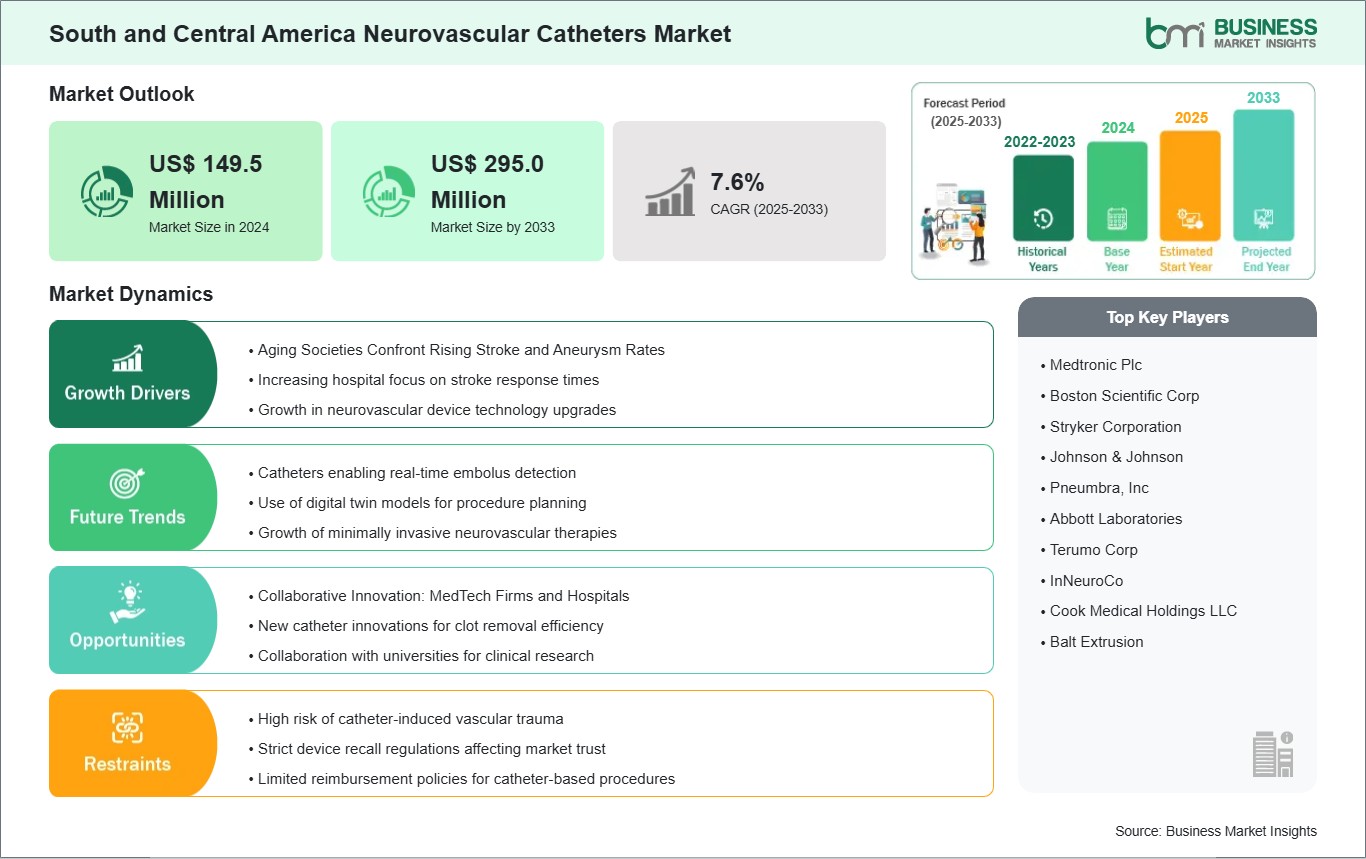
The South and Central America Neurovascular Catheters market size is expected to reach US$ 295.0 million by 2033 from US$ 149.5 million in 2024. The market is estimated to record a CAGR of 8.1% from 2025 to 2033.
Brazil is the largest national market, supported by investments in hospital infrastructure, comprehensive imaging suites, and neurologist training programs that facilitate catheter‑based therapies for ischemic stroke and cerebral aneurysms. Mexico, Argentina, and Colombia demonstrate promising growth as tertiary care hospitals adopt mechanical thrombectomy, embolization, and flow diversion techniques as part of standard neurovascular care.
Stroke remains a leading cause of disability in South and Central America, increasing demand for catheter‑based mechanical thrombectomy procedures. Neurovascular catheters — including thrombectomy, access, and microcatheters — play a critical role in navigating complex cerebral vasculature to restore perfusion during large vessel occlusion events. The rising burden of vascular risk factors such as hypertension, diabetes, and obesity, along with public health campaigns promoting early stroke intervention, strengthens procedural volumes in urban centers.
Healthcare reforms in Brazil and Colombia are expanding access to advanced imaging (CT/MRI) and interventional suites, enabling early detection and endovascular management of aneurysms and arteriovenous malformations. Private hospitals and specialty stroke centers are the primary adopters of the latest‑generation catheters, while public institutions incorporate these technologies as training and funding improve. Strategic collaborations between global MedTech firms and local distributors are expanding device availability, procedural training, and post‑market support. Continued healthcare investment, growing procedural capacity, and rising disease incidence position South & Central America for sustained growth in the neurovascular catheters market.

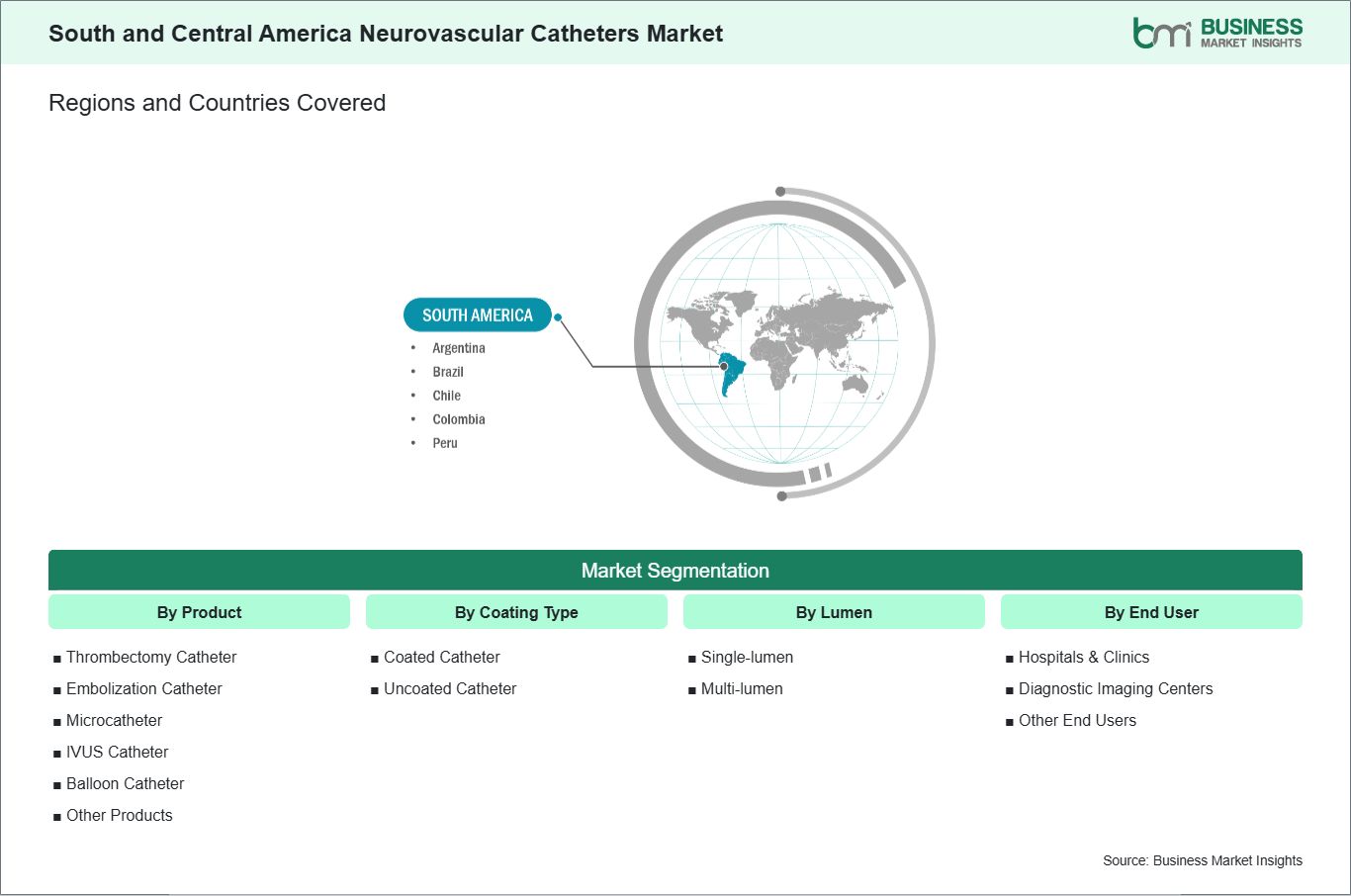
Key segments that contributed to the derivation of the South and Central America Neurovascular Catheters market analysis are product, coating type, lumen, and end user.
Stroke remains a major cause of death and long‑term disability, particularly in larger countries such as Brazil and Mexico, where healthcare modernization and improved diagnostic access have increased detection and referral rates. This detection growth expands the pool of candidates suitable for catheter‑based mechanical thrombectomy, which has become an essential treatment paradigm for ischemic stroke involving large vessel occlusions.
Neurovascular catheters are critical in these procedures, enabling physicians to navigate tortuous cerebral vasculature, mechanically remove occlusive clots, and restore blood flow, improving functional outcomes when deployed quickly. Cerebral aneurysms and other vascular anomalies are detected more frequently through expanded use of CT angiography and MRI in major hospitals, increasing volumes of endovascular aneurysm treatments, including coil embolization and flow diversion. These interventions depend on specialized microcatheters and embolization catheters for precise device delivery to target sites.
Regional healthcare improvements — such as better access to high‑resolution imaging, enhanced stroke pathways, and expanded procedural training — are creating larger, well‑supported patient populations amenable to neuro interventional care. Public awareness and preventive health campaigns elevate demand for neurovascular catheters in South & Central America.
As neurovascular procedures become sophisticated, hospitals in Brazil, Mexico, Argentina, and Colombia partner with global device manufacturers to access advanced catheter technologies, clinician training, and procedural support. These collaborations involve long‑term supply agreements, co‑development projects, and structured education programs tailored to local clinical needs and procedural workflows.
For MedTech firms, engaging with regional clinical stakeholders provides direct insight into specific anatomical, procedural, and logistical challenges inherent to South & Central American practice. This engagement enhances product design — for example, improving catheter trackability, flexibility, and support in diverse patient anatomies — and accelerates adoption in clinical environments where decision‑making is experience‑driven. Hospitals benefit from early access to next‑generation devices, robust on‑site training, and post‑sale procedural support, which improve physician proficiency and patient outcomes.
Clinical research collaborations with academic centers and tertiary hospitals help generate real‑world evidence that supports regulatory acceptance, guideline integration, and broader reimbursement coverage. Institutions participating in such studies become reference centers, promoting procedural best practices across national and regional networks. Commercially, partnerships with major hospital systems and national health ministries provide MedTech firms with stable procurement pathways and deeper market penetration. As the region prioritizes value‑based care and minimally invasive treatments, strategic collaborations will play a pivotal role in expanding access to cutting‑edge neurovascular catheter technologies and ensuring sustained market growth.

The South and Central America neurovascular catheters market demonstrates steady growth, with size and share analysis highlighting evolving trends and competitive dynamics among key players. The report further examines subsegments categorized by product, coating type, lumen, and end user, offering insights into their contribution to overall market performance.
By product, the thrombectomy catheter subsegment dominated the market in 2024, driven by the high volume of mechanical thrombectomy procedures for ischemic stroke management.
Per coating type, the coated catheters subsegment dominated the market in 2024, driven by infection control preferences in tertiary care settings.
Based on lumen, the multi-lumen subsegment dominated the market in 2024, driven by its versatility in delivering multiple therapies simultaneously.
By end user, the hospitals and clinics subsegment dominated the market in 2024, driven by procedural volumes and infrastructure readiness.
| Report Attribute | Details |
|---|---|
| Market size in 2024 | US$ 149.5 Million |
| Market Size by 2033 | US$ 295.0 Million |
| CAGR (2025 - 2033) | 7.6% |
| Historical Data | 2022-2023 |
| Forecast period | 2025-2033 |
| Segments Covered | By Product
|
| Regions and Countries Covered | South and Central America
|
| Market leaders and key company profiles |
|
The "South and Central America Neurovascular Catheters Market Size and Forecast (2025–2033)" report provides a detailed analysis of the market covering below areas:
The geographical scope of the South and Central America Neurovascular Catheters market report is divided into: Brazil, Argentina, Peru, Chile, and Colombia. Brazil held the largest share in 2024.
The South & Central America neurovascular catheters market reflects diverse adoption shaped by healthcare infrastructure, economic factors, and stroke epidemiology. Brazil is the largest market, driven by an extensive network of tertiary care hospitals in cities such as São Paulo, Rio de Janeiro, and Brasilia that conduct high volumes of mechanical thrombectomy and aneurysm embolization procedures. Growing investments in stroke centers, catheterization labs, and diagnostic imaging support faster adoption of advanced catheters.
Mexico represents a significant market with expanding private and public hospital capabilities in Mexico City, Guadalajara, and Monterrey, focusing on stroke care pathways and endovascular interventions. Argentina shows promising adoption in Buenos Aires and Cordoba, where healthcare spending is bolstering neuro interventional suites. Colombia has emerging activity in Medellín and Bogotá, including early clinical cases of advanced robotic thrombectomy that point to innovative procedural adoption. Chile and Peru display incremental growth, with urban hospitals introducing catheter‑based stroke care and neurovascular procedures.
Across these countries, hospitals and clinics remain the dominant end users due to procedural throughput and infrastructure concentration. Diagnostic imaging centers with interventional capability are integrating catheter procedures to expand service offerings. Regional disparities persist — especially in rural and public sector facilities — but targeted investments and clinician training programs are narrowing capability gaps, fostering market development.

The South and Central America Neurovascular Catheters market is evaluated by gathering qualitative and quantitative data post primary and secondary research, which includes important corporate publications, association data, and databases. A few of the key developments in the South and Central America neurovascular catheters market are:
The South and Central America Neurovascular Catheters Market is valued at US$ 149.5 Million in 2024, it is projected to reach US$ 295.0 Million by 2033.
As per our report South and Central America Neurovascular Catheters Market, the market size is valued at US$ 149.5 Million in 2024, projecting it to reach US$ 295.0 Million by 2033. This translates to a CAGR of approximately 7.6% during the forecast period.
The South and Central America Neurovascular Catheters Market report typically cover these key segments-
The historic period, base year, and forecast period can vary slightly depending on the specific market research report. However, for the South and Central America Neurovascular Catheters Market report:
The South and Central America Neurovascular Catheters Market is populated by several key players, each contributing to its growth and innovation. Some of the major players include:
The South and Central America Neurovascular Catheters Market report is valuable for diverse stakeholders, including:
Essentially, anyone involved in or considering involvement in the South and Central America Neurovascular Catheters Market value chain can benefit from the information contained in a comprehensive market report.
Please tell us your area of interest
(Market Segments/ Regions and Countries/ Companies)