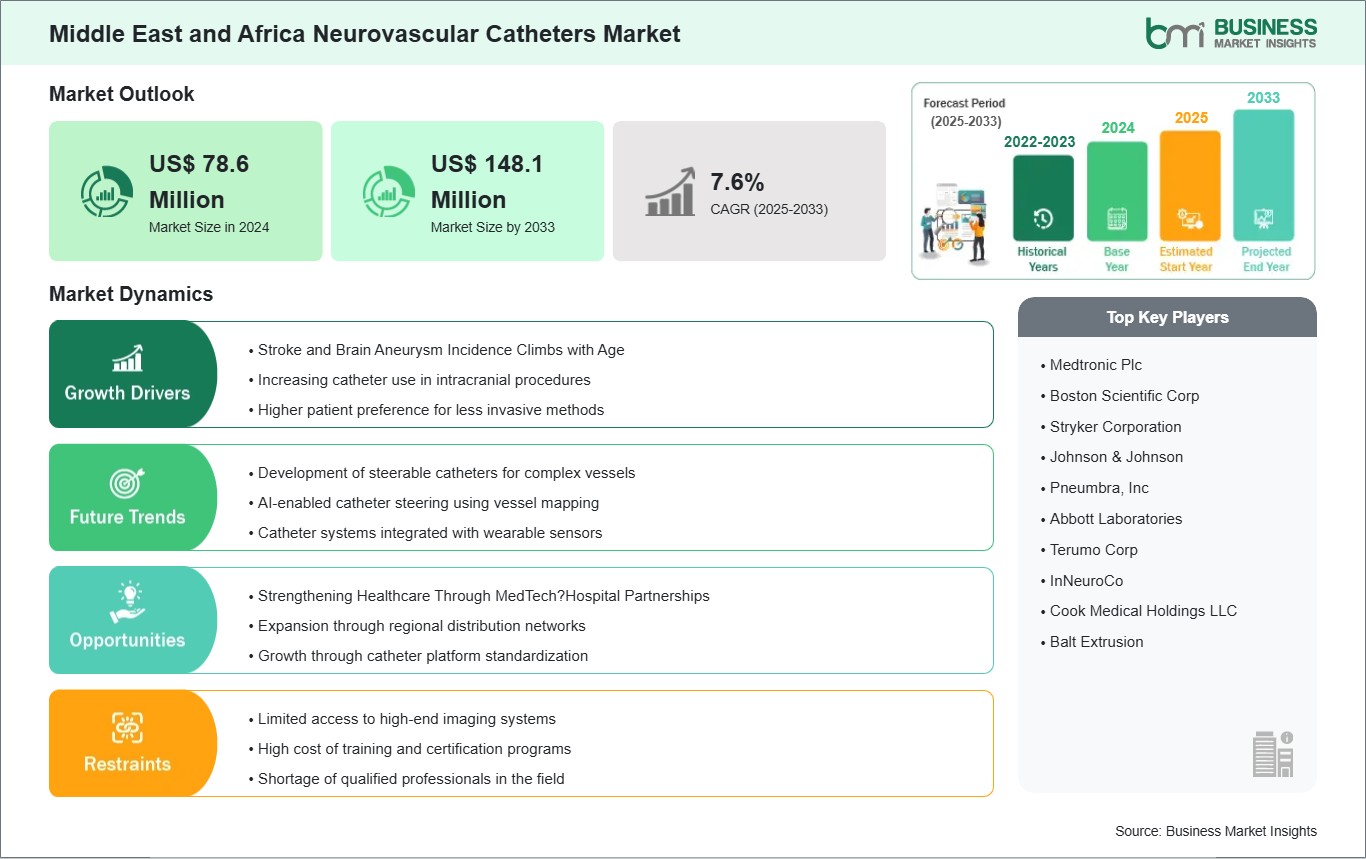
The Middle East and Africa Neurovascular Catheters market size is expected to reach US$ 148.1 million by 2033 from US$ 78.6 million in 2024. The market is estimated to record a CAGR of 7.6% from 2025 to 2033.
Saudi Arabia, UAE, and South Africa lead regional growth due to well-developed hospital infrastructure, government initiatives to improve stroke care, and investment in neuro-interventional suites. In North Africa, countries such as Egypt and Morocco are witnessing growing procedural volumes as urban hospitals upgrade imaging capabilities and stroke management protocols. Stroke is a leading cause of death in the region, and the prevalence of ischemic stroke has been rising due to aging populations and increasing prevalence of hypertension, diabetes, and obesity. Catheter-based interventions, such as mechanical thrombectomy for large vessel occlusions and endovascular coil embolization for cerebral aneurysms, are becoming standard care in tertiary hospitals, fueling demand for thrombectomy and microcatheter systems.
Advancements in hospital infrastructure, including hybrid angiography labs and modern intensive care units, have supported the adoption of coated and multi-lumen catheters, particularly in critical care settings. Government healthcare programs and public-private partnerships in GCC countries have facilitated procurement and clinician training, accelerating catheter adoption. Across MEA, hospitals and clinics dominate as end users, but diagnostic imaging centers and specialized stroke units are gradually integrating interventional catheter procedures.
Collaborations between MedTech companies and hospitals, along with regional clinical trials, have bolstered market growth by improving access to advanced devices, building physician expertise, and supporting real-world evidence generation.

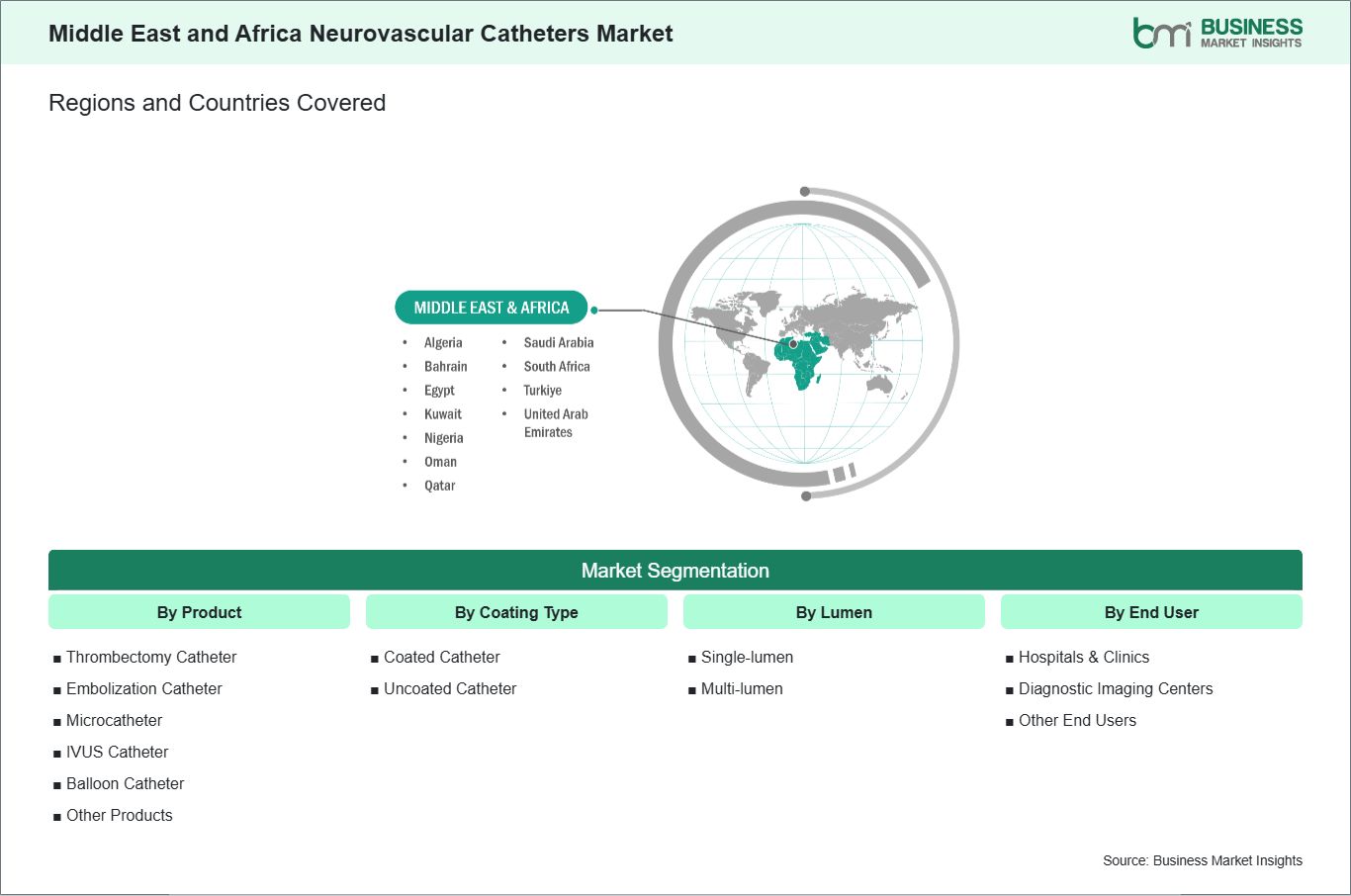
Key segments that contributed to the derivation of the Middle East and Africa Neurovascular Catheters market analysis are product, coating type, lumen, and end user.
Stroke remains a leading cause of mortality and long-term disability across the region, with ischemic strokes accounting for the majority of cases. Mechanical thrombectomy is used as a primary treatment for large vessel occlusions, elevating demand for thrombectomy catheters capable of navigating complex cerebral vasculature and restoring perfusion.
Cerebral aneurysms are diagnosed due to improved access to CT angiography and MRI in urban tertiary hospitals, leading to higher volumes of coil embolization and flow diversion procedures. Microcatheters and embolization catheters are essential for precise device delivery and successful endovascular interventions. Coated catheters are gaining popularity in tertiary care settings where infection control is a priority. Multi-lumen catheters are being adopted in ICUs to facilitate simultaneous administration of fluids, medications, and contrast agents.
Public awareness campaigns and increasing healthcare spending in GCC countries and parts of North Africa have contributed to early detection and intervention, expanding the patient base for neurovascular catheter procedures. Rising procedural volumes, combined with technological advancement and infrastructure investment, are driving sustained demand for neurovascular catheters across the region.
Hospitals rely on collaborations to access advanced catheter technologies, procedural training, and device support, particularly in regions where neuro-interventional expertise is developing.
MedTech firms benefit by gaining insights into regional clinical needs, procedural workflows, and local healthcare requirements, enabling the development of catheters optimized for anatomical and procedural challenges prevalent in patients. Co-development initiatives, long-term supply agreements, and structured physician training programs accelerate product adoption and build procedural confidence. Hospitals gain early access to next-generation devices, hands-on training, and technical support, enhancing patient outcomes and procedural efficiency. Clinical collaborations and research initiatives reinforce adoption by generating real-world evidence that supports guideline inclusion, reimbursement approval, and market acceptance. Hospitals participating in trials become reference centers, promoting the wider adoption of neurovascular catheter systems in neighboring countries.
Commercially, partnerships with prominent hospital networks, stroke centers, and healthcare authorities provide MedTech firms with reliable revenue streams and expanded market reach. These collaborations are impactful in countries such as Saudi Arabia, the UAE, and Egypt, where hospital modernization and stroke center expansion are high priorities. As healthcare systems emphasize minimally invasive, value-based care, strategic collaborations remain central to increasing access to neurovascular catheters and sustaining market growth.

The Middle East and Africa neurovascular catheters market demonstrates steady growth, with size and share analysis highlighting evolving trends and competitive dynamics among key players. The report further examines subsegments categorized within product, coating type, lumen, and end user, offering insights into their contribution to overall market performance.
By product, the thrombectomy catheter subsegment dominated the market in 2024, driven by mechanical thrombectomy adoption for acute stroke cases.
Per coating type, the coated catheters subsegment dominated the market in 2024, driven by an infection prevention focus on modern hospitals.
Based on lumen, the multi-lumen subsegment dominated the market in 2024, driven by the rising demand for simultaneous therapy administration in the ICU and stroke interventions.
By end user, hospitals and clinics subsegment dominated the market in 2024, driven by strong investment in neuro-interventional facilities and procedural capacity.
| Report Attribute | Details |
|---|---|
| Market size in 2024 | US$ 78.6 Million |
| Market Size by 2033 | US$ 148.1 Million |
| CAGR (2025 - 2033) | 7.6% |
| Historical Data | 2022-2023 |
| Forecast period | 2025-2033 |
| Segments Covered | By Product
|
| Regions and Countries Covered | Middle East and Africa
|
| Market leaders and key company profiles |
|
The "Middle East and Africa Neurovascular Catheters Market Size and Forecast (2025–2033)" report provides a detailed analysis of the market covering below areas:
The geographical scope of the Middle East and Africa Neurovascular Catheters market report is divided into: Turkiye, the UAE, Saudi Arabia, Bahrain, Oman, Egypt, South Africa and Africa, Algeria, Nigeria, Kuwait, and Qatar. Turkiye held the largest share in 2024.
The MEA neurovascular catheters market varies widely across countries due to differences in infrastructure, healthcare investment, and procedural capacity. Turkiye and Saudi Arabia are large markets, driven by modern hospitals, dedicated stroke centers, and widespread adoption of catheter-based interventions. Urban centers such as Riyadh and Jeddah lead in procedural volumes and infrastructure development.
The UAE follows closely, with well-established tertiary care facilities, advanced imaging capabilities, and strong private healthcare participation. Hospitals are early adopters of coated and multi-lumen catheters in stroke and aneurysm procedures. Egypt represents a high-potential market in North Africa, with expanding hospital infrastructure and increasing access to neuro-interventional procedures in Cairo and Alexandria. Hospitals are investing in hybrid angiography suites and stroke units to improve procedural outcomes. South Africa and other Sub-Saharan countries are witnessing the gradual adoption of advanced catheters, largely in private hospital networks and urban centers. Differences in healthcare funding, infrastructure, and clinician expertise affect regional adoption, but rising stroke incidence, aging populations, and healthcare modernization initiatives continue to drive demand across MEA. Hospitals and clinics remain the dominant end users, while diagnostic imaging centers and tertiary care hospitals are emerging as secondary adopters.

The Middle East and Africa Neurovascular Catheters market is evaluated by gathering qualitative and quantitative data post primary and secondary research, which includes important corporate publications, association data, and databases. A few of the key developments in the Middle East and Africa neurovascular catheters market are:
The Middle East and Africa Neurovascular Catheters Market is valued at US$ 78.6 Million in 2024, it is projected to reach US$ 148.1 Million by 2033.
As per our report Middle East and Africa Neurovascular Catheters Market, the market size is valued at US$ 78.6 Million in 2024, projecting it to reach US$ 148.1 Million by 2033. This translates to a CAGR of approximately 7.6% during the forecast period.
The Middle East and Africa Neurovascular Catheters Market report typically cover these key segments-
The historic period, base year, and forecast period can vary slightly depending on the specific market research report. However, for the Middle East and Africa Neurovascular Catheters Market report:
The Middle East and Africa Neurovascular Catheters Market is populated by several key players, each contributing to its growth and innovation. Some of the major players include:
The Middle East and Africa Neurovascular Catheters Market report is valuable for diverse stakeholders, including:
Essentially, anyone involved in or considering involvement in the Middle East and Africa Neurovascular Catheters Market value chain can benefit from the information contained in a comprehensive market report.
Please tell us your area of interest
(Market Segments/ Regions and Countries/ Companies)