
Night Vision Device Market Outlook: Size, Share, Trends, Growth Analysis, Competitive Landscape & Forecast, 2026-2033

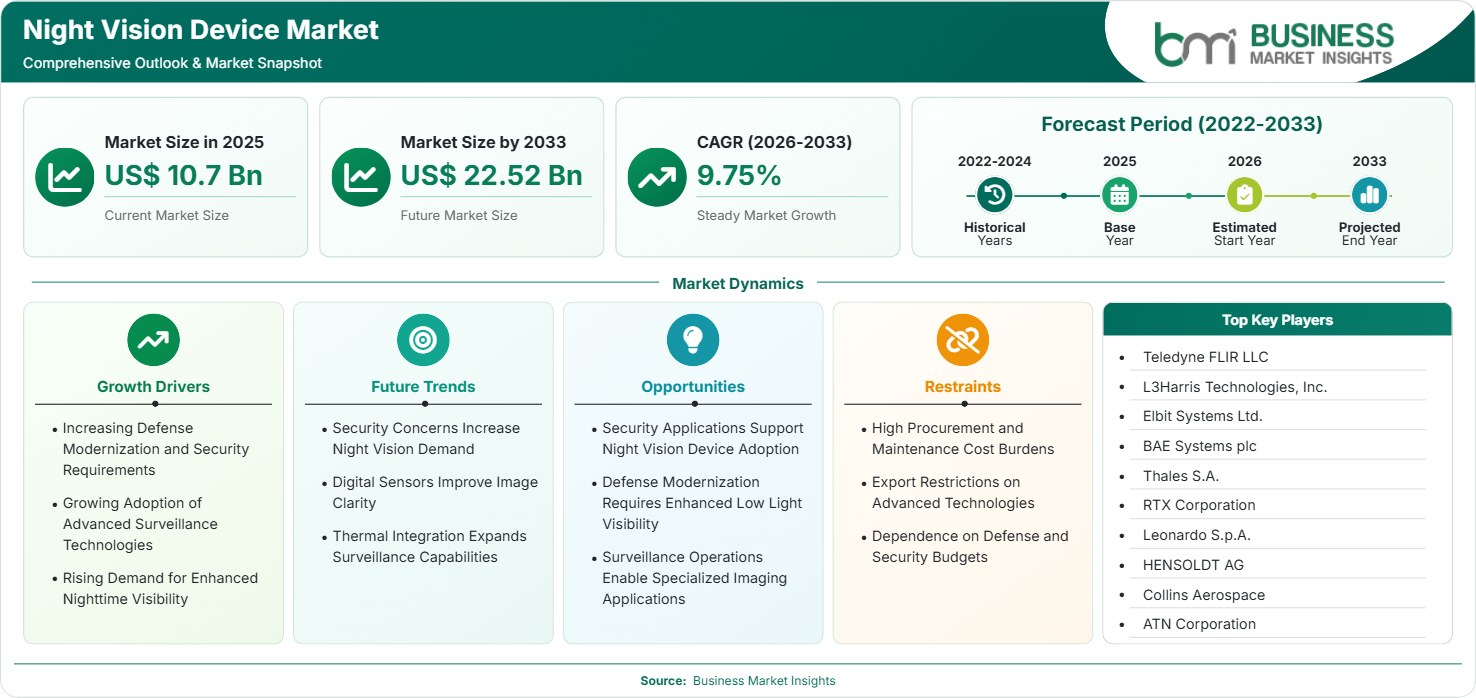
The Night Vision Device Market size was valued at US$ 10.7 Billion in 2025 and is projected to reach US$ 22.52 Billion by 2033, growing at a CAGR of 9.75% during 2026–2033. Key growth drivers include defense modernization, border security investments, thermal imaging advances, and expanding surveillance applications, while opportunities arise from AI-enabled imaging, smart sensors, autonomous platforms, and commercial security adoption.

Report Coverage
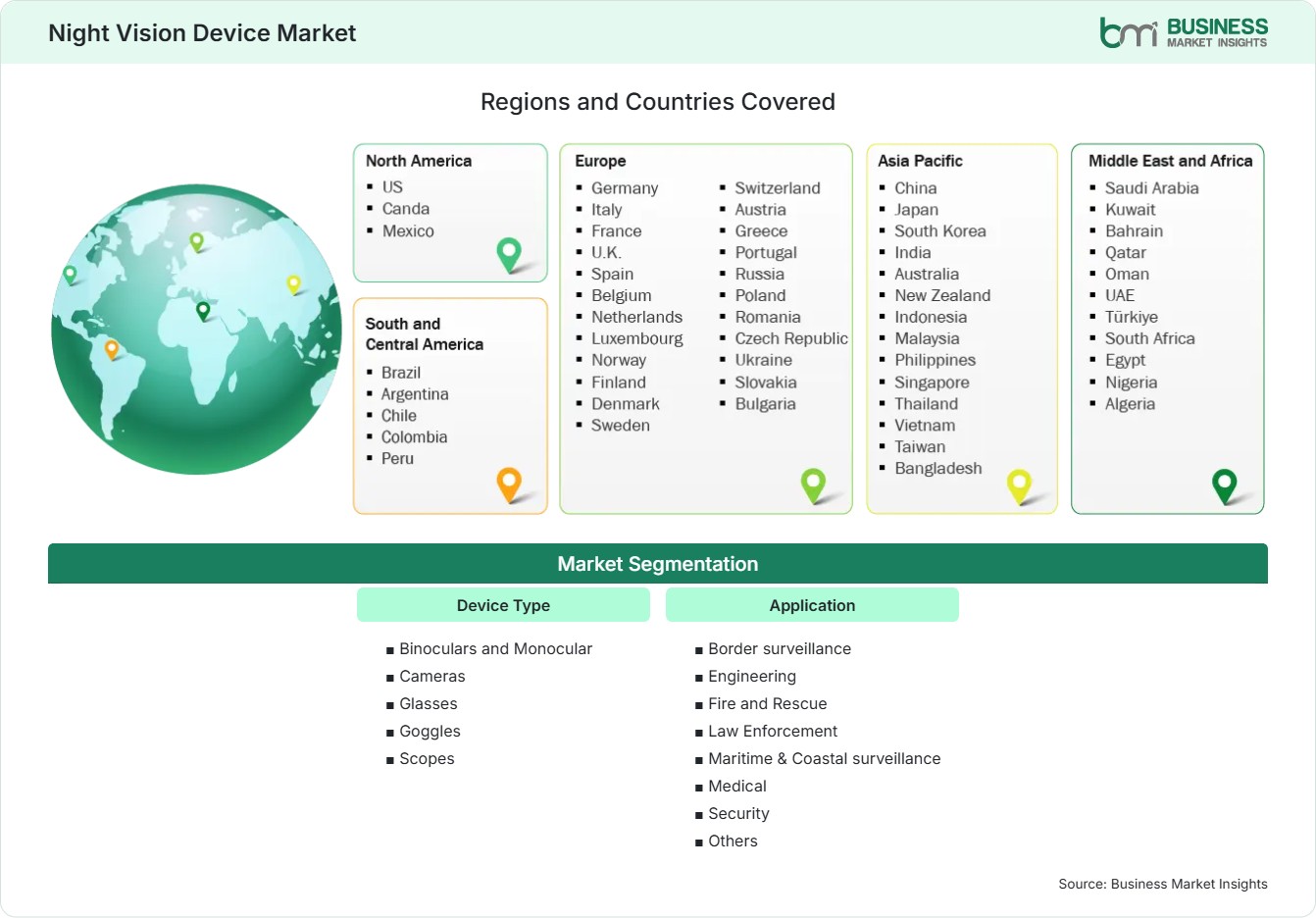
  • Device Type: Binoculars and Monocular, Cameras, Glasses, Goggles, Scopes
  • Application: Border surveillance, Engineering, Fire and Rescue, Law Enforcement, Maritime & Coastal surveillance, Medical, Security, Others
US$ 10.7 Bn Market size in 2025
US$ 22.52 Bn Market Size by 2033
9.75% CAGR, 2026 - 2033
2026-2033 Forecast Period

AI Overview

Night Vision Device Market Summary

  • North America Region: North America holds 36%–39% market share in 2025, growing at a CAGR of 8.8%–9.3% during 2026–2033. Defense procurement, border monitoring programs, and thermal imaging upgrades support demand. Emerging opportunities stem from autonomous surveillance integration and next-generation soldier systems. US market benefits from sustained military modernization and security investments, advancing at an estimated 8.9%–9.4% CAGR.
  • Fastest Growing Region: Asia Pacific holds 24%–27% market share in 2025 and is forecast to expand at a CAGR of 11.2%–11.8% during 2026–2033. Rising defense spending, infrastructure protection, indigenous manufacturing, and maritime monitoring initiatives create substantial commercial and government opportunities.
  • Leading Segment: Goggles account for 31%–34% market share in 2025 and are projected to grow at a CAGR of 9.2%–9.8%. Military adoption, hands-free operation, tactical mobility requirements, and digital imaging enhancements continue supporting widespread deployment globally.
  • High Growth Segment: Border surveillance represents 21%–24% market share in 2025 and is expected to register a CAGR of 11.5%–12.1%. Persistent geopolitical tensions, illegal crossing prevention, and integrated monitoring networks are fueling investment across multiple regions.
  • Key Market Opportunity: Expanding deployment on unmanned aerial systems, smart perimeter security infrastructure, and AI-assisted target recognition platforms is creating scalable revenue opportunities across defense, maritime surveillance, and critical infrastructure monitoring applications.
  • Major Market Players: Teledyne FLIR LLC, L3Harris Technologies, Inc., Elbit Systems Ltd., BAE Systems plc, Thales S.A., RTX Corporation, Leonardo S.p.A., HENSOLDT AG, Collins Aerospace, and ATN Corporation.
Strategic Insights

Night Vision Device Market: Strategic Insights

Night Vision Device Market Strategic Framework
FREE PDF
Request your free sample
Request free sample
Stakeholder View

Key Takeaways

  • The industry value chain increasingly integrates optics suppliers, infrared sensor manufacturers, software developers, defense integrators, and system assemblers, creating opportunities for vertically integrated offerings.
  • Border surveillance and maritime monitoring applications present the strongest upside due to rising investments in national security, unmanned systems, and persistent monitoring capabilities.
  • Product innovation is shifting toward fused thermal and digital imaging platforms incorporating AI-assisted target detection, connectivity features, and reduced power consumption.
  • Asia Pacific offers compelling investment potential as countries expand indigenous defense manufacturing capabilities and prioritize modernization of surveillance infrastructure.
  • Competitive activity increasingly includes strategic acquisitions, defense partnerships, and technology collaborations aimed at strengthening sensor, optics, and analytics capabilities.
  • Commercial adoption across industrial security, firefighting, and critical infrastructure monitoring is creating incremental revenue streams beyond traditional defense demand.
Geographic Outlook

Night Vision Device Market Regional Highlights

North America Night Vision Device Market

North America accounts for 36%–39% of global revenue in 2025 and is projected to register a CAGR of 8.8%–9.3% through 2033. Strong defense budgets, tactical modernization programs, and advanced surveillance infrastructure sustain regional leadership. The Night Vision Device Market share remains concentrated in the United States, supported by continuous procurement of soldier systems and border technologies. Investments in AI-enabled surveillance and thermal imaging networks further reinforce growth prospects across government and commercial sectors.

  • Military modernization programs continue generating demand for advanced thermal imaging and fused vision platforms.
  • Border management agencies increasingly deploy integrated monitoring solutions combining sensors, analytics, and imaging technologies.
  • Critical infrastructure operators expand surveillance investments to strengthen protection against evolving threats.
  • Defense contractors emphasize lightweight, networked systems improving situational awareness and mission effectiveness.

US Night Vision Device Market

The United States represents 74%–78% of the North American Night Vision Device Market revenue and is expected to grow at 8.9%–9.4% through 2033. Procurement operations within the military, homeland security, and law enforcement institutions provide a healthy environment for technology adoption. Continuous investments in advanced soldier systems, unmanned platforms, and surveillance systems help to keep up with market trends and stimulate innovation in imaging and sensors.

  • Army modernization remains a major demand catalyst for advanced vision technologies and integrated battlefield systems.
  • Homeland security investments support deployment across border regions, transportation assets, and strategic infrastructure.
  • Commercial security adoption expands among energy, utilities, and industrial operators requiring nighttime monitoring.
  • Domestic innovation ecosystems accelerate development of miniature infrared sensors and digital imaging capabilities.

Europe Night Vision Device Market

Europe captures 25%–28% Night Vision Device Market share in 2025 and is forecast to expand at a CAGR of 9.4%–9.9%. Regional demand is driven by defense readiness programs, border control policies, and rising security expenditures among NATO member countries. Germany is the primary domestic market, and Poland ranks among the fastest-growing markets owing to rapid defense acquisition and upgrade activities driven by changing geopolitical dynamics.

  • NATO-aligned modernization programs continue increasing procurement of advanced night-operational capabilities.
  • Germany leads regional demand through defense manufacturing strength and technology development expertise.
  • Poland experiences rapid expansion driven by military readiness and surveillance upgrades.
  • Maritime surveillance investments strengthen adoption across coastal monitoring and naval applications.
  • Public security agencies increasingly utilize advanced imaging technologies for operational effectiveness.

Asia Pacific Night Vision Device Market

Asia Pacific accounts for 24%–27% share in 2025 and records the strongest growth at 11.2%–11.8% CAGR. The increase in expenditure on defense, territorial surveillance, and domestic production of technology contributes to increased adoption. China is the leading country in terms of regional share, whereas India is the fastest-growing country in the region due to its military upgrades and surveillance technologies.

  • Regional governments prioritize surveillance modernization and defense self-reliance strategies.
  • India benefits from strong procurement pipelines supporting domestic and international suppliers.
  • China maintains leadership through significant investments in defense technologies and manufacturing capacity.
  • Maritime monitoring requirements increase deployment across coastal and naval environments.
  • Infrastructure protection and emergency response applications broaden commercial demand potential.

Rest of World Night Vision Device Market

The Rest of World region represents 10%–13% global share in 2025 and is expected to expand at a CAGR of 10.0%–10.6%. The Middle East is benefiting from the defense and border security expenditures, whereas South and Central America have embraced the use of surveillance solutions to enhance security. In the Middle East, Saudi Arabia is the market leader, while in South America, Brazil has become a fast-growing market because of its security modernization efforts.

  • Gulf countries invest heavily in border protection and critical infrastructure surveillance.
  • Saudi Arabia remains a major procurement market for advanced defense technologies.
  • Brazil expands deployment across law enforcement, infrastructure, and environmental monitoring applications.
  • Energy sector security requirements contribute to demand growth throughout resource-producing economies.
  • Emergency response modernization strengthens adoption among government agencies.
Global Market Geography
FREE PDF
Request your free sample
Request free sample
Segment Analysis

Night Vision Device Market Segmentation

Device Type

Device Type represents the largest revenue category, accounting for approximately 58%–61% share in 2025 and expanding at a CAGR of 9.3%–9.8%. The Night Vision Device Market scope continues broadening as military, security, and industrial users demand specialized form factors optimized for distinct operational environments and mission requirements.

  • Binoculars and Monocular: Widely used across military observation, wildlife monitoring, and security applications, supported by portability, affordability, and ease of deployment.
  • Cameras: Increasing adoption in surveillance networks, industrial facilities, and autonomous systems benefits from digital integration and real-time analytics capabilities.
  • Glasses: Lightweight wearable solutions gain traction across tactical operations requiring enhanced mobility and situational awareness in low-light conditions.
  • Goggles: Strong demand from defense organizations stems from hands-free operation and operational effectiveness during extended deployments.
  • Scopes: Precision targeting, observation, and reconnaissance requirements continue supporting adoption across defense and law-enforcement environments.

Application

Applications account for approximately 39%–42% of total industry demand in 2025 and are forecast to expand at a CAGR of 10.1%–10.7%. Evolving Night Vision Device Market trends reflect growing diversification beyond military uses into security, emergency response, and specialized monitoring environments.

  • Border surveillance: Expanding investments in national security and integrated monitoring networks support sustained technology deployment.
  • Engineering: Infrastructure inspection and low-light operational environments create niche but expanding opportunities.
  • Fire and Rescue: Emergency response teams increasingly deploy thermal and night-imaging technologies to improve visibility and safety.
  • Law Enforcement: Public security agencies utilize advanced vision systems for surveillance, search operations, and tactical missions.
  • Maritime & Coastal surveillance: Coastal monitoring, anti-smuggling efforts, and port security initiatives drive adoption.
  • Medical: Clinical imaging and specialized diagnostics applications support selective deployment of advanced imaging technologies.
  • Security: Commercial and industrial users invest in surveillance platforms protecting assets and facilities.
Market Forces

Night Vision Device Market Dynamics

Key Market Drivers

Defense Modernization and Tactical Awareness Programs

Global modernization programs continue to act as key catalysts for growth. Members of NATO and some nations in Asia keep on raising expenditures on lethal weapons, intelligence, and surveillance equipment. Increased demand for situational awareness is driving purchases of thermal imagers, image intensifiers, and fusion systems. Night Vision Device Market growth is directly associated with digitization initiatives on the battlefield, enabled by sensors, networks, and analytics. The procurement policies favor lightweight systems that are more enduring. Military organizations are also focused on ensuring interoperability between vehicles, unmanned aerial systems, and personal gear, thus promoting the use of more advanced technologies.

Expansion of Border and Critical Infrastructure Security

Governments worldwide are strengthening border protection capabilities amid rising geopolitical uncertainty and transnational security concerns. Surveillance systems nowadays integrate night-vision capabilities with radar, artificial intelligence-enabled data analysis, and sensor-based technologies. 24-hour surveillance capabilities are needed in airports, ports, energy sites, and transport routes. This results in greater scope for deployment in both stationary and portable systems. Higher levels of security sophistication will continue to drive investments in imaging systems that can work reliably in bad weather conditions.

Advancements in Thermal Imaging and Sensor Miniaturization

Rapid innovation in infrared detectors, image processing algorithms, and battery technologies is improving system performance while reducing weight and power requirements. Manufacturers continue introducing compact platforms suitable for handheld, wearable, and unmanned applications. Night Vision Device Market trends clearly show that products which combine features such as thermal imaging, digital optics, wireless capabilities, and AI-based target recognition will prevail. With decreasing costs and enhanced ruggedness of the devices, more widespread use beyond military applications is made possible. Competitive advantage now lies in image clarity, detection range, robustness, and software capabilities.

Key Market Opportunities

AI-Enabled Surveillance and Autonomous Monitoring

Integrating artificial intelligence is a major opportunity area for equipment providers. Advanced analytical algorithms can automate threat detection, movement tracking, and anomaly detection in the surveillance environment. As organizations strive for greater operational efficiency, there is a growing need for tools that generate intelligence rather than visuals. Night Vision Device Market Forecasts indicate expanding value creation from software-driven capabilities, particularly across border management, critical infrastructure, and defense applications. Vendors offering integrated hardware and analytics platforms may achieve stronger competitive positioning and recurring revenue opportunities.

Commercial Security Adoption Across Industries

Industrial facilities, logistics hubs, utilities, and transportation assets increasingly require persistent monitoring solutions. Growing security demands and risk concerns motivate the implementation of sophisticated imaging systems at commercial facilities. Growing knowledge of the advantages of thermal imaging facilitates the acquisition of such technology by non-defense-oriented entities. There is potential for application in environmental observation, wildlife management, and infrastructure inspection. Vendors providing tailor-made solutions can tap into non-military revenue pools.

Integration with Unmanned and Robotic Platforms

Unmanned aerial vehicles, ground robots, and maritime platforms increasingly rely on advanced imaging technologies for navigation, monitoring, and reconnaissance missions. Sensor weight reduction, power savings, and enhanced analytical capabilities improve the feasibility of use in autonomous systems. Defense departments and corporate organizations are still assessing their robotic platforms to increase efficiency and reduce risks to their personnel. Companies whose portfolios suit the needs of autonomous systems may be in an advantageous position.

Market Restraints and Challenges

High Procurement and Lifecycle Costs

Advanced infrared detectors, optical assemblies, and other robust hardware raise the cost of purchasing thermal imaging equipment. The high cost may dissuade procurement by financially strapped government bodies and commercial firms. Not only is there the initial cost, but there are also maintenance, recalibration, software upgrades, and hardware replacement, all of which factor into the cost of ownership. Consequently, smaller organizations tend to opt for cheaper surveillance technologies. Such costs might hinder large-scale deployment and adoption of the technology, even where it clearly works well.

Export Controls and Supply Chain Constraints

Strategic imaging technologies may have to contend with rigorous restrictions, licensing needs, and regulations that make it difficult for manufacturers and suppliers to operate effectively. Such constraints could extend the duration of the sales process, restrict some companies' access to certain global markets, and even increase compliance costs. Changes in the availability of raw materials, sensors, and semiconductors may affect manufacturing timelines and lead to higher operational costs. Tensions between different nations may also affect sourcing decisions. Localization and diversification are measures that mitigate such risks.

Company Analysis

Competitive Landscape

Night Vision Device Market analysis indicates competition is driven by sensor innovation, defense contracts, thermal imaging expertise, and platform integration capabilities.

Company Name

Overview

Products and Services relevant to this market

Teledyne FLIR LLC

Global imaging technology leader serving defense, security, industrial and public safety sectors.

Thermal cameras, infrared sensors, surveillance systems, unmanned platform imaging payloads.

L3Harris Technologies, Inc.

Major defense technology provider with extensive battlefield awareness and sensing capabilities.

Enhanced night vision goggles, weapon sights, tactical imaging systems.

Elbit Systems Ltd.

Defense electronics specialist with strong presence in soldier modernization programs.

Night vision systems, thermal imaging solutions, integrated surveillance equipment.

BAE Systems plc

International defense contractor focused on advanced electronics and mission systems.

Imaging sensors, night vision technologies, reconnaissance solutions.

Thales S.A.

Diversified technology group active across aerospace, defense and security domains.

Night vision optics, thermal imaging, soldier systems.

RTX Corporation

Aerospace and defense company with advanced sensing and mission capabilities.

Infrared technologies, targeting systems, surveillance solutions.

Leonardo S.p.A.

European defense technology provider serving military and security customers.

Observation systems, thermal sensors, maritime surveillance technologies.

HENSOLDT AG

Sensor specialist focused on defense and security applications.

Electro-optical systems, surveillance equipment, imaging sensors.

Collins Aerospace

Aerospace technology provider supporting defense and mission-critical applications.

Advanced optics, sensing solutions, integrated mission systems.

ATN Corporation

Specialized producer of commercial and professional night vision equipment.

Digital night vision devices, scopes, binoculars, thermal optics.

Trust & Transparency

Research Methodology

The market analysis combines proprietary research with secondary data from government agencies, company disclosures, regulatory filings, industry databases and expert interviews. Market estimates are validated through data triangulation, cross-market benchmarking and analyst review.

View Full Research Methodology

Questions Answered

Frequently Asked Questions

What does a Night Vision Device Market Report typically cover?

A comprehensive report evaluates market size, competitive dynamics, technology developments, regional opportunities, segmentation performance, regulatory factors, and future growth prospects.

Which device category currently leads industry revenue?

Goggles remain the leading category because they provide hands-free operation, tactical mobility, and strong compatibility with military modernization requirements.

How is artificial intelligence influencing product development?

AI improves object recognition, automated monitoring, target classification, and operational decision-making, enhancing the value proposition of modern imaging platforms.

Which region offers the strongest long-term growth potential?

Asia Pacific demonstrates the most attractive growth outlook due to increasing defense budgets, domestic manufacturing initiatives, and expanding surveillance infrastructure investments.

What are the primary demand generators for night vision devices?

Defense modernization, border surveillance, law enforcement operations, maritime security, industrial monitoring, and emergency response applications collectively generate the majority of global demand.

Access the Full Night Vision Device Market Report

Get segment-level forecasts, regional estimates, competitive benchmarking, company profiles and downloadable Excel datasets.

Access the full Night Vision Device Market Report
350 pages PDF & Excel | 2026-09-22
Similar Research

Related Market Reports