Market Summary
Executive Summary and Global Market Analysis
Enhanced vision technology includes airborne imaging and display solutions that give pilots of aircraft a clearer view of their surroundings when natural visibility is obscured, using onboard sensors and navigation data to show pilots an augmented view of obstacles, terrain, and runway environments within the flight deck (cockpit). These systems allow pilots to operate safely in environments where no other visual reference points exist.
The aviation industry continues to gain momentum from the desire of organizations in the aviation sector to achieve operational resilience and to provide enhanced flight accessibility. Airlines, defense, and private operators want increased situational awareness while flying in difficult approach, landing, and en route conditions. Enhanced vision technology has become more relevant to a diverse set of flight missions by improving pilots' ability to visually perceive their surroundings without reliance on external factors.
There are many types of technologies and platforms in aviation. Infrared is being used to visualize thermal scenes; synthetic vision systems provide digitally recreated environments for flight; and combined vision configurations fuse multiple input streams onto one display. How these systems are being used varies significantly depending on whether the aircraft are fixed wing, rotary wing or unmanned and based on their mission profiles and operational complexity.
New generations of cockpit visualizing capabilities are now emerging and being developed. Manufacturers continue to improve interfaces, sensor fusion, and processing of display data to create simpler ways for pilots to receive their flight information. The competitive advantages between manufacturers are being derived more from the interface compatibility and visual clarity of the systems and how well they combine with continually advancing avionics systems in today's aircraft.
Segment Analysis
Enhanced Vision System Market Segmentation
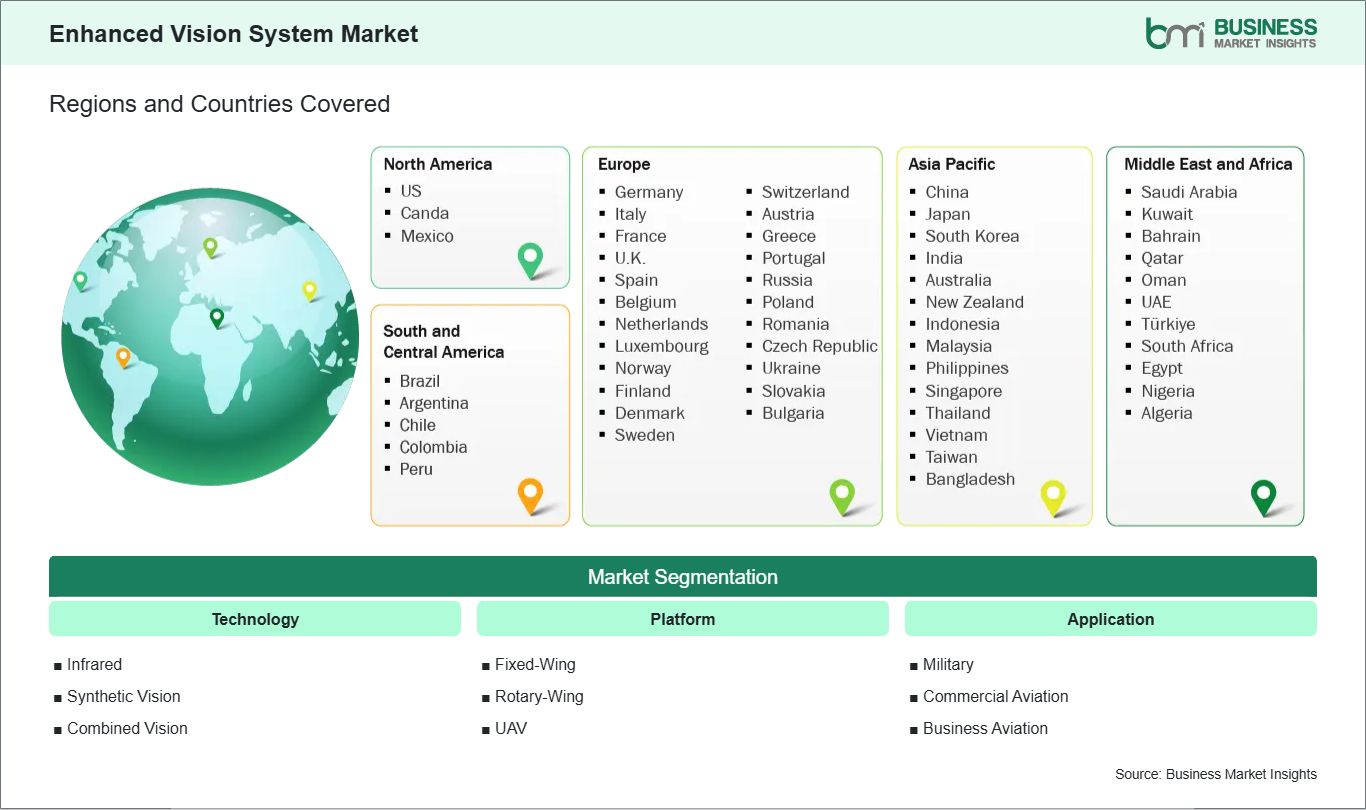
The enhanced vision system market is segmented by technology, platform, and application, reflecting varying operational visibility requirements across flight environments.
By Technology
- Infrared - Enables thermal imaging for low-visibility navigation conditions.
- Synthetic Vision - Generates digital terrain models for enhanced cockpit visualization.
- Combined Vision - Integrates multiple imaging sources for improved situational clarity.
By Platform
- Fixed-Wing - Supports long-range navigation and commercial flight operations.
- Rotary-Wing - Enhances visibility in low-altitude and mission-critical operations.
- UAV - Enables autonomous navigation support in unmanned aerial systems.
By Application
- Military - Improves mission awareness in tactical and surveillance operations.
- Commercial Aviation - Enhances passenger flight safety under adverse conditions.
- Business Aviation - Supports operational flexibility and executive travel safety.
Market Forces
Enhanced Vision System Market Drivers and Opportunities
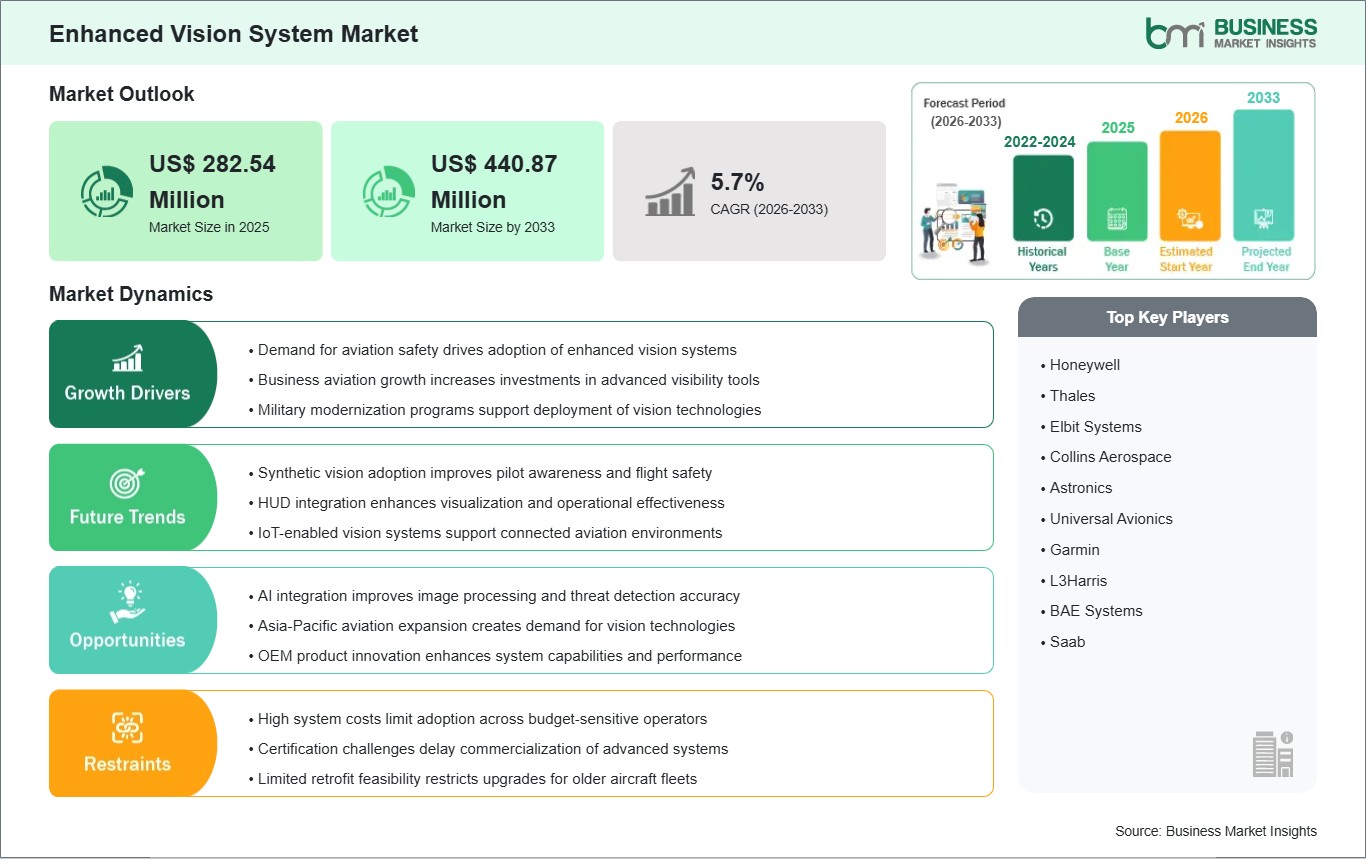
Rising demand for aviation safety
Enhanced vision systems are expected to grow in popularity and use because of the continued increase in focus on aviation safety. Modern air operations face numerous operational challenges, such as bad weather, limited visibility, obstructions on runways, and difficult terrain during high-risk flight phases. Enhanced vision systems provide real-time visual information to pilots generated from advanced sensor and imaging technology, enabling pilots to make better decisions by helping them with situational awareness and reducing the need for external visual references. Enhanced vision systems will enable safer flight operations within the commercial aviation, business aviation, and military aviation segments.
Global regulatory bodies and aviation associations are placing increasing priorities on using technologies that improve aviation safety and decrease the chances of accidents. Enhanced vision systems provide the pilot with maximum navigation performance and superior operational situational awareness, especially in challenging operating conditions with limited visual reference. Increased global air traffic creation and air traffic density/complexity mean there will be greater demand for better flight safety solutions in the future.
Integration with AI
Significantly, the introduction of artificial intelligence also provides substantial opportunities for the growth of the enhanced vision system market. Avionics systems' performance will be enhanced through improvements in image processing, object detection, pattern recognition, and predictive navigation capabilities as a result of AI technologies. Enhanced vision systems utilize AI-based algorithms to analyze sensor data from numerous different sources so that pilots receive a clearer view of their environment and improved situational awareness. As a result, advanced data analysis allows for faster reactions to changing flight conditions and supports improved decision-making in fast-moving operational settings.
Future progress in AI-powered cockpit technologies is predicted to further expand the enhanced vision system's capabilities; advances such as predictive analytics, machine learning, and real-time environmental mapping will allow for increased operational efficiency, along with decreased pilot workload. Additionally, these innovations will enable aircraft systems to detect potential hazards, predict changing weather conditions, and provide more effective navigation assistance. With aviation's continued progression toward more automation and digitization, enhanced vision solutions powered by AI are expected to become increasingly important to both piloted and unpiloted operations. It is anticipated to create new potential applications and establish sustained demand for advanced vision technologies throughout the aviation sector.
Size and Share Analysis
Enhanced Vision System Market Size and Share Analysis
The enhanced vision system market is projected to grow from US$ 282.54 million in 2025 to US$ 440.87 million by 2033, registering a CAGR of 5.7% from 2026 to 2033.
By technology, the market is segmented into infrared, synthetic vision, and combined vision. Combined vision holds a dominant position due to its ability to merge infrared imaging with synthetic terrain visualization, providing pilots with enhanced situational awareness across diverse operating conditions. Infrared systems remain widely utilized for their effectiveness in detecting terrain, obstacles, and runway environments during nighttime and adverse weather operations. Synthetic vision solutions also maintain a significant presence by generating computer-based terrain displays that improve navigation accuracy and flight safety.
By platform, the market is categorized into fixed-wing, rotary-wing, and UAV. Fixed-wing aircraft account for a substantial share owing to widespread integration of enhanced vision technologies across commercial aviation, military fleets, and business jets. Rotary-wing platforms represent an important market segment as helicopters frequently operate in challenging environments requiring superior visibility and terrain awareness. UAV applications are also expanding as unmanned systems increasingly incorporate advanced vision technologies to support surveillance, reconnaissance, and autonomous navigation functions.
By application, the market is segmented into military, commercial aviation, and business aviation. Military represents the leading application segment due to extensive utilization of enhanced vision systems in tactical missions, surveillance operations, and low-visibility flight environments. Commercial aviation accounts for a significant share as airlines implement enhanced vision capabilities to support safer landings, reduce weather-related disruptions, and improve flight efficiency. Business aviation also contributes notably to market demand, with operators adopting these systems to enhance pilot awareness, operational flexibility, and passenger safety.
Report Coverage
Enhanced Vision System Market Report Coverage and Deliverables
The "Enhanced Vision System Market Size and Forecast (2022-2033)" report provides a detailed analysis of the market covering below areas:
- Market size and forecast at global, regional, and country levels for all key market segments covered under the scope
- Market trends, along with market dynamics such as drivers, restraints, and key opportunities
- Market analysis covering key trends, global and regional frameworks, major players, regulations, and recent developments
- Industry landscape and competitive analysis covering market concentration, heat map analysis, prominent players, and recent developments
- Detailed company profiles, including SWOT analysis
Geographic Insights
Enhanced Vision System Market Geographic Insights
The Enhanced Vision System market shows diverse regional adoption patterns influenced by aviation safety regulations, technological modernization of aircraft fleets, sensor integration advancements, and operational efficiency requirements. Across global aviation ecosystems, demand for improved visibility solutions is strengthening as operators seek to enhance situational awareness and reduce operational risk under challenging environmental conditions.
North America maintains a strong position supported by advanced aviation infrastructure and early adoption of avionics innovation. Military aviation programs and commercial fleet upgrades contribute to steady system integration across multiple aircraft categories. The region's emphasis on flight safety and technological advancement encourages consistent utilization of enhanced vision capabilities.
Asia Pacific demonstrates increasing adoption driven by expanding aviation fleets, rising passenger traffic, and modernization of commercial and defense aircraft. Investments in aviation infrastructure and aircraft procurement programs are supporting broader integration of advanced cockpit technologies. Growing emphasis on operational safety and navigation accuracy further reinforces market expansion across the region.
Europe continues to emphasize stringent aviation safety standards and modernization of aircraft systems, encouraging adoption of enhanced vision technologies across both commercial and military aviation sectors. Emerging markets in the Middle East, Africa, and South America are gradually integrating advanced avionics solutions as aviation infrastructure develops. These regions present long-term opportunities linked to fleet expansion and technology upgrades.
Industry Activity
Recent Developments
The enhanced vision system market is evaluated by gathering qualitative and quantitative data post primary and secondary research, which includes important corporate publications, association data, and databases. Recent developments and news in the market include:
- In October 2025, Honeywell announced the launch of its Honeywell Alternative Navigation Architecture (HANA), a multi-sensor navigation solution that integrates vision-aided navigation using live camera feeds, supporting aircraft and UAV operations in GPS-denied environments and strengthening its enhanced vision and situational awareness capabilities.
- In January 2025, L3Harris Technologies, announced that it secured a $263 million contract for continued production of Enhanced Night Vision Goggle Binocular systems for defense customers. The program strengthens its position in the enhanced vision and night-vision systems segment, supporting next-generation situational awareness technologies for pilots and ground operations.
Trust & Transparency
Research Methodology
The market analysis combines proprietary research with secondary data from government agencies, company disclosures, regulatory filings, industry databases and expert interviews. Market estimates are validated through data triangulation, cross-market benchmarking and analyst
review.
View Full Research Methodology
Key Sources Referred:
Aviation avionics industry reports Government aviation safety regulatory publications Aircraft manufacturer technical documentation Aerospace engineering journals Company annual reports and filings Airline fleet modernization studies Aviation safety research papers Avionics technology conference proceedings