
Nanomaterials Market Outlook: Size, Share, Trends, Growth Analysis, Competitive Landscape & Forecast, 2026–2033

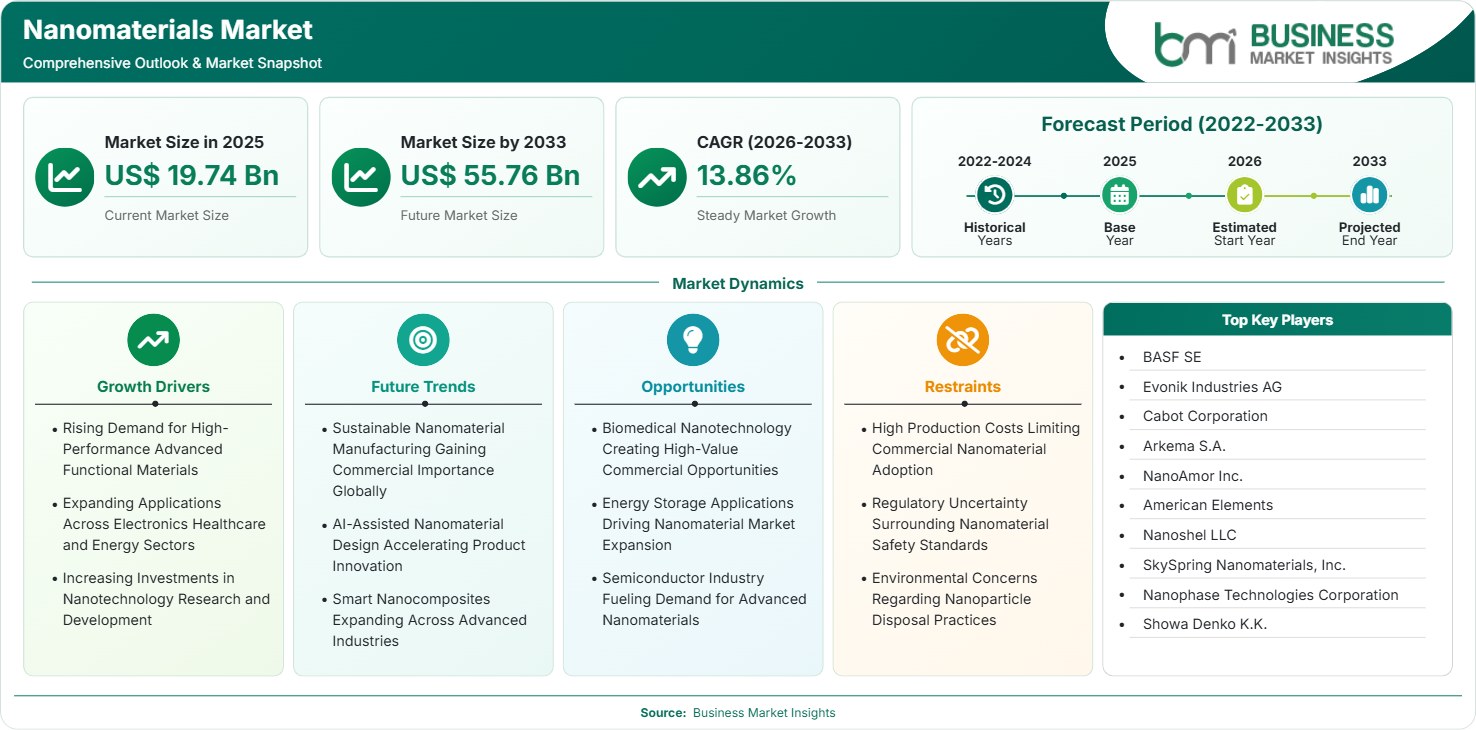
The Nanomaterials Market size was valued at US$ 19.74 Billion in 2025 and is projected to reach US$ 55.76 Billion by 2033, growing at a CAGR of 13.86% during 2026–2033. Growing demand for advanced functional materials, rapid nanotechnology innovation, expanding semiconductor manufacturing, and increasing adoption across healthcare and energy applications continue driving market expansion worldwide.

Report Coverage
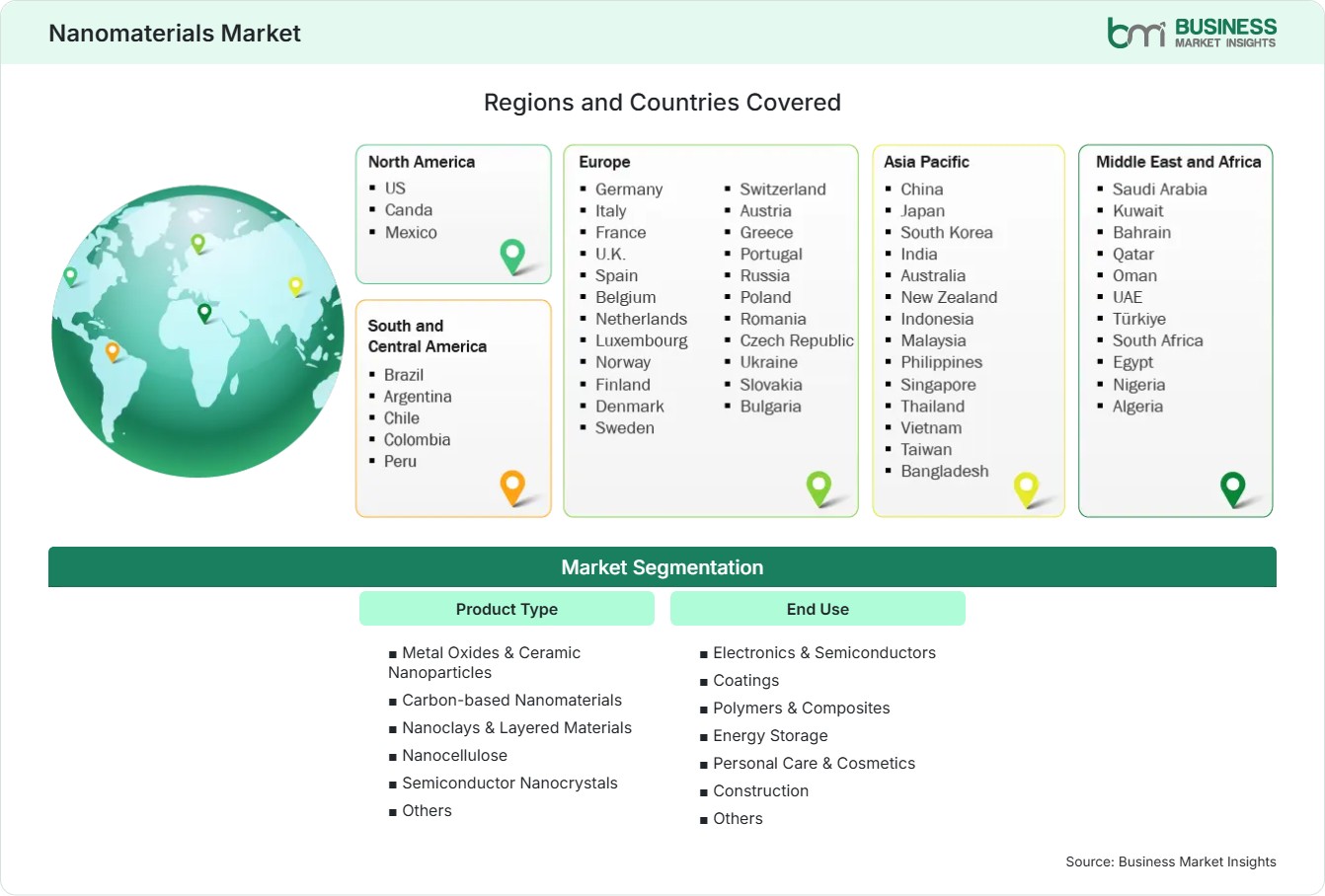
  • Product Type: Metal Oxides & Ceramic Nanoparticles, Carbon-based Nanomaterials, Nanoclays & Layered Materials, Nanocellulose, Semiconductor Nanocrystals, Others
  • End Use: Electronics & Semiconductors, Coatings, Polymers & Composites, Energy Storage, Personal Care & Cosmetics, Construction, Others
US$ 19.74 Bn Market size in 2025
US$ 55.76 Bn Market Size by 2033
13.86% CAGR, 2026 - 2033
2026-2033 Forecast Period

AI Overview

Nanomaterials Market Summary

  • North America Region: North America holds 33%–36% market share in 2025 and is projected to grow at a 13.1%–13.7% CAGR during 2026–2033. Strong nanotechnology research, expanding semiconductor manufacturing, increasing biomedical applications, and significant public-private R&D investments continue supporting regional market growth. The U.S. dominates the regional market through advanced material science innovation, extensive research infrastructure, and growing commercialization of nanotechnology solutions, expanding at approximately 13.2%–13.8% CAGR during the forecast period.
  • Fastest Growing Region: Asia Pacific accounts for 34%–37% market share in 2025 and is expected to register a 14.8%–15.4% CAGR during 2026–2033. Expanding electronics manufacturing, increasing investments in semiconductor fabrication, rapid industrialization, and government support for nanotechnology innovation continue accelerating regional growth.
  • Leading Segment: Electronics & Semiconductors represents 29%–33% market share in 2025 while expanding at a 14.0%–14.6% CAGR through 2033. Increasing miniaturization, high-performance electronic devices, advanced chip manufacturing, and next-generation semiconductor technologies continue driving demand.
  • High Growth Segment: Carbon-based Nanomaterials account for 23%–27% market share in 2025 and are anticipated to register a 15.3%–16.0% CAGR during 2026–2033. Rising utilization in batteries, conductive composites, flexible electronics, aerospace materials, and advanced coatings continues strengthening adoption.
  • Key Market Opportunity: Expanding commercialization of nanomedicine, next-generation batteries, advanced semiconductor materials, lightweight composites, and sustainable nanotechnology solutions is creating substantial long-term opportunities for manufacturers.
  • Major Market Players: BASF SE, Evonik Industries AG, Cabot Corporation, Arkema S.A., NanoAmor Inc., American Elements, Nanoshel LLC, SkySpring Nanomaterials, Inc., Nanophase Technologies Corporation, and Resonac Holdings Corporation (formerly Showa Denko K.K.).
Strategic Insights

Nanomaterials Market: Strategic Insights

Nanomaterials Market Strategic Framework
FREE PDF
Request your free sample
Request free sample
Stakeholder View

Key Takeaways

  • The market eco-system is advancing towards an extremely integrated value chain system wherein raw material suppliers, semiconductor manufacturers, and industries utilizing such materials work together to develop advanced nanomaterials for commercial use.
  • Electronics and semiconductors are still leading in terms of opportunities for revenue generation whereas energy storage and coatings represent diversified growth prospects.
  • Advances in graphene, carbon nanotubes, quantum dots, nanocellulose, and engineered nanoparticles are contributing to the enhancement of electrical conductivity and performance of multi-functional materials.
  • Asia Pacific presents the strongest long-term investment opportunity owing to expanding semiconductor fabrication, and increasing nanotechnology commercialization across industrial sectors.
  • Strategic acquisitions, joint research initiatives, university-industry collaborations, and capacity expansion projects are accelerating development of next-generation nanomaterials.
  • Future competitive advantage will increasingly depend on scalable manufacturing processes, regulatory compliance, sustainable production methods, material customization, and application-specific nanotechnology innovation.
Geographic Outlook

Nanomaterials Market Regional Highlights

North America Nanomaterials Market

North America accounted for approximately 33%–36% of the Nanomaterials Market share in 2025 and is projected to expand at a CAGR of 13.1%–13.7% through 2033. The region benefits from advanced nanotechnology research, strong semiconductor manufacturing, growing biomedical innovation, and increasing investments in sustainable materials.

  • Semiconductor manufacturers increasingly utilize advanced nanomaterials to improve chip performance, transistor miniaturization, thermal management, and manufacturing efficiency across next-generation electronic devices.
  • Biomedical research organizations continue expanding nanotechnology applications for targeted drug delivery, diagnostic imaging, regenerative medicine, and precision therapeutic solutions.
  • Government-funded nanotechnology initiatives continue supporting commercialization of advanced materials while encouraging collaboration between research institutions and industrial manufacturers.
  • Growing adoption of lightweight nanocomposites across aerospace and automotive industries strengthens regional demand for high-performance engineered nanomaterials.

US Nanomaterials Market

The United States remains the dominant contributor within North America, accounting for approximately 81%–84% of regional revenue while growing at a CAGR of 13.2%–13.8% during the forecast period. Strong R&D investments, advanced semiconductor manufacturing, biotechnology innovation, and expanding commercialization of nanotechnology continue supporting sustained market development.

  • Federal research funding continues accelerating development of advanced nanomaterials for healthcare, defense, electronics, and renewable energy applications.
  • Semiconductor manufacturers increasingly integrate nanoscale materials into advanced chip fabrication to improve computing performance and energy efficiency.
  • Pharmaceutical companies continue expanding nanomedicine research supporting targeted therapies, controlled drug delivery, and diagnostic innovations.

Europe Nanomaterials Market

Europe represented 24%–27% market share in 2025 and is anticipated to grow at a CAGR of 13.5%–14.1% through 2033. Sustainability initiatives, advanced manufacturing capabilities, and increasing industrial research continue supporting regional market expansion. Germany leads the regional market through advanced material science capabilities, while France records one of the fastest growth rates driven by nanotechnology investments and industrial innovation.

  • Germany continues strengthening nanomaterial production supporting automotive lightweighting, electronics manufacturing, and industrial engineering applications.
  • France demonstrates rapid adoption across biomedical research, specialty chemicals, cosmetics, and advanced materials development.
  • European manufacturers increasingly develop environmentally sustainable nanomaterials complying with evolving environmental and chemical safety regulations.
  • Growing investments in battery technologies and renewable energy systems continue expanding demand for advanced nanoscale materials.

Asia Pacific Nanomaterials Market

Asia Pacific accounted for 34%–37% of global revenue in 2025 and is projected to register the highest CAGR of 14.8%–15.4% during 2026–2033. Rapid industrialization, expanding semiconductor fabrication, increasing electronics manufacturing, and strong government investment in nanotechnology continue driving regional growth. China leads overall demand, while South Korea records one of the fastest growth rates due to advanced semiconductor and battery manufacturing.

  • China continues expanding nanotechnology manufacturing capacity supporting electronics, renewable energy, healthcare, and industrial material applications.
  • South Korea records strong growth through investments in advanced semiconductor fabrication, battery materials, and next-generation electronic technologies.
  • Japan continues developing high-value nanomaterials supporting automotive innovation, healthcare technologies, and advanced industrial manufacturing.
  • India increasingly invests in nanotechnology research supporting pharmaceuticals, agriculture, water treatment, and advanced material development.
  • Rising consumer electronics production continues accelerating regional demand for conductive, lightweight, and high-performance nanomaterials.

Rest of World Nanomaterials Market

The Rest of the World contributed 8%–10% of global revenue in 2025 and is expected to expand at a CAGR of 13.7%–14.3% through 2033. South & Central America continue adopting nanomaterials across mining, coatings, agriculture, and industrial manufacturing applications, while the Middle East & Africa expand investments in advanced materials supporting energy, construction, and water treatment projects.

  • Brazil leads regional nanotechnology adoption through expanding industrial manufacturing and advanced materials research initiatives.
  • Saudi Arabia and the UAE increasingly invest in nanotechnology supporting energy diversification, water treatment, and high-performance construction materials.
  • Mining industries continue utilizing nanomaterials to improve extraction efficiency, equipment durability, and process optimization.
  • Growing investment in renewable energy infrastructure strengthens demand for nanomaterials used in batteries, solar technologies, and energy storage systems.
  • Government-backed innovation programs continue encouraging commercialization of nanotechnology solutions across emerging industrial economies.
Global Market Geography
FREE PDF
Request your free sample
Request free sample
Segment Analysis

Nanomaterials Market Segmentation

Product Type

Product innovation continues driving the commercialization of nanomaterials across multiple high-value industries as manufacturers focus on enhancing electrical conductivity, mechanical strength, thermal stability, and chemical functionality. This segment accounted for approximately 51%–55% market share in 2025 and is projected to register a CAGR of 14.2%–14.8% during 2026–2033. The Market scope continues expanding through continuous advances in engineered nanoparticles, and application-specific material development supporting industrial and scientific innovation.

  • Metal Oxides & Ceramic Nanoparticles: Widely utilized in catalysts, coatings, sensors, electronics, biomedical devices, and energy storage applications owing to excellent thermal stability, chemical resistance, and multifunctional performance characteristics.
  • Carbon-based Nanomaterials: Experience the fastest adoption due to exceptional electrical conductivity, lightweight properties, high mechanical strength, and growing utilization across batteries, electronics, aerospace, and advanced composite materials.
  • Nanoclays & Layered Materials: Increasingly incorporated into polymer composites, packaging materials, automotive components, and coatings to improve barrier performance, mechanical durability, flame resistance, and structural stability.
  • Nanocellulose: Gains momentum across sustainable packaging, biomedical engineering, paper manufacturing, lightweight composites, and environmentally friendly materials because of its renewable origin and high strength-to-weight ratio.
  • Semiconductor Nanocrystals: Continue expanding across optoelectronics, quantum dot displays, sensors, solar cells, and advanced semiconductor devices requiring superior optical and electronic performance.

End Use

Growing industrial adoption continues positioning nanomaterials as essential components across electronics, healthcare, energy, construction, and specialty manufacturing applications. This segment represented approximately 29%–33% market share in 2025 while advancing at a CAGR of 14.0%–14.6% during the forecast period. Increasing investments in advanced manufacturing and sustainable technologies continue shaping Nanomaterials Market trends, encouraging broader commercialization across diverse industrial sectors.

  • Electronics & Semiconductors: Represents the leading application through extensive utilization in semiconductor fabrication, sensors, conductive materials, flexible electronics, memory devices, and advanced integrated circuit manufacturing.
  • Coatings: Expands steadily by improving corrosion resistance, scratch protection, UV stability, antimicrobial performance, and self-cleaning functionality across automotive, industrial, aerospace, and construction applications.
  • Polymers & Composites: Increasingly incorporates nanomaterials to enhance mechanical strength, thermal conductivity, impact resistance, lightweight characteristics, and overall structural performance across industrial manufacturing.
  • Energy Storage: Continues recording strong growth as advanced nanomaterials improve battery efficiency, charging performance, electrode conductivity, supercapacitor performance, and renewable energy storage technologies.
  • Personal Care & Cosmetics: Utilizes nanoscale ingredients to improve UV protection, product stability, skin penetration, controlled ingredient delivery, and formulation performance across premium cosmetic products.
  • Construction: Growing adoption supports development of stronger concrete, durable coatings, thermal insulation materials, self-healing structures, and environmentally sustainable building materials with enhanced long-term performance.
Market Forces

Nanomaterials Market Dynamics

Key Market Drivers

Rising Demand for High-Performance Advanced Functional Materials

The increasing use of light and durable materials in various fields including auto, aerospace, electronics, healthcare and industrial manufacturing is fueling the nanomaterial market globally. Engineered nanomaterials offer better electrical conductivity, thermal stability, strength, corrosion resistance and optical qualities than traditional materials. As per the estimates from International Energy Agency (IEA) and advancements in the semiconductor industry, growing electrification and digitalization are pushing demand for such materials used in batteries and electronic devices. Such factors further bolstering Nanomaterials Market growth through diverse commercial applications in different high-end sectors.

Expanding Applications Across Electronics Healthcare and Energy Sectors

With rapid technological innovations, nanomaterial usage is growing exponentially in the production of semiconductors, diagnostic tools, drug delivery mechanisms, renewable energy technology, energy storage systems, and advanced coatings. In addition, electronics firms are incorporating nanomaterials in the fabrication of chips, displays, and sensors for enhanced functionality in smaller form factors. Health institutions are still developing applications in nanotechnology for therapeutic purposes. These innovations continue shaping Nanomaterials Market trends, and encouraging greater investment in research, product development.

Increasing Investments in Nanotechnology Research and Development

Governments, academic institutions, research organizations, and private businesses keep making huge investments in R&D of nanotechnology in order to create new materials that will possess improved functionalities and have high commercial value. The major areas of study involve the creation of sustainable manufacturing methods, medical applications, electronic devices, clean energy solutions, and environmentally safe nanomaterials. The continuous improvement in production scalability and material characterization is projected to improve the commercialization aspect.

Key Market Opportunities

Biomedical Nanotechnology Creating High-Value Commercial Opportunities

Biomedical applications continue emerging as one of the most promising areas for nanomaterial commercialization. Nanotechnology enables targeted drug delivery, precision diagnostics, regenerative medicine, biosensors, and advanced imaging systems that improve treatment effectiveness while reducing adverse effects. The Nanomaterials Market Forecasts indicate substantial long-term opportunities for manufacturers developing specialized nanomaterials supporting pharmaceutical innovation and next-generation healthcare technologies.

Energy Storage Applications Driving Nanomaterial Market Expansion

The rise in usage of electric cars, renewable energy technology, and grid battery storage is driving the need for innovative nanomaterials that can enhance battery capacity, charge speed, lifecycle, and energy density. Nano-structured electrode materials, conductive materials, and separators enhance the efficiency of batteries. This trend opens up great investment opportunities for companies producing nanomaterials in the energy storage industry.

Semiconductor Industry Fueling Demand for Advanced Nanomaterials

Rapid semiconductor miniaturization and increasing computing performance requirements continue driving demand for advanced nanoscale materials supporting next-generation chip fabrication. Quantum dots, semiconductor nanocrystals, carbon nanotubes, graphene, and advanced conductive materials improve electronic performance while enabling continued technological innovation. Expanding investments in artificial intelligence, high-performance computing, and consumer electronics further strengthen long-term demand for specialized nanomaterials.

Market Restraints and Challenges

High Production Costs Limiting Commercial Nanomaterial Adoption

Factor: Nanomaterial manufacturing is a complicated process that involves advanced production technology, specific equipment, quality control techniques, and technical skills, which cause increased costs in manufacturing. Impact: The high cost in manufacturing may hinder commercialization within price sensitive sectors while delaying the adoption process by SMEs. Organizations are still working on optimizing their processes, scaling up their manufacturing and automating the manufacturing process.

Regulatory Uncertainty Surrounding Nanomaterial Safety Standards

Factor: Regulatory frameworks governing nanomaterial safety, environmental impact, labeling requirements, and occupational exposure continue evolving across different international markets. Impact: Regulatory uncertainty increases compliance complexity, extends product approval timelines, and raises testing costs for manufacturers. Organizations must invest in comprehensive toxicological assessments, environmental studies, and regulatory documentation before commercializing new nanomaterial products across multiple jurisdictions.

Company Analysis

Competitive Landscape

The competitive landscape is characterized by continuous innovation in engineered nanoparticles, carbon nanomaterials, advanced composites, and specialty nanotechnology solutions. The Nanomaterials Market analysis indicates that leading companies are investing in production capacity expansion, sustainable manufacturing technologies, research collaborations, and application-specific material development to strengthen their competitive position across global end-use industries.

Company Name

Overview (20–30 words)

Products and Services Relevant to this Market (20–30 words)

BASF SE

Global specialty chemicals company developing advanced nanomaterials supporting industrial manufacturing, coatings, electronics, and energy applications.

Nanoparticles, specialty chemicals, performance materials, advanced coatings, battery materials, and industrial nanotechnology solutions.

Evonik Industries AG

Specialty chemicals manufacturer focused on high-performance nanomaterials and advanced functional materials for diverse industrial applications.

Silica nanoparticles, specialty additives, biomedical materials, advanced polymers, and nanotechnology-enabled industrial solutions.

Cabot Corporation

Global performance materials company specializing in conductive additives and engineered nanomaterials for industrial manufacturing.

Carbon nanotubes, conductive carbons, battery materials, specialty additives, and advanced performance materials.

Arkema S.A.

Advanced materials manufacturer delivering specialty nanomaterials supporting electronics, coatings, renewable energy, and industrial applications.

High-performance polymers, specialty additives, nanocomposites, coating materials, and advanced functional materials.

NanoAmor Inc.

Nanotechnology company supplying engineered nanomaterials for research, industrial development, and commercial manufacturing.

Metal nanoparticles, nanotubes, nanowires, quantum dots, graphene materials, and customized nanotechnology products.

American Elements

Global manufacturer of engineered advanced materials serving research institutions and industrial customers worldwide.

Nanoparticles, nanometals, oxides, ceramics, quantum materials, and customized advanced material solutions.

Nanoshel LLC

Supplier of nanotechnology materials supporting scientific research and industrial product development across multiple sectors.

Nanopowders, graphene, nanotubes, metal oxides, nanocomposites, and laboratory nanomaterial products.

SkySpring Nanomaterials, Inc.

Advanced material supplier providing nanotechnology products for commercial, industrial, and research applications.

Carbon nanomaterials, metal oxides, nanowires, quantum dots, and customized nanotechnology solutions.

Nanophase Technologies Corporation

Nanotechnology manufacturer focused on engineered nanoparticles for personal care, coatings, and industrial applications.

Zinc oxide nanoparticles, specialty nanomaterials, personal care ingredients, coatings, and advanced functional additives.

Resonac Holdings Corporation

Diversified materials company developing advanced nanotechnology solutions supporting electronics, semiconductors, and industrial manufacturing.

Advanced semiconductor materials, carbon products, specialty chemicals, electronic materials, and functional nanotechnology solutions.

Trust & Transparency

Research Methodology

The market analysis combines proprietary research with secondary data from government agencies, company disclosures, regulatory filings, industry databases and expert interviews. Market estimates are validated through data triangulation, cross-market benchmarking and analyst review.

View Full Research Methodology

Questions Answered

Frequently Asked Questions

How does this Nanomaterials Market Report benefit industry participants?

The market Report provides comprehensive insights into market dynamics, competitive positioning, regional opportunities, technology trends, segmentation analysis, and future investment prospects, enabling informed strategic decision-making.

Which region dominates the Market?

Asia Pacific leads the global market through strong electronics manufacturing, expanding semiconductor production, increasing government investments in nanotechnology, and continuous commercialization of advanced material technologies.

Why does the electronics & semiconductors segment lead the market?

The segment dominates because nanomaterials significantly improve semiconductor performance, enable miniaturization, enhance electrical conductivity, and support manufacturing of advanced electronic devices and integrated circuits.

Which product type is expected to witness the fastest growth?

Carbon-based nanomaterials are projected to register the highest growth due to increasing utilization in batteries, electronics, aerospace, conductive composites, renewable energy technologies, and advanced industrial applications.

What factors are driving the Nanomaterials Market?

Growing demand for advanced functional materials, expanding semiconductor manufacturing, increasing nanotechnology research, rising energy storage applications, and broader adoption across healthcare, electronics, and industrial manufacturing are the primary market growth drivers.

Access the Full Nanomaterials Market Report

Get segment-level forecasts, regional estimates, competitive benchmarking, company profiles and downloadable Excel datasets.

Access the full Nanomaterials Market Report
350 pages PDF & Excel | 2026-08-20
Similar Research

Related Market Reports