
Mobility Scooter Market Outlook: Size, Share, Trends, Growth Analysis, Competitive Landscape & Forecast, 2026–2033

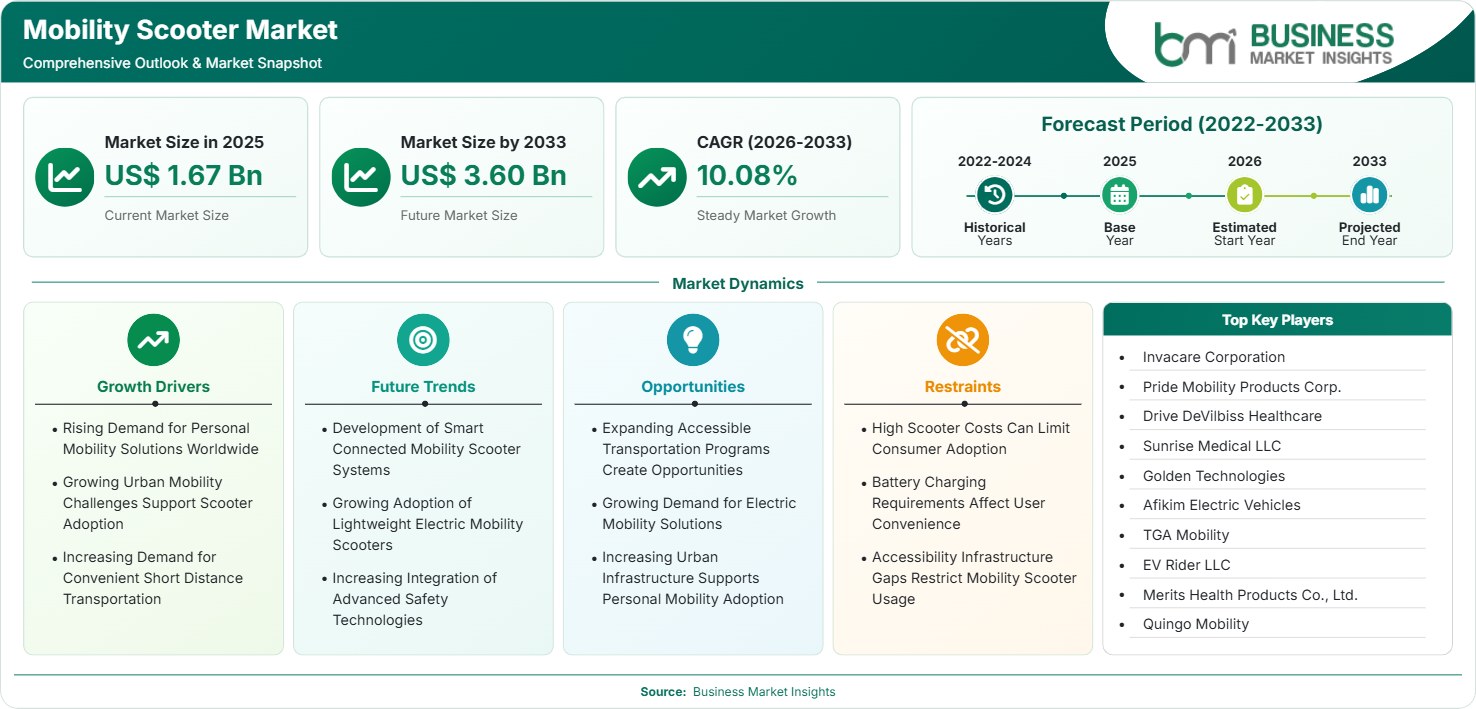
The Mobility Scooter Market size was valued at US$ 1.67 Billion in 2025 and is projected to reach US$ 3.60 Billion by 2033, growing at a CAGR of 10.08% during 2026–2033, driven by personal mobility demand, accessible transportation, urban convenience, electric mobility adoption, and supportive infrastructure.

Report Coverage
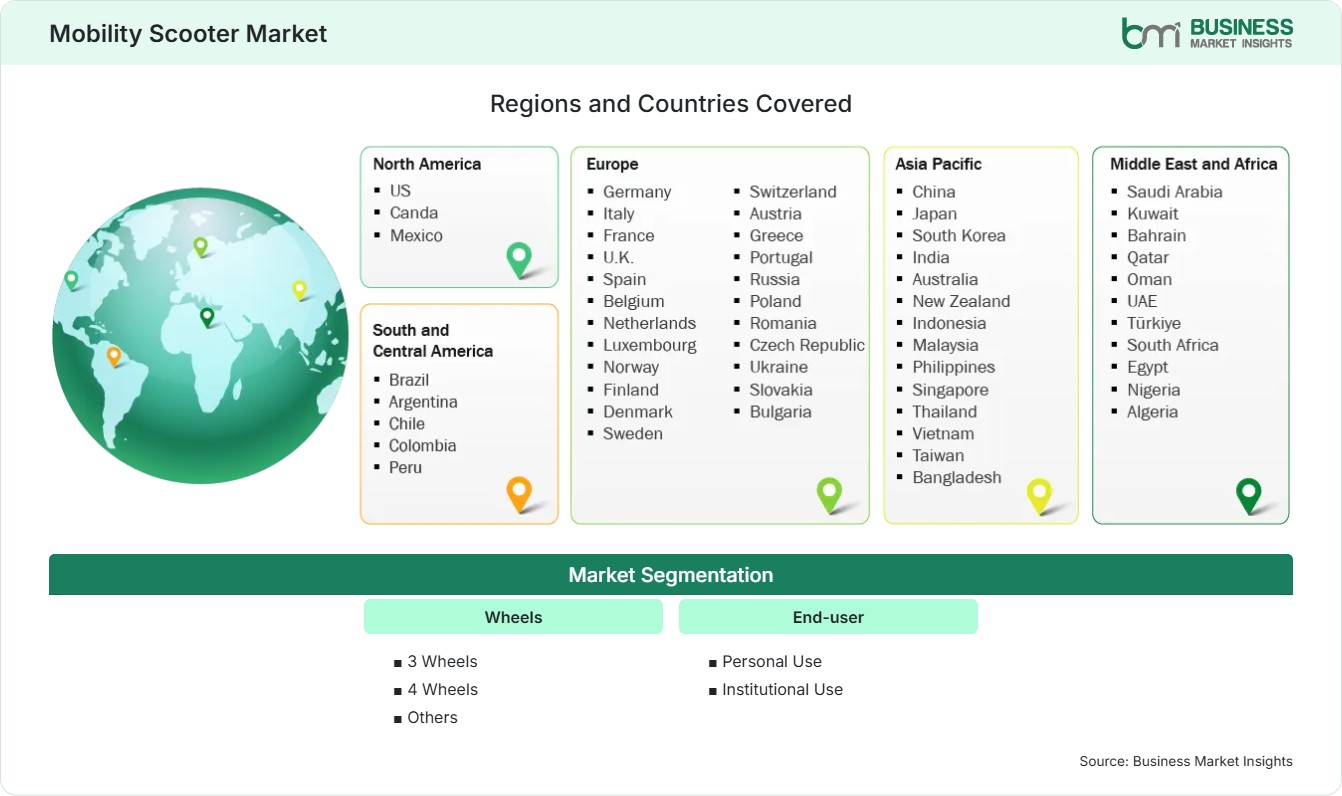
  • Wheels: 3 Wheels, 4 Wheels, Others
  • End-user: Personal Use, Institutional Use
US$ 1.67 Bn Market size in 2025
US$ 3.60 Bn Market Size by 2033
10.08% CAGR, 2026 - 2033
2026-2033 Forecast Period

AI Overview

Mobility Scooter Market Summary

  • North America: North America holds a 27%–30% share in 2025 and is growing at a 9.1%–9.8% CAGR through 2033, supported by accessibility programs, established healthcare distribution, consumer independence, replacement demand, and product innovation. The US Mobility Scooter Market represents a 23%–26% global share and advances at a 9.0%–9.7% CAGR, supported by personal mobility needs and institutional procurement.
  • Fastest Growing Region: Asia Pacific holds a 29%–32% share in 2025 and records an 11.5%–12.4% CAGR through 2033, supported by urban mobility constraints, expanding healthcare access, electric transportation adoption, improving distribution networks, and rising demand for convenient personal mobility.
  • Leading Segment: 4 Wheels represents a 48%–52% share in 2025 and advances at a 9.8%–10.5% CAGR through 2033, supported by stability preferences, outdoor usability, longer travel requirements, improved seating, and broader suitability across user groups.
  • High Growth Segment: Institutional Use holds a 22%–26% share in 2025 and advances at an 11.8%–12.7% CAGR through 2033, supported by rehabilitation facilities, assisted-living centers, accessible tourism, healthcare procurement, fleet requirements, and organized mobility services.
  • Key Market Opportunity: Expanding accessible transportation programs can encourage scooter procurement through healthcare providers, mobility agencies, public facilities, tourism operators, and institutional buyers seeking dependable last-mile mobility solutions.
  • Major Market Players: Invacare Corporation, Pride Mobility Products Corporation, Drive DeVilbiss Healthcare, Sunrise Medical LLC, Golden Technologies, Afikim Electric Vehicles, TGA Mobility, EV Rider LLC, Merits Health Products Co., Ltd., Quingo Mobility.
Strategic Insights

Mobility Scooter Market: Strategic Insights

Mobility Scooter Market Strategic Framework
FREE PDF
Request your free sample
Request free sample
Stakeholder View

Key Takeaways

  • Product demand is increasingly influenced by the complete mobility experience, including transportability, charging convenience, seating ergonomics, maneuverability, maintenance access, and suitability for indoor and outdoor environments.
  • Four-wheel configurations provide a strong commercial foundation because buyers frequently prioritize stability and confidence, while compact three-wheel designs retain relevance where turning radius and maneuverability matter more.
  • Manufacturers can differentiate through modular batteries, lighter frames, foldable architectures, improved suspension, digital battery monitoring, ergonomic controls, and designs that simplify vehicle loading and transportation.
  • Asia Pacific provides an attractive expansion environment because mobility needs are intersecting with urban development, improving healthcare access, expanding electric transportation infrastructure, and broader consumer awareness.
  • Distribution strategy remains commercially important because mobility scooters require demonstrations, fitting guidance, maintenance support, replacement parts, and customer education that pure online purchasing cannot always provide.
  • Future competition will increasingly depend on combining affordability with reliability, portability, battery performance, safety-oriented engineering, accessible controls, financing options, and dependable post-sale service.
Geographic Outlook

Mobility Scooter Market Regional Highlights

North America Mobility Scooter Market

North America holds a 27%–30% share in 2025 and is projected to grow at a 9.1%–9.8% CAGR through 2033. Established healthcare channels and accessibility-focused purchasing provide a mature foundation, while replacement demand and product upgrades support continued expansion.

  • Healthcare providers and mobility dealers remain important channels because users often require demonstrations, configuration guidance, maintenance, and product fitting before purchase.
  • Demand is supported by personal transportation requirements across residential communities, shopping environments, recreational destinations, and accessible public facilities.
  • Product development increasingly emphasizes portability, battery convenience, suspension, ergonomic controls, and improved maneuverability for varied operating environments.
  • Institutional procurement creates opportunities in assisted-living facilities, rehabilitation settings, hospitality properties, and organized transportation programs.

US Mobility Scooter Market

The US represents a 23%–26% global share in 2025 and advances at a 9.0%–9.7% CAGR through 2033. Demand benefits from established distribution networks, accessibility awareness, replacement purchasing, and diverse product availability.

  • Medicare-related eligibility considerations, private purchasing, and dealer-supported sales influence product selection and purchasing pathways across consumer groups.
  • Compact travel models appeal to users seeking easier transportation, while full-size products address longer-distance outdoor mobility requirements.
  • Manufacturers increasingly compete through charging convenience, seating comfort, suspension systems, controls, portability, and differentiated product configurations.

Europe Mobility Scooter Market

Europe accounts for a 25%–28% Mobility Scooter Market share in 2025 and is advancing at an 8.7%–9.5% CAGR through 2033. Germany, the UK, France, Italy, and Spain remain important markets, while Eastern Europe offers developing opportunities.

  • European accessibility initiatives support demand for mobility products that facilitate participation in community, retail, leisure, and transportation environments.
  • Germany and the UK provide established demand through healthcare-related channels, specialist dealers, and mature assistive mobility ecosystems.
  • Spain, Italy, and France offer opportunities through tourism accessibility, residential mobility requirements, and expanding consumer awareness of electric personal transportation.
  • Manufacturers are emphasizing compact dimensions and transport-friendly configurations where users frequently combine scooters with cars or public transportation.

Asia Pacific Mobility Scooter Market

Asia Pacific represents a 29%–32% share in 2025 and records the fastest growth at an 11.5%–12.4% CAGR. China, Japan, India, South Korea, and Australia provide varied opportunities across consumer and institutional applications.

  • China offers manufacturing and consumption opportunities as electric mobility capabilities expand alongside demand for accessible personal transportation.
  • Japan provides a sophisticated assistive mobility environment where compact dimensions, maneuverability, reliability, and user-friendly controls remain important purchasing considerations.
  • India represents an emerging opportunity as healthcare access, urban development, and awareness of assistive mobility products improve.
  • Australia and South Korea provide potential through established healthcare systems, active aging-in-place preferences, accessibility requirements, and consumer demand for outdoor mobility.

Rest of World Mobility Scooter Market

Rest of World holds a 15%–18% share in 2025 and is projected to grow at a 9.5%–10.4% CAGR through 2033. Latin America, the Middle East, and Africa present developing opportunities as mobility access expands.

Latin American demand is supported by private mobility purchases, healthcare services, rehabilitation requirements, and accessible tourism. Middle Eastern markets can benefit from premium mobility applications, hospitality accessibility, and healthcare investment, while African markets offer longer-term potential as assistive technology availability improves.

  • Brazil and Mexico provide promising commercial opportunities through healthcare distribution, private consumers, rehabilitation services, and accessible tourism.
  • Gulf countries can support premium product demand through healthcare facilities, hospitality projects, shopping destinations, and accessibility-oriented infrastructure.
  • South Africa represents an important entry market where established healthcare channels can support distribution and servicing capabilities.
  • Developing markets require stronger financing, dealer networks, maintenance infrastructure, and customer education to convert unmet mobility needs into sustained demand.
Global Market Geography
FREE PDF
Request your free sample
Request free sample
Segment Analysis

Mobility Scooter Market Segmentation

Wheels

4 Wheels leads the structure with a 48%–52% share in 2025 and a 9.8%–10.5% CAGR through 2033. Stability, outdoor usability, longer travel, and consumer confidence support its leading position.

  • 3 Wheels: Provides tighter maneuverability for indoor environments, narrow pathways, retail spaces, and users prioritizing turning flexibility over maximum stability.
  • 4 Wheels: Offers enhanced stability and balanced handling for outdoor travel, longer distances, uneven surfaces, and users seeking greater driving confidence.
  • Others: Covers specialized wheel configurations designed for particular stability, maneuverability, comfort, or performance requirements across niche mobility applications.

End-user

Personal Use accounts for a 67%–71% share in 2025, while Institutional Use records faster expansion through 2033. Consumer independence, assisted mobility programs, healthcare facilities, and organized services influence purchasing decisions.

  • Personal Use: Addresses individual transportation needs across homes, communities, shopping areas, recreational destinations, and short-distance journeys requiring independent mobility.
  • Institutional Use: Serves rehabilitation centers, assisted-living facilities, healthcare organizations, hospitality properties, and accessible transportation programs requiring multiple mobility units.
Market Forces

Mobility Scooter Market Dynamics

Key Market Drivers

Rising Demand for Personal Mobility Solutions Worldwide

The increasing desire for independent mobility is prompting buyers to focus on mobility equipment that ensures less reliance on carers and conventional modes of transport. According to the World Health Organization, mobility is one of the key needs for assistive technology. Comfort, maneuverability, range, portability, and ease of use have become some of the factors considered when evaluating scooters other than basic mobility needs. The Mobility Scooter Market trends call for innovations in mobility equipment that are compatible with people’s lifestyles. Manufacturers will be able to take advantage of such a trend by developing equipment that can cater to varying usage environments like residential estates, shopping centers, parks, healthcare institutions, and urban trips within shorter distances.

Growing Urban Mobility Challenges Support Scooter Adoption

The urban setting presents particular mobility problems that have to do with traffic jams, restricted parking spaces, high pedestrian populations, and the disparity between destination points and traditional modes of transportation. Mobility scooters are solutions to close distances where it becomes necessary to substitute walking and driving an automobile. Efficient design is crucial to users who operate the scooters in indoor settings, on sidewalks, in residential areas, and even commercially. Better designs of accessible infrastructure would strengthen the adoption of the scooters in terms of making mobility easier for them. Therefore, the mobility scooter market growth is linked to both personal mobility needs and infrastructure development. The manufacturers that perfect the turn radius, brakes, clearance, comfort, and transportability can effectively cater to the urban operational challenges.

Increasing Demand for Convenient Short Distance Transportation

Needs for short-distance transportation are driving interest in small electric vehicles that will make it possible to cover everyday trips without the complications of traditional automobiles. Customers are looking for devices that will allow them to go from their house to shops, public institutions, to doctors' appointments, and places of entertainment. Folding designs, removable batteries, lightweight construction, and ease of controls could help to facilitate use by customers who carry their scooters in cars. Ease of battery recharging is important in terms of product utility, as customers require reliability of the process in order to use the vehicle on a daily basis. The Mobility Scooter Market forecasts indicate that interest in such solutions will continue due to consideration of practical everyday travel needs, including portability, mobility, storage, and transportation of the product.

Key Market Opportunities

Expanding Accessible Transportation Programs Create Opportunities

Accessible transportation systems have the potential to generate institutional demand through the incorporation of mobility scooters within the facilities of hospitals, rehabilitation institutions, hospitality institutions, publicly accessible sites, and community-based transportation services. Procurement institutions can take advantage of the ease of maintenance and replacement offered by fleets of standardized mobility scooters. Manufacturers of mobility scooters can produce institutional packages including robust scooters along with charging facilities, maintenance agreements, replacement batteries, and associated services. Additionally, alliances with accessibility institutions and transportation institutions can contribute towards increasing awareness among potential customers who do not recognize the mobility scooters as a mode of transportation on their own accord.

Growing Demand for Electric Mobility Solutions

The shift towards electric vehicles is offering the chance to make improvements to mobility scooters via more effective motor designs, lightweight batteries, better ways to charge them, and superior energy management systems. The lithium-ion battery designs will be able to allow the portability and packaging benefits where relevant, while smart battery monitoring will enable the provision of information regarding the available operating time to users. Manufacturers may consider regenerative capabilities, connectivity for diagnostics, modularity of the battery system, and accessories for charging in a residential setting. The development of electric mobility offers the possibility of presenting scooters as a convenient means of personal transportation and not only as an assistive device. This wider positioning will help to widen its consumer base of people who want to travel short distances with ease.

Increasing Urban Infrastructure Supports Personal Mobility Adoption

Better sidewalks, curbs, entrances, walking areas, ramps, and mobility-friendly public infrastructure could increase the utility of electric scooters on routine travel paths. Urban planners and mobility service providers can generate more demand by taking into account space for turns, surface conditions, availability of charging stations, parking, and safer crossings when planning infrastructure. Suppliers can meet this demand through the design of scooters that fit different settings, both indoors and outdoors. Accessible transit systems can help to extend the distance covered through scooters by using them to augment and not replace transit modes. The application goes beyond tourism and retail but can be extended to health care facilities, housing developments, and large public spaces.

Market Restraints and Challenges

High Scooter Costs Can Limit Consumer Adoption

Factor: The buying cost of mobility scooters becomes a barrier when they need sophisticated batteries, suspension systems, rugged frames, customized seating, safety equipment, and service provision by dealers. Impact: High initial cost may lead consumers to postpone buying replacements, buy cheaper units, or even restrict some users from buying if there is not enough compensation or financing available. Manufacturers may overcome this factor using different pricing strategies such as tiered pricing, modular design, financing, second-hand units, and more basic scooters with similar functionality. Dealers may increase the value proposition by providing information on costs throughout the lifecycle, warranty, maintenance, battery replacement, and product compatibility. More extensive procurement programs can enhance affordability through the consolidation of demand and lower costs of acquisitions for institutions.

Battery Charging Requirements Affect User Convenience

Factor: Battery charging is an essential aspect of the use of mobility scooters, and one can encounter issues with regard to the location of charging, time of charging, battery deterioration, battery storage, and availability of appropriate electrical sockets. Impact: Charging can make the use of mobility scooters inconvenient to customers traveling regularly, without storage space, or needing mobility all day. Removable batteries, clear charging indication, effective energy consumption, portable charging equipment, and battery choice corresponding to particular consumer habits can help the manufacturer address the concerns. Educating dealers about charging procedures, battery storage, and replacement will minimize operational issues. Designs for products that are easy to charge but have adequate operational capacity could enhance user experience and address problems of electric mobility.

Company Analysis

Competitive Landscape

The Mobility Scooter Market analysis indicates competition among established assistive mobility manufacturers, specialist scooter developers, healthcare-oriented suppliers, and companies focused on electric personal transportation. Differentiation centers on stability, portability, battery systems, comfort, maneuverability, product durability, dealer networks, servicing, and institutional relationships.

Company Name

Overview

Products and Services relevant to this market

Invacare Corporation

Established provider of mobility and accessibility products serving individual and institutional mobility requirements.

Mobility scooters, powered mobility equipment, seating solutions, replacement components, accessories, and related support services.

Pride Mobility Products Corporation

Major mobility manufacturer with broad scooter offerings spanning portable, full-size, three-wheel, and four-wheel configurations.

Three-wheel and four-wheel scooters, travel scooters, folding models, heavy-duty scooters, accessories, and mobility support.

Drive DeVilbiss Healthcare

Healthcare equipment provider offering mobility solutions for homecare, clinical, and community applications.

Mobility scooters, powered mobility equipment, walking aids, accessories, replacement parts, and related healthcare mobility products.

Sunrise Medical LLC

Mobility technology company focused on products supporting independence, rehabilitation, and everyday accessibility.

Mobility scooters, power mobility solutions, seating systems, positioning products, accessories, and mobility support services.

Golden Technologies

US mobility specialist offering a broad portfolio designed for personal transportation and accessibility needs.

Three-wheel and four-wheel scooters, portable models, folding scooters, heavy-duty products, accessories, and support services.

Afikim Electric Vehicles

Specialist electric mobility manufacturer with extensive experience developing powered scooters for personal mobility applications.

Portable, mid-size, full-size, all-terrain, and multi-purpose mobility scooters with related accessories and support.

TGA Mobility

Mobility specialist focused on practical scooters designed for varied outdoor and everyday mobility environments.

Mobility scooters, powered mobility products, accessories, servicing support, and mobility solutions for individual users.

EV Rider LLC

Mobility company focused on portable and electric scooter designs emphasizing convenience and transportability.

Folding scooters, travel scooters, lightweight mobility products, batteries, chargers, accessories, and replacement components.

Merits Health Products Co., Ltd.

Medical mobility equipment manufacturer serving consumer, healthcare, and rehabilitation-related applications.

Mobility scooters, power wheelchairs, electric mobility products, seating solutions, accessories, and replacement parts.

Quingo Mobility

Specialist mobility scooter brand using differentiated wheel architecture and ergonomic design principles.

Five-wheel mobility scooters, stability-focused products, adaptive footplates, posture-control features, accessories, and support.

Trust & Transparency

Research Methodology

The market analysis combines proprietary research with secondary data from government agencies, company disclosures, regulatory filings, industry databases and expert interviews. Market estimates are validated through data triangulation, cross-market benchmarking and analyst review.

View Full Research Methodology

Questions Answered

Frequently Asked Questions

What does the Mobility Scooter Market report indicate about future competition?

The report indicates that competitive positioning will increasingly depend on product usability, portability, stability, battery convenience, comfort, affordability, dealer support, servicing capabilities, and institutional relationships. Companies capable of combining reliable engineering with accessible pricing and strong customer support can strengthen their position as mobility needs diversify.

Why are urban accessibility improvements creating new opportunities for mobility scooters?

Accessible sidewalks, ramps, curb transitions, pedestrian areas, public facilities, and transportation connections make scooter travel more practical. Better infrastructure can expand the number of destinations users can reach independently, increasing the utility of scooters across retail, healthcare, residential, leisure, and community environments.

How are battery technologies influencing mobility scooter adoption?

Battery development is improving portability, energy management, charging convenience, and product packaging. Removable batteries can simplify charging for users without dedicated charging spaces, while improved monitoring can provide clearer information about remaining capacity. These developments can make electric mobility more practical for frequent short-distance travel.

Which applications present the strongest opportunity in the market?

Personal transportation remains the core application, while rehabilitation facilities, assisted-living centers, accessible tourism, healthcare campuses, residential communities, and public venues provide additional opportunities. Institutional applications can generate recurring demand because organizations may require multiple scooters, scheduled maintenance, replacement batteries, and standardized service arrangements.

What factors are improving Mobility Scooter Market return on investment?

Improved product durability, recurring replacement requirements, institutional procurement, accessible transportation initiatives, and demand for independent short-distance travel can support commercial returns. Manufacturers can strengthen economics through modular designs, efficient servicing, differentiated product tiers, and accessories that create additional revenue opportunities beyond the initial scooter purchase.

Access the Full Mobility Scooter Market Report

Get segment-level forecasts, regional estimates, competitive benchmarking, company profiles and downloadable Excel datasets.

Access the full Mobility Scooter Market Report
350 pages PDF & Excel | 2026-09-15
Similar Research

Related Market Reports