
Missile Guidance System Market Outlook: Size, Share, Trends, Growth Analysis, Competitive Landscape & Forecast, 2026-2033

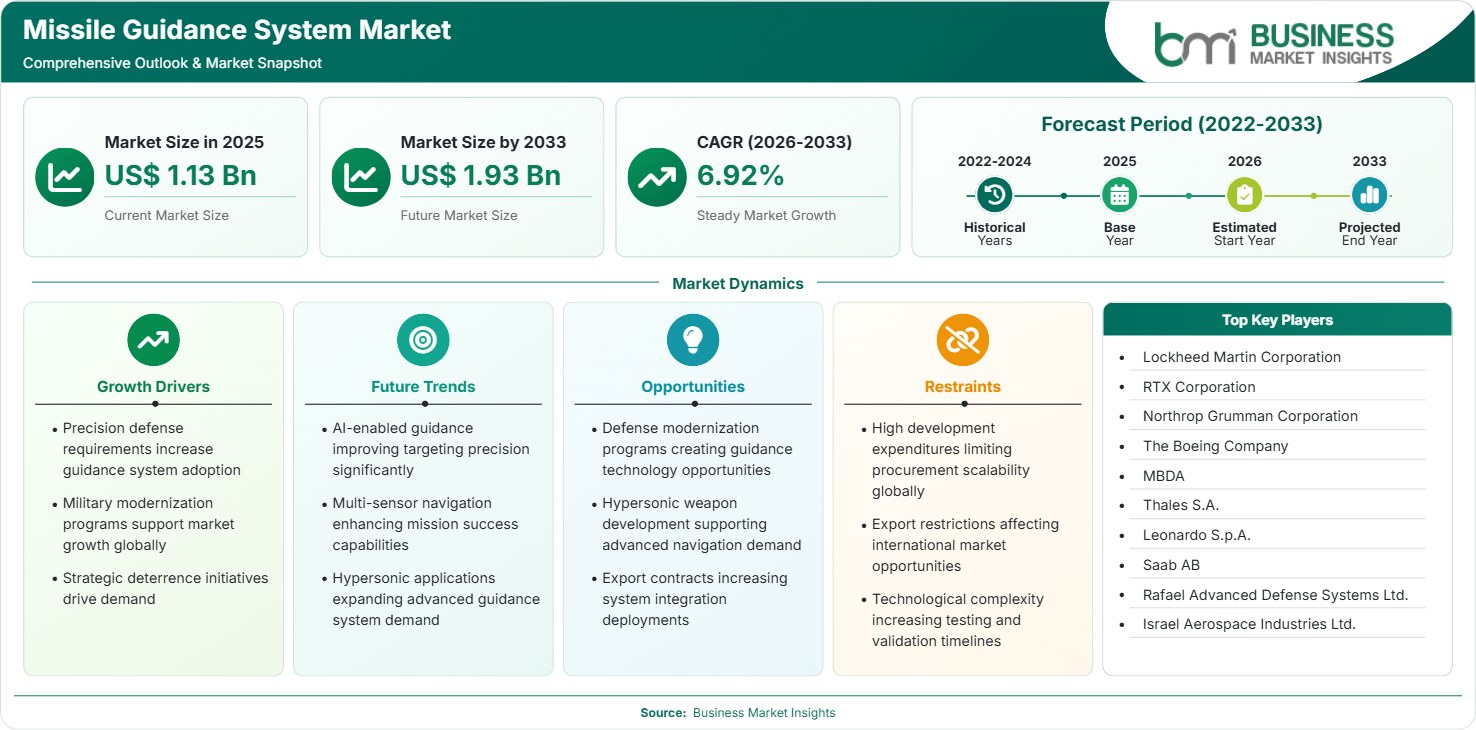
The Missile Guidance System Market size was valued at US$ 1.13 Billion in 2025 and is projected to reach US$ 1.93 Billion by 2033, growing at a CAGR of 6.92% during 2026–2033. Growth is supported by rising defense modernization, precision-strike requirements, AI-enabled targeting, multi-sensor navigation integration, hypersonic weapon development, and expanding missile procurement programs across NATO, Asia-Pacific, and Middle Eastern nations.

Report Coverage
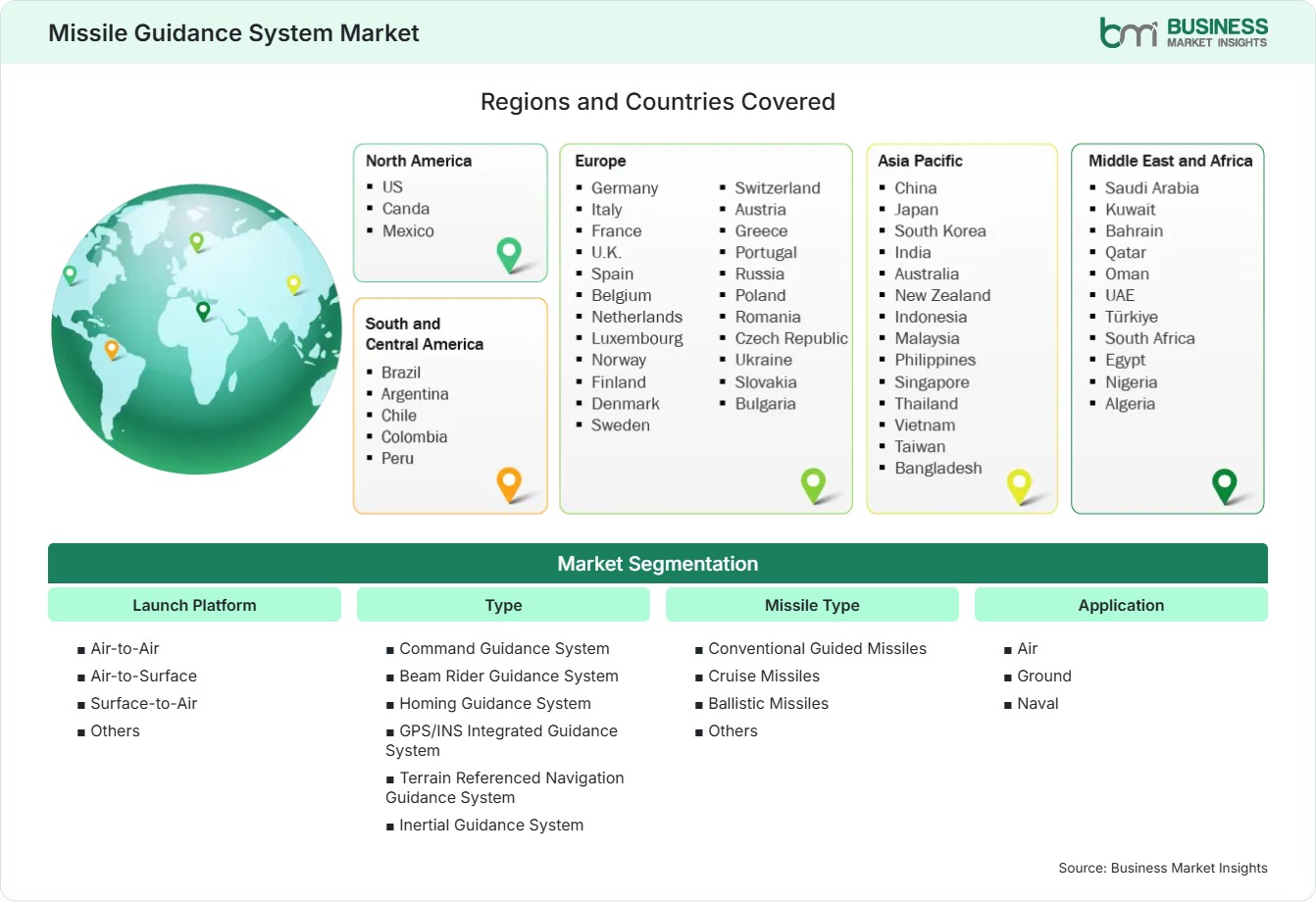
  • Launch Platform: Air-to-Air, Air-to-Surface, Surface-to-Air, Others
  • Type: Command Guidance System, Beam Rider Guidance System, Homing Guidance System, GPS/INS Integrated Guidance System, Terrain Referenced Navigation Guidance System, Inertial Guidance System
  • Missile Type: Conventional Guided Missiles, Cruise Missiles, Ballistic Missiles, Others
  • Application: Air, Ground, Naval
US$ 1.13 Bn Market size in 2025
US$ 1.93 Bn Market Size by 2033
6.92% CAGR, 2026 - 2033
2026-2033 Forecast Period

AI Overview

Missile Guidance System Market Summary

  • North America Region: North America holds a Missile Guidance System Market share of 36%–39% in 2025, growing at a CAGR of 6.3%–6.8% during 2026–2033. Growth is supported by missile modernization funding, integrated air defense programs, advanced seeker technologies, and hypersonic weapon initiatives, creating long-term procurement opportunities. US market benefits from sustained defense appropriations and next-generation interceptor integration, advancing at approximately 6.4%–6.9% CAGR.
  • Fastest Growing Region: Asia Pacific holds a market share of 27%–30% in 2025, expanding at a CAGR of 7.8%–8.4% during 2026–2033. Regional demand stems from military modernization, border security priorities, indigenous missile production, technology transfer partnerships, and increasing investments in advanced precision-strike systems.
  • Leading Segment: Homing Guidance System holds a market share of 30%–33% in 2025, advancing at a CAGR of 7.0%–7.5% during 2026–2033. Superior targeting accuracy, countermeasure resistance, autonomous engagement capability, and expanding deployment across air-defense and long-range strike platforms sustain segment leadership.
  • High Growth Segment: GPS/INS Integrated Guidance System holds a Missile Guidance System Market share of 18%–21% in 2025, growing at a CAGR of 8.2%–8.8% during 2026–2033. Demand rises from network-centric warfare, satellite-assisted navigation, resilient positioning technologies, and integration across cruise, ballistic, and tactical missile inventories.
  • Key Market Opportunity: Increasing adoption of AI-enabled navigation algorithms, multi-domain combat operations, and anti-jamming technologies opens substantial commercialization opportunities for sensor fusion, guidance software, and advanced inertial navigation suppliers globally.
  • Major Market Players: Lockheed Martin Corporation, RTX Corporation, Northrop Grumman Corporation, The Boeing Company, MBDA, Thales S.A., Leonardo S.p.A., Saab AB, Rafael Advanced Defense Systems Ltd., Israel Aerospace Industries Ltd.
Strategic Insights

Missile Guidance System Market: Strategic Insights

Missile Guidance System Market Strategic Framework
FREE PDF
Request your free sample
Request free sample
Stakeholder View

Key Takeaways

  • The value chain increasingly depends on collaboration among sensor manufacturers, software developers, defense electronics providers, propulsion specialists, and systems integrators, creating high entry barriers.
  • GPS/INS integrated solutions and advanced homing technologies offer the strongest commercial upside due to growing requirements for long-range precision engagement capabilities.
  • AI-assisted target recognition, sensor fusion, and anti-jamming capabilities are reshaping product-development priorities and influencing procurement criteria among leading defense agencies.
  • Asia-Pacific presents a compelling investment destination as regional governments increase defense budgets and support indigenous missile production initiatives.
  • Strategic partnerships, joint ventures, and defense-industrial cooperation agreements are becoming preferred approaches for technology access and program execution.
  • Demand is increasingly shifting toward modular and upgradeable architectures that support lower lifecycle costs and improved interoperability across military platforms.
Geographic Outlook

Missile Guidance System Market Regional Highlights

North America Missile Guidance System Market

North America accounts for approximately 36%–39% of the Missile Guidance System Market share in 2025 and is projected to expand at a CAGR of 6.3%–6.8% through 2033. Regional demand is supported by sustained defense budgets, missile defense initiatives, hypersonic weapon programs, and advanced seeker development. The United States dominates procurement spending, while Canada contributes through modernization programs and NATO capability alignment. Ongoing investments in integrated battle command systems, precision warfare capabilities, and next-generation interceptors continue strengthening regional competitiveness and technological leadership.

  • U.S. defense modernization programs prioritize resilient navigation and advanced targeting technologies across tactical and strategic missile inventories.
  • Growing investments in hypersonic weapon development encourage deployment of sophisticated guidance and sensor-fusion architectures.
  • Missile-defense initiatives stimulate demand for advanced homing, navigation, and command-guidance technologies.
  • Collaboration between defense agencies and private contractors accelerates innovation and product qualification activities.

US Missile Guidance System Market

The United States represents approximately 78%–82% of regional revenue and maintains a CAGR of 6.4%–6.9% through 2033. Procurement priorities emphasize missile-defense modernization, precision-guided munitions, and hypersonic strike programs. Investments in AI-enabled navigation, advanced seekers, and integrated battle networks drive continuous technology upgrades. Strong industrial capacity and long-term defense acquisition plans support market expansion.

  • Large-scale procurement programs sustain demand across air, land, and naval missile applications.
  • AI-enabled targeting technologies receive increased funding under advanced weapons initiatives.
  • Domestic manufacturing capabilities support supply-chain resilience and technology leadership.
  • Hypersonic weapon research drives innovation across navigation and guidance subsystems.

Europe Missile Guidance System Market

Europe holds 24%–27% Missile Guidance System Market share in 2025 and is expected to record a CAGR of 6.7%–7.2% through 2033. Regional growth reflects elevated defense expenditure, missile-stock replenishment programs, and collaborative weapon-development initiatives. France remains the leading market, while Poland demonstrates the fastest growth supported by modernization investments exceeding many Western European peers. NATO readiness objectives continue stimulating procurement.

  • France benefits from strong domestic missile-manufacturing capabilities and export programs.
  • Poland records one of the region's fastest expansion rates through accelerated modernization plans.
  • Joint European weapon-development initiatives encourage advanced guidance-system adoption.
  • Security concerns continue increasing procurement of precision-guided missile inventories.

Asia Pacific Missile Guidance System Market

Asia Pacific accounts for 27%–30% of revenue in 2025 and is projected to expand at a CAGR of 7.8%–8.4%. Regional governments prioritize indigenous missile development, strategic deterrence capability, and border security enhancement. China leads regional demand, while India represents the fastest-growing national market owing to domestic defense-production initiatives and missile modernization programs.

  • Indigenous defense-manufacturing strategies support development of advanced navigation technologies.
  • Rising geopolitical tensions increase procurement of precision-guided missile systems.
  • India strengthens domestic production through public-private collaboration models.
  • Regional technology-transfer agreements accelerate deployment of advanced seeker solutions.
  • Growing naval modernization programs create additional demand across maritime applications.

Rest of World Missile Guidance System Market

Rest of World contributes 10%–13% of global Missile Guidance System Market revenue and is projected to expand at a CAGR of 7.0%–7.6%. Middle Eastern countries continue investing heavily in missile defense and precision-strike capabilities. South America remains comparatively smaller but benefits from selective modernization programs. Saudi Arabia is the leading market, while the UAE demonstrates particularly strong technology-procurement momentum.

  • Gulf nations prioritize integrated air-defense and missile-interceptor capabilities.
  • Strategic partnerships support technology transfer and local assembly initiatives.
  • South American modernization programs focus on improving defense readiness.
  • Demand for advanced navigation technologies rises alongside regional security concerns.
  • Indigenous manufacturing ambitions encourage long-term procurement and development activities.
Global Market Geography
FREE PDF
Request your free sample
Request free sample
Segment Analysis

Missile Guidance System Market Segmentation

Launch Platform

Launch-platform demand reflects evolving military doctrines emphasizing multi-domain engagement capabilities. This segment accounted for roughly 28%–31% share in 2025 and is projected to grow at 6.7%–7.3% CAGR through 2033. The Missile Guidance System Market scope continues to expand as armed forces seek interoperability across air, ground, and maritime environments.

  • Air-to-Air: Guided engagement requirements and beyond-visual-range weapons programs support sustained deployment across modern fighter aircraft fleets.
  • Air-to-Surface: Strong demand originates from precision-strike missions requiring high targeting accuracy against mobile and hardened targets.
  • Surface-to-Air: Air-defense modernization and counter-missile initiatives continue expanding adoption of sophisticated guidance technologies.

Type

The type segment is characterized by technological advancements that enable more accurate navigation, autonomous guidance, and immunity to electronic warfare. Homing systems have the largest market share in the Missile Guidance System Market category, accounting for about 30%–33%, and are growing at a 7.0%–7.5% CAGR owing to superior engagement accuracy and operational flexibility.

  • Command Guidance System: Continues supporting air-defense applications where centralized control and engagement oversight remain preferred.
  • Beam Rider Guidance System: Maintains relevance in tactical defense roles requiring comparatively lower operational complexity.
  • Homing Guidance System: Benefits from autonomous target-tracking features and expanding deployment across advanced missile inventories.
  • GPS/INS Integrated Guidance System: Growing strongly due to enhanced positioning accuracy and resilience against navigation uncertainty.
  • Terrain Referenced Navigation (TRN) Guidance system: Supports low-altitude and long-range missions in contested environments.
  • Inertial Guidance System: Remains essential for reliable navigation where external signals are degraded or unavailable.

Missile Type

Missile-based demand varies with range requirements, mission types, and doctrine. In this category, there is evidence of strong growth, driven by modernization plans and the adoption of precision warfare tactics. The Missile Guidance System Market trends are towards sophisticated navigation designs across high-value missile platforms.

  • Conventional Guided Missiles: Continue representing substantial procurement volumes due to versatility and established deployment history.
  • Cruise Missiles: Benefit from long-range precision engagement requirements and advanced navigation integration.
  • Ballistic Missiles: Demand sophisticated guidance technologies to improve strike accuracy and mission effectiveness.

Application

The diversity of applications is due to usage in air, ground, and maritime battlefields. This market category accounted for about 32%–35% of the overall Missile Guidance System Market share in 2025 and is forecast to grow at a 7.1%–7.6% CAGR, driven by rising demand for precise-strike capabilities and multi-domain operations.

  • Air: Fighter aircraft, bombers, and unmanned platforms increasingly rely on advanced navigation and targeting systems.
  • Ground: Land-based defense and tactical missile systems require precise engagement capabilities across diverse operational scenarios.
  • Naval: Maritime security programs stimulate demand for anti-ship and naval air-defense missile applications.
Market Forces

Missile Guidance System Market Dynamics

Key Market Drivers

Defense Modernization and Precision Warfare Priorities

Many nations in NATO, the Asia-Pacific, and the Middle East have continued to expand their stockpiles of precision-guided weaponry to enhance operational efficiency. Many NATO member countries and those that publish their military budgets individually have increased defense spending due to heightened security threats. The use of precision-guided weaponry reduces collateral damage while enhancing the probability of mission success. As such, the need for advanced guidance systems will drive the development cycle of increasingly sophisticated guidance technology. Expanding inventories of cruise missiles, air-defense interceptors, and tactical strike weapons remain fundamental contributors to sustained industry expansion.

Advances in Sensor Fusion and Autonomous Targeting

Modern missile systems have begun integrating technologies such as infrared seekers, radars, GPS sensors, inertial navigation systems, and AI-based analytics. Integration of sensors helps improve the accuracy of target recognition and increases survivability in challenging conditions. Acquisition agencies have begun focusing on acquiring systems capable of operating in electronic warfare environments. Such technological innovations have introduced many changes to procurement requirements and have led to the replacement of old navigational systems. Autonomy adds to the speed and reliability of engagement and makes advanced guidance technologies vital components of modern precision-strike systems.

Expansion of Missile Defense Architectures

Investments in missile defenses are rising worldwide due to the emergence of new air threats. Systems that incorporate interception systems, battle management, and multi-layered defenses require precision guidance technology. An increased need for air defense upgrades is driving the uptake of command guidance, homing, and navigation systems. Regular testing, upgrades, and deployments generate recurring revenue for industry players. The resulting ecosystem growth strengthens long-term demand for sophisticated navigation and targeting capabilities.

Key Market Opportunities

AI-Enabled Navigation and Anti-Jamming Solutions

Military organizations aim to have a guidance system that operates efficiently without GPS access. An intelligent navigation platform can provide better path optimization, target recognition, and mission planning capabilities. Firms that research machine learning and automated navigation systems stand a chance of obtaining lucrative long-term contracts. The more complicated the operations become, the greater the need for anti-jamming technologies, which will be required in missiles of all tactical and strategic types. These trends position intelligent navigation platforms among the most attractive investment segments.

Growth of Indigenous Missile Development Programs

Several countries have opted to invest in local capabilities for defense production to reduce their dependence on imports and ensure security. In-house development of missiles involves local knowledge in guidance hardware, navigation, and engagement software. This opens up many business opportunities for subsystem vendors, software developers, and technology specialists. Longer procurement processes also help in revenue predictability. The existing Missile Guidance System Market Forecasts indicate robust participation by local manufacturing systems in Asia and the Middle East.

Hypersonic and Long-Range Strike Programs

High-speed platforms require extremely sophisticated navigation and targeting systems capable of performing under very challenging circumstances. Countries have been investing heavily in developing long-range strike weapons capable of overcoming state-of-the-art defenses. Suppliers of guidance systems that can cater for such futuristic programs could stand to gain from high-value contracts and even long-term development partnerships. Expanding research activities also foster innovation in materials, sensors, and software architectures relevant to broader defense markets.

Market Restraints and Challenges

High Development Cost and Procurement Constraints

The development of guidance systems entails considerable research, qualification testing, cybersecurity considerations, and integration validation. Factor: These aspects may lead to considerable development costs, significantly increasing missile program budgets. Impact: budget-constrained nations will be hesitant about purchasing such systems, buying fewer units or considering system upgrades. High costs will hinder smaller manufacturers from entering the market, further consolidating the industry around large, already existing firms.

Export Restrictions and Regulatory Complexity and Market Access Limitations

Technological solutions for defense applications continue to be governed by stringent export control guidelines, licensing requirements, and geopolitical considerations. Factor: Technology transfers that involve navigation, seekers, and targeting tend to be regulated by the government. Impact: Approval processes may take a long time, restricting customer availability and limiting the number of markets available. Regulatory challenges may also complicate multinational collaboration efforts, affecting program schedules and commercial predictability for manufacturers.

Company Analysis

Competitive Landscape

The competitive environment reflects strong technological barriers and extensive defense-acquisition requirements. Current Missile Guidance System Market analysis indicates leadership concentrated among a combination of global defense primes and specialized missile developers.

Company Name

Overview

Products and Services relevant to this market

Lockheed Martin Corporation

Major defense contractor with extensive missile and fire-control portfolio serving global defense agencies.

Precision-guided missile systems, navigation technologies, integrated targeting and interceptor solutions.

RTX Corporation

Advanced aerospace and defense company with strong missile-defense and guidance capabilities.

Seeker technologies, missile guidance systems, air-defense interceptors and radar integration.

Northrop Grumman Corporation

Defense technology leader specializing in advanced mission systems and weapons solutions.

Navigation components, missile electronics, seeker technologies and integrated defense architectures.

The Boeing Company

Aerospace manufacturer supporting strategic and tactical missile programs globally.

Guidance subsystems, navigation technologies and missile-defense program support.

MBDA

Leading European missile developer serving NATO and international defense customers.

Air-to-air, surface-to-air, cruise missiles and advanced guidance technologies.

Thales S.A.

Defense electronics specialist focused on high-performance sensing and navigation solutions.

Inertial navigation systems, seekers, targeting systems and defense electronics.

Leonardo S.p.A.

European defense company active in integrated military technology solutions.

Guidance electronics, targeting subsystems and navigation technologies.

Saab AB

Defense manufacturer with advanced missile and precision-engagement capabilities.

Missile-control systems, guidance technologies and related combat solutions.

Rafael Advanced Defense Systems Ltd.

Specialized developer of precision weapons and missile-defense systems.

Advanced seekers, guidance electronics and precision-targeting solutions.

Israel Aerospace Industries Ltd.

Major aerospace and defense supplier with broad missile-system expertise.

Missile guidance technologies, navigation systems and integrated defense solutions.

Trust & Transparency

Research Methodology

The market analysis combines proprietary research with secondary data from government agencies, company disclosures, regulatory filings, industry databases and expert interviews. Market estimates are validated through data triangulation, cross-market benchmarking and analyst review.

View Full Research Methodology

Questions Answered

Frequently Asked Questions

Why are GPS/INS integrated systems gaining importance?

These systems combine satellite positioning and inertial navigation, improving reliability, accuracy, and mission continuity when external signals are disrupted or unavailable.

Which region offers the strongest long-term growth potential?

Asia Pacific presents strong long-term potential because of defense modernization, indigenous manufacturing initiatives, increasing security concerns, and expanding missile-development programs.

What does a Missile Guidance System Market Report typically evaluate?

A comprehensive report assesses market size, technology evolution, regional demand, competitive dynamics, procurement patterns, segmentation, growth opportunities, and strategic industry developments.

How does AI influence next-generation missile guidance systems?

AI enhances target recognition, adaptive navigation, sensor fusion, route optimization, and resiliency against interference, supporting improved operational effectiveness in contested environments.

What factors are driving adoption of advanced missile guidance technologies?

Rising precision-strike requirements, electronic warfare threats, missile-defense investments, and modernization programs are encouraging deployment of advanced navigation, targeting, and seeker technologies across military forces.

Access the Full Missile Guidance System Market Report

Get segment-level forecasts, regional estimates, competitive benchmarking, company profiles and downloadable Excel datasets.

Access the full Missile Guidance System Market Report
350 pages PDF & Excel | 2026-11-10
Similar Research

Related Market Reports