
Methionine Market Outlook: Size, Share, Trends, Growth Analysis, Competitive Landscape & Forecast, 2026-2033

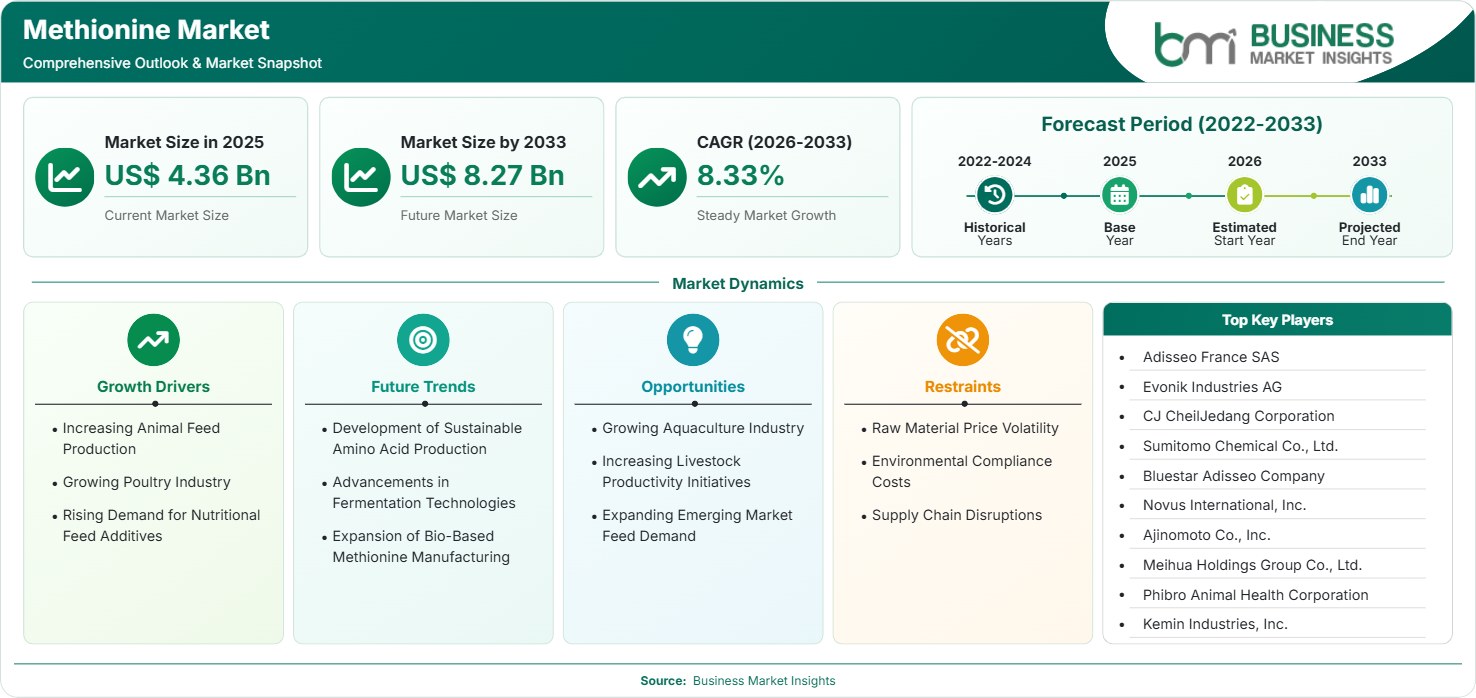
The Methionine Market size was valued at US$ 4.36 Billion in 2025 and is projected to reach US$ 8.27 Billion by 2033, growing at a CAGR of 8.33% during 2026–2033, driven by rising animal nutrition demand, expanding livestock production, increasing feed efficiency requirements, and opportunities in sustainable protein development.

Report Coverage
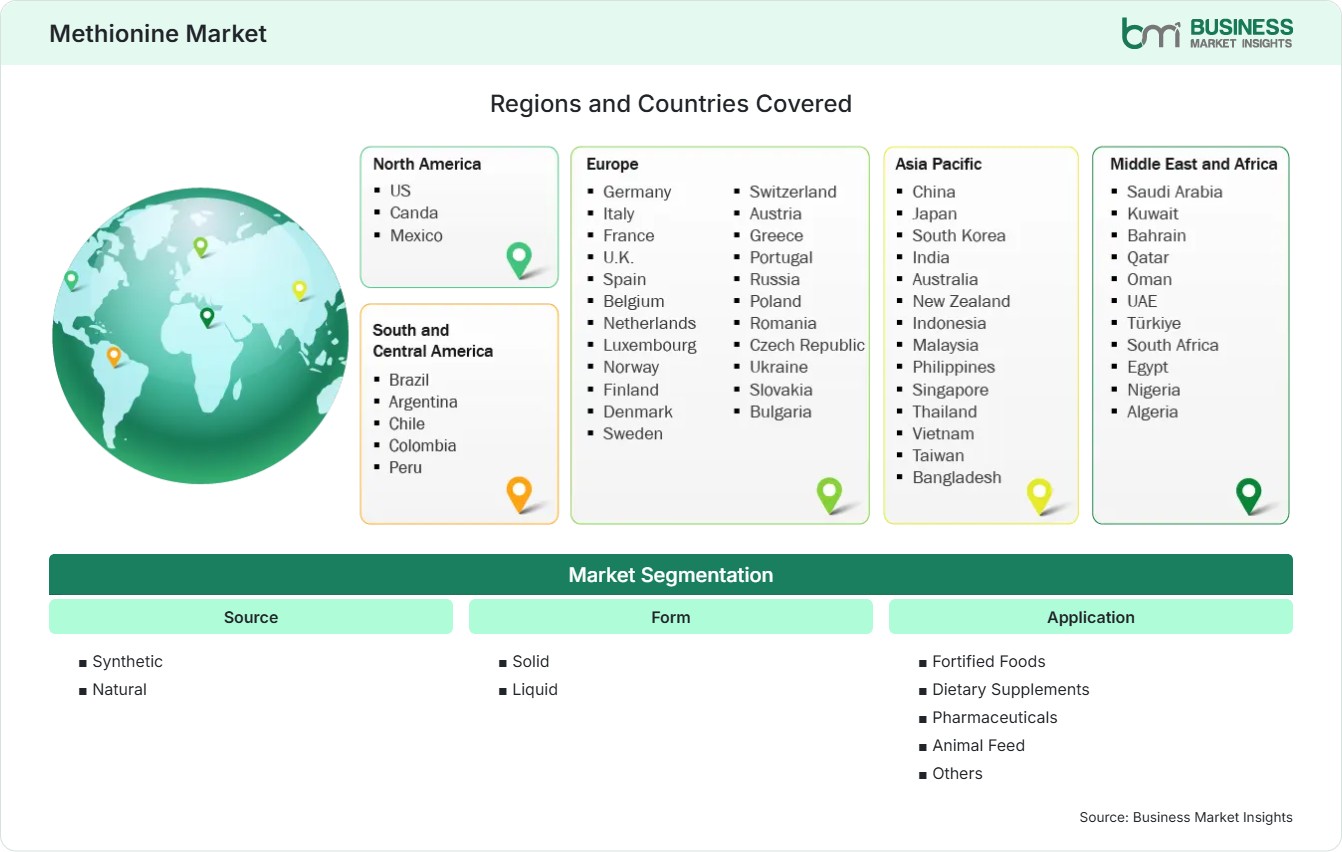
  • Source: Synthetic, Natural
  • Form: Solid, Liquid
  • Application: Fortified Foods, Dietary Supplements, Pharmaceuticals, Animal Feed, Others
US$ 4.36 Bn Market size in 2025
US$ 8.27 Bn Market Size by 2033
8.33% CAGR, 2026 - 2033
2026-2033 Forecast Period

AI Overview

Methionine Market Summary

  • North America Region: North America holds a 27%–30% share in 2025, expanding at a CAGR of 7.8%–8.2% during 2026–2033, supported by advanced livestock farming, compound feed adoption, nutritional optimization, and research investments. The US market demonstrates strong adoption of amino acid supplements with a CAGR of 8.0%–8.3% through 2033.
  • Fastest Growing Region: Asia Pacific accounts for 38%–41% share in 2025 and records the fastest CAGR of 9.2%–9.7% during 2026–2033, supported by increasing poultry production, expanding aquaculture operations, growing feed manufacturing capacity, and rising demand for efficient animal nutrition solutions.
  • Leading Segment: Animal Feed represents 55%–58% share in 2025 and grows at a CAGR of 8.5%–8.9% during 2026–2033, driven by livestock productivity improvement, feed formulation optimization, poultry expansion, and increasing adoption of essential amino acid supplementation.
  • High Growth Segment: Dietary Supplements shows 10%–13% share in 2025 with a CAGR of 9.0%–9.5% during 2026–2033, supported by increasing nutritional awareness, functional food innovation, health-focused consumption patterns, and expanding applications in specialized nutrition products.
  • Key Market Opportunity: Rising demand for sustainable protein production, precision animal nutrition, alternative feed solutions, and emerging market livestock modernization creates investment opportunities through advanced formulations, biotechnology innovation, and efficient production technologies.
  • Major Market Players: Adisseo France SAS, Evonik Industries AG, CJ CheilJedang Corporation, Sumitomo Chemical Co., Ltd., Bluestar Adisseo Company, Novus International, Inc., Ajinomoto Co., Inc., Meihua Holdings Group Co., Ltd., Phibro Animal Health Corporation, Kemin Industries, Inc.
Strategic Insights

Methionine Market: Strategic Insights

Methionine Market Strategic Framework
FREE PDF
Request your free sample
Request free sample
Stakeholder View

Key Takeaways

  • Methionine production relies on an integrated ecosystem involving raw material suppliers, biotechnology developers, fermentation technology providers, feed manufacturers, and livestock producers, creating opportunities for companies with efficient supply chain capabilities and sustainable production models.
  • Animal Feed applications remain the primary growth engine as poultry, swine, and aquaculture producers increasingly focus on improving feed conversion efficiency, reducing formulation costs, and enhancing animal health outcomes through precision nutrition strategies.
  • Innovation is shifting toward advanced fermentation processes, environmentally optimized manufacturing methods, and improved amino acid formulations that support sustainable livestock production while addressing increasing regulatory expectations around agricultural emissions.
  • Asia Pacific provides a compelling investment opportunity due to expanding livestock industries, rising protein consumption, and government initiatives supporting agricultural modernization, with China and India emerging as important demand centers.
  • Strategic partnerships, capacity expansions, and technology collaborations among amino acid manufacturers are shaping competitive positioning as companies seek greater production efficiency, regional presence, and long-term supply reliability.
  • Growing interest in sustainable agriculture and alternative protein systems is encouraging manufacturers to explore broader applications beyond traditional feed markets, creating opportunities across nutritional supplements and specialty food formulations.
Geographic Outlook

Methionine Market Regional Highlights

North America Methionine Market

North America represented 27%–30% share in 2025 and is projected to grow at a CAGR of 7.8%–8.2% during 2026–2033. The region maintains a strong position due to advanced livestock production systems, established feed manufacturing infrastructure, and increasing demand for efficient animal nutrition solutions. The Methionine Market share is supported by poultry and swine producers adopting amino acid supplementation to improve feed efficiency, reduce costs, and enhance production sustainability across commercial farming operations.

  • The United States dominates regional consumption through large-scale poultry production, advanced feed formulation practices, and increasing adoption of precision nutrition programs supporting livestock productivity improvements.
  • Canada demonstrates steady adoption through expanding animal husbandry operations, sustainable agriculture initiatives, and increasing utilization of balanced feed additives for improved livestock health management.
  • Advanced biotechnology capabilities and established amino acid production networks enable manufacturers to provide consistent supply and customized nutritional solutions for regional feed producers.
  • Growing environmental sustainability initiatives encourage livestock operators to optimize feed efficiency, reducing resource consumption while maintaining productivity through scientifically formulated amino acid supplementation.

US Methionine Market

The United States accounted for 82%–85% of North American revenue in 2025 and is expected to expand at a CAGR of 8.0%–8.3% through 2033. Strong poultry production, commercial livestock farming, and advanced feed manufacturing capabilities continue supporting demand. The country benefits from research-driven nutrition practices, increasing focus on sustainable agriculture, and widespread adoption of scientifically balanced feed formulations across industrial farming operations.

  • Large poultry and livestock industries continue driving demand as producers prioritize optimized feed conversion ratios and improved animal performance through essential amino acid supplementation.
  • Feed manufacturers increasingly integrate precision nutrition approaches, enabling customized formulations that address specific requirements across different livestock categories and production environments.
  • Growing investments in sustainable farming practices encourage producers to adopt efficient nutritional solutions that support productivity while reducing environmental impact from livestock operations.

Europe Methionine Market

Europe accounted for 24%–27% share in 2025 and is forecast to expand at a CAGR of 8.1%–8.5% during 2026–2033. The region benefits from stringent animal nutrition standards, advanced agricultural systems, and strong focus on sustainable livestock production. Germany leads regional consumption, while France and the Netherlands demonstrate strong growth through innovative farming practices, advanced feed technologies, and increasing demand for high-quality animal nutrition products.

  • Germany remains a major market due to established livestock industries, advanced feed production facilities, and strong adoption of scientifically developed nutritional additives.
  • France continues expanding amino acid utilization through modern poultry farming systems and government-supported sustainable agriculture programs focused on efficient production methods.
  • The Netherlands demonstrates strong growth through intensive livestock farming, innovative agricultural technologies, and emphasis on reducing environmental impact through optimized feed solutions.
  • European regulatory frameworks promoting responsible animal production encourage manufacturers to develop efficient formulations aligned with sustainability and food security objectives.

Asia Pacific Methionine Market

Asia Pacific accounted for 38%–41% share in 2025 and is projected to register the fastest CAGR of 9.2%–9.7% during 2026–2033. Rising meat consumption, expanding poultry production, aquaculture development, and increasing feed manufacturing investments support regional expansion. China represents the largest market, while India demonstrates rapid growth due to increasing livestock modernization, rising protein demand, and expanding commercial farming activities.

  • China leads regional demand through extensive poultry production, large feed manufacturing capacity, and increasing adoption of advanced nutritional additives for livestock efficiency.
  • India demonstrates high growth potential due to expanding dairy, poultry, and aquaculture sectors supported by increasing agricultural modernization initiatives.
  • Southeast Asian countries are increasing methionine consumption as commercial farming expands and producers seek improved productivity through balanced animal nutrition strategies.
  • Regional feed manufacturers are investing in advanced formulation capabilities to address rising demand for affordable and efficient livestock production solutions.

Rest of World Methionine Market

The Rest of World region represented 8%–10% Methionine Market share in 2025 and is anticipated to grow at a CAGR of 7.5%–8.0% through 2033. South and Central America benefit from expanding poultry production, agricultural exports, and increasing feed industry investments. Middle East and Africa are witnessing gradual adoption due to livestock development programs, food security initiatives, and improving agricultural infrastructure. Brazil leads regional demand, while Saudi Arabia and South Africa demonstrate emerging opportunities.

  • Brazil remains a significant market through large-scale poultry production, export-oriented agriculture, and increasing adoption of nutritional feed additives.
  • Middle Eastern countries are investing in livestock productivity solutions to improve domestic food production and reduce dependence on imported animal products.
  • South Africa demonstrates rising demand through expanding commercial farming operations and modernization of agricultural practices.
  • Increasing partnerships between feed producers and technology providers improve access to advanced amino acid solutions across emerging economies.
  • Government-supported agricultural development programs create long-term opportunities for nutritional additive adoption in developing livestock markets.
Global Market Geography
FREE PDF
Request your free sample
Request free sample
Segment Analysis

Methionine Market Segmentation

Source

The source segment plays a critical role in determining production efficiency, sustainability profile, and application suitability. Synthetic methionine dominates adoption due to scalable manufacturing, consistent quality, and cost efficiency across animal feed applications. The segment accounted for 88%–91% share in 2025 and is projected to expand at a CAGR of 8.0%–8.4% between 2026–2033. The Methionine Market scope continues expanding as manufacturers explore bio-based production technologies.

  • Synthetic: Synthetic methionine remains the preferred option for commercial feed applications due to reliable supply, standardized composition, and compatibility with large-scale livestock nutrition programs.
  • Natural: Natural methionine solutions are gaining attention through clean-label nutrition trends, sustainable ingredient development, and increasing research into plant-derived amino acid sources.

Form

The form segment influences transportation efficiency, storage requirements, and application flexibility across feed manufacturing operations. Solid formulations accounted for 72%–75% share in 2025 and continue leading adoption due to easier handling, longer shelf stability, and widespread industrial usage. The segment is expected to grow at a CAGR of 8.1%–8.5% during 2026–2033 as feed producers prioritize operational efficiency and formulation accuracy across global production facilities.

  • Solid: Solid methionine products dominate commercial usage because of simplified logistics, stable storage characteristics, and compatibility with automated feed processing systems.
  • Liquid: Liquid formulations support specialized applications requiring rapid mixing, precise dosing, and flexible integration into advanced feed manufacturing processes.

Application

The application segment represents the largest demand contributor as methionine is essential for improving animal growth, protein synthesis, and feed conversion efficiency. Animal Feed held 55%–58% share in 2025 and is projected to grow at a CAGR of 8.5%–8.9% through 2033. Increasing livestock production and evolving nutrition strategies continue strengthening adoption across multiple application areas.

  • Fortified Foods: Fortified food applications are expanding through increasing nutritional enrichment initiatives and growing interest in amino acid-enhanced food products supporting improved dietary quality.
  • Dietary Supplements: Dietary supplements are gaining traction as consumers increasingly seek targeted nutrition solutions, supporting specialized formulations containing essential amino acids for wellness applications.
  • Pharmaceuticals: Pharmaceutical applications utilize methionine for therapeutic formulations, antioxidant support products, and specialized healthcare solutions requiring high-purity amino acid ingredients.
  • Animal Feed: Animal feed represents the primary application area due to increasing livestock production, poultry industry expansion, and demand for efficient nutritional supplementation strategies.
Market Forces

Methionine Market Dynamics

Key Market Drivers

Increasing Animal Feed Production

Global production of livestock products is boosting the demand for amino acid supplements owing to the emphasis placed on enhancing feed utilization and performance of animals. According to the Food and Agriculture Organization, there is sustained growth in meat production globally, especially in developing countries, which is driving the increased use of feed additives. The Methionine Market growth will be boosted by growth in the commercial production of poultry, swine, and aquaculture, which requires optimal nutritional formulation. Companies have increased their production capacity and fermentation technology in order to cope with the increased demand.

Growing Poultry Industry

The poultry industry continues to be a significant driver for the need for methionine, owing to its role in protein formation, growth, and efficient utilization of feed. The expansion of the poultry industry in Asia-Pacific and Latin American regions is motivating feed producers to adopt amino acid-balanced feeds. Rising consumer demands for protein at affordable prices continue to fuel investments in the poultry industry. Scientifically developed feed systems are being adopted by producers in order to boost their productivity without increasing costs. Enhanced poultry genetics and modern farming practices further increase nutritional requirements, creating consistent demand for methionine-based solutions across broiler and layer production systems.

Rising Demand for Nutritional Feed Additives

Increased focus on animal welfare, efficiency in nutrient uptake, and sustainable practices has increased the use of nutritional additives in livestock industries. The usage of methionine enables maximum utilization of protein and minimizes nitrogen losses due to overfeeding. Emphasis by regulators on responsible and sustainable practices in agriculture is pushing livestock farmers towards adopting precision feeding systems. Trends in the Methionine Market demonstrate increased incorporation of amino acid solutions in innovative feed formulas that promote efficient performance and sustainability. Development of better ways of application in various livestock types is also supported by research spending.

Key Market Opportunities

Growing Aquaculture Industry

Increased production from aquaculture is bound to provide substantial growth prospects for the methionine industry as fish farms have increased their reliance on nutrition systems that are optimized to meet their needs. An increased appetite for seafood products, the lack of fish in the wild and the support of government policies towards developing aquaculture facilities are some of the reasons why producers are seeking to enhance feed efficiencies. The supplement is useful in improving growth and protein efficiency in water-based animals. Aquatic feed companies could benefit from these developments in Asia Pacific and Latin America.

Increasing Livestock Productivity Initiatives

The efforts being made by governments and other private organizations to increase the productivity of livestock are bringing in new prospects for manufacturers of amino acids. Programs of agricultural development, digital agriculture, and increased attention to animal nutrition are making producers consider scientifically balanced formulas of feed. The Methionine Market Forecasts are driven by increasing investments into efficient livestock management systems in developing countries. The demand for methods of production that increase the growth rate, decrease expenses, and increase resource efficiency is growing among producers.

Expanding Emerging Market Feed Demand

Growing meat consumption, urbanization, and increasing disposable incomes across emerging economies are creating opportunities for methionine manufacturers to expand regional production and distribution networks. Asia Pacific, African and Latin American countries are setting up advanced feed manufacturing plants owing to an increase in livestock population. Rising demand for cost-effective animal proteins will encourage the use of superior nutritional supplements. Organizations that have local manufacturing plants along with effective supply chains will be able to expand their reach in developing countries. Future growth prospects in the industry include expansion of farming practices and awareness about balanced animal nutrition.

Market Restraints and Challenges

Raw Material Price Volatility

Factor: Fluctuations in raw material availability and energy costs can increase manufacturing expenses for methionine producers. Impact: High production cost may pose a challenge in terms of price stability and profitability as well as handling long-term contracts by manufacturers. Production of methionine involves complicated chemical and fermentation processes that need to have constant supply of ingredients. Commodity prices, transport costs, and political factors may all affect efficiency of operations. The industry is trying to solve this problem via diversification of their supply chains, optimization of processes, and effective sourcing programs.

Environmental Compliance Costs

Factor: Increasing environmental regulations related to chemical manufacturing and industrial emissions are raising compliance requirements for amino acid producers. Impact: Increased funding for sustainable production technology and emission reduction equipment may result in higher operational costs. It is essential for manufacturers to embrace sustainable processes, use resources efficiently, and make their production facilities compliant with new environmental regulations. Although it will contribute to sustainability in the long term, it may be challenging for small-scale manufacturers in the short term. Firms are concentrating on biotechnological developments and sustainable manufacturing practices.

Company Analysis

Competitive Landscape

The Methionine Market analysis highlights a competitive environment shaped by global amino acid producers, biotechnology companies, and integrated nutrition solution providers. Leading participants focus on production capacity expansion, sustainable manufacturing, strategic partnerships, and innovation in animal nutrition applications. Companies compete through product quality, supply reliability, geographic reach, and technological advancements supporting efficient feed formulations.

Company Name

Overview

Products and Services relevant to this market

Adisseo France SAS

Global animal nutrition company specializing in amino acids and feed additives with strong manufacturing capabilities.

Produces liquid and powder methionine solutions, nutritional additives, and feed optimization products for livestock applications.

Evonik Industries AG

Chemical and nutrition technology provider offering specialty ingredients for sustainable animal production systems.

Supplies MetAMINO methionine products, nutritional solutions, and services supporting poultry and livestock feed efficiency.

CJ CheilJedang Corporation

Biotechnology and food ingredient company with advanced fermentation capabilities and global production networks.

Manufactures amino acid products including methionine for animal feed and nutrition applications.

Sumitomo Chemical Co., Ltd.

Diversified chemical manufacturer developing agricultural and specialty chemical solutions globally.

Provides nutritional ingredients and chemical technologies supporting animal health and feed applications.

Bluestar Adisseo Company

Animal nutrition company focused on amino acid production and sustainable feed solutions.

Offers methionine products, feed additives, and nutritional technologies for livestock producers worldwide.

Novus International, Inc.

Animal nutrition specialist providing science-based solutions for livestock health and performance improvement.

Develops nutritional additives, feed supplements, and methionine-based solutions for animal production.

Ajinomoto Co., Inc.

Global amino acid manufacturer with extensive biotechnology expertise and ingredient innovation capabilities.

Supplies amino acid products, nutritional ingredients, and animal feed solutions for global markets.

Meihua Holdings Group Co., Ltd.

Biotechnology company producing amino acids through large-scale fermentation technologies.

Manufactures amino acid ingredients and nutritional products supporting animal feed applications.

Phibro Animal Health Corporation

Animal health company providing nutritional products and performance solutions for livestock industries.

Offers feed additives, animal nutrition products, and solutions supporting livestock productivity.

Kemin Industries, Inc.

Global ingredient manufacturer specializing in animal nutrition, health, and food technologies.

Provides nutritional solutions, feed additives, and specialty ingredients improving animal performance.

Trust & Transparency

Research Methodology

The market analysis combines proprietary research with secondary data from government agencies, company disclosures, regulatory filings, industry databases and expert interviews. Market estimates are validated through data triangulation, cross-market benchmarking and analyst review.

View Full Research Methodology

Questions Answered

Frequently Asked Questions

Where can companies find detailed industry insights on this sector?

A Methionine Market Report provides analysis of competitive dynamics, segmentation, regional developments, supply trends, and future investment opportunities across global value chains.

What role does biotechnology play in methionine production?

Biotechnology supports innovation in amino acid manufacturing by improving fermentation efficiency, reducing resource consumption, and enabling development of sustainable production approaches.

Why is Asia Pacific a key region for methionine demand?

Asia Pacific benefits from expanding poultry production, rising meat consumption, growing aquaculture activities, and increasing investments in commercial feed manufacturing infrastructure.

How does methionine support sustainable livestock production?

Methionine improves protein utilization in animal diets, helping reduce excess nitrogen emissions and supporting efficient resource use. It enables producers to maintain productivity while optimizing feed formulations.

What factors influence methionine pricing trends?

Pricing is influenced by raw material availability, production capacity, energy costs, supply-demand balance, and global logistics conditions. Large-scale producers continue improving manufacturing efficiency to manage cost fluctuations.

Access the Full Methionine Market Report

Get segment-level forecasts, regional estimates, competitive benchmarking, company profiles and downloadable Excel datasets.

Access the full Methionine Market Report
350 pages PDF & Excel | 2026-08-12