
Methanol Market Outlook: Size, Share, Trends, Growth Analysis, Competitive Landscape & Forecast, 2026-2033

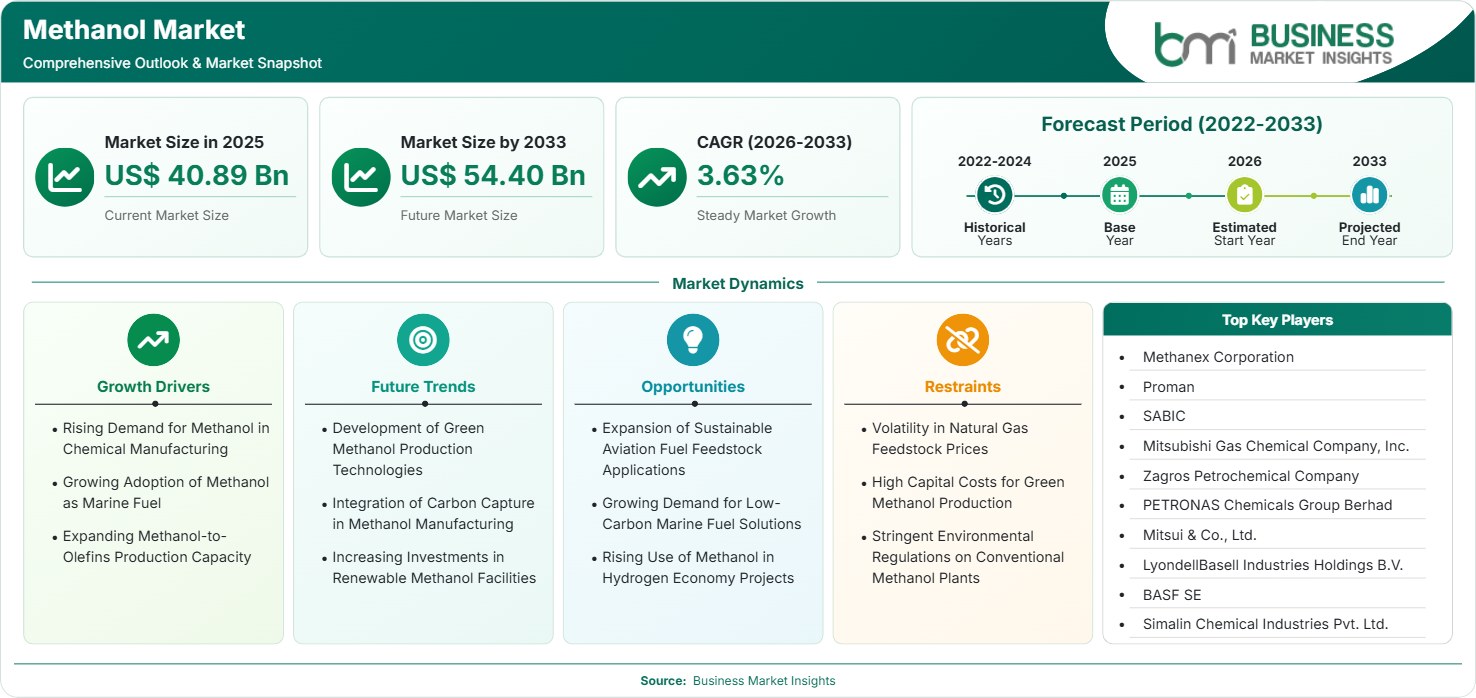
The Methanol Market size was valued at US$ 40.89 Billion in 2025 and is projected to reach US$ 54.40 Billion by 2033, growing at a CAGR of 3.63% during 2026–2033. Rising demand from chemical manufacturing industries, increasing methanol-to-olefins production, growing use of methanol as a clean-burning fuel, and expanding industrial applications are supporting market growth. Opportunities are emerging from renewable methanol production, sustainable fuel initiatives, and growing adoption of methanol across transportation and energy sectors.

Report Coverage
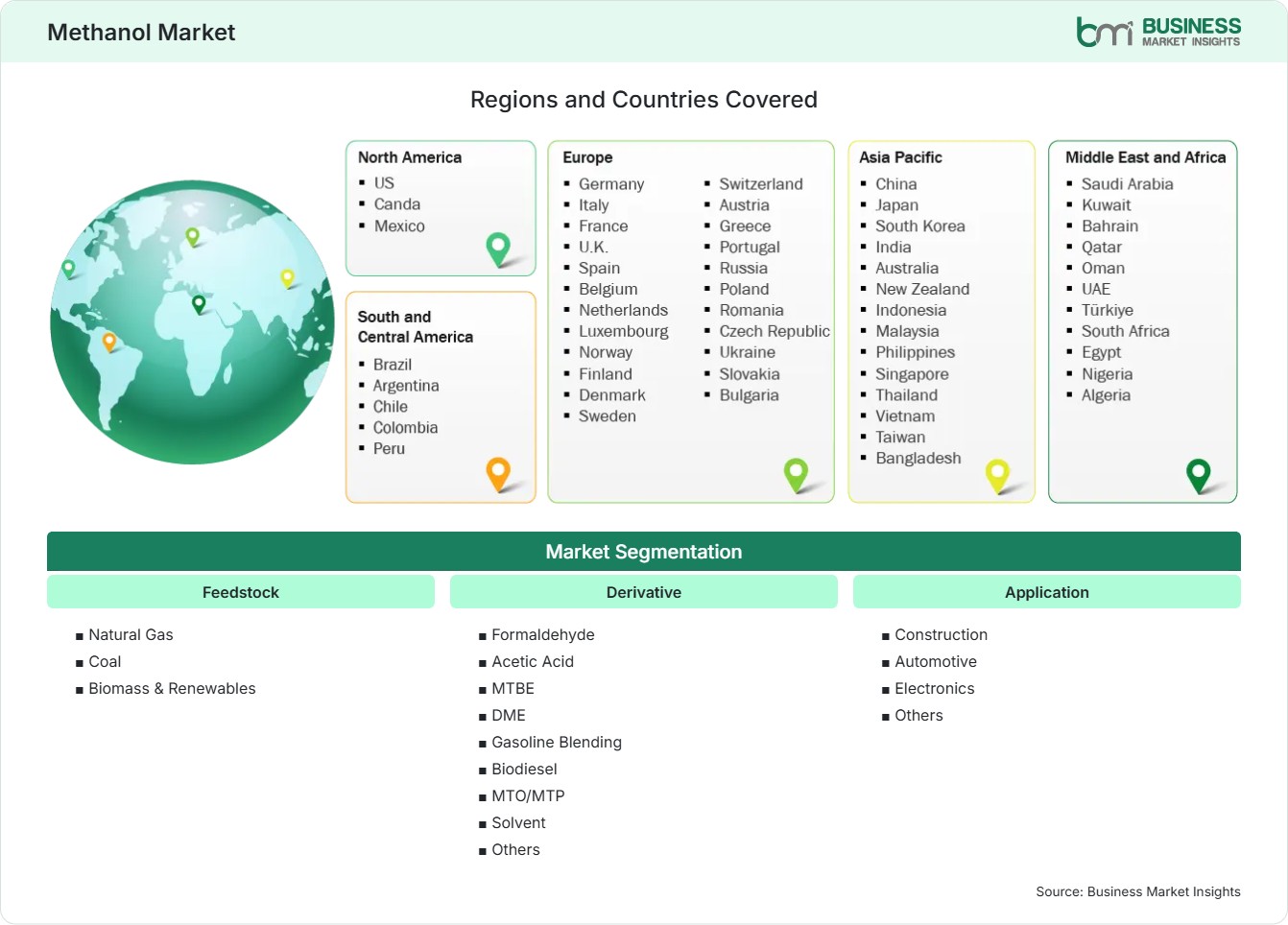
  • Feedstock: Natural Gas, Coal, Biomass & Renewables
  • Derivative: Formaldehyde, Acetic Acid, MTBE, DME, Gasoline Blending, Biodiesel, MTO/MTP, Solvent, Others
  • Application: Construction, Automotive, Electronics, Others
US$ 40.89 Bn Market size in 2025
US$ 54.40 Bn Market Size by 2033
3.63% CAGR, 2026 - 2033
2026-2033 Forecast Period

01 AI Overview

Methanol Market Summary

  • North America Region: North America holds a methanol market share of 18%–21% in 2025 and is projected to grow at a CAGR of 3.2%–4.2% during 2026–2033. Strong natural gas availability, chemical manufacturing activities, and investments in low-carbon fuel initiatives support regional demand. The US market is projected to grow at a CAGR of 3.4%–4.4% through 2033.
  • Fastest Growing Region: Asia Pacific accounts for 48%–51% share in 2025 and is expected to grow at a CAGR of 4.2%–5.2% during the forecast period. Expanding industrial production, growing chemical demand, and increasing methanol consumption in China and India continue driving regional growth.
  • Leading Segment: Natural Gas Feedstock represents 58%–61% share in 2025 and is projected to grow at a CAGR of 3.5%–4.5% through 2033. Cost competitiveness, abundant availability, and efficient production economics support segment leadership.
  • High Growth Segment: MTO/MTP (Methanol to Olefins/Methanol to Propylene) holds 16%–19% share in 2025 and is projected to grow at a CAGR of 5.2%–6.2% during 2026–2033. Rising demand for petrochemical intermediates and polymers is accelerating adoption.
  • Key Market Opportunity: Growing investments in green methanol, sustainable marine fuels, and renewable chemical feedstocks are creating substantial opportunities across global markets.
  • Major Market Players: Methanex Corporation, Proman, SABIC, Mitsubishi Gas Chemical Company, Inc., Zagros Petrochemical Company, PETRONAS Chemicals Group Berhad, Mitsui & Co., Ltd., LyondellBasell Industries Holdings B.V., BASF SE, and Simalin Chemical Industries Pvt. Ltd.
02 Strategic Insights

Methanol Market: Strategic Insights

Methanol Market Strategic Framework
FREE PDF
Request your free sample
Request free sample
03 Stakeholder View

Key Takeaways

  • Natural gas remains the dominant feedstock due to its cost efficiency, widespread availability, and established production infrastructure. Its economic advantages continue to support large-scale methanol manufacturing, particularly in regions with abundant natural gas reserves.
  • MTO (Methanol-to-Olefins) and MTP (Methanol-to-Propylene) technologies are gaining greater importance as petrochemical manufacturers increasingly adopt alternative routes for producing key olefins, helping diversify feedstock sources and improve supply flexibility.
  • Asia Pacific continues to lead global demand because of its strong industrial base, expanding chemical manufacturing sector, rapid urbanization, and growing investments in downstream methanol applications across multiple industries.
  • Renewable and green methanol represent a major growth opportunity, supported by decarbonization initiatives, stricter environmental regulations, and rising investments in sustainable fuel solutions and low-carbon industrial processes.
  • Construction, automotive, and chemical industries remain key demand centers, driving consistent consumption of methanol-derived products such as formaldehyde, acetic acid, adhesives, plastics, coatings, and resins.
  • A key methanol market trend is the growing adoption of green methanol for marine fuel applications, renewable energy integration, and carbon reduction strategies as industries pursue long-term sustainability goals.
  • Manufacturers are focusing on production efficiency, feedstock diversification, and technological innovation to strengthen competitiveness, reduce emissions, and support expanding demand across transportation, energy, and chemical processing applications.
04 Geographic Outlook

Methanol Market Regional Highlights

North America Methanol Market

North America accounted for a 18%–21% share in 2025 and is projected to expand at a CAGR of 3.2%–4.2% during 2026–2033. The region benefits from abundant natural gas resources, established chemical manufacturing infrastructure, and growing investments in low-carbon fuel development. The Methanol Market share is supported by strong production capabilities and increasing utilization of methanol across chemical processing and energy applications.

  • Methanol producers continue leveraging low-cost natural gas feedstocks to maintain competitive production economics and supply stability.
  • Demand remains strong from formaldehyde, acetic acid, and fuel additive manufacturing industries across the region.
  • Investments in renewable methanol projects are increasing as companies pursue carbon reduction objectives and sustainable production pathways.
  • Marine fuel applications are emerging as a promising growth area due to tightening environmental regulations and decarbonization efforts.
  • Chemical manufacturers continue utilizing methanol as a key raw material for downstream value-added products.

US Methanol Market

The US represented a 15%–18% share in 2025 and is estimated to grow at a CAGR of 3.4%–4.4% through 2033. Strong petrochemical production, natural gas availability, and increasing interest in alternative fuels support market expansion. Methanol Market growth in the US is driven by rising demand for chemical intermediates, fuel blending applications, and industrial manufacturing activities.

  • Petrochemical companies continue integrating methanol into diverse production processes to improve operational flexibility.
  • Investments in sustainable fuel alternatives are creating additional growth opportunities for producers.
  • Growing industrial activity is supporting steady consumption across downstream applications.
  • Expansion of export capabilities is strengthening the position of US producers within global supply chains.

Europe Methanol Market

Europe held a 17%–20% share in 2025 and is expected to grow at a CAGR of 3.0%–4.0% from 2026–2033. Germany, France, and the Netherlands represent major markets due to strong industrial manufacturing activities, chemical production, and sustainability initiatives. Germany is estimated to expand at 3.5%–4.5% CAGR, supported by growing demand for environmentally friendly chemical feedstocks.

  • Industrial decarbonization initiatives are encouraging the development of renewable and low-carbon methanol production pathways.
  • Germany continues investing in sustainable chemical manufacturing and advanced industrial technologies.
  • Demand from construction, automotive, and specialty chemical applications remains steady across the region.
  • Increasing emphasis on circular economy principles is supporting adoption of renewable feedstocks.
  • Marine transportation companies are evaluating methanol as a viable lower-emission fuel alternative.

Asia Pacific Methanol Market

Asia Pacific accounted for a 48%–51% share in 2025 and is projected to register a CAGR of 4.2%–5.2% during 2026–2033. The methanol market forecast in APAC suggest that the China, India, Japan, and South Korea are leading markets due to extensive industrial activity, rising petrochemical production, and growing demand for methanol derivatives. China is expected to grow at 4.8%–5.8% CAGR, while India demonstrates strong growth potential with a CAGR of 5.0%–6.0% during the forecast period.

  • China remains the largest consumer due to extensive MTO/MTP operations and large-scale chemical manufacturing capacity.
  • Industrial expansion is supporting increasing demand for methanol-based intermediates and downstream products.
  • India continues witnessing rising consumption driven by infrastructure growth, manufacturing expansion, and chemical production activities.
  • Investments in new production facilities and capacity expansion projects are strengthening regional supply capabilities.
  • Demand from transportation and fuel-related applications is gradually increasing across several countries.

Rest of World Methanol Market

Rest of World accounted for a 12%–15% share in 2025 and is expected to grow at a CAGR of 3.4%–4.4% through 2033. The Middle East, Latin America, and Africa continue representing important production and export regions due to feedstock availability and growing industrial activities. Saudi Arabia, Iran, and Brazil remain key markets within the global methanol industry.

  • Middle Eastern countries continue expanding production capacity to capitalize on abundant natural gas resources.
  • Iran remains an important producer with significant export-oriented manufacturing operations.
  • Growing industrial development across Latin America is supporting consumption of methanol-based products.
  • Regional investments in petrochemical projects are creating new opportunities for market expansion.
  • Export-oriented production strategies continue strengthening the role of these regions in global methanol supply chains.
Global Market Geography
FREE PDF
Request your free sample
Request free sample
05 Segment Analysis

Methanol Market Segmentation

Feedstock

Feedstock selection significantly influences methanol production economics, carbon emissions, and supply reliability. Natural Gas accounted for 58%–61% share in 2025 and is projected to grow at a CAGR of 3.5%–4.5% through 2033 due to abundant availability, cost competitiveness, and efficient conversion processes.

  • Natural Gas: The leading segment owing to lower production costs, widespread commercial adoption, and established global production infrastructure.
  • Coal: Maintains significant demand in regions with abundant coal reserves and established coal-to-methanol production facilities.
  • Biomass & Renewables: The fastest-growing feedstock category supported by sustainability initiatives, carbon reduction targets, and growing investments in green methanol production.

Derivative

Derivative demand is influenced by industrial production activity, chemical manufacturing requirements, and fuel applications. Formaldehyde accounted for 24%–27% share in 2025 and is projected to grow at a CAGR of 3.4%–4.4% through 2033 due to extensive utilization in construction materials, resins, adhesives, and engineered wood products.

  • Formaldehyde: The dominant derivative segment driven by strong demand from the construction, furniture, and industrial manufacturing sectors.
  • Acetic Acid: Widely utilized in chemical processing, coatings, adhesives, and textile manufacturing applications.
  • MTBE: Continues to be used as a gasoline blending component to improve fuel performance characteristics.
  • DME: Gaining attention as an alternative clean fuel and LPG substitute in selected industrial and transportation applications.
  • Gasoline Blending: Supported by increasing use of methanol-based fuel blending solutions in several countries.
  • Biodiesel: Demand is linked to renewable fuel production and sustainable energy initiatives.
  • MTO/MTP: The fastest-growing segment, holding 16%–19% share in 2025 and projected to grow at a CAGR of 5.2%–6.2% through 2033 due to increasing production of olefins and petrochemical intermediates.
  • Solvent: Utilized across paints, coatings, pharmaceuticals, and industrial processing applications.
  • Others: Includes applications in fuel cells, antifreeze products, and specialty chemical manufacturing.

Application

Application demand is driven by industrial expansion, infrastructure development, manufacturing activity, and downstream chemical consumption. Construction accounted for 36%–39% share in 2025 and is projected to grow at a CAGR of 3.8%–4.8% through 2033 due to extensive use of methanol-derived products in building materials and construction chemicals.

  • Construction: The leading segment supported by strong demand for formaldehyde-based resins, adhesives, insulation products, and engineered wood materials.
  • Automotive: Methanol derivatives are increasingly utilized in fuel applications, coatings, plastics, and automotive component manufacturing.
  • Electronics: Demand is supported by semiconductor production, electronic component manufacturing, and specialty chemical applications.
  • Others: Includes marine transportation, energy generation, pharmaceuticals, packaging, paints and coatings, and numerous industrial applications that rely on methanol-based intermediates and chemicals.
06 Market Forces

Methanol Market Dynamics

Key Market Drivers

Rising Demand for Methanol in Chemical Manufacturing

Methanol continues to serve as one of the most important building blocks in the global chemical industry due to its extensive use in producing formaldehyde, acetic acid, solvents, and various specialty chemicals. Growing industrialization, increasing construction activity, and rising production of plastics, resins, adhesives, and coatings are contributing to sustained demand for methanol-based derivatives. Manufacturers across multiple sectors rely on methanol because of its versatility and cost-effectiveness as a chemical intermediate. Expansion of downstream chemical manufacturing capacity, particularly across Asia Pacific and the Middle East, is further strengthening consumption levels. Continued growth in industrial production and chemical processing activities is expected to support long-term methanol market expansion.

Growing Adoption of Methanol as Marine Fuel

The shipping industry has started examining methanol as a replacement fuel source because of its ability to cut down emissions and achieve decarbonization goals. As the environmental laws become more stringent and there is increased pressure on reducing emissions of greenhouse gases, the owners of vessels have been looking for alternative fuels that can help them do so. Methanol is being considered for this purpose because of its benefits, including better storage and transportation than some alternative fuels, while complying with the evolving environmental laws. The use of methanol by shipping companies will help them to meet future sustainability targets.

Expanding Methanol-to-Olefins Production Capacity

Methanol-to-Olefins (MTO) and Methanol-to-Propylene (MTP) technologies continue gaining importance as petrochemical producers seek alternative pathways for olefin manufacturing. Increasing demand for polyethylene, polypropylene, and other downstream petrochemical products is encouraging investment in new MTO and MTP facilities, particularly in Asia. These technologies allow producers to convert methanol into valuable petrochemical feedstocks used in plastics, packaging materials, and consumer goods. Capacity expansion projects and growing integration between methanol production and petrochemical manufacturing are supporting steady growth in methanol consumption. Rising demand for olefin-based products is expected to remain a significant driver of future industry development.

Key Market Opportunities

Expansion of Sustainable Aviation Fuel Feedstock Applications

Sustainable aviation fuel development is creating attractive opportunities for methanol producers seeking participation in the low-carbon fuel ecosystem. Aviation stakeholders are increasingly investing in alternative fuel pathways designed to reduce emissions while maintaining compatibility with existing aviation infrastructure. Methanol can serve as an intermediate feedstock in the production of sustainable fuels and synthetic aviation fuel solutions. As governments, airlines, and fuel producers intensify decarbonization efforts, demand for feedstocks supporting sustainable fuel production is expected to increase. Companies investing in renewable methanol technologies may benefit from emerging opportunities within the aviation sector.

Growing Demand for Low-Carbon Marine Fuel Solutions

The maritime industry's pursuit of cleaner fuel alternatives is creating significant growth opportunities for methanol producers. Low-carbon and renewable methanol variants are attracting attention as viable options for reducing vessel emissions and supporting environmental compliance initiatives. Port operators, shipping companies, and logistics providers are increasingly exploring fuel infrastructure capable of supporting methanol-powered fleets. As international regulations continue emphasizing emission reductions, demand for low-carbon marine fuels is expected to rise. Producers capable of supplying sustainable methanol solutions are well positioned to benefit from this evolving methanol market opportunity.

Rising Use of Methanol in Hydrogen Economy Projects

Hydrogen development initiatives are creating new opportunities for methanol utilization across energy and industrial applications. Methanol can function as a hydrogen carrier and storage medium, providing practical advantages in transportation and handling compared to pure hydrogen. Increasing investment in hydrogen infrastructure, fuel cell technologies, and clean energy projects is generating interest in methanol-based hydrogen solutions. Research efforts and commercial pilot projects are expanding understanding of methanol's role within future hydrogen value chains. Growth in hydrogen-related investments is expected to support new long-term demand opportunities across multiple regions.

Market Restraints and Challenges

Volatility in Natural Gas Feedstock Prices

Factor: Natural gas remains the primary feedstock used in global methanol production, making manufacturers sensitive to fluctuations in energy markets and feedstock costs. Variations in natural gas pricing can result from geopolitical developments, supply disruptions, seasonal demand changes, and broader energy market conditions.

Impact: Feedstock price volatility directly affects production economics, profitability, and long-term investment planning. Rising natural gas prices can increase manufacturing costs and reduce competitiveness in certain regions. Producers must continuously optimize operations, diversify sourcing strategies, and improve efficiency to mitigate the impact of fluctuating feedstock expenses.

High Capital Costs for Green Methanol Production

Factor: Production of renewable or green methanol requires significant investment in carbon capture technologies, renewable energy systems, feedstock processing infrastructure, and advanced production facilities. These projects often involve higher capital requirements than conventional methanol plants.

Impact: High investment costs can slow commercialization and limit adoption of renewable methanol projects, particularly in regions with limited policy support or financial incentives. Developers must secure substantial funding and establish long-term demand commitments to justify project economics. Although green methanol offers significant sustainability benefits, cost-related challenges remain a key barrier to large-scale deployment.

07 Company Analysis

Competitive Landscape

The Methanol Market analysis is characterized by competition among global methanol producers, petrochemical companies, integrated energy firms, and specialty chemical manufacturers. Market participants are focusing on production capacity expansion, feedstock optimization, renewable methanol development, and downstream integration strategies to strengthen their market positions. Increasing investments in low-carbon methanol production, marine fuel applications, and sustainable chemical manufacturing are reshaping competitive dynamics. Strategic partnerships, long-term supply agreements, and export-oriented production facilities continue to play an important role in market growth and competitive differentiation.

Company Name

Overview

Products and Services Relevant to this Market

Methanex Corporation

One of the world's largest methanol producers and suppliers.

Methanol production, global distribution, supply chain management, and industrial methanol solutions.

Proman

Integrated energy and petrochemical company with significant methanol operations.

Methanol production, downstream derivatives, renewable methanol initiatives, and industrial applications.

SABIC

Global diversified chemicals manufacturer.

Methanol, petrochemical feedstocks, industrial chemicals, and downstream chemical products.

Mitsubishi Gas Chemical Company, Inc.

Major chemical producer serving industrial and specialty markets.

Methanol, specialty chemicals, formaldehyde products, and industrial intermediates.

Zagros Petrochemical Company

Leading methanol producer in the Middle East.

Methanol manufacturing, export-oriented production, and petrochemical feedstocks.

PETRONAS Chemicals Group Berhad

Integrated chemicals company with broad product portfolio.

Methanol production, chemical intermediates, industrial chemicals, and petrochemical solutions.

Mitsui & Co., Ltd.

Diversified corporation with investments across chemical value chains.

Methanol trading, supply chain services, production investments, and chemical distribution.

LyondellBasell Industries Holdings B.V.

Global chemical and refining company.

Methanol-related feedstocks, petrochemical products, and industrial chemical solutions.

BASF SE

International chemical manufacturer with diversified product portfolio.

Chemical intermediates, methanol derivatives, industrial solutions, and specialty chemicals.

Simalin Chemical Industries Pvt. Ltd.

Chemical manufacturer serving industrial and specialty applications.

Methanol-based products, industrial chemicals, solvents, and downstream chemical solutions.

10 Trust & Transparency

Research Methodology

The market analysis combines proprietary research with secondary data from government agencies, company disclosures, regulatory filings, industry databases and expert interviews. Market estimates are validated through data triangulation, cross-market benchmarking and analyst review.

View Full Research Methodology

11 Questions Answered

Frequently Asked Questions

What opportunities exist for methanol producers?

Major opportunities include renewable methanol production, sustainable aviation fuel applications, low-carbon marine fuel solutions, hydrogen economy projects, and growing industrial decarbonization initiatives.

4. Why does Asia Pacific lead the market?

Asia Pacific leads due to extensive chemical manufacturing activity, strong industrial growth, large-scale MTO/MTP capacity, and significant methanol consumption in China, India, and other industrial economies.

Which derivative segment is growing the fastest?

MTO/MTP (Methanol-to-Olefins/Methanol-to-Propylene) is the fastest-growing derivative segment owing to increasing demand for olefins and petrochemical feedstocks used in plastics and industrial manufacturing.

Which feedstock segment dominates the market?

Natural Gas dominates the market due to its cost-effectiveness, widespread availability, efficient conversion processes, and strong commercial adoption across major methanol-producing regions.

What is driving growth in the methanol market report?

Growth is driven by increasing demand from chemical manufacturing industries, expanding methanol-to-olefins capacity, growing use of methanol-based derivatives, and rising adoption of methanol as an alternative fuel.

Access the Full Methanol Market Report

Get segment-level forecasts, regional estimates, competitive benchmarking, company profiles and downloadable Excel datasets.

Access the full Methanol Market Report
350 pages PDF & Excel | 2026-08-05