
Medical Device Contract Manufacturing Market Outlook: Size, Share, Trends, Growth Analysis, Competitive Landscape & Forecast, 2026-2033

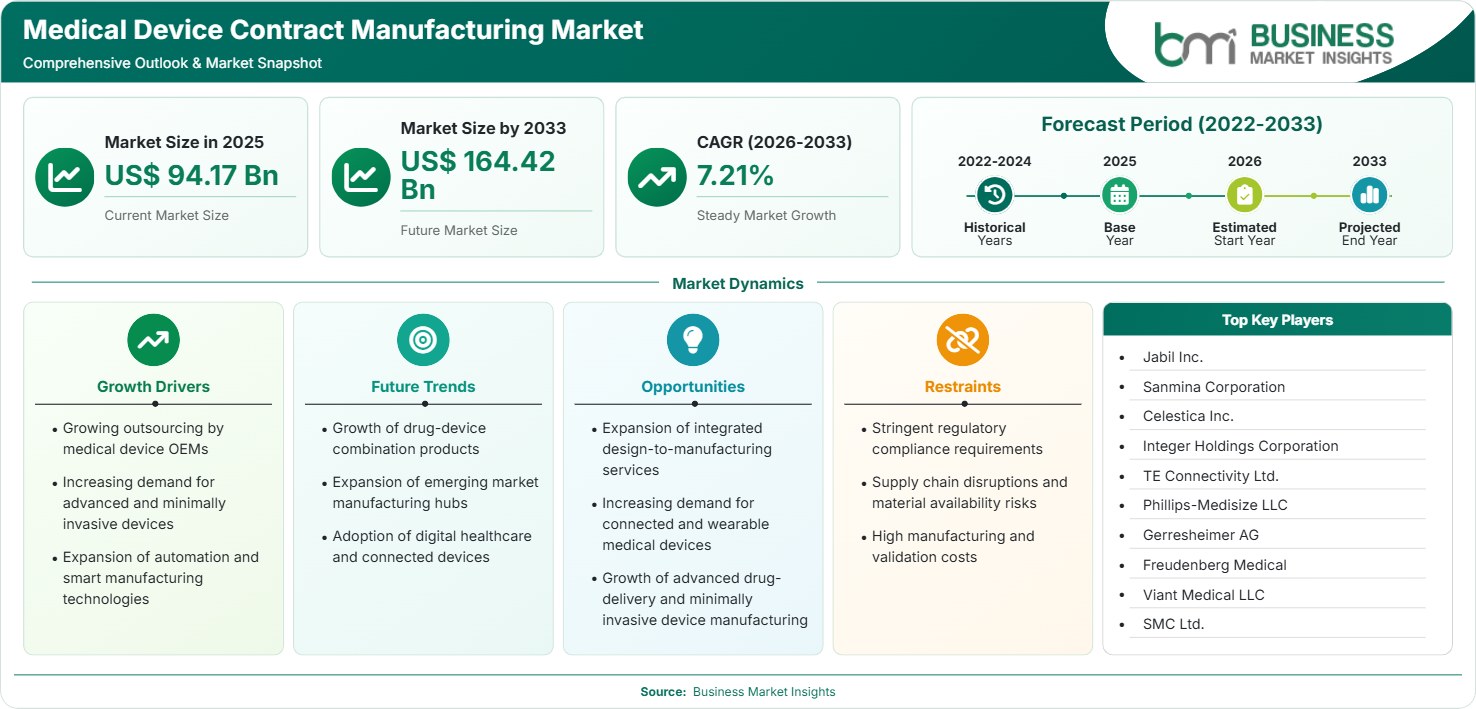
The Medical Device Contract Manufacturing Market size was valued at US$ 94.17 Billion in 2025 and is projected to reach US$ 164.42 Billion by 2033, growing at a CAGR of 7.21% during 2026–2033, driven by outsourcing expansion, complex device manufacturing demand, regulatory compliance requirements, automation adoption, and opportunities in minimally invasive devices, wearable technologies, and advanced drug-delivery systems.

Report Coverage
  • Device Class: Class I, Class II, Class III
  • Service Type: Component & Accessories Manufacturing, Device Manufacturing, Packaging and Labeling
  • Device Type: Cardiovascular Devices, Orthopedic Devices, Drug Delivery Devices, Diagnostic Imaging Devices, Respiratory Devices
  • End-user: Original Equipment Manufacturers, Pharmaceutical & Biopharmaceutical Companies
US$ 94.17 Bn Market size in 2025
US$ 164.42 Bn Market Size by 2033
7.21% CAGR, 2026 - 2033
2026-2033 Forecast Period

AI Overview

Medical Device Contract Manufacturing Market Summary

  • North America Region: North America holds a Medical Device Contract Manufacturing Market share of 36%–39% in 2025, growing with a CAGR of 6.7%–7.1% during 2026–2033, influenced by strong OEM presence, FDA-compliant manufacturing networks, outsourcing adoption, automation investments, advanced device development, and increasing demand for specialized production capabilities. The U.S. remains the regional leader through large OEM outsourcing activity and advanced manufacturing infrastructure, recording a CAGR of 6.9%–7.3%.
  • Fastest Growing Region: Asia Pacific accounts for a 28%–31% share in 2025 and is expected to expand at 8.4%–8.9% CAGR during 2026–2033. Growth is supported by cost-efficient production, healthcare investments, medical device exports, skilled labor availability, regulatory improvements, and expanding manufacturing ecosystems across China, India, and Southeast Asia.
  • Leading Segment: Class II devices represent a 48%–52% share of the Medical Device Contract Manufacturing Market in 2025 and are projected to grow at 7.0%–7.5% CAGR during 2026–2033. Demand is supported by widespread utilization in diagnostic, monitoring, cardiovascular, orthopedic, and therapeutic applications requiring scalable manufacturing and quality assurance expertise.
  • High Growth Segment: Drug Delivery Devices account for 18%–21% share in 2025 and are expected to expand at 8.8%–9.3% CAGR during 2026–2033. Rising biologics adoption, self-administration trends, wearable injectors, and precision delivery requirements continue accelerating outsourcing requirements.
  • Key Market Opportunity: Increasing outsourcing of complex minimally invasive devices, connected healthcare technologies, wearable monitoring solutions, and advanced drug-delivery platforms creates substantial opportunities for vertically integrated manufacturing partners with regulatory expertise.
  • Major Market Players: Jabil Inc., Sanmina Corporation, Celestica Inc., Integer Holdings Corporation, TE Connectivity Ltd., Phillips-Medisize LLC, Gerresheimer AG, Freudenberg Medical, Viant Medical LLC, and SMC Ltd.
Strategic Insights

Medical Device Contract Manufacturing Market: Strategic Insights

Medical Device Contract Manufacturing Market Strategic Framework
FREE PDF
Request your free sample
Request free sample
Stakeholder View

Key Takeaways

  • The industry value chain is shifting toward end-to-end manufacturing partnerships encompassing design engineering, prototyping, validation, assembly, sterilization, packaging, and regulatory support services.
  • Drug delivery devices and minimally invasive technologies represent the most attractive outsourcing opportunities due to increasing complexity and regulatory requirements.
  • Smart manufacturing technologies, including robotics, digital quality management, AI-driven inspection, and advanced analytics, are becoming major competitive differentiators.
  • Asia Pacific offers a compelling investment case due to lower production costs, expanding medical technology ecosystems, and increasing healthcare infrastructure investments.
  • Strategic acquisitions continue expanding manufacturing capabilities in catheter systems, cardiovascular devices, precision molding, and micro-component production.
  • Supply chain resilience initiatives are encouraging OEMs to diversify manufacturing footprints across multiple regions to reduce operational risk and improve continuity.
Geographic Outlook

Medical Device Contract Manufacturing Market Regional Highlights

North America Medical Device Contract Manufacturing Market

North America accounted for 36%–39% of global revenue in 2025 and is projected to register a CAGR of 6.7%–7.1% through 2033. The region benefits from advanced healthcare infrastructure, strong OEM presence, and extensive FDA-regulated manufacturing capabilities. Contract manufacturers continue investing in automation, precision machining, and advanced assembly operations. The Medical Device Contract Manufacturing Market share remains highest in North America due to strong innovation ecosystems and outsourcing adoption among medical technology companies.

  • Growing demand for minimally invasive devices is increasing outsourcing requirements for specialized manufacturing expertise and precision engineering capabilities.
  • Medical technology companies increasingly seek vertically integrated manufacturing partners capable of supporting design, validation, production, and packaging activities.
  • Automation investments are improving productivity, quality consistency, and scalability across manufacturing operations.
  • Regulatory expertise remains a key differentiator as OEMs navigate evolving compliance requirements.
  • Expansion of advanced cardiovascular and orthopedic device production supports sustained manufacturing demand.

US Medical Device Contract Manufacturing Market

The United States contributes approximately 70%–74% of North American revenue and is forecast to expand at 6.9%–7.3% CAGR through 2033. Strong medical technology innovation, increasing chronic disease prevalence, and significant outsourcing activity support demand. The country maintains leadership through advanced production infrastructure and established regulatory frameworks. Manufacturers continue expanding capacity for complex devices, diagnostics, and connected healthcare technologies.

  • OEMs increasingly outsource production to accelerate commercialization and improve operational efficiency.
  • High demand for cardiovascular and orthopedic technologies supports contract manufacturing investments.
  • Digital manufacturing technologies are improving quality control and production visibility.
  • Supply chain diversification initiatives continue driving facility expansion across multiple states.

Europe Medical Device Contract Manufacturing Market

Europe accounted for 24%-27% of market share in 2025 and is expected to record a CAGR of 7.2%-7.6% through 2033. The region will benefit from advanced health care infrastructure, innovations in medical technology, and compliance with Medical Device Regulation requirements. The region of Germany is dominant in manufacturing, whereas Ireland is growing rapidly due to investments in medtech and export-oriented production. Increasing demand for high-precision manufacturing and component specialization continues to strengthen the regional competitiveness of the Medical Device Contract Manufacturing Market.

  • Medical Device Regulation compliance is encouraging partnerships with experienced manufacturing providers.
  • Demand for precision components supports investments in advanced production technologies.
  • Expansion of diagnostic and drug-delivery device manufacturing strengthens regional growth prospects.
  • Strategic collaborations between OEMs and contract manufacturers continue increasing.
  • Sustainability initiatives are influencing packaging and production decisions.

Asia Pacific Medical Device Contract Manufacturing Market

Asia-Pacific has held a share between 28% and 31% in 2025 and is expected to exhibit an 8.4% to 8.9% CAGR up to 2033. This region enjoys advantages such as low manufacturing costs, rising healthcare spending, and rising exports of medical devices. China is the largest contributor in the region, but India shows the highest growth rate due to manufacturing and healthcare spending in the Medical Device Contract Manufacturing market. The region increasingly serves as a strategic production hub for global medical technology companies.

  • Government-backed manufacturing initiatives support facility expansion and technology adoption.
  • Rising healthcare demand is stimulating production of diagnostic and therapeutic devices.
  • Skilled engineering talent strengthens the regional manufacturing ecosystem.
  • International OEMs increasingly establish partnerships with regional manufacturing specialists.
  • Export-oriented production capabilities continue improving regional competitiveness.

Rest of World Medical Device Contract Manufacturing Market

Rest of World held 8%-10% market share in 2025 and is projected to witness a CAGR of 6.8%-7.2% during 2023-2033. Latin America has been witnessing healthcare infrastructural development and manufacturing in the region. The Middle East Medical Device Contract Manufacturing Market is focusing on diversification and production within the healthcare sector. Brazil is the leader in manufacturing activities within the region, whereas Saudi Arabia has shown the highest growth rate due to healthcare reforms.

  • Local manufacturing initiatives are reducing dependence on imported medical devices.
  • Healthcare infrastructure investments continue supporting regional demand growth.
  • Regulatory improvements are encouraging foreign investment and manufacturing expansion.
  • Strategic partnerships facilitate technology transfer and operational capability development.
  • Growing healthcare access is increasing demand for affordable medical technologies.
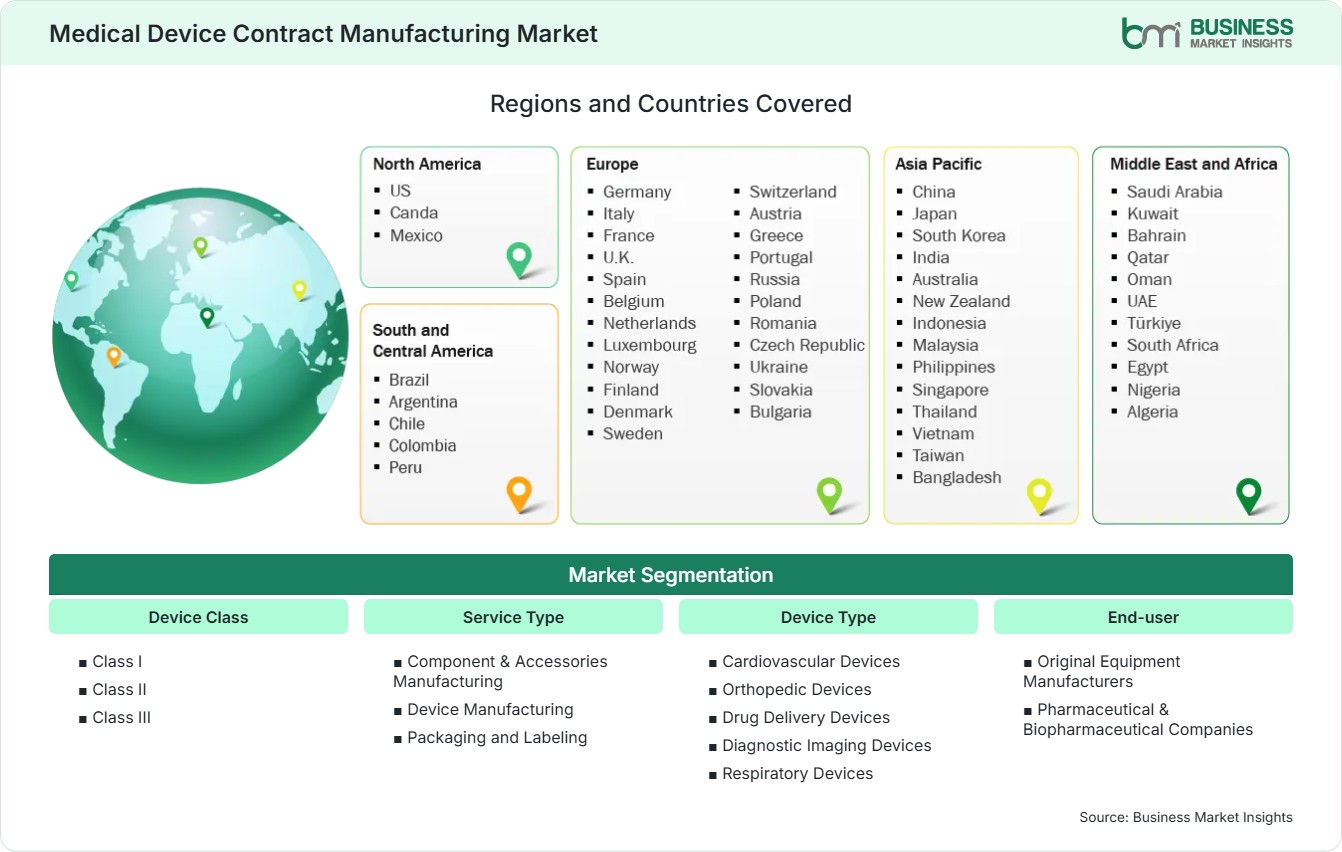
Global Market Geography
FREE PDF
Request your free sample
Request free sample
Segment Analysis

Medical Device Contract Manufacturing Market Segmentation

Device Class

The largest contributor to the Device Class segment is the Class II Devices segment, holding 48%-52% market share in 2025 and projected to grow at a 7.0%-7.5% CAGR during 2026-2033. Growth in the production of diagnostic machines, infusion systems, surgical instruments, and monitoring devices has contributed to the rise in outsourcing. The scope of the Medical Device Contract Manufacturing Market is expanding owing to the increasing dependence of OEMs on specialized outsourcing service providers.

  • Class I: These devices require relatively simple manufacturing processes and lower regulatory scrutiny. Outsourcing supports cost efficiency, production flexibility, and streamlined distribution for high-volume healthcare products.
  • Class II: Class II devices represent the largest outsourcing category due to moderate regulatory requirements and broad utilization across therapeutic, diagnostic, and monitoring applications requiring scalable manufacturing capabilities.
  • Class III: Manufacturing of Class III devices demands advanced engineering expertise, stringent validation procedures, and regulatory compliance, making specialized contract manufacturers essential partners for OEMs.

Service Type

The service type remains an important distinguishing factor, with the device manufacturing category holding a 39% - 43% market share in 2025 and posting a CAGR of 7.3% - 7.8% through 2033. OEMs are increasingly outsourcing manufacturing activities to optimize their operations and facilitate the quicker commercialization of products. Growth will also be driven by the growing demand for integrated service solutions, prototyping, assembly, validation, sterilization, and supply chain management.

  • Component & Accessories Manufacturing: Precision components, molded parts, connectors, and subassemblies form the foundation of modern medical devices. Outsourcing supports quality consistency and manufacturing scalability.
  • Device Manufacturing: Full-scale device production services enable OEMs to reduce capital expenditures while leveraging specialized expertise, automated production systems, and regulatory compliance capabilities.
  • Packaging and Labeling: Packaging and labeling services ensure regulatory compliance, product protection, traceability, and operational efficiency across global healthcare supply chains.

Device Type

Drug Delivery Devices were among the devices that held 18%-21% market share in 2025 and had the highest growth rate, at 8.8%-9.3% CAGR during 2033. Growth in the use of biological drugs, production of wearable injectors, and practices of self-injection contributed to the demand for outsourcing services. The medical device contract manufacturing market trends emphasize precision molding, microfluidics, connectivity solutions, and advanced assembly.

  • Cardiovascular Devices: Cardiovascular technologies require high-precision manufacturing, strict quality control, and advanced material expertise to ensure safety, reliability, and clinical performance.
  • Orthopedic Devices: Orthopedic manufacturing relies on precision machining, specialized materials, and advanced finishing technologies to support implants, instruments, and fixation systems.
  • Drug Delivery Devices: Increasing demand for biologics and patient-centric therapies continues driving outsourcing of injectors, infusion systems, and wearable delivery platforms.
  • Diagnostic Imaging Devices: Complex imaging equipment requires advanced electronics integration, precision assembly, and extensive validation procedures supporting diagnostic accuracy and reliability.
  • Respiratory Devices: Demand for respiratory care technologies is supported by rising chronic respiratory disease prevalence, healthcare investments, and increasing home-care adoption.

End-user

Original Equipment Manufacturers (OEMs) accounted for 58% to 62% of the market in 2025 and are projected to expand at a 7.1% to 7.6% CAGR till 2033. Pressure to cut costs, innovate, and improve supply chain efficiency will drive outsourcing. Contract manufacturers are offering comprehensive services, including product development, manufacturing, regulatory assistance, and end-of-life services.

  • Original Equipment Manufacturers (OEMs): OEMs utilize contract manufacturers to improve operational flexibility, reduce capital investment requirements, and accelerate product commercialization.
  • Pharmaceutical & Biopharmaceutical Companies: Drug-device combination products, wearable injectors, and advanced delivery systems continue expanding outsourcing opportunities within pharmaceutical manufacturing ecosystems.
Market Forces

Medical Device Contract Manufacturing Market Dynamics

Key Market Drivers

Growing Outsourcing by Medical Device OEMs

Medical technology companies increasingly outsource manufacturing functions to specialized partners to improve cost efficiency, accelerate commercialization, and focus internal resources on innovation. Increasing complexity in modern-day machines demands knowledge of precision engineering and clean-room manufacturing. The Medical Device Contract Manufacturing Market growth would continue to be driven by OEMs' need for flexible production capabilities. Medical device contract manufacturers offer solutions that help launch products, manage demand fluctuations, and support international expansion. Increasing competition in the healthcare market has further driven outsourcing to improve efficiency.

Increasing Demand for Advanced and Minimally Invasive Devices

Healthcare providers increasingly favor minimally invasive procedures because of shorter recovery times, reduced hospitalization requirements, and improved patient outcomes. This trend is driving demand for sophisticated catheters, surgical instruments, cardiovascular systems, and diagnostic technologies. There is increased investment in precision molding, micro-machining, and cleanroom assembly capabilities among contract manufacturers to meet changing demands. There is an increase in the use of connected healthcare devices and wearable technologies, which is increasing the need for specialized manufacturing skills. Companies with the capacity to meet complex production needs can benefit from outsourcing activity across multiple therapeutic areas.

Expansion of Automation and Smart Manufacturing Technologies

Automation techniques are changing how manufacturing processes operate across efficiency, quality assurance, and scalability. The use of robots, machine vision systems, predictive maintenance tools, and software solutions for quality management is becoming widespread in factories manufacturing medical equipment. Automated solutions minimize the incidence of defects, improve traceability, and facilitate adherence to regulatory requirements. With the incorporation of Industry 4.0 technologies, real-time monitoring and optimization of manufacturing processes are possible. As labor becomes more expensive and the demands concerning quality grow, automation is vital for manufacturing large-scale healthcare products.

Key Market Opportunities

Growth of Drug-Device Combination Products

Drug-device combination products offer tremendous growth potential as more drug companies develop self-administration and user-friendly drug delivery systems. Technologies like wearable injectors, auto-injectors, pre-filled syringes, and connected delivery systems require advanced manufacturing skills spanning both device and pharmaceutical technologies. The Medical Device Contract Manufacturing Market Forecasts suggest that the industry will continue to grow owing to applications in biologic drugs and personalized medicine. Companies providing integrated manufacturing and packaging solutions for devices, along with other associated services, are set to benefit from the rising demand of pharmaceutical and biopharmaceutical clients.

Expansion of Emerging Market Manufacturing Hubs

The emerging economies are also getting a foothold in the global healthcare manufacturing supply chain. Countries in the Asia-Pacific region are attracting foreign investment through supportive policies, skilled labor, and healthcare ecosystems. Contract manufacturers are building manufacturing plants closer to burgeoning healthcare markets to improve efficiency and optimize supply chains. Increasing healthcare expenditure, production incentives, and investments in healthcare technology are creating opportunities for capacity expansion. The diversified manufacturing bases of some companies enable them to meet regional demand while remaining resilient to geopolitical and logistical disruptions in global supply chains.

Adoption of Digital Healthcare and Connected Devices

The rise of connected medical devices opens up new possibilities for medical technology manufacturers. Devices such as wearable monitors, remote patient management devices, and digitally enhanced therapy devices need skills in integrating electronics and software and assembling components. Healthcare companies are embracing connected solutions to achieve better results. Manufacturing companies that can undertake electronics manufacturing and complex assembly can benefit from increased demand. The marriage between health care and technology is likely to present many opportunities for innovative manufacturing companies in the future.

Market Restraints and Challenges

Stringent Regulatory Compliance Requirements

Factor: Medical devices must comply with extensive regulatory requirements involving design validation, manufacturing controls, documentation, and post-market surveillance.

Impact: Compliance obligations increase operational complexity, production costs, and time-to-market requirements. Contract manufacturers must continuously invest in quality management systems, workforce training, and regulatory expertise to maintain certifications and customer trust. Regulatory changes across multiple jurisdictions further increase administrative burdens and validation requirements. Smaller manufacturers may face challenges allocating sufficient resources to maintain compliance while simultaneously expanding operational capabilities and technological expertise.

Supply Chain Disruptions and Material Availability Risks

Factor: Medical device production depends on specialized components, precision materials, and globally distributed supplier networks.

Impact: Supply chain disruptions can delay production schedules, increase procurement costs, and affect delivery performance. Manufacturers increasingly face challenges related to transportation constraints, geopolitical uncertainty, and supplier concentration risks. Ensuring continuity of critical materials requires supplier diversification strategies and inventory optimization initiatives. Persistent supply chain volatility may affect profitability and operational efficiency, particularly for manufacturers serving highly regulated healthcare markets where alternative sourcing options are limited.

Company Analysis

Competitive Landscape

The competitive environment is characterized by global manufacturing footprints, regulatory expertise, cleanroom infrastructure, automation investments, and vertically integrated production capabilities. The Medical Device Contract Manufacturing Market analysis highlights increasing competition around advanced molding, catheter manufacturing, drug-delivery systems, connected healthcare technologies, and precision component production. Major participants continue expanding capacity, enhancing quality management systems, and pursuing acquisitions to strengthen specialized manufacturing capabilities.

Company Name

Overview

Products and Services Relevant to this Market

Jabil Inc.

Global engineering and manufacturing company serving leading healthcare and medical technology companies through large-scale regulated production facilities.

Medical device manufacturing, design engineering, minimally invasive device production, electronics manufacturing, supply chain management, and commercialization services.

Sanmina Corporation

Advanced manufacturing solutions provider with expertise in regulated healthcare production and complex medical systems manufacturing.

Device assembly, precision manufacturing, cleanroom production, system integration, testing services, and healthcare product lifecycle support.

Celestica Inc.

Electronics and healthcare manufacturing specialist supporting OEMs through scalable production and engineering solutions.

Medical electronics manufacturing, design support, supply chain management, assembly services, and regulatory-compliant production.

Integer Holdings Corporation

Leading outsourced manufacturer specializing in medical technology components and finished device production.

Cardiovascular devices, neuromodulation components, orthopedic manufacturing, catheter technologies, and precision medical assemblies.

TE Connectivity Ltd.

Connectivity and sensor technology company supporting advanced healthcare and medical device applications.

Medical connectors, sensors, interconnect systems, diagnostic device components, and healthcare electronics solutions.

Phillips-Medisize LLC

Global CDMO providing design, development, and manufacturing services for medical and pharmaceutical products.

Drug-delivery devices, diagnostic systems, connected healthcare solutions, injection molding, and finished device manufacturing.

Gerresheimer AG

Specialized manufacturer serving pharmaceutical and medical technology industries through advanced production capabilities.

Drug-delivery systems, inhalers, diagnostic components, medical packaging, and device manufacturing solutions.

Freudenberg Medical

Contract design and manufacturing partner focused on minimally invasive and complex medical technologies.

Catheters, hypotubes, medical tubing, minimally invasive device manufacturing, and precision component production.

Viant Medical LLC

Medical technology manufacturing company supporting OEMs across multiple therapeutic categories.

Precision molding, assembly services, orthopedic manufacturing, cardiovascular device production, and product development support.

SMC Ltd.

Contract manufacturing organization focused on disposable and single-use medical device technologies.

Drug-delivery devices, diagnostic products, disposable medical systems, engineering support, and manufacturing services.

Trust & Transparency

Research Methodology

The market analysis combines proprietary research with secondary data from government agencies, company disclosures, regulatory filings, industry databases and expert interviews. Market estimates are validated through data triangulation, cross-market benchmarking and analyst review.

View Full Research Methodology

Questions Answered

Frequently Asked Questions

Why are vertically integrated manufacturing services becoming important?

Healthcare companies increasingly prefer partners offering design support, component manufacturing, assembly, sterilization, packaging, and supply chain management through a single operational framework, reducing complexity and improving commercialization efficiency.

What does the Medical Device Contract Manufacturing Market Report indicate about regional opportunities?

The report identifies Asia Pacific as the fastest-growing region due to manufacturing incentives, skilled labor availability, expanding healthcare investments, and increasing participation in global medical technology supply chains.

How is automation influencing contract manufacturing operations?

Automation improves production efficiency, quality consistency, traceability, and regulatory compliance while reducing manufacturing errors and supporting large-scale production requirements for complex healthcare devices.

Which device category presents the strongest growth potential?

Drug delivery devices represent one of the fastest-growing categories due to expanding biologics adoption, self-administration trends, wearable injector demand, and growth in personalized treatment approaches.

What factors are encouraging OEMs to outsource manufacturing activities?

OEMs increasingly outsource production to reduce capital expenditures, access specialized engineering expertise, improve scalability, accelerate product launches, and maintain compliance with stringent global regulatory requirements.

Access the Full Medical Device Contract Manufacturing Market Report

Get segment-level forecasts, regional estimates, competitive benchmarking, company profiles and downloadable Excel datasets.

Access the full Medical Device Contract Manufacturing Market Report
350 pages PDF & Excel | 2026-08-27